What's new
Ram Heavy Duty Forum

Register a free account today to become a member! Once signed in, you'll be able to participate on this site by adding your own topics and posts, as well as connect with other members through your own private inbox!

Sway when towing TT

They had a price increase $12 first. $2.50 reweighs.
I think each one has a different pay scale too. I have seen some people pay 13 and 3. Guess I should have said about 12. Lol.

Thanks for sharing the increase. I didn't do any 2nd weighs this year.

I use the CAT scale quite often. It is within 10 miles of home. I use it when I cut a load of firewood or haul something interesting.
 
I think each one has a different pay scale too. I have seen some people pay 13 and 3. Guess I should have said about 12. Lol.

Thanks for sharing the increase. I didn't do any 2nd weighs this year.

I use the CAT scale quite often. It is within 10 miles of home. I use it when I cut a load of firewood or haul something interesting.
It's a good step to provide a little piece of mind and some extra insurance. In today's litigious society an over or improperly loaded vehicle can incur financial penalties on the low side to loss of insurance coverage at the other end of the spectrum.
 
It's a good step to provide a little piece of mind and some extra insurance. In today's litigious society an over or improperly loaded vehicle can incur financial penalties on the low side to loss of insurance coverage at the other end of the spectrum.
That's an internet lure that is regurgitated time and again. I do not recall a person (non commercial) ever having first hand proof of insurance being denied. Insurance covers you when things go wrong, like you drink and drive and kill a family.... or you speed and total your car and possibly others.... or you have an overloaded trailer and crash. Insurance is just that.... insurance.

If anyone could, please block out the name and address, but post the scan of the letter from the insurance company denying a claim for an overloaded trailer. I'll die waiting I bet.

Sent from my SM-N986U1 using Tapatalk
 
So I am guessing the answer is no. A CAT scale weighs each one at the same time.

Pulling forward on a single weigh scale will skew the numbers.

But I suppose it would get you close.

And if the area is lacking in CAT scales, it would be better than taking a long ride just to get some weights.
I have scaled semis and my truck and 5er on the single scales for years. Simply involves a little math like they used to teach. Most variance I have ever experienced was 10’s of lbs. and usually due to ramps up onto the scales. To compensate, I would weigh all axles both going on and coming off the scales. Like I said, usually within tens of lbs..
 
I have scaled semis and my truck and 5er on the single scales for years. Simply involves a little math like they used to teach. Most variance I have ever experienced was 10’s of lbs. and usually due to ramps up onto the scales. To compensate, I would weigh all axles both going on and coming off the scales. Like I said, usually within tens of lbs..
I just ask because I was helping a guy trying to figure out his tongue weight. He took his truck and trailer and tried to weigh his setup and came up with a ridiculous high tongue weight

He went back up with just the truck and he got steer, total, and drive. His total was 110lbs from steer and drive combined. Which for our HeftyDuty is nothing.. But a 1500 can be an issue.

Thanks for the reply. At our dump as you drive on the scale the numbers just keep going up until you hit the middle were you get gross and keep going down as you get off. I would venture somewhere there you could get steer and then drive.

Always looking for another way to skin a CAT...

Great discussion here.
 
Dude at work bought a tongue weight scale off Amazon that he's going to let me use.

Dunno how accurate random Amazon stuff is but it's a start.

I have a TT but it's probably better with those who have toy haulers so they can find the best place to park the toy in the rear for proper tongue loading.
 
That's an internet lure that is regurgitated time and again. I do not recall a person (non commercial) ever having first hand proof of insurance being denied. Insurance covers you when things go wrong, like you drink and drive and kill a family.... or you speed and total your car and possibly others.... or you have an overloaded trailer and crash. Insurance is just that.... insurance.

If anyone could, please block out the name and address, but post the scan of the letter from the insurance company denying a claim for an overloaded trailer. I'll die waiting I bet.

Sent from my SM-N986U1 using Tapatalk
Insurance is one thing, ligation against you is another. Either way you are exposing yourself to possible very bad times.
Worth the risks?
 
First let me say you’re a good guy to be concerned with getting your hitch setup correct. I’ve seen a lot of folks camping that aren’t setup right and just run it whether they don’t know any better or just ignore It. It’s hard to tell from your pic but looks like you’re squatting too much meaning your weight distribution is off. Looks like too much on the rear axle but that’s only a guess looking at the pic. There’s been a lot of good advice on here, I’ll share my experience and hope it helps you. I tow a 37’ TT that’s a little over 11k loaded. It’s heavy and has a lot of surface area that catches wind. I have a solid WDH and would never tow without one. Crossing bridges and passing 18 wheelers do affect me to varying degrees even with the WDH. The best advice in towing is keep a safe speed where you feel comfortable and have the most control. It’s easy to get caught up in the flow of traffic or feel pressured to keep up. Don’t let it get to you just drive safe.

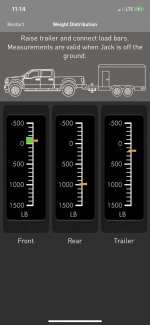
Looks like you have a great WDH and your truck has some innate sway control built in. If you’re still experiencing excessive sway, as others have recommended, you may want to evaluate and adjust the WDH setup. I pasted a link from the Fastway company below that explains it well. You may also want to give them a call. I’ve called in the past and they were very helpful. I also pasted a link to the Curt Betterweigh device and one of the several YouTube videos that shows its application. It plugs into the OBDC port and works with your smart phone ... is absolutely worth the money. It’s easy to setup and relatively cheap ($99). Once you have it calibrated you can use it to get tongue weight, weight distribution, set the brake gain and a lot more. I use it every time when hooking up to the TT to make sure I’m where I should be. It’ll give you an idea until you can get to a CAT scale if you want. I inserted a pic that illustrates the weight distribution function from when I was hooking up. I take screenshots every time I tow as references to see if something has changed since the last hook up.

Another option would be make an appointment with a trailer dealer who can set it up for you but I’m sure they will charge for the service. It may be worth it if you don‘t have the right tools or inclination. Sometimes it’s worth it just to pay the guy for their training and experience. Torque spec settings are important and for a TT, the ball head mount screw on mine requires around 450 lbs so make sure you’re right and tight.

Good luck solving the issue. Post back and let us know the outcome.


Attachments

  • FF267EA2-275C-4E0E-8EE4-501B163E6253.png
    FF267EA2-275C-4E0E-8EE4-501B163E6253.png
    268.2 KB · Views: 20
Last edited:
I had a similar problem with a previous truck. Turns out I was distributing too much weight to the front axle. Go to a CAT scale and get weighed out and you’ll know where you’re at with weights.
 
First let me say you’re a good guy to be concerned with getting your hitch setup correct. I’ve seen a lot of folks camping that aren’t setup right and just run it whether they don’t know any better or just ignore It. It’s hard to tell from your pic but looks like you’re squatting too much meaning your weight distribution is off. Looks like too much on the rear axle but that’s only a guess looking at the pic. There’s been a lot of good advice on here, I’ll share my experience and hope it helps you. I tow a 37’ TT that’s a little over 11k loaded. It’s heavy and has a lot of surface area that catches wind. I have a solid WDH and would never tow without one. Crossing bridges and passing 18 wheelers do affect me to varying degrees even with the WDH. The best advice in towing is keep a safe speed where you feel comfortable and have the most control. It’s easy to get caught up in the flow of traffic or feel pressured to keep up. Don’t let it get to you just drive safe.

Looks like you have a great WDH and your truck has some innate sway control built in. If you’re still experiencing excessive sway, as others have recommended, you may want to evaluate and adjust the WDH setup. I pasted a link from the Fastway company below that explains how it well. You may also want to give them a call. I’ve called in the past and they were very helpful. I also pasted a link to the Curt Betterweigh device and one of the several YouTube videos that shows its application. It plugs into the OBDC port and works with your smart phone ... is absolutely worth the money. It’s easy to setup and relatively cheap ($99). Once you have it calibrated you can use it to get tongue weight, weight distribution, set the brake gain and a lot more. I use it every time when hooking up to the TT to make sure I’m where I should be. It’ll give you an idea until you can get to a CAT scale if you want. I inserted a pic that illustrates the weight distribution function from when I was hooking up. I take screenshots every time I tow as references to see if something has changed since the last hook up.

Another option would be make an appointment with a trailer dealer who can set it up for you but I’m sure they will charge for the service. It may be worth it if you don‘t have the right tools or inclination. Sometimes it’s worth it just to pay the guy for their training and experience. Torque spec settings are important and for a TT, the ball head mount screw on mine requires around 450 lbs so make sure you’re right and tight.

Good luck solving the issue. Post back and let us know the outcome.


You give good advice as well,Kimo. I have been involved with trucking since 1989, and was a licensed weighmaster for most of that time. Even so, the trailer towing weights, distribution, tongue weights,etc.. is confusing as hell! When I bought my first TT in 2014, I was fortunate that Camping World in Syracuse, NY set me up properly. I told them I had never towed a TT before, so they gave me the tutorial with the WHD and sway control. I'm still nowhere near an authority, just know enough to be dangerous! It's great to see a bunch of good people here willing to help.
 
Well... your first problem is going over 65mph.... the tires on the trailer are rated for like 55
 
Well... your first problem is going over 65mph.... the tires on the trailer are rated for like 55
Um, no. Not correct. There are trailer tires rated for 65 and frankly some that are rated better than that. We should be using facts and not urban legend information here.


Just one reference point that blows away the old wives tail that trailer tires are speed limited to 55mph.
 
Um, no. Not correct. There are trailer tires rated for 65 and frankly some that are rated better than that. We should be using facts and not urban legend information here.


Just one reference point that blows away the old wives tail that trailer tires are speed limited to 55mph.

You're right, facts are important. That Salem uses Carlisle tires with maximum speed rating as listed in the book that came with the trailer for 55MPH. Not all ST tires are created equal, they are called China bombs for a reason. Unless you put proper LT tires on a trailer like this, they're ****, and should be kept under between 55 - 60MPH. You're talking about the best line of ST tires available, the marathons are still made in china POS ST tires.

If you need a download link to Forest Rivers user manual, i'm sure I can find one for you.

This is from the Carsilse ST faq Page :

"In the past, most trailer tires were rated at 62 or 65 mph. Today, some of our tires are "rated" (speed symbols) at 87 mph (N), some at 75 mph (L), some at 65 mph (J: ST tires) and some at 62 mph (J: non-metric tires).
Please remember that speed ratings are test speeds and not recommended driving speeds. The ratings apply only to the tire itself, and not a particular vehicle. The speed rating does not mean that the vehicle can be safely operated at the tire's rated speed. "
We recommend driving no more than 60 mph when towing a trailer. Please always drive at a safe speed and abide by the posted speed limit.

Take important note that while the MAXIMUM speed rating does not mean it's a SAFE speed rating. These china bombs break apart just looking at them.

Also, i never said anything about trailer tires being limited to 55MPH, I said HIS tires are limited to 55MPH, he has an entry level forest river model that uses bottom of the barrel tires. It's not an insult, or intended to be an insult, it just.. is what it is.
 
You're right, facts are important. That Salem uses Carlisle tires with maximum speed rating as listed in the book that came with the trailer for 55MPH. Not all ST tires are created equal, they are called China bombs for a reason. Unless you put proper LT tires on a trailer like this, they're ****, and should be kept under between 55 - 60MPH. You're talking about the best line of ST tires available, the marathons are still made in china POS ST tires.

If you need a download link to Forest Rivers user manual, i'm sure I can find one for you.

This is from the Carsilse ST faq Page :

"In the past, most trailer tires were rated at 62 or 65 mph. Today, some of our tires are "rated" (speed symbols) at 87 mph (N), some at 75 mph (L), some at 65 mph (J: ST tires) and some at 62 mph (J: non-metric tires).
Please remember that speed ratings are test speeds and not recommended driving speeds. The ratings apply only to the tire itself, and not a particular vehicle. The speed rating does not mean that the vehicle can be safely operated at the tire's rated speed. "
We recommend driving no more than 60 mph when towing a trailer. Please always drive at a safe speed and abide by the posted speed limit.

Take important note that while the MAXIMUM speed rating does not mean it's a SAFE speed rating. These china bombs break apart just looking at them.

Also, i never said anything about trailer tires being limited to 55MPH, I said HIS tires are limited to 55MPH, he has an entry level forest river model that uses bottom of the barrel tires. It's not an insult, or intended to be an insult, it just.. is what it is.

We will just need to agree to disagree. That being said, I didn't catch that you were focused on his specific tires. Many people have wives tails about trailer tires. Additionally, there is a great deal of debate about using LT tires on trailers. I don't. Sidewall construction is different and I personally don't want to go there. We can agree to disagree.
 
You're right, facts are important. That Salem uses Carlisle tires with maximum speed rating as listed in the book that came with the trailer for 55MPH. Not all ST tires are created equal, they are called China bombs for a reason. Unless you put proper LT tires on a trailer like this, they're ****, and should be kept under between 55 - 60MPH. You're talking about the best line of ST tires available, the marathons are still made in china POS ST tires.

If you need a download link to Forest Rivers user manual, i'm sure I can find one for you.

This is from the Carsilse ST faq Page :

"In the past, most trailer tires were rated at 62 or 65 mph. Today, some of our tires are "rated" (speed symbols) at 87 mph (N), some at 75 mph (L), some at 65 mph (J: ST tires) and some at 62 mph (J: non-metric tires).
Please remember that speed ratings are test speeds and not recommended driving speeds. The ratings apply only to the tire itself, and not a particular vehicle. The speed rating does not mean that the vehicle can be safely operated at the tire's rated speed. "
We recommend driving no more than 60 mph when towing a trailer. Please always drive at a safe speed and abide by the posted speed limit.

Take important note that while the MAXIMUM speed rating does not mean it's a SAFE speed rating. These china bombs break apart just looking at them.

Also, i never said anything about trailer tires being limited to 55MPH, I said HIS tires are limited to 55MPH, he has an entry level forest river model that uses bottom of the barrel tires. It's not an insult, or intended to be an insult, it just.. is what it is.

Carlisle tires are plenty fine i have ran em for many years on my tandem dump trailer and other trailers at speeds well over the “maximum” speeds and over the max weight (the odd time) i have yet to have one blow they wear good and are a great trailer tire...
 
I see these tires around. According to manufacturer, 81mph speed rating.... Like I said, we should be careful about making sure of our facts....

Also, I routinely cruise at 70mph pulling With ST tires. I've had one blowout in the past 10 years - though it was due to a low pressure situation resulting in increased heat.

 
Guess I'm late to the game but related to the original question.

I find that on freeways / highways travelling over 65 I do get some sway especially when passing big rigs.

Longer TT's are going to catch a lot of wind and want to temporarily sway, especially in the drafts when passing semis. You can't totally eliminate it, even with sway control. I assume you weren't towing this trailer with the Titan, so it's not something the Ram does and the old truck did not. So the question is, how MUCH sway? A natural amount, or is there a problem? Is it uncomfortable because it is new, or because it is too much to be safe?

The style of WDH you have in the picture already has some built in sway control. You could add to it if you want, but that should be adequate.

My TT is a 33 ft and 6100 dry weight per the sticker but I would guess that was from a spec sheet and closer to 6400 if they weighed it. I've pulled it with a 1500 with a WDH and it had bad wind sway because the truck was too light to stand in against it. I've pulled it locally without WDH and on highway with the same WDH with my 2500 CTD. My WDH is chain style with the additional friction bar sway control that IMO is worthless. Truck is 50% heavier and wind sway is much better but still exists. I don't notice much difference in wind sway on the 2500 with or without the WDH + sway control. It becomes more noticeable at 70 mph, but not uncomfortable or unsafe. Therefore, I'm going to unscientifically conclude that this new generation of lighter and longer TT's with higher centers of gravity are just prone to low-level yet mostly harmless sway.


To set that hitch up correctly you need to measure the 4 wheel arches empty, then add the trailer and get the front wheel arches back to within a quarter inch (closer to zero is better) to empty. That means that you removed weight from the rear axle of the truck and applied it back to the front axle to replace almost or even all of the lost front axle weight.

Save this comment, it's exactly how to set up a WDH, in addition to making sure the trailer deck is level. The rear of your truck ought to still squat some, the front is the critical measurement. Keep in mind that the shank holes are at 1 1/4" intervals and the chain links are whatever length they are, so this is not an analog system you can dial in to the gnat's ass. You just want to the closest settings. If being a tiny bit off made things unsafe, the lawyers would make sure we had WDH's with smaller increments.


And if your tires truly are only 55 mph rated (check with the tire manufacturer, not the RV manual) then I'd probably switch them out for peace of mind.
 
Back
Top