
What's new
Ram Heavy Duty Forum

Register a free account today to become a member! Once signed in, you'll be able to participate on this site by adding your own topics and posts, as well as connect with other members through your own private inbox!

Mid ship fuel tank

I want to install a second 22 gal tank on my 2023 RAM 3500 C&C. I'd like to keep the rear tank as the primary, transfer fuel from the mid tank using an AUX switch and have both fuel gauges with the range guesstimator. Looks like the retail price would be in the $1200 range.

I ASSuME that I can
1. just leave the rear pump/sender wiring alone,
2. do the VehConfig 3 and ECUConfig 4 but not the CBC config I/O,
3. run the output of the mid pump to the aux? input on the rear pump,
4. wire up the fuel sender and an aux switch to the mid pump.

Anyone see a big error in this?

I can think of a few issues, but they probably aren't insurmountable.

I don't know for sure if the resistance/output voltage from the midship fuel tank and the rear fuel tank senders is the same. The modules are different (likely because the height of the tanks are different) but there could be something else different. I think they are the same as I've been running some tests but no guarantees.

Brake line should be fine since you have a 3500, it should go through the crossmember. However if the fuel lines to the rear tank go under the crossmember (they would if it was a 4500/5500, not positive on 3500), you will have to replace those and there isn't a factory configuration that would work. That said they are standard quick connectors, I imagine you should be able to make some that would fit. I think you can buy those ends in AN compatible fittings and make your own lines at home. You'd need to make 3 - the vapor line from the frame to the rear tank (which I think is 5/16" on both ends), the transfer line from the output of the midship pump (which may be 3/8" but I am not positive) to the aux port on the rear tank (which I think is 5/16"), and then the main fuel line from the frame to the rear pump (which is the bigger size, probably 3/8"). Part of me thinks making the lines may be cheaper and easier than going the Mopar route..

If you want me to do some measuring on those fitting sizes I can do that easily enough.

You can move the cap off of the rear tank's aux port to the midship vapor port to cap it off.

And yeah, you'd need to wire fuel sender 2 (the midship in your case) into the dark blue/grey wire (pin 8) on the front side of the XY965A (blue handle) wiring connector, as well as tap into the black fuel sender return (pin 7). If you want to operate it manually with the aux switch you can just run an aux output to the midship transfer pump and put a 20 amp fuse in the aux PDC, should be good to go at that point.

That's all that comes to mind - if you wanted it to automatically transfer I can imagine the computer might not like the tanks being reversed, but since you are doing it manually I think it's possible provided the fuel senders have the same ranges.
 
Said a lot...

Thanks. That really helps, esp. the wiring to the mid-tank sender.

Just crawled under the truck. I have a 2023 RAM 3500 C&C (60" CA) Cummins. It has four lines and electrical running under the frame. Two fuel, two brake lines. Looks like that doubles the amount of work, esp. since I can't remove the bed. (It's an Earth Cruiser Terranova, has a frame mounted camper). I'd be very temped to cut the fuel lines and patch them since it should be low pressure.
 
No problem - yeah that is rough, I don't think I'd want to tackle this without having access from above. It's doable, but it'd just be an extra pain since you need to get to the top of the rear tank too.

Thanks for the clarification on the brake lines - sounds like it's the same as a 4500/5500, which isn't what was indicated on Tech Authority but those drawings can be misleading.. But you have to clean up everything that goes under the crossmembers between the T slot and the stud for the strap so the fuel tank can snug up right against the crossmember. This picture below I posted that shows the added studs is the best example I have.

I don't know what the 3500 brake line part numbers are, I didn't look those up as I didn't think they were different. But brake lines at least could be easily made from scratch, double flaring tools aren't too expensive.

IMG_5359.jpeg
 
FUEL TRANSFER IS WORKING!

So I've been spending the last month and a bit testing out all kinds of crazy ideas to get the fuel transfer working in some shape or form without resorting to a manual switch. To recap, the BCM (body computer) had the right settings in it, but the PCM (engine computer) also needed a setting changed and I couldn't do it.

I spent a while with a CAN sniffer, and while I was able to find the data on the bus for the main (combined) fuel gauge, the individual fuel senders appear to be encoded into some high frequency updates for the instrument cluster, and I gave up on that route.

My next plan was to read the voltages off the two fuel senders. I was making great progress on this, I even had a chart of the voltages for each of the senders roughly equating to each level of fuel. I had an Arduino controller put together that could read the voltages and trigger the fuel transfer relay appropriately. The whole back chassis of my truck was a mess of test wires, multimeters, fuel senders out of the tanks, it was a sight to see. I was getting close to done with the microcontroller approach, probably would have had that working later this week.

Then @AH64ID sent me a message.. Did I know there is a dual fuel tank setting in AlfaOBD under the engine computer?

No, no I did not. :oops: And it seems no one else did either. I can only blame myself - I had always assumed AlfaOBD couldn't make any changes to the PCM, but it appears it can for certain things. Looks like it can enable the dual alternators and PTO features if needed also. I had never even looked there.

I enabled that and it started trying to transfer shortly afterwards. Success!

I put my truck back together, I need to drive it a bit over the next few days as I actually have too much fuel in the front tank at the moment to auto transfer, but I am confident it will work now.

I am not going to go back through the entire thread to clean up all the troubleshooting and discussion, but I did edit the post for the AlfaOBD changes. And just to repeat it here, you need the 3 changes to the body computer as well as this on the engine computer:

Dual Fuel Tank Enable/Disable: Enabled

So in summary - this conversion can be done 100% factory, especially if you can get ahold of the rear chassis harness. Even if you don't want to do that and do the modified wiring way I documented, the factory behavior is all attainable with AlfaOBD.

Thank you again @AH64ID!
 
Been driving when I can and it's definitely working. The midship tank dropped down to about 2/3rds full and then it started transferring out of the rear to maintain that 2/3rds level in the midship tank.

Now I wonder if the transfer flow 50 gallon midship tank would work, but I don't think I'm crazy enough to try that now that I have a working setup. TF says it won't work on a dual tank setup, that it will cause all sort of DTCs but I am not sure why that would be the case. I could see there being some logic in the computers where if it starts transferring from the rear to the midship tank and doesn't see an appropriate rise in levels in the midship tank it assumes there is a broken transfer line and it's pumping diesel on to the ground. Whether the larger midship tank would throw that off enough, who knows. I'm just taking guesses.
 
FUEL TRANSFER IS WORKING!

So I've been spending the last month and a bit testing out all kinds of crazy ideas to get the fuel transfer working in some shape or form without resorting to a manual switch. To recap, the BCM (body computer) had the right settings in it, but the PCM (engine computer) also needed a setting changed and I couldn't do it.

I spent a while with a CAN sniffer, and while I was able to find the data on the bus for the main (combined) fuel gauge, the individual fuel senders appear to be encoded into some high frequency updates for the instrument cluster, and I gave up on that route.

My next plan was to read the voltages off the two fuel senders. I was making great progress on this, I even had a chart of the voltages for each of the senders roughly equating to each level of fuel. I had an Arduino controller put together that could read the voltages and trigger the fuel transfer relay appropriately. The whole back chassis of my truck was a mess of test wires, multimeters, fuel senders out of the tanks, it was a sight to see. I was getting close to done with the microcontroller approach, probably would have had that working later this week.

Then @AH64ID sent me a message.. Did I know there is a dual fuel tank setting in AlfaOBD under the engine computer?

No, no I did not. :oops: And it seems no one else did either. I can only blame myself - I had always assumed AlfaOBD couldn't make any changes to the PCM, but it appears it can for certain things. Looks like it can enable the dual alternators and PTO features if needed also. I had never even looked there.
I enabled that and it started trying to transfer shortly afterwards. Success!

I put my truck back together, I need to drive it a bit over the next few days as I actually have too much fuel in the front tank at the moment to auto transfer, but I am confident it will work now.

I am not going to go back through the entire thread to clean up all the troubleshooting and discussion, but I did edit the post for the AlfaOBD changes. And just to repeat it here, you need the 3 changes to the body computer as well as this on the engine computer:

Dual Fuel Tank Enable/Disable: Enabled

So in summary - this conversion can be done 100% factory, especially if you can get ahold of the rear chassis harness. Even if you don't want to do that and do the modified wiring way I documented, the factory behavior is all attainable with AlfaOBD.

Thank you again @AH64ID!

I get it. I enabled the idle shutdown timer in the PCM on my 3500. Ended up disabling it eventually, turned out to be more of an inconvenience. Damn if I could remember where I found it. LOL. Remote start will shut it off after 20 minutes anyway and I decided I didn't like it shutting down if we were stuck in a jam or other circumstance. I originally enabled it thinking I'd take advantage of mid-towing cool down but it's just not useful for me.
 
I'm just thankful it was found, hiding in plain sight, before I implemented any of my other solutions. I was really close as well. Turned out for the best in the end..
 
Learned something new today. On the cluster screen that shows the two fuel tank levels, the "Fuel Tank Levels" text switches over to "Transferring" when the transfer pump is running. I appreciate the little touch.

View attachment 63786
That's cool. Sometimes it's the little things that are awesome.

It would be cool if you could use this programming to add a in bed tank and have it work like it was OEM.
 
I think it's possible. The issue would be finding a fuel level sensor for the in bed tank that mimics the voltages/resistances of the factory sender. Beyond that it should be straightforward unless there is that logic I was speculating about that could throw DTC's from different tank sizes. But I don't see how to prove that out without someone actually trying.

I also don't know if any of this wiring for the PDC/BCM/PCM is present on the non chassis cab trucks.
 
I don't know for sure if the resistance/output voltage from the midship fuel tank and the rear fuel tank senders is the same. The modules are different (likely because the height of the tanks are different) but there could be something else different. I think they are the same as I've been running some tests but no guarantees.

In case anyone wants to attempt this (either making the midship tank the secondary, or using an aftermarket tank/sending unit), I tested out both the midship and rear fuel senders and they appear to have roughly the same outputs. 8.4 volts on completely empty, 1.4 volts on completely full.
 
In case anyone wants to attempt this (either making the midship tank the secondary, or using an aftermarket tank/sending unit), I tested out both the midship and rear fuel senders and they appear to have roughly the same outputs. 8.4 volts on completely empty, 1.4 volts on completely full.
I have an Aux tank on my 2019 2500 and have done all the ODB items to add the 2nd tank on the screen and such. I have all the wires on the BCM and PDC, so where does my sending unit wire go, and hook up to including the fuel pump? Do I tap an wire under the PDC? What else should i check as well? Thanks, Marc
 
I have an Aux tank on my 2019 2500 and have done all the ODB items to add the 2nd tank on the screen and such. I have all the wires on the BCM and PDC, so where does my sending unit wire go, and hook up to including the fuel pump? Do I tap an wire under the PDC? What else should i check as well? Thanks, Marc
Since you are working on a normal HD and not a chassis cab I think you are probably breaking new ground here. I would wager that Ram hasn't populated the harness on the HD's with any of the second tank wires since that's not an option, so underneath the PDC would probably be your best bet.

If you had access to Tech Authority (learning the hoops to go through to sign up the first time is a bit of a pain, but at $36 for a 3 day pass it's reasonable) you could pull up the wiring diagrams for your truck and figure it out. I don't have an active TA subscription at the moment myself.

Don't forget to enable the dual tank in the engine computer in AlfaOBD, that setting eluded me for a while and it won't trigger the transfer pump without that enabled.

I also think there is a non zero chance that the computer may throw faults if your pump and tank sizes don't somewhat match the chassis cab option. I've been warned by TransferFlow that the chassis cabs don't like having the midship 22 gallon tank replaced with their 50 gallon if the rear 52 is also there. They claimed the computer freaks out, and the only reason I can figure that would be the case is if they have some logic along the lines of "transfer pump has been running for X time, the main tank needs to have gone up by Y percent otherwise that means the transfer pump is dead or line is broken and I'm pumping fuel all over the ground".. YMMV but good luck.
 
Since you are working on a normal HD and not a chassis cab I think you are probably breaking new ground here. I would wager that Ram hasn't populated the harness on the HD's with any of the second tank wires since that's not an option, so underneath the PDC would probably be your best bet.

If you had access to Tech Authority (learning the hoops to go through to sign up the first time is a bit of a pain, but at $36 for a 3 day pass it's reasonable) you could pull up the wiring diagrams for your truck and figure it out. I don't have an active TA subscription at the moment myself.

Don't forget to enable the dual tank in the engine computer in AlfaOBD, that setting eluded me for a while and it won't trigger the transfer pump without that enabled.

I also think there is a non zero chance that the computer may throw faults if your pump and tank sizes don't somewhat match the chassis cab option. I've been warned by TransferFlow that the chassis cabs don't like having the midship 22 gallon tank replaced with their 50 gallon if the rear 52 is also there. They claimed the computer freaks out, and the only reason I can figure that would be the case is if they have some logic along the lines of "transfer pump has been running for X time, the main tank needs to have gone up by Y percent otherwise that means the transfer pump is dead or line is broken and I'm pumping fuel all over the ground".. YMMV but good luck.
I believe I have all the wires in the harness for this to work. I have BMC - C1/A Pin 16 for the fuel transfer relay. I have BMC C5/E pin 15 for the fuel level sensor for tank 2. I have PDC pin 29 which is the transfer pump (#87 of the fuel transfer relay) that should go to the Aux fuel pump motor. I have done the AlfaOBD items: AlfaOBD:
VehConfig 3: Two Fuel Sending Units Present / "YES"
ECUConfig 4: Secondary Fuel Tank Capacity / "197 L/208 L"
CBC Config I/O: Fuel Transfer ON/OFF Relay Control - Pin A16 / "will update when verify"
That is why I where everyone connects and how the fuel pump lead and fuel level sender from my Aux 2nd tank. Thanks,
 
I believe I have all the wires in the harness for this to work. I have BMC - C1/A Pin 16 for the fuel transfer relay. I have BMC C5/E pin 15 for the fuel level sensor for tank 2. I have PDC pin 29 which is the transfer pump (#87 of the fuel transfer relay) that should go to the Aux fuel pump motor. I have done the AlfaOBD items: AlfaOBD:
VehConfig 3: Two Fuel Sending Units Present / "YES"
ECUConfig 4: Secondary Fuel Tank Capacity / "197 L/208 L"
CBC Config I/O: Fuel Transfer ON/OFF Relay Control - Pin A16 / "will update when verify"
That is why I where everyone connects and how the fuel pump lead and fuel level sender from my Aux 2nd tank. Thanks,

That sounds mostly right to me, although I am not sure about pin 29 being right for the PDC output for the transfer pump. On my truck that was connector C6 pin 20, but again mine is a 2022 chassis cab and a 2019 HD may be different.

Those 3 settings need to be changed, but you are missing a big one - you need to connect to the engine computer (totally different module when initially connecting with AlfaOBD - usually you connect to the body computer for those 3 settings) and then set:

Dual Fuel Tank Enable/Disable: Enabled

Otherwise you'll never get it to trigger the transfer pump.

I'll attach the wiring diagram PDF I used (which again, is for a 2022 4500 chassis cab, not a 2019 2500) in case it is useful. You need to line the pages up left to right to follow it all.

Hope it works out for you and I hope you'll let us know how it goes, the other guy who tried this in the other thread never reported back.
 

Attachments

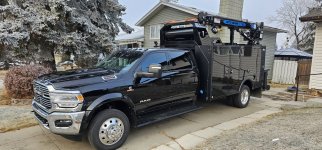
Thanks for doing such thorough installation / build instructions for this process @gprguy . I picked up a 23 5500 that only has the rear tank and I've been searching everywhere to see if this is possible to complete.

I have a service truck body on my C&C so some areas may be a little tight. Looks like I'm going to have a project on my hands this spring When I have some free time. I'll just have to double check all the parts are the same. Having the extra 22G midship tank will give me some breathing room when I am working out in the middle of nowhere.

It's also nice to see they have an Aux connector on the rear module. I should be able to use that connector for my webasto when I install that this year as well.

Thanks again for the lists and instructions.

Here's a pic of the unit I'll hopefully be getting all this done to this year.

1000003045.jpg
 
Nice rig!

I haven't posted about it yet, but I actually did get ahold of the rear wiring harness. It was only about $270, so I plan to swap over to that before I start building my bed. I'll post up details/pics when I get to that point.

The worst part of the whole deal is getting a set of brake lines from Mopar without them being destroyed in shipping. The install is pretty straightforward. With the body on, if you have the ability to get the truck up in the air on a lift at all it should still be doable although I imagine you'll have to drop the rear tank to get access to things.
 
Nice rig!

I haven't posted about it yet, but I actually did get ahold of the rear wiring harness. It was only about $270, so I plan to swap over to that before I start building my bed. I'll post up details/pics when I get to that point.

The worst part of the whole deal is getting a set of brake lines from Mopar without them being destroyed in shipping. The install is pretty straightforward. With the body on, if you have the ability to get the truck up in the air on a lift at all it should still be doable although I imagine you'll have to drop the rear tank to get access to things.
Why not make your own brake lines its pretty easy stuff
 
Sure and that's an option I mentioned back in the thread where I talked about them. I have the tools to do so, but I wanted the factory looking part.
Here with all the salt i take every advantage to avoid rustable components such as using stainless brake lines lol
 
Back
Top