What's new
Ram Heavy Duty Forum

Register a free account today to become a member! Once signed in, you'll be able to participate on this site by adding your own topics and posts, as well as connect with other members through your own private inbox!

Mid ship fuel tank

Step 3 - Fuel Lines

Here's a quick overview of the before/after fuel line configuration.

Before, you have two hard lines going from the rear tank forward, underneath the crossmember and they connect to hard lines right behind the cab, same area that the brakes have a junction block. The larger diameter line is the fuel supply, the smaller one is the fuel return (fuel vapor in Ram's vernacular).

We'll be removing those two lines and instead installing two shorter lines that go from the midship tank location up to the hard lines. We'll then install a third line (which is actually two pieces) that goes from the rear tank fuel supply port to the midship tank auxiliary port. The old fuel vapor port on the rear tank gets capped off and not used.

The auxiliary port is normally used to draw fuel out for an onboard generator, welder, etc, anything diesel powered. But it's really just a port into the tank, so in dual tank setups that's where the rear fuel pump (now re-purposed as a transfer pump) can dump fuel into from the rear tank. The BCM will monitor the fuel level in the midship tank and when it gets low enough activate the rear fuel pump to transfer fuel into it until it's full enough. The engine runs 100% off the midship tank.

Here's a comparison picture for length of the old fuel lines vs. the new ones.
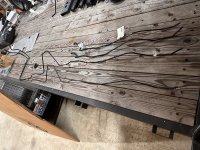
IMG_5344.jpeg

These lines will be full of fuel of course, so be prepared to make a mess. I drained the fuel out of the under cab fuel filter (there is a small petcock on the side) which helped some, but there will still be some left especially in the return line.

Be delicate with the fuel line quick connectors. There are a couple different styles, some with safety clips and some without, but be patient as they are all plastic.

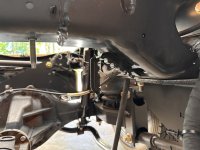
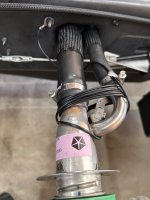
I'd start by disconnecting both lines at the rear tank (leave the breather line that goes to the rollover valve alone, that stays as-is) and rotating them upwards 90 degrees so they don't leak fuel. They have a separate section on the end so you can spin them upwards if you remove the lines from the clips. Then disconnect the lines at the frame connections behind the cab - these lines have little blue safety clips on them that have to come off first, then you can fight with disconnecting the actual clips. Drain the remaining fuel from the lines into a catch pan. Below you can see the fuel lines disconnected (please excuse all the other wires and air lines here, I am in the middle of my air suspension install).

IMG_5342.jpeg

Once you have them reasonably empty of fuel you can disconnect the two small extensions off the rear of the lines - best to have those out of the way. Next you need to get them removed from the truck. I was able to remove them without cutting them, but it was a struggle to get them past the crossmember where they go underneath. It took a bunch of persuading and some light bending, but what worked for me was to work them backwards enough to clear the front crossmember, then pull the front down and take them forward. Sliding them past the shock was the trickiest bit.

Once they are removed, install the new front lines (05146908AA fuel supply, 05146916AA fuel vapor) making sure you get the right line in the right place. The supply (larger line) goes on top. These are much easier to install due to their short length. Once they are in you can line up the brake and fuel lines in each clip and close them up.

IMG_5345.jpeg

Next install the rear transfer line. This comes in two pieces - put the main hardline (68193570AA) in first. It goes through the crossmember and will fit in the upper portion of the frame clips. You can close those clips up when you are satisfied with the routing. Lastly install the rear section of the transfer line (68193999AA), it's an L shaped piece that connects from the frame hard line to the supply (large driver's side port) on the fuel tank. It has those blue/red safety clips on both ends.

At this point the rear section of the fuel line should look like this:

IMG_5348.jpeg

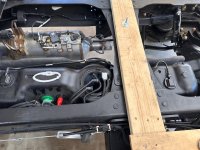
And at the midship location you should have 3 fuel lines ready to connect to your new pump:

IMG_5351.jpeg

Please keep in mind if you have a 4500/5500 60" CA (or anything other than an 84" CA) the fuel line part numbers will likely be different.

If you have a 3500 60" CA I have what I think are the correct part numbers in the post below but I have no way to verify.
Different years may also mean different part numbers, this was all done on a 2022 4500 84" CA truck. I am reasonably sure this will be good for any 2021-2023 4500/5500 84" CA truck but your milage may vary.

<continued...>
 
Last edited:
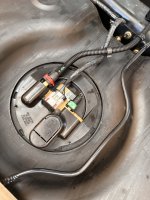
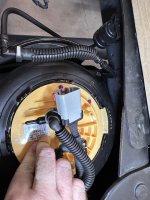
One last thing to do with the fuel lines - you still have an open fuel return/vapor connection on the rear fuel tank module. Go find your new midship fuel pump module and remove the black with green clip cap that comes on its auxiliary port. Put that on the rear fuel tank return connection to seal it up.

Rear tank before:

IMG_5341.jpeg

Rear tank after:

IMG_5353.jpeg

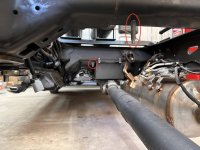
One last bit of cleanup before we move on - there will be an unused fuel/brake line clip on the bottom of the middle crossmember as shown below. Remove it so the crossmember is smooth and there's nothing that will be crushed when the new midship tank is snugged up against it:

IMG_5343.jpeg

Now would also be a good time to finish cleaning up the wire harnesses, getting them zip tied and clipped back into the frame. Next step will be installing the tank which will limit your access to the inside of the frame rail.

That's caught up to where I am at. I'll post the rest after I install the fuel tank and module. It should be pretty much plug and play from here.
 
Last edited:
Step 4 - Tank install

On to the good stuff, we are almost done.

Install the two double ended studs (part number 6508830AA) in the crossmembers. They thread into existing weld nuts. I added a little blue (medium) loctite to the ends going into the crossmember. I've highlighted them below.

IMG_5359.jpeg

Next, prepare the tank (part number 68496625AB). I recommend tipping it up on the end and giving it a few knocks to get any crud down into one corner and then vacuuming it out. The fuel filter will get anything before it gets to the expensive pumps and the engine, but it'll still go through the in tank pump and that's not necessary.

You need to put the heat shield (part number 5031027AC) over the 3 pegs on the side of the tank. At they factory they have some kind of push on fastener for the pegs to hold this in place - that's not available from the parts desk, but I am sure something could be figured out. A spring washer of some sort. I used a couple of small vice grips as seen below. It's just to keep the shield from going anywhere until the straps are in place.

IMG_5360.jpeg

Add the crossover vent hose (aka the purge hose, part number 5032258AB) to the tank next. You want this on the tank before you put it in place, otherwise you will have a lot of fun trying to put it between the tank and the strap after the fact (ask me how I know, or guess based on the picture below). Here's what it looks like and the rough orientation of how it is installed - the midship tank has two rollover vents since it has two high spots.

IMG_5362.jpeg

Now it's time to install the tank. Have a helper hold the tank into place while you get the straps in place. I'd start with the rear strap (the bigger one, part number 5031013AA) - one end hooks into the driver's side of the crossmember, and then you need to bend it around to go over the stud you installed earlier. Loosely secure with one of the 6104717AA nuts.

The front one is a little bit more fun - the stud is right next to the driveshaft carrier mount and there isn't a lot of room to work. Get the T hook end of the smaller strap (part number 5031015AA) in first but be careful - I caught my fingers in there and was pretty lucky to only have a small scratch. Could have been a lot worse. The stud end is tougher - you need to get it worked around so it's up past the drive shaft mount, and then I used a long pry bar to pry the strap over and get it to seat on the stud. Once you get that far put one of the same 6104717AA nuts on it.

Now's a good time to check for clearances, make sure no wires or hoses are going to be pinched, etc before you tighten the straps. In particular check that crossover vent hose that should be inside the rear strap between the strap and the tank. When you are ready torque the nuts to 37 ft/lbs. They go tight up against the crossmember so you can wrench them on that far before breaking out the torque wrench if you want. When you are done, it should look like this:

IMG_5363.jpeg

Now we add the filter to the vent crossover tube. The filter is part number 52029544AA and looks like this:

IMG_5364.jpeg

As you can see it has a built in fir tree push pin that goes into the front side of the crossmember. Attach it to the vent hose, pop it into the crossmember hole that looks the best, and it should look like this:

IMG_5365.jpeg

<continued...>
 
Step 5 - Fuel Module

We're on the home stretch. Your fuel module (part number 68569543AA) should have come with a new big green O ring. If it didn't, you can order one separate as part number 55366298AA. Put the O ring in place by just setting it in the groove.

IMG_5366.jpeg

Here's the fuel module. It's spring loaded so it's slightly taller than the tank's height. This puts some tension on the unit when it is installed and it keeps the bucket solidly on the bottom of the tank. You can see the float on the bottom of the picture, be gentle with that part.

IMG_5367.jpeg

Slide the module into the tank, leading with the float. The float goes towards the front of the tank, and the tab on the fuel module goes towards the back. There's "LOCATOR" embossed on the tank where the tab goes.

IMG_5368.jpeg

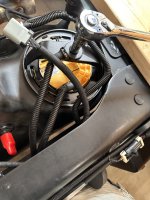
The lock ring (part number 04721916AA) goes on next. You'll be able to get it started by pushing down on the pump module so it is seated, but you'll need either a tool (linked above) or if you are feeling lucky a screwdriver and hammer. The tool is only $18, I highly recommend it. You can see the tool in use below, it attaches to the lock ring.

IMG_5369.jpeg

You'll need to put some serious torque on the lock ring to get it to seat fully to the middle position. I'm using a longer 1/2" ratchet and it took some force. There's a detail shot below of how the lock ring should be in the center position.

IMG_5370.jpeg

Alright, done with the lock ring tool. Get rid of it, the next step is we need to modify the fuel pump cover (part number 52014009AA) slightly. Here's the before shot - we need to cut out the marked area to be able to access the aux port. This is where the rear tank dumps fuel into the midship tank.

IMG_5373.jpeg

And here's the after shot, installed on the fuel tank ring. It just clips into place in 4 places.

IMG_5374.jpeg

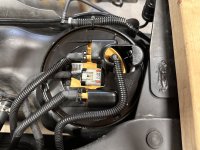
Now the really satisfying part - hook up the new fuel vapor/return line, the fuel supply line, the transfer line to the aux port, and the wiring connector. You can see I also added a zip tie to the vent hose to connect it to the lock ring - it was flopping around out there and this seemed like a good idea to me.

IMG_5380.jpeg

<continued...>
 
Step 6 - Filler Neck and AlfaOBD

Last part. The filler neck (part number 5031041AF gets connected in the obvious fashion. It does not come with hose clamps. I was able to find an extra for the filler hose in the kit that came with my truck, but the smaller hose I had to stop by the hardware store. Don't forget to hook up the grounding cable to the chassis - there is a ground stud right there for you to use. Obviously this part will vary if you already have a bed in place, you may need to extend the hoses.

IMG_5376.jpeg

Time to add some fuel. You need to add at least something to the midship tank - this is what the engine runs off of now, it can't be empty. I put 5 gallons in from a portable container. Top off with your new diesel cap (part number 52013994AB) and the physical install is done.

IMG_5379.jpeg

At this point I would test the midship tank before doing any AlfaOBD changes. Right now the truck will just run off the midship tank and not know the rear tank is even there. Keep in mind the fuel lines are empty, and if you did like me the chassis fuel filter is also drained. I cycled the key three times (ie: set the truck to run but don't crank the engine (foot off the brake), let the fuel pump run till it shuts off, then shut off the truck, repeat twice more). Make sure the midship pump is the one running. Check for fuel leaks on top of the tank as well as where the lines connect along the frame rail. The rear pump shouldn't be doing anything right now. After that I was able to start the truck without any problems. You may get some coughing if there's still air in the line but it'll sort itself out.

You should also see a fuel gauge that reflects what is in the midship tank. For me, I put 5 gallons in what is a 22 gallon tank so it showed 1/4. I knew my rear 52 gallon tank had 35-40 gallons so that told me it was reading the correct sender.

Side note - check your main fuse box under the hood. Make sure you have a 20 amp fuse in F73 which is the transfer pump. Mine had one from the factory even though it only came with the rear tank, but it's worth making sure.

On to AlfaOBD. If you aren't familiar with how it works there are plenty of sticky threads in this same forum with all the details on what you need and how it works.

You need to change 3 settings under the BODY COMPUTER car configuration change menu with the truck key in the run position but the engine not running. They are:

VehConfig 3: Two Fuel Sending Units Present: Yes

ECUConfig 4: Secondary Fuel Tank Capacity: 197 L/208 L

CBC Config I/O: Fuel Transfer ON/OFF Relay Control - Pin A16: Yes

And one more setting after connecting AlfaOBD to the ENGINE computer:

Dual Fuel Tank Enable/Disable: Enabled

Shut off the truck, let it sit a few minutes, and start it back up. If it all took effect you should see your fuel gauge reflecting an overall capacity between the two tanks. You'll also have a new page on the cluster in the fuel tab showing separate gauges for the two tanks:

IMG_5378.jpeg

Very, very cool.

I have not yet test driven it, and I didn't idle it long enough in my garage to get it to transfer fuel yet. I suspect I may have slightly too much fuel in the midship tank to get it to transfer, so I will take it for a drive tomorrow and report back. Here is the description from Ram on how the system decides to transfer:

The front tank runs the engine through the normal mounted 2 fuel filters. When the fuel gets down to approximately 1⁄4 tank the Body Control Module (BCM) grounds the Fuel Transfer Relay which activates the pump (Called “Auxiliary Pump” in WiTech) in the rear tank which fills the front tank. The BCM turns off the rear pump when the tank gets to 7/8 fill. This cycle is repeated until the rear fuel tank reaches Low Fuel Warning.

I am not sure if the overall fuel capacity parameter needs to be altered in AlfaOBD or not - I will figure that out after I fill it up for the first time.

That's it other than the test drive report - if there's any questions I'll do my best. I have a fair amount of diagrams saved off from Tech Authority from this whole project.

Edit: The fuel transfer finally works! There was a fourth setting needed above that's under the engine computer, @AH64ID found it!
 
Last edited:
Spectacular!

On my factory dual tanks, it maintains the front tank between 5/8 and 3/4 tank. When it gets down somewhere between 1/2 and 3/4 level, it transfers evidently only a couple gallons or so, getting the tank back up to nearly 3/4 level.

Curious if yours does the same. If so, it should have kicked on to transfer by now. Maybe it just needs to be ran for a bit?
 
That's what I am thinking - I ran it for less than 5 minutes since I didn't have the tail pipe on it. I'll get that on today and put on some miles.
 
No luck on the test drive, it's just not running the rear pump. I've verified that my connection to the pump is good, and that I have continuity all the way up to where the pump positive goes into the PDC. So now I am digging into trying to figure out if there's a missing relay or something, or hopefully not something unpopulated on the PDC.

I also have this sneaking suspicion that it just needs a few more key cycles to get that feature to take effect. However the new gauges in the dash took right away, so I am not betting on that. That said they are different feature codes in different sections of AlfaOBD.
 
that’s a whole lot of info! Man imma dig into this but don’t wanna cut anything. Can we buy the correct plug….and then pin them ourselves to make like a jumper harness? I would much rather to build a complete stand alone that ties in vs cutting. Other than that, holy crap you’ve dug into this and got all the good information! Thanks!
 
If you don't want to cut into it you have two options - you can either figure out what these pins/connectors are and buy the pins and tools needed to both add the missing wires to the rear side of the connectors and also swap the two tanks, or you can buy a new rear harness for the truck. I wasn't able to figure out the pin types. @Jimmy07 might know. If you want to try to get the rear harness, my best guess for your truck with the dual tanks is 68525916AB (it's a 2022 3500 chassis cab if I remember right?). It looks like it's orderable online for $260 or so. No guarantees that's the right part number though, and if you already have a bed on yours that may be an adventure to swap out.

Anyway - you may want to hold off in general till I get mine transferring properly. So far I have ruled out my wiring - I can supply 12v to the connector that leaves the PDC and it will run the rear pump to transfer fuel no problem. I even heard some gurgling the first time while it filled up the transfer line, so this tells me it's never run since I swapped the new lines in. That leaves me with a few options - either there's some relay missing in the PDC that is hidden away on the circuit board as all the plug in relays are present, there is something missing in the BCM, the option just hasn't taken effect in the computer yet, or the option in AlfaOBD isn't working right. Still digging.

Interestingly those are the same rear harness part numbers for my truck. Last time I tried to find one they were either unavailable or $500-600. I'd be tempted to grab one of those myself, but since this is not the source of my problem I'm going to think about that after I get this working.
 
either there's some relay missing in the PDC that is hidden away on the circuit board as all the plug in relays are present, there is something missing in the BCM

Good news is I think I can rule these two out. For a 2022 Ram 4500 Cummins, there is exactly 1 part number for the PDC and 1 part number for the BCM. No option specific part numbers. So all the hardware should be physically there.
 
The news is not great. We can add the option (the pin A16 option) in AlfaOBD to add what is needed to the BCM side of things to transfer fuel, but as it turns out the PCM has a role as well and flashing that is something the dealer would have to be willing to do, and that's assuming that witech would even let them enable the dual tank option while flashing the PCM (it looks like when you flash the PCM you need to tell it if it has dual alternators, dual tanks, and/or PTO).

So - if you have a way to flash the PCM and get that rear wiring harness, this entire project is plug and play. If not, it's going to take some creativity unless someone comes up with some brilliant way around the PCM issue.

The good news is that AlfaOBD can do the most important part of this whole procedure - enable the dual fuel gauges in the dash and set the analog gauge to read a combined total. I am glad we can at least do that as if AlfaOBD couldn't do that part, I don't know how else it would be done.

As far as transferring fuel, I am probably going to build myself a little microcontroller to do it instead of having the BCM/PCM do it. Unfortunately I am not going to do that in this thread or in public for hopefully obvious reasons.

I will say that if you followed my details above, there are two wires of importance out of the bottom of your PDC (fuse box in the engine compartment). C6 pin 16 which is a small solid violet wire is the trigger wire for transferring fuel - if you were to disconnect that from it's source (the BCM) and apply 12v there, that's how you trigger all the factory relays and fuses to run the transfer pump in the rear tank. You also need to disconnect C3 pin 39 (a small dark blue with yellow stripe wire) and ground that, as that is the connection that goes to the PCM and since the PCM is not flashed to have dual tanks enabled, it doesn't know to ground that wire and complete the relay circuit.

Thanks as always to Jimmy for helping with the diagnosis.

Edit: The implication being that if you didn't want to figure out how to do the transfer automatically, you could easily set up an aux switch or some other switch to transfer manually with the info above. You don't have any safeties at that point, you could overflow the midship tank, but lots of people run transfer tanks that way..
 
Last edited:
The news is not great. We can add the option (the pin A16 option) in AlfaOBD to add what is needed to the BCM side of things to transfer fuel, but as it turns out the PCM has a role as well and flashing that is something the dealer would have to be willing to do, and that's assuming that witech would even let them enable the dual tank option while flashing the PCM (it looks like when you flash the PCM you need to tell it if it has dual alternators, dual tanks, and/or PTO).

So - if you have a way to flash the PCM and get that rear wiring harness, this entire project is plug and play. If not, it's going to take some creativity unless someone comes up with some brilliant way around the PCM issue.

The good news is that AlfaOBD can do the most important part of this whole procedure - enable the dual fuel gauges in the dash and set the analog gauge to read a combined total. I am glad we can at least do that as if AlfaOBD couldn't do that part, I don't know how else it would be done.

As far as transferring fuel, I am probably going to build myself a little microcontroller to do it instead of having the BCM/PCM do it. Unfortunately I am not going to do that in this thread or in public for hopefully obvious reasons.

I will say that if you followed my details above, there are two wires of importance out of the bottom of your PDC (fuse box in the engine compartment). C6 pin 16 which is a small solid violet wire is the trigger wire for transferring fuel - if you were to disconnect that from it's source (the BCM) and apply 12v there, that's how you trigger all the factory relays and fuses to run the transfer pump in the rear tank. You also need to disconnect C3 pin 39 (a small dark blue with yellow stripe wire) and ground that, as that is the connection that goes to the PCM and since the PCM is not flashed to have dual tanks enabled, it doesn't know to ground that wire and complete the relay circuit.

Thanks as always to Jimmy for helping with the diagnosis.

Edit: The implication being that if you didn't want to figure out how to do the transfer automatically, you could easily set up an aux switch or some other switch to transfer manually with the info above. You don't have any safeties at that point, you could overflow the midship tank, but lots of people run transfer tanks that way..

Have you inquired about having the PCM flashed?
 
Have you inquired about having the PCM flashed?

I do not have a dealer that I would trust enough to try to go that route, I feel like it would be a big can of worms for me. Others may have better luck. I can say that in the procedure to flash the PCM it does mention this:

On vehicles equipped with dual generator, dual fuel tank, and/or PTO, obtain a Configuration Report and verify these options show to be enabled before releasing the vehicle to the customer.

So that implies that either there are options to be selected during the PCM flash, or that the PCM flash goes off of the sales codes (which would not be correct in this case) to set the right options.
 
This is an AWESOME Thread, thank you for sharing all the details and info thus far.
I wonder if the Alpha can change sales codes for you?
Being that this is a commercial truck I bet someone out there can modify the PCM without much issues, seeing as your doing it right "All factory parts"
 
Last edited:
Thanks - Alfa can do a lot, but it doesn't exactly change the sales codes to my understanding - it changes the underlying configurations on the truck. It does have what's needed for this change on the BCM side, and with some help from Jimmy I was able to confirm that Alfa is setting that option correctly. However on the PCM side, Alfa doesn't really seem to go there as that's more "tuning", and there's a piece missing there for the transfer to work.

I think in the past the dealer could add sales codes in their witech system and basically do whatever they wanted. Ram cracked down on that and changed the system so it can only enable sales codes on a given truck if the truck was built with that code from the factory. Or at least that's what I have gathered..
 
Still working on a solution to get the transfer pump to run automatically. I think I have about 3 options that I am tracking down, and worst case if none of those pan out option 4 is run the transfer pump to an aux switch and control it manually as I described above.

But the real reason for the post is this photo. I topped off both tanks, and how beautiful is this:

IMG_5400.jpeg

1067 mile DTE. Sure, I will never get 15mpg towing or with my camper on, but even at 10mpg that's a solid 740. Even if I have to run the transfer manually the mod was worth it to me.
 
VehConfig 3: Two Fuel Sending Units Present: Yes

ECUConfig 4: Secondary Fuel Tank Capacity: 197 L/208 L

CBC Config I/O: Fuel Transfer ON/OFF Relay Control - Pin A16: Yes

I want to install a second 22 gal tank on my 2023 RAM 3500 C&C. I'd like to keep the rear tank as the primary, transfer fuel from the mid tank using an AUX switch and have both fuel gauges with the range guesstimator. Looks like the retail price would be in the $1200 range.

I ASSuME that I can
1. just leave the rear pump/sender wiring alone,
2. do the VehConfig 3 and ECUConfig 4 but not the CBC config I/O,
3. run the output of the mid pump to the aux? input on the rear pump,
4. wire up the fuel sender and an aux switch to the mid pump.

Anyone see a big error in this?
 
Back
Top