What's new
Ram Heavy Duty Forum

Register a free account today to become a member! Once signed in, you'll be able to participate on this site by adding your own topics and posts, as well as connect with other members through your own private inbox!

Regens at alarming rate!

Higher RPM moves exhaust through the entire system (intake through exhaust tailpipe) faster, creating a cooling effect. Low rpm operation under load causes heat to be retained in the system. Back in my modified 12 valve cummins days I’d drop a gear on hills to cool things down, pulling a load up inclines for a extended period would come close to burying the egt gage. Drop a gear, instant cool down of a couple hundred degrees.
That's a great explanation. Thank you for your input.
 
There is no way that those 2 glue beads should cause that much restriction. I’ve seen trucks before 19+ models with the filter completely black with gunk on them and they had zero problem. I’ve seen people run them until they got a CEL and never have Regen issues. Has anyone tried disconnecting the ram air scoop on top of the radiator, having the air intake going straight in to the side of the air box? I know I get a lot of bugs in mine from it. I’m wondering if all of the shutters and stuff behind the grill is causing some kind of turbulence in the air system? But it seems to be the programming in the ECM as some who didn’t have any problems before having updates done on their trucks are now having issues. I still think it is some of the “Greenie” emissions updates without reengineering the system to make them work.
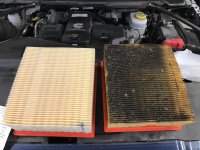
I wouldn’t be so sure of that. I’ve seen some interesting photos posted over this discussion many times. Far too many people having success with the filter change for it to be coincidence. Not saying it will always fix the issue, but I lived it personally. As I said before it may have to do with more than just the glue strips, but the glue strips seem to be a commonality in many. Take a look at the debris pattern on the media between these two. Top is an aftermarket glue strip filter, bottom is the correct AB filter. IMG_3826.jpeg
IMG_3828.jpeg
 
Last edited:
Quick update on my excessive regen situation and a warning to check your oil level!

I've been documenting my regens, dealer appointment in 3 weeks. Was getting ~120 miles then ~60 mile regens. Then I got a regen that took 250 miles to complete. 40 miles later a regen that took 400 miles to complete! Checked oil and it was high. Was changing fuel filters this weekend so picked up more oil as well.

I had almost 1 gallon of fuel in my oil! I had just changed my oil 1 month, 3k ago.

Seems to have gone back to 120 miles then 60 mile regens since oil and fuel filter change on Saturday.

All the right filters and fluids.
If you are still under powertrain warranty, I hope you’re documenting all of your findings with your dealer. A gallon of fuel in a 3 gallon oil sump is absurdly high fuel dilution. Much more than I would expect you’d see from even frequent regeneration. I’d be suspicious of at least one injector with a cracked nozzle that is dumping fuel in rather than atomizing it. That would account for excessive soot and fuel downstream to the DPF, ineffective active regeneration, and the excess dilution in the engine oil. If you’ve been running that truck with that high a fuel count in the oil I would be concerned for premature cam and lifter failure. Not to mention damage to the DOC / DPF. When you have too much fuel going downstream, it can cause a runaway regeneration that can overheat and ultimately destroy both the DOC and DPF.
 
I agree that it does make a difference but it shouldn’t. These trucks (19+) shouldn’t be that sensitive. The prior years would run whatever quality filter was put in them with zero issues. They would run until they got a CEL for restricted air filter and still not have Regen issues.
 
Higher RPM moves exhaust through the entire system (intake through exhaust tailpipe) faster, creating a cooling effect. Low rpm operation under load causes heat to be retained in the system. Back in my modified 12 valve cummins days I’d drop a gear on hills to cool things down, pulling a load up inclines for a extended period would come close to burying the egt gage. Drop a gear, instant cool down of a couple hundred degrees.
Definitely.

But there’s also times when it’s beneficial to drop a gear. Road speed has to account for some of this. It’s more beneficial to keep some RPM’s at lower speed than to lug the engine constantly and barely push any flow through the system. And engine load will have an effect on all of this also.

Absolutely right though that the whole “drop two gears and redline it down the highway for 20 miles” principle isn’t going to do much good for regeneration. You need constant engine load, exhaust flow, higher EGT, and a length of time to make regeneration work the best.
 
I agree that it does make a difference but it shouldn’t. These trucks (19+) shouldn’t be that sensitive. The prior years would run whatever quality filter was put in them with zero issues. They would run until they got a CEL for restricted air filter and still not have Regen issues.
Agreed.

If the system is that sensitive it’s weak and flawed.
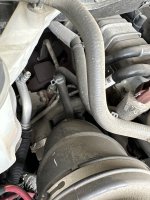
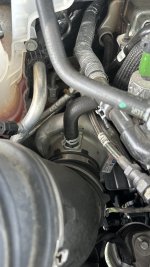
I’ll mention another thing to consider, I’ve been discussing with a very good Ram diesel tech. 18 and previous trucks Vs 19 and up the draw tube for the CCV filter off the engine is significantly different. 18 and down, the tube went into the intake pipe and there was a filter of sorts in the pipe, 19 and newer that tube goes into the charger housing directly with nothing in between it and the charger. With a lot of these trucks adding fuel to the crankcase and causing fuel dilution and higher sump levels, he’s wondering if the design change is adding to much oil, or oil vapor to the intake air. Definitely something to consider.

2017:71606241587__A0000086-307F-494F-9C2E-BD35FF9DD326.jpeg

2022:
IMG_3662.jpeg
 
If you are still under powertrain warranty, I hope you’re documenting all of your findings with your dealer. A gallon of fuel in a 3 gallon oil sump is absurdly high fuel dilution. Much more than I would expect you’d see from even frequent regeneration. I’d be suspicious of at least one injector with a cracked nozzle that is dumping fuel in rather than atomizing it. That would account for excessive soot and fuel downstream to the DPF, ineffective active regeneration, and the excess dilution in the engine oil. If you’ve been running that truck with that high a fuel count in the oil I would be concerned for premature cam and lifter failure. Not to mention damage to the DOC / DPF. When you have too much fuel going downstream, it can cause a runaway regeneration that can overheat and ultimately destroy both the DOC and DPF.

Have a long list of regen cycles for dealer to look at. I have been monitoring oil levels every couple of days. The excessive fuel in oil was after the 250 mile regen followed by the 400 mile regen 40 miles later. I changed immediately.

Changed fuel filters at the same time. Since then, might be to soon, but seems like regens frequency has been improving. Last one took only 38 miles to complete. Around 120-140 miles between them. They looked pretty dirty but was my first time changing diesel fuel filters.

It is possible the PCM is dynamic in that it might be trying to purge DPF after a history excessive regens? Or is it all sensor based logic? Trying to understand the back to back insanely long regens then back to "normal" excessive regens. Driving style has not change. Still 130 miles a day unloaded, 90% highway.

PXL_20230923_161349597.jpg
 
Have a long list of regen cycles for dealer to look at. I have been monitoring oil levels every couple of days. The excessive fuel in oil was after the 250 mile regen followed by the 400 mile regen 40 miles later. I changed immediately.

Changed fuel filters at the same time. Since then, might be to soon, but seems like regens frequency has been improving. Last one took only 38 miles to complete. Around 120-140 miles between them. They looked pretty dirty but was my first time changing diesel fuel filters.

It is possible the PCM is dynamic in that it might be trying to purge DPF after a history excessive regens? Or is it all sensor based logic? Trying to understand the back to back insanely long regens then back to "normal" excessive regens. Driving style has not change. Still 130 miles a day unloaded, 90% highway.

View attachment 63104
Is your truck a 2022?

I’ve seen multiple reports of 22’s having bad DOC’s. That may be part of your issue.

If the DOC isn’t oxidizing the fuel, or if your truck is dumping excessive fuel, you may not be getting adequate regeneration when the cycle is running and that could account for the long length of the regens. It may take extra long for those to finish, and depending on how they go, you may get more cycles back to back. I think this is also why many trucks are popping the P242F code for ash restriction. The trucks not seeing the differential pressure come down where it anticipates it should be, so it “sees” the leftover soot (or whatever else is contaminating the DPF) as ash build up, even though that’s not what it is. Once P242F is set, the truck will inhibit regeneration completely.
 
Is your truck a 2022?

I’ve seen multiple reports of 22’s having bad DOC’s. That may be part of your issue.

If the DOC isn’t oxidizing the fuel, or if your truck is dumping excessive fuel, you may not be getting adequate regeneration when the cycle is running and that could account for the long length of the regens. It may take extra long for those to finish, and depending on how they go, you may get more cycles back to back. I think this is also why many trucks are popping the P242F code for ash restriction. The trucks not seeing the differential pressure come down where it anticipates it should be, so it “sees” the leftover soot (or whatever else is contaminating the DPF) as ash build up, even though that’s not what it is. Once P242F is set, the truck will inhibit regeneration completely.
It is a 22'.

I planned was to drive this truck for 400k+. I might be dumping after 100k now. I am certainty concerned about longevity.
 
It is a 22'.

I planned was to drive this truck for 400k+. I might be dumping after 100k now. I am certainty concerned about longevity.
I feel the same way about my 2022 at this point. This was going to be the last truck I wanted to buy for several hundred thousand miles. Every other Dodge / Ram Cummins I’ve owned (5 previous trucks) was utterly reliable and trouble free. This 22 has been back to the dealership more times in 22 months of ownership than all my other trucks combined, and some of the issues with it are as-yet unresolved!
 
I finally had a regen yesterday, and this was the first one in slightly over 500 miles. Up to this point, I was hitting a regen about every 100-150 miles. Mine is a 2021, and I now have 32,000 miles on it. Here's a bit of my history:
The truck runs great, but it seemed to show soot buildup on the DPF gauge a little too frequently in the first year of ownership. It is my daily driver, and yes, I tow my camper (10,000 pounds) a lot too. I have never run a CAI on any of my diesels, so I decided to try an S&B just for fun.

After installation, the truck ran great! The soot buildup went to 0%, and pretty much stayed there all the time, I really only had the 24 hour programmed regen cycle at that point. It has run like that for at least 20,000 miles. Starting about 4 months ago, it began to register soot, and regen way too often. Oil is religiously changed, as well as fuel filters. at 32,000 miles, fuel filters have been changed 3 times. I use all OEM Mopar oil and fuel filters too.

The only change in the service intervals, was going from the 10w30 oil to the 5w40 oil (both Rotella). So what else has changed? Fuel quality? Oil quality? I'm just guessing now. The truck definitely isn't fuel diluting my oil as some have reported, stays on the full mark, and has no fuel smell. My dealer appointment is 10-4-23 for open recalls and this issue.

So, in order to try and narrow things down, I removed the S&B and put everything back to stock, along with a correct fresh Mopar air filter, and that's where I am now, slightly over 500 miles on this last regen, and it didn't take long at all to complete (so that is much better). I can't explain it, so hoping the dealer has anything resembling an idea.

My hour meter currently reads:
Idle hours 296
drive hours 993
total hours 1289
As a %, I know the idle hours are too high, but I virtually never let my truck sit and idle, that's just what it is daily driving. I don't have much hope that the dealer will figure anything out, as there are no CEL's, and if the computer can't tell them the exact problem, then they just stare at you blankly these days (man, I miss old school mechanics). I will report back after my appointment.

 
I feel the same way about my 2022 at this point. This was going to be the last truck I wanted to buy for several hundred thousand miles. Every other Dodge / Ram Cummins I’ve owned (5 previous trucks) was utterly reliable and trouble free. This 22 has been back to the dealership more times in 22 months of ownership than all my other trucks combined, and some of the issues with it are as-yet unresolved!
Same here, Matt. I've had more problems with this '22 than any vehicle I've owned in 46 years, and that includes high school beaters. We could (and did) fix anything on those old trucks ourselves as well.
 
Well I’m new to HDrams just took mine it’s also a 22’ August 22’ build date 21xxx miles to the shop for this very thing and got it back today not looking promising as my dpf is still climbing while on the highway on the way home from the dealer
 
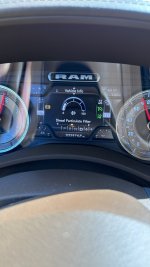
My 22 HO finished another regeneration yesterday at 35,819 miles. Driving it today, I took a look at the DPF gauge, already showing 25% reading at 35,877. So in exactly 58 miles it’s climbed that much already. Mostly all interstate driving unloaded. Something happened to this thing back in early July. It would easily achieve 800-1000+ miles between regeneration cycles and within the span of one cycle, it went down into 300-400 miles between (or less) and has never recovered. No P2459 code yet, but nothing about the way it’s currently operating strikes me as “as expected” or “normal”IMG_3877.jpegIMG_3879.jpeg
 
Well I’m new to HDrams just took mine it’s also a 22’ August 22’ build date 21xxx miles to the shop for this very thing and got it back today not looking promising as my dpf is still climbing while on the highway on the way home from the dealer
What did the dealership find? Any info provided as to diagnosis or diagnostics performed?
 
I just pulled up to my dealership for this (yet another) problem with this gawdawful truck. I'll let y'all know what they have to say.
I just got off the phone with my dealer service advisor. I scheduled my truck in for the 16th of this month. I’m 100 miles from the 3 / 36 terminating and I want this thing looked at. This will be the second time now in only a thousand miles or so that the soot load has reappeared within 50 miles of the last regen cycle finishing. There’s no way the truck is filling the DPF to 25% in 50 miles unless there’s something causing significantly more soot. Especially considering that not long ago I could go 800-1000 miles between the regeneration cycles and not much has changed with how I use the truck.
 
My 22 HO finished another regeneration yesterday at 35,819 miles. Driving it today, I took a look at the DPF gauge, already showing 25% reading at 35,877. So in exactly 58 miles it’s climbed that much already. Mostly all interstate driving unloaded. Something happened to this thing back in early July. It would easily achieve 800-1000+ miles between regeneration cycles and within the span of one cycle, it went down into 300-400 miles between (or less) and has never recovered. No P2459 code yet, but nothing about the way it’s currently operating strikes me as “as expected” or “normal”View attachment 63266
How are you getting the miles since last regen? Are you just monitoring the DPF screen and recording the mileage?

Thanks.
 
Back
Top