

I don’t have the mountains or miles you have but, my experience seems very similar to yours. Right now I’ve got 475 miles since my last automatic regen, a little stop and go, my gauge just hit 45% so I expect an regen real soon. Seems normal to me.This has been an interesting read. I have been obsessively trying to get an idea of how my regens are performing for the past couple of weeks to get an idea of if I need to start preparing myself for an issue. 2020 2500 with 54K miles and the last two periods between regens have have been:
333.7 Miles
9 Hours 26 Minutes
(mostly short trips with a couple moderate highway trips)
256.1 Miles
7 hours 38 minutes
(All short trips)
I thought these seem pretty short intervals, but this truck gets a lot of short empty trips. Lats time I drove up through the Mountains on a 2 1/2 hour trip and then back a couple days later it did not regen once and the passive regen seemed very effective.
I think based on everything I am reading in here I am going to count this as a win for 54K miles and keep my fingers crossed it stays around this level.
Ram Heavy Duty Forum
You are using an out of date browser. It may not display this or other websites correctly.
You should upgrade or use an alternative browser.
You should upgrade or use an alternative browser.
Regen
- Thread starter Glassman
- Start date

CaptainMike
Well-Known Member
Yep, mine too. When I parked after yesterday's regen the gauge read about 13%. This morning, after a 3 - 4 minute remote start warmup in 21 degree ambient temp it read 0% when I got going. I think little tiny gnomes with little tiny wire brushes cleaned the DPF while I slept last night. That's the only other plausible explanation.The other thing I’ve noticed with the DPF gauge, and why I think there is a programming issue, is that my gauge will sometimes register 12.5% or even 25% and then drop back down rapidly with a quick merging in traffic or passing without the DPF being hot enough for passive regen. The truck isn’t estimated soot loading accurately all the time.

- Messages
- 5,262
- Reaction score
- 5,499
- Points
- 113
Yep, mine too. When I parked after yesterday's regen the gauge read about 13%. This morning, after a 3 - 4 minute remote start warmup in 21 degree ambient temp it read 0% when I got going. I think little tiny gnomes with little tiny wire brushes cleaned the DPF while I slept last night. That's the only other plausible explanation.
DPF gnomes and trunk monkeys….. what else will they come up with?


flan
Well-Known Member
- Messages
- 4,879
- Reaction score
- 10,944
- Points
- 113
There is definetly a hardware or software issue on the frequent regen trucks. They should be able to handle any driving or idling condition. I maintain a strictly city 2011 6.7 5500 that sees tons of idle time and never tows but does weigh in a bit heavy because of the box on its chassis. My 19 does not have issues but I use it mainly for towing. Not much in town driving. Maybe if I did it would be a problem child. Even running the “wrong” aa air filter for the last 8k miles, no issue.
There’s little scuttle but on the 4th gens as far as regen issues, and this wasn’t much of a issue til late 2021. Don’t let the dealer or anyone else make you feel guilty that your using the truck incorrectly. Hold rams feet to the fire, they have the problem.
There’s little scuttle but on the 4th gens as far as regen issues, and this wasn’t much of a issue til late 2021. Don’t let the dealer or anyone else make you feel guilty that your using the truck incorrectly. Hold rams feet to the fire, they have the problem.
CaptainMike
Well-Known Member
Testify, Brother!!There is definetly a hardware or software issue on the frequent regen trucks. They should be able to handle any driving or idling condition. I maintain a strictly city 2011 6.7 5500 that sees tons of idle time and never tows but does weigh in a bit heavy because of the box on its chassis. My 19 does not have issues but I use it mainly for towing. Not much in town driving. Maybe if I did it would be a problem child. Even running the “wrong” aa air filter for the last 8k miles, no issue.
There’s little scuttle but on the 4th gens as far as regen issues, and this wasn’t much of a issue til late 2021. Don’t let the dealer or anyone else make you feel guilty that your using the truck incorrectly. Hold rams feet to the fire, they have the problem.
56ram2500
Well-Known Member
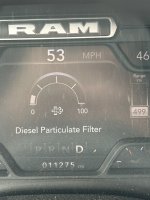
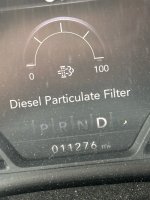
Today when on a short 82 mile trip I took a look see at DPF gauge ( I had recently switched to a new fuel station that claimed no bio mixed diesel  ) so when it was safe I took the below photo only to be surprised shortly after for DPF to drop down to zero, passive regen I assume... I was really surprised to see it had even raised as I just had a 24 hr regen about 110 miles earlier and at least 40% was hwy speeds of 50-60 MPH, another surprise was that I was on 2 lane county roads during the passive regen so my speed was limited to 50-55, and one place you can sometimes hit 60 MPH if no traffic...
) so when it was safe I took the below photo only to be surprised shortly after for DPF to drop down to zero, passive regen I assume... I was really surprised to see it had even raised as I just had a 24 hr regen about 110 miles earlier and at least 40% was hwy speeds of 50-60 MPH, another surprise was that I was on 2 lane county roads during the passive regen so my speed was limited to 50-55, and one place you can sometimes hit 60 MPH if no traffic...Attachments

Big difference in DOC / DPF and overall emissions system between a 2011 and 2019+ truck. Also cab and chassis trucks have different emissions mapping compared to the pickups. Regeneration trigger parameters are different.There is definetly a hardware or software issue on the frequent regen trucks. They should be able to handle any driving or idling condition. I maintain a strictly city 2011 6.7 5500 that sees tons of idle time and never tows but does weigh in a bit heavy because of the box on its chassis. My 19 does not have issues but I use it mainly for towing. Not much in town driving. Maybe if I did it would be a problem child. Even running the “wrong” aa air filter for the last 8k miles, no issue.
There’s little scuttle but on the 4th gens as far as regen issues, and this wasn’t much of an issue til late 2021. Don’t let the dealer or anyone else make you feel guilty that your using the truck incorrectly. Hold rams feet to the fire, they have the problem.
Earlier models were higher flowing and regenerated much easier. If the 2011 is loaded out all the time, it’s probably keeping itself clean through passive regeneration.
You think an emissions intact tune will change the performance parameters enough to lower soot loading and make regen easier for the truck to accomplish? Was thinking about that the other day.Big difference in DOC / DPF and overall emissions system between a 2011 and 2019+ truck. Also cab and chassis trucks have different emissions mapping compared to the pickups. Regeneration trigger parameters are different.
Earlier models were higher flowing and regenerated much easier. If the 2011 is loaded out all the time, it’s probably keeping itself clean through passive regeneration.
I think there’s some potential there. Provided the truck can be appropriately tuned to run a little cleaner. I don’t know that I would trust just a blanket or cookie cutter tune. I would want to see the truck on the dyno before, during, and after. In order to see how the parameters are changing performance, as well as the emissions outputs. However I think you’ll be somewhat limited by the emissions system itself. I’m not convinced the system currently in use is of the highest quality in terms of efficiency and flow. IYou think an emissions intact tune will change the performance parameters enough to lower soot loading and make regen easier for the truck to accomplish? Was thinking about that the other day.
flan
Well-Known Member
- Messages
- 4,879
- Reaction score
- 10,944
- Points
- 113
There’s been no Tier change since 2019s new emission system, but the 22s seem to have 90% of these regen issues. Ram has a problem on their hands with them.Big difference in DOC / DPF and overall emissions system between a 2011 and 2019+ truck. Also cab and chassis trucks have different emissions mapping compared to the pickups. Regeneration trigger parameters are different.
Earlier models were higher flowing and regenerated much easier. If the 2011 is loaded out all the time, it’s probably keeping itself clean through passive regeneration.
I think a good chunk of it comes down to component quality. Multiple reports of the packing / insulation dislodging internally, and screens coming apart inside the systems. I’m sure that doesn’t account for all of them, but a fair number. As much as I hate to admit it, I think there is some merit to the “COVID truck” theory. Last I looked, 2022’s were carrying about 60-65% of the trucks reporting regen issues on my spreadsheetThere’s been no Tier change since 2019s new emission system, but the 22s seem to have 90% of these regen issues. Ram has a problem on their hands with them.
I’m not gonna enter my info on your sheet because I’m not sure I have a problem, yet. I’ve noticed my soot load up quicker here recently and I just had a regen hit at about 250 miles. I’m going to hook up to my TT this weekend and give the DPF a good workout.I think a good chunk of it comes down to component quality. Multiple reports of the packing / insulation dislodging internally, and screens coming apart inside the systems. I’m sure that doesn’t account for all of them, but a fair number. As much as I hate to admit it, I think there is some merit to the “COVID truck” theory. Last I looked, 2022’s were carrying about 60-65% of the trucks reporting regen issues on my spreadsheet
Yeah if you’re going to tow with it, see how it performs. If correctly it should clean down to zero and stay there. A good burnout with a load on the system is ideal. Even better if it goes into an active regeneration while it’s towing. Once it’s done, see how long it takes soot load to return.I’m not gonna enter my info on your sheet because I’m not sure I have a problem, yet. I’ve noticed my soot load up quicker here recently and I just had a regen hit at about 250 miles. I’m going to hook up to my TT this weekend and give the DPF a good workout.

AZCummins
Active Member
- Messages
- 68
- Reaction score
- 163
- Points
- 33
I think there’s some potential there. Provided the truck can be appropriately tuned to run a little cleaner. I don’t know that I would trust just a blanket or cookie cutter tune. I would want to see the truck on the dyno before, during, and after. In order to see how the parameters are changing performance, as well as the emissions outputs. However I think you’ll be somewhat limited by the emissions system itself. I’m not convinced the system currently in use is of the highest quality in terms of efficiency and flow. I
I have been wondering this exact same thing. Planning to reach out to Calibrated Power to see if they have gotten any feedback on their tunes impacting regen in a positive or negative way. They seem to advertise the truck running cleaner on their tunes. Just worried if I take the plunge and end up with an actual emissions system issue after the tune I will be out of pocket since the warranty will be toast.You think an emissions intact tune will change the performance parameters enough to lower soot loading and make regen easier for the truck to accomplish? Was thinking about that the other day.
I’m also interested. Report back with your findings.I have been wondering this exact same thing. Planning to reach out to Calibrated Power to see if they have gotten any feedback on their tunes impacting regen in a positive or negative way. They seem to advertise the truck running cleaner on their tunes. Just worried if I take the plunge and end up with an actual emissions system issue after the tune I will be out of pocket since the warranty will be toast.
Yeah let us know what they say.I have been wondering this exact same thing. Planning to reach out to Calibrated Power to see if they have gotten any feedback on their tunes impacting regen in a positive or negative way. They seem to advertise the truck running cleaner on their tunes. Just worried if I take the plunge and end up with an actual emissions system issue after the tune I will be out of pocket since the warranty will be toast.

OLEJOE
Well-Known Member
I have a 22’ 2500 that started off with a regen issue. Got my first regen at 300 miles and 14 hours right after I was leaving the dealership after having some sales codes programmed. Evidently they idled the truck to keep the batteries up. The regens varied from 10-14 hours as long as I wasn’t towing. Towing they were on the 24 hour schedule. I changed fuel brand in November of last year and every regen has been at +/- 24 hours since. It takes me a month or more to get 24 hours on my truck but being retired, I can plan for the regens and get a good thorough clean out when it does.
I also feel for the folks who are having issues. It’s terrible and there’s no excuse to have that much money tied up in something that doesn’t work. What is even more frustrating is not being able to find someone who has any idea what to even look for. It’s a gut wrenching situation.
I also feel for the folks who are having issues. It’s terrible and there’s no excuse to have that much money tied up in something that doesn’t work. What is even more frustrating is not being able to find someone who has any idea what to even look for. It’s a gut wrenching situation.
That’s something I’m going to try. I’m going to change up where I get fuel, so far I’ve been consistently getting my fuel from one station and def from a box. Staring this weekend, since I need both I’m gonna get fuel and def from the truck stop near my house and see how that affects my regens. Seen several posts, including yours, which have had positive results after switching fueling stations.I have a 22’ 2500 that started off with a regen issue. Got my first regen at 300 miles and 14 hours right after I was leaving the dealership after having some sales codes programmed. Evidently they idled the truck to keep the batteries up. The regens varied from 10-14 hours as long as I wasn’t towing. Towing they were on the 24 hour schedule. I changed fuel brand in November of last year and every regen has been at +/- 24 hours since. It takes me a month or more to get 24 hours on my truck but being retired, I can plan for the regens and get a good thorough clean out when it does.
I also feel for the folks who are having issues. It’s terrible and there’s no excuse to have that much money tied up in something that doesn’t work. What is even more frustrating is not being able to find someone who has any idea what to even look for. It’s a gut wrenching situation.
flan
Well-Known Member
- Messages
- 4,879
- Reaction score
- 10,944
- Points
- 113
DEF will have no effect on regen, but fuel may. Bio content seems to have a different effect as the higher the bio, it burns with less BTU than straight diesel. Most times getting that information from the filling station is very difficult.That’s something I’m going to try. I’m going to change up where I get fuel, so far I’ve been consistently getting my fuel from one station and def from a box. Staring this weekend, since I need both I’m gonna get fuel and def from the truck stop near my house and see how that affects my regens. Seen several posts, including yours, which have had positive results after switching fueling stations.