What's new
Ram Heavy Duty Forum

Register a free account today to become a member! Once signed in, you'll be able to participate on this site by adding your own topics and posts, as well as connect with other members through your own private inbox!

Automatic Regen too often

The lowest I’ve ever seen the PID is 0.4%. That had less than 5 minutes of run time post active regen and was an active regen with 6400D (from what I’ve seen it works well, very well).

The lowest other one I have seen is 2.0%, which was an active regen after towing at 20K GCW for 7 hours with about 10 minutes of runtime before shutdown.

The PID % immediately following an active regen, post shutdown and restart after sitting, is the closest thing to calculated soot/ash load in the DPF I can figure out how to measure.
Any idea how long the "sitting" periods needs to be to get an accurate reading after a regen? I rarely am able to shut mine off right after a regen, so it has a little time to rise. Lowest I've seen is 6% with 6500 at the 1oz/10gal ratio. As I mentioned, never seen single digits until started the 6400/6500 regimen. The iDash only shows whole numbers.
 
Any idea how long the "sitting" periods needs to be to get an accurate reading after a regen? I rarely am able to shut mine off right after a regen, so it has a little time to rise. Lowest I've seen is 6% with 6500 at the 1oz/10gal ratio. As I mentioned, never seen single digits until started the 6400/6500 regimen. The iDash only shows whole numbers.

I’m not sure of the exact time. It seems like it’s more than an on/off/on. The ECM may have to shut down and restart.
 
I’m not sure of the exact time. It seems like it’s more than an on/off/on. The ECM may have to shut down and restart.
Ok. I've run errands after a regen where I'll start/stop a few times and it'll stay at the mid 40s where the regen ended until a more lengthy stop.
 
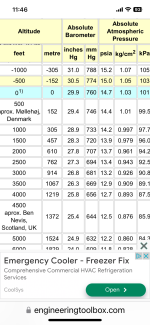
Well since we seem to be dealing with an air density issue and the programming connected to it, I have a few questions for the more knowledgeable members here. I read a post somewhere that Cummins was altering the reading from the TBAP sensor to meet emissions requirements that lead to the fining. I’m not sure exactly how the difference in barometric pressure affects the tuning. I assume the absolute barometric pressure varies with altitude and that’s what adjust the tune for changes in altitude. I have checked the TBAP reading on my truck and it has a value of 15. My 18’ model truck showed a value of 14.7 sitting in the same exact spot. For the people who have the ability to check this value and can report what yours reads and your altitude ? There may be absolutely no correlation between this and the problem we’re seeing but just another idea looking for a solution. I don’t know what value this is supposed to be for the correlating altitude but my truck is normally operated at 100-200 ASL. Anyway thanks for any replies.
 
I found a chart that shows altitude/psi values and according to the chart I should be at 500 feet below sea level and the reading from my 18’ model was correct.
 

Attachments

  • IMG_2115.png
    IMG_2115.png
    531.2 KB · Views: 21
I found a calculator that shows the value decreases with an increase in temperature at the same altitude.
 
14.7 psi at sea level is the standard value, but it will vary based on weather patterns.

For example my truck currently shows 13.2 psia with the engine off. That’s standard pressure for 3,000’ but I’m actually at 2,710’.
 
14.7 psi at sea level is the standard value, but it will vary based on weather patterns.

For example my truck currently shows 13.2 psia with the engine off. That’s standard pressure for 3,000’ but I’m actually at 2,710’.
Mine is reading spot on for 500 ft below sea level and Im 200 ft above. The standard value goes down when temperature goes up, so mine is off by 4 tenths. The calculator I found on line adjusts for temperature and exact elevation. Thanks for the reply.
 
14.7 psi at sea level is the standard value, but it will vary based on weather patterns.

For example my truck currently shows 13.2 psia with the engine off. That’s standard pressure for 3,000’ but I’m actually at 2,710’.
Also in your case since it’s reading higher altitude, wouldn’t that make the fuel leaner than vice versa ?
 
Mine is reading spot on for 500 ft below sea level and Im 200 ft above. The standard value goes down when temperature goes up, so mine is off by 4 tenths. The calculator I found on line adjusts for temperature and exact elevation. Thanks for the reply.

Does your monitor show tenths?

What’s the ambient pressure outside right now? Weather can easily make it off by 0.4 psi.

Also in your case since it’s reading higher altitude, wouldn’t that make the fuel leaner than vice versa ?

Diesels don’t run rich:lean like a gas engine does. The engine doesn’t adjust anything to run a specific fuel ratio, and the ratio constantly varies on diesels unlike gas engines.

There are fueling and boost tables based on altitude but .4 psia won’t make a difference in my tuning experience.
 
Does your monitor show tenths?

What’s the ambient pressure outside right now? Weather can easily make it off by 0.4 psi.


Diesels don’t run rich:lean like a gas engine does. The engine doesn’t adjust anything to run a specific fuel ratio, and the ratio constantly varies on diesels unlike gas engines.

There are fueling and boost tables based on altitude but .4 psia won’t make a difference in my tuning experience.
My monitor does show tenths but Im not sure exactly what the BP is at the moment. The TBAP has to be what adjusts the tuning for varying altitudes otherwise it would be blowing black smoke (into the DPF) when going from sea level to 10,000 feet. The older diesel engines had to run fuel additives when going to California to keep them from smoking. They had no sensors at all so nothing to correct for elevation.
 
I thought I'd share my experiences with regens. FYI, my truck is a 2022 with approximately 50,000 miles. I've been in the process of a multi-trip, cross country move so I've put a lot of miles and have been paying attention to the DPF gauge and Regen frequency. The truck had not been regening while pulling a trailer but the DPF gauge rose any time I slowed down pulling the trailer through town or anytime I was not pulling a trailer. Sometimes, It would seem to fill faster in more humid weather. The oil level on the dipstick had gone up a bit after an oil change and only 5,000 miles. I had the dealer change the oil since I was worried about dilution. I put on about 5,000 more miles and noticed the level rising again. This time, I talked to a different dealership than I normally frequent and told them about the issue and asked them to change the oil.

They asked me about the air filter and explained that they have had problems with the air filters that have the "glue strips". They told me that that filter restricts the airflow just enought to cause problems. I was told to only use the "correct" Mopar filter without the 2 glue strips. I thought I remembered them mention a service bulletin about the filters but am not certain. They also told me that these engines make a lot of power and need a lot of air. if the filter is dirty or the wrong filter is used, regens can become more frequent.

They changed my oil and found that my air filter was somewhat dirty (I live on gravel) and it was the filter with the glue. I have put about 1400 miles on the truck since then. While towing, it has, as expected, not had to Regen. The biggest difference I have noticed is that when not towing, and around town driving the DPF gauge takes much longer to register anything. I have not had an active Regen this time except for the normal 24 hour Regen. Time will tell if this will continue. I have another trailer load to move then the truck will be mainly used without the trailer. For now, I'll buy an extra air filter from the dealership to have as a spare so I can change it at the first sign of more frequent regens. I'm thankful for this dealership and feel hopeful that regens may be less frequent. I will continue to monitor and update if I have anything worthwhile to contribute. Best of luck to everyone dealing with frequent regens!

 
Last edited:
I have a 24 Ram 3500 HO SRW. Here are my regens in hours since I got the truck at the end of Feb.
24
12 - Some heavy towing
8
13 - Some heavy towing
8
15.5 - Some heavy towing
8
8
8
7.5
18 - Archoil 6400d/6500
12 - Archoil 6500

As you can see I marked any where I towed "heavy" which I'm defining as anything over 7500 lbs. None of my towing was long distance. Most of the other times had at least a little towing of my bass boat which is around 3500 lbs. Based on what I am seeing the Archoil does make a difference. I have not towed anything on the tanks with Archoil in the fuel. I have been using the "performance" dose of the 6500.
 
My monitor does show tenths but Im not sure exactly what the BP is at the moment. The TBAP has to be what adjusts the tuning for varying altitudes otherwise it would be blowing black smoke (into the DPF) when going from sea level to 10,000 feet. The older diesel engines had to run fuel additives when going to California to keep them from smoking. They had no sensors at all so nothing to correct for elevation.

I noticed this morning that ambient pressure only updates in 0.14 or 0.15 increments, i.e. it started at 13.20 and then showed 13.34 and 13.05 as the other readings as my elevation changed). The MAP sensor updates in 0.01 incriments.

Not sure when you mean by additives needed in California for smoking. There weren't sensors to adjust for elevation, but there are boost inputs to the fuel pump.

Ambient pressure is looked at, but boost pressure (MAP sensor) is a more important reading.
 
I noticed this morning that ambient pressure only updates in 0.14 or 0.15 increments, i.e. it started at 13.20 and then showed 13.34 and 13.05 as the other readings as my elevation changed). The MAP sensor updates in 0.01 incriments.

Not sure when you mean by additives needed in California for smoking. There weren't sensors to adjust for elevation, but there are boost inputs to the fuel pump.

Ambient pressure is looked at, but boost pressure (MAP sensor) is a more important reading.
I agree that the MAP sensor is more important to calculate fuel/boost but I think the BP helps the MAP determine how much fuel with how much boost. I think the lower BP reading will help during low boost situations and may trim the fuel back just a hair. Hopefully enough to increase the EGT’s enough to help passive regen or lower the soot level created. I ordered the sensor and going to see if there is any difference. I know if I carried it to a dealer they would say that it is in range or it would throw a code. But with what the sensor is showing, the ECM doesn’t know it’s not being operated at 500 ft below sea level.
 
I agree that the MAP sensor is more important to calculate fuel/boost but I think the BP helps the MAP determine how much fuel with how much boost. I think the lower BP reading will help during low boost situations and may trim the fuel back just a hair. Hopefully enough to increase the EGT’s enough to help passive regen. I ordered the sensor and going to see if there is any difference. I know if I carried it to a dealer they would say that it is in range or it would throw a code. But with what the sensor is showing, the ECM doesn’t know it’s not being operated at 500 ft below sea level.

Sure it makes a difference, but less than 1'000 feet of error isn't going to make any difference to a diesel. There simply isn't any variance in the tables I've seen for your ambient pressure to your reading.
 
Sure it makes a difference, but less than 1'000 feet of error isn't going to make any difference to a diesel. There simply isn't any variance in the tables I've seen for your ambient pressure to your reading.
If they get my order out today, I should have the new sensor by Wednesday and be able to see if it makes any difference. I did notice that the 2897332 TBAP sensor has been superseded to 2897332NX. I wonder what the deal is with that.
 
I know I'll probably be crucified for this but something interesting has occurred

I just got back from a 28 hour, 1760 mile round-trip vacation (Oklahoma to Wyoming and back). My truck had 2 engine hours since the last regen before leaving. The EVIC never left the DPF screen. In 30 hours I never had an active regen message. Additionally, I reviewed "dash" camera footage to verify I didn't miss it as I can view essentially 1 min increments as a 1 second screen shot type of video. So I can view an hour in 1 minute. I set up this camera that has high resolution so I can see everything in front of me - evic, vehicles out the windshield, etc after fighting ram on getting the repairs done so that I have iron clad proof of anything going forward.

Someone help me make sense of that. No regen message and I'm 6 hours past the 24 hour timed regen. I highly doubt it made a difference, but the entire 28 hour trip had a 8k pound travel trailer attached. I averaged 9.5mpg there and 11mpg back. Which I attribute mostly to going up in elevation vs down.

Anyways, I'm stumped to say the least. 3k miles ago they replaced the DPF and MAP. Not sure if there was any flash updates that changed the timed regens if EGTs are consistently high....
 
Not sure what happened, but my CEL/P2459 cleared itself after being on for nearly a week. All I did was top off the DEF with the expensive stuff (platinum whatever) due to the place not having the cheaper stuff I top off with and 2 days later, the CEL is gone?

I'm not sure what to make of it - I can't imagine the DEF really made that much of a difference?
 
Not sure what happened, but my CEL/P2459 cleared itself after being on for nearly a week. All I did was top off the DEF with the expensive stuff (platinum whatever) due to the place not having the cheaper stuff I top off with and 2 days later, the CEL is gone?

I'm not sure what to make of it - I can't imagine the DEF really made that much of a difference?
Thats a regen frequency code so not sure why DEF would impact it but my truck has done this twice before too - thrown a code for regen issues then a day or 2 later cleared on its own and not come back for 3-6 months. Its bizarre and really degrades my confidence in the trucks reliability.
 
Back
Top