What's new
Ram Heavy Duty Forum

Register a free account today to become a member! Once signed in, you'll be able to participate on this site by adding your own topics and posts, as well as connect with other members through your own private inbox!

2024 Ram 3500 SRW towing/payload questions (again!)

ErikTheRed

Well-Known Member
Messages
349
Reaction score
421
Points
63
Location
Sacramento-ish
Just last month I purchased a new 2024 Ram 3500 Bighorn CC LB 4x4 HO/Aisin SRW. A dealership in Reno (two hours from me) had pretty much the exact truck I wanted, and since last month Ram dealerships stopped accepting new orders for 2024's and with inventories dwindling, I drove up there and bought it. I replaced my 2006 Ram 2500 CC SB 5.9, which I loved and served us very well, but it was getting old. I got what I think was a very fair deal on the new truck, sticker on the truck was $74,800 and I got it for $62,200, and they threw in a spray-in bedliner and very nice side steps from a local truck store, and a set of Firestone Transforce AT2 tires since I didn't like the standard-issue Transforce tires. Aaanywho.... thats not what I came here to talk about LOL. I bought the 3500 because we do alot of towing and I figured since the price diff isn't huge from the 2500 to the 3500, and because I really want the Aisin trans, might as well go for it. Better to have too much truck and not need it than to have too little truck WHEN you need it, right? Ok so I buy the truck, and then we decide to also upgrade our toy hauler. Since I now have a 3500 with a long bed and plenty of power, we decide to make the change from a bumper pull to a 5th wheel. My wife and I go 5th wheel shopping (with her VERY particular and specific set of prerequisites, as well as a few of my own) and we decide on a Genesis Vortex 3016IKS. The Vortex is 37' long, has a GVWR of 15k and a hitch weight of 2700 lbs. I decided to hold off a bit on the purchase to do some more research. Welp, Im glad I did because now, after reading for the last couple days everything I can feast my eyes on covering this topic, I still have questions LOL. I know darn well my truck has plenty of "towing capacity" to pull a 15k trailer, thats not an issue. But as you all know, the issue is with payload capacity, especially with a heavy toy hauler. The door jamb sticker on my truck shows I have 4100 lbs of available payload. So, the quick & easy math for an uninformed nitwit is, 2700# pin weight + my wife and I + a 150# 5th wheel hitch + a bag of bbq briquettes and a cpl camp chairs = plenty of payload. Right? Nope, wrong. I didn't figure for LOADED pin weight, and I've learned the secret estimate formula is to add approx 22% of the trailer GVWR to the pin weight. Doing that, I end up with about 3300# pin weight, and now margins are getting razor thin. Adding my adjusted pin weight + 5th hitch + my wife and I and maybe the dog + the bag of briquettes and camp chairs and we're RIGHT AT that 4100# payload. And I mean, like, maybe even 50 lbs over and that doesn't even account for the can of Copenhagen in my pocket or my wife's crochet yarn ball. I've read countless forum threads and comments in the last few days, and I'm reading everything from the two extremes of this debate-- the goose-stepping payload Nazis who say even 3 ounces over the factory-stated payload limit and the Earth will cease to spin on its axis and cause a polar shift calamity, to the other end of the debate where I see "ahh thats hogwash, payloads ain't nothin more than snobby lawyer gobliddygook. I tow six railcars and D8 dozer over the Sierras with my Kia Sportage and I ain't never had no problems." Realistically, in my real life, I probably fall somewhere smack dab in the middle of those. Its kinda like knowing that the "posted speed limit IS the speed limit", but we all go a little over it anyway with regularity and we accept the risk to ourselves, and to an extent, the risk to others as well. So my question to those of us in the middle-ish of this eternal debate, how much over the payload is considered "the margin"? Yes I understand there really isn't a margin. I'm just asking, if my stickered payload is 4100, and say after I'm fully loaded my payload is a cpl/few hundred pounds over that, is that really the end of the world? What would you do or not do, and why?

Cue the comments, "you shoulda got a dually and this wouldn't be an issue." Yes, quite plainly, you'd be correct. But that would be entirely unhelpful considering, as stated above, I've already bought the truck and its not a dually. That I'm aware of, most dealerships don't have "ooops I goofed I shoulda bought a dually so I'm returning this SRW" policies, so I'm fairly well locked into this truck for at least the next 6 years. What I need to know is, or more accurately, what I'd like to hear opinions on, is whether or not we need to shop for a smaller/lighter toy hauler (which is not desirable for us) just because we might end up a couple hundred pounds over payload.

Also, can someone confirm that the rear axle in a 3500 HO/Aisin SRW is actually the same 12" axle thats in a dually? If it is, its my understanding that this axle actually has a GAWR of 11,000 lbs, and is rated at 7000# by Ram mostly due to tire/wheel capacity. And if THATS true, and the tires were upgraded to a higher load rating, would that actually increase the available payload of the truck...... even if the snobby lawyers would never officially agree to it?

Thanks for any advice or opinions!
 
Firstly, I fall under the "goose-stepping nazis" category. After all, the limit is the limit. It's not about what the truck can or cannot do, but instead the potential legal issue you get yourself into should an accident occur that hurts someone. I don't know about you, but if my daughter were killed in accident where the offending driver was overloaded, you can bet your azz I'm going after him.

That said, for your situation, I'd get that fifth wheel and not look back. A couple hundred pounds? Pft, that's nothing. That's accumulated dust in the wheel well. Don't worry about it.

Also, my rear GAWR is 9750. I'm not gonna try to guess what lawyers did what, or what engineers did what, or what you could accomplish if you change tire or wheel or whatever.
 
Your RAWR is what will be your limiting factor, so as long as you exceed that or your wheel/tire ratings you’ll be fine.

That’s still a big 5th wheel for a SRW in terms of overall size, so that’s a consideration depending on how often and far you plan on towing it. Completely doable and not crazy, just a thought to consider.

All of the HD Rams use the same axle housing, which is capable of a lot more weight than Ram rates it for. The Ram rating is based on the package thou, and not just the housing. The original AAM 11.5 housing was retired for 10,912lbs and the current version has been upgraded, but I’ve never seen a revised number from AAM. Either way, the truck isn’t rated for that much RAW in any configuration.
 
I was having the same issue pulling my 42ft 5er. I was more concerned with the weight on the axles. After shifting the cargo around and adding 25-30 gallons of fresh water I was able to the axle weight around 50 to 100 pounds under, depending on what momma was packing. I try and keep my trailer around 15K or under loaded. I have just under 25k miles of pulling it, never had any problems.
 
Go by RAWR loading and you're good.

Put the charcoal in the camper.

Enjoy.

P.S. The 12" HO axle R&P, tube and axle shaft size is the same as DRW but is necked down at the spindles AFAIK.
 

"Firstly, I fall under the "goose-stepping nazis" category. After all, the limit is the limit."

But then you say....

"That said, for your situation, I'd get that fifth wheel and not look back. A couple hundred pounds? Pft, that's nothing."

:oops:;) So which it it? I'm confused! :D

Regarding axle weight rating, well, I'm confused there too. According to FCA the rear axle rating is 7000#. But, a good bit of that capacity is taken up by the truck itself. So how does one know what's left? Let's say for the sake of this example that the rear axle is supporting 3000# worth of truck, without any extra cargo. Doesn't this mean there's only 4000# of available RAWR? I don't know if I'm intellectualizing that properly, but if so, I don't suppose there's much difference between that axle rating and available payload on the door sticker.
 
I would suggest (from experience) that you actually measure your pin weight first. Lots of Google places to find out how to do the 2 step process. My pin weight is very large, and a long way from any published spec. I know lots of people that tow big 5th wheels with a SRW and laugh at the "weight police". I'm not one of them. Now, I did change to 17" wheels instead of 16" on the 5th wheel, and have independent suspension (Morryde) added, and disc brakes. But my pin weight for a 2017 Cedar Creek 5th wheel 36CKTS is over 4,000 lbs, as calculated on scales. My listed Payload is 5,632 lbs, which is more than most.

That said, none of my friends who have similar 5th wheels and SRW diesel trucks have had any issues. Of course, they've not had any wrecks either.

But you really need to weigh and calculate your Pin Weight, and then look at it vs. your CCC on the door jamb.
 

"Firstly, I fall under the "goose-stepping nazis" category. After all, the limit is the limit."

But then you say....

"That said, for your situation, I'd get that fifth wheel and not look back. A couple hundred pounds? Pft, that's nothing."

:oops:;) So which it it? I'm confused! :D

Regarding axle weight rating, well, I'm confused there too. According to FCA the rear axle rating is 7000#. But, a good bit of that capacity is taken up by the truck itself. So how does one know what's left? Let's say for the sake of this example that the rear axle is supporting 3000# worth of truck, without any extra cargo. Doesn't this mean there's only 4000# of available RAWR? I don't know if I'm intellectualizing that properly, but if so, I don't suppose there's much difference between that axle rating and available payload on the door sticker.

Load the truck with your hitch, gear, wife and her crochet stuff, slap a can of skoal in yer pocket and take it to a scale...
 
This is basic math. Not Rocket science. You'll find a CAT scale or similar at the truck stop is your friend. Front axle weight. Rear axle weight. Trailer axle weight.

You have not purchased the trailer you say? What do you want in the truck? Toss it in and pay the $12 or whatever it is now to get actual front and rear axle weights. 22% of the #15k trailer gross is #3300. If your door jamb show 4100 - 3300 = 800 pounds for the truck. Put stuff in the trailer and stow as necessary to balance it when rolling.
 
This is basic math. Not Rocket science. You'll find a CAT scale or similar at the truck stop is your friend. Front axle weight. Rear axle weight. Trailer axle weight.

You have not purchased the trailer you say? What do you want in the truck? Toss it in and pay the $12 or whatever it is now to get actual front and rear axle weights. 22% of the #15k trailer gross is #3300. If your door jamb show 4100 - 3300 = 800 pounds for the truck. Put stuff in the trailer and stow as necessary to balance it when rolling.

There's even an app (CAT Scales).
 
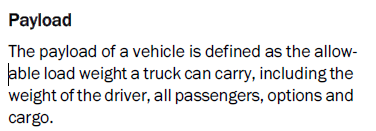
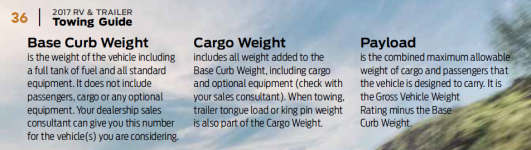
I've seen this argument before. But it seems silly to argue semantics. Yes, many people call PAYLOAD by its other name CARGO CARRYING CAPACITY.


But the Cat Scale APP is great.
 
CCC is for trailers that don't hold passengers and is different than payload.
 
CCC is for trailers that don't hold passengers and is different than payload.
Outside of the nomenclature, they are functionally the same number. Gross vehicle weight rating - current actual weight = remaining (or overloaded) payload/ccc whether a trailer or a truck.
 
I continue to believe they are one and the same thing for pickup truck tow vehicles. Many articles I find back that up. If I'm wrong, I'm wrong.


Well you're wrong.

Just another improperly applied term perpetuated by random internet dudes. Just because it's on the internet doesn't make it true.

For every non-oem random link you find, I can find one that clearly shows the difference.

Passengers are not cargo.

1724906510873.png


I'll close with this. I think the use of "CCC" is probably part lazy typing, part lack of actual knowledge of the proper terms, maybe a little trying to sound smart. Does anyone actually say out loud, "Cargo Carrying Capacity," or do most (if not all) say "payload?"

I'm done.
 
This is basic math. Not Rocket science.
I understand its math. I did the math. Thats how I know I'm gonna be a little over, maybe even up to 300-400 lbs over, my payload. And thats why I asked for opinions on whether or not its something others would or wouldn't do.

No I have not purchased the trailer. And since I don't own it I can't very well pull it to a scale and weight it out, so I have to use "the math". I suppose if I just hook up the trailer and my wife and I jump in the truck, and I leave briquettes, the COPENHAGEN and my wife's yarn ball in the trailer, we'd be within payload. This thread was more to just gain other's wisdom on the subject.

Up until last month my truck was a 2006 Ram 2500 CC 4x4 5.9. Our trailer is a 2020 Grand Design 21G toy hauler, which has a loaded tongue weight of near 1400 lbs, Often times such as on our Sand Mountain trips I'd have my 750# Can Am 2-up quad in the bed of the truck along with a full set of sand paddles for our X3 and all sorts of camping gear packed in there wherever I could find a nook or a cranny. Plus my portly 300 lb self and my much less portly 150 lb wife, we were considerably over the payload on that setup too. Never a problem and the truck towed/handled extremely well under those conditions. So HEY!! Maybe I just answered my own questions and gave myself the advice I was looking for! ;) Seriously, the reason I'm more concerned now is because we're talking A LOT more weight that I was toting before. Yes I was over payload, but I was dealing with a lot less weight overall. To use the speeding analogy again, if the speed limit is 15mph and you do 19, that 25% over the speed limit ain't no big whoop. But if you're doing 70 mph and decide to go 25% over that, yikes. Crash at 19 and, well, it ain't gonna fun but probably you're ok. Crash at 88 mph.... the groundhogs are gonna be bringin' ya yer mail.
 
Last edited:
As it pertains to this particular discussion, I've used "cargo" and "payload" interchangeably. I think most reasonable people would understand that, even if the two terms have technically different definitions. So there. :cool:
 
Back
Top