
Ram Heavy Duty Forum
You are using an out of date browser. It may not display this or other websites correctly.
You should upgrade or use an alternative browser.
You should upgrade or use an alternative browser.
2021 RAM 3500 Tradesman | AEV Prospector | FWC Grandby
- Thread starter ramblinChet
- Start date


ramblinChet
Drinks Alone
- Messages
- 650
- Reaction score
- 3,120
- Points
- 93
Thanks for the tip - next time I will take a close look at the diamond ones.FYI One diamond metal cutting wheel will cut what many packets of abrasive wheels will cut.
And thank you for your kind words - I would suggest you design a simplified system and give it a go since it's a great exercise.The majority of my installs are in RVs with considerably more space available, but seeing this makes me want to build a system in a box just for the hell of it.
Also, I appreciate your tip on the chassis ground for the MPPT and your post inspired me to perform additional research on this topic including the "Wiring Unlimited" PDF produced by Victron Energy. If anyone has an interest here is some additional information along with a link to the PDF:
Wiring Unlimited is all about electrical wiring of systems containing batteries, inverters, chargers and inverter/chargers – and going by the testaments on the Victron Community, an invaluable resource. Wiring Unlimited’s primary purpose is to aid in the understanding of the basic principles behind certain electrical concepts and how they apply to Victron Energy products and the installation of such products.
Download Wiring Unlimited: Wiring-Unlimited-EN.pdf
Last edited:
ramblinChet
Drinks Alone
- Messages
- 650
- Reaction score
- 3,120
- Points
- 93
Taking time to work through a problem and identify multiple solutions offers choices, and having options is generally beneficial. This approach guided my design of the Blue Sea Systems DC Accessory Panel, where I valued the space for four accessories: one 12V dash socket, two Dual USB chargers, and one Mini Voltmeter. While I prioritized the Mini Voltmeter and one Dual USB charger, the 12V dash socket and second USB charger seemed less essential for my off-grid camper, as they duplicated existing outlets. After further research, I purchased a Blue Sea Systems Mini OLED Tank Meter and a Temperature Meter to enhance system monitoring, ensuring a precise and efficient layout.
Inspired by an aircraft cockpit, I designed my camper’s gauges, switches, and controls to prioritize efficiency and intuition. I applied this cockpit-inspired logic to the secondary row gauges - system voltage, auxiliary diesel tank percent full, and outside air temperature - based on their importance, frequency of use, and logical grouping. Arranging them left-to-right in this order optimizes a top-to-bottom, left-to-right scan, ensuring a balanced, intuitive interface for my off-grid system.

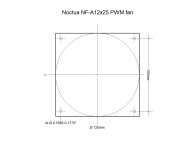
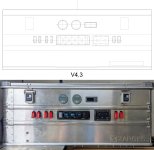
I created a layout drawing for two Noctua 120mm fans, to be placed on each side of the Zarges K470 case, ensuring optimal cooling for my camper’s electronics. Though this drawing took only moments to create - and may seem minor to others - I carefully plan every modification. Planning 120mm holes for a $900+ case justified the effort, as one mistake could compromise the project. This precision ensures the fans integrate seamlessly with my layout.
I positioned a 120mm hole saw on the Zarges K470 case’s side to cut holes for two Noctua fans, but the horizontal raised ribs - designed for structural rigidity - raised concerns. I had to cut through these ribs, so I considered cutting speed, down-force, lubrication, and the risk of the teeth catching a rib, potentially wrenching the drill from my hand. A drill press with a clamped case would have eased these concerns, but I planned a controlled hand-drilling process instead.
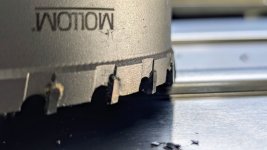
Another concern was drill breakthrough - a common issue most have experienced. It occurs when drilling thin, unsupported sheet metal, pulling the bit into the workpiece as it breaks through. To avoid this, I drilled a pilot hole, progressed to using the hole saw’s pilot bit, and then remounted the hole saw, keeping RPMs low, applying light pressure, and pausing to cool the Tungsten Carbide teeth and workpiece. This careful process ensured clean cuts through the Zarges K470’s raised ribs, supporting my precise fan placement.
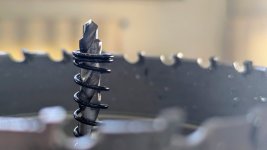
Cutting the 120mm hole freehand was challenging, using a 30-year-old Craftsman drill and a $25 hole saw, especially with the Zarges K470’s raised ribs. Despite these non-ideal tools, it worked. All holes were deburred and cleaned with a hand file, ensuring a professional finish.

I test fit the Noctua fan and grille on each side of the Zarges K470 case, confirming secure mounting and clean alignment, and both fit well and looked professional. While a complete shop would streamline the process, this unique project is nearly complete, soon freeing me to plan and enjoy off-grid adventures for years to come.

I'm going to ask you to take a moment to consider how meticulous design and layout helps to align you with spiritual truths:
Inspired by an aircraft cockpit, I designed my camper’s gauges, switches, and controls to prioritize efficiency and intuition. I applied this cockpit-inspired logic to the secondary row gauges - system voltage, auxiliary diesel tank percent full, and outside air temperature - based on their importance, frequency of use, and logical grouping. Arranging them left-to-right in this order optimizes a top-to-bottom, left-to-right scan, ensuring a balanced, intuitive interface for my off-grid system.
- DC Voltmeter
- offers quick health check for batteries and charging
- highest priority among secondary gauges
- a direct indication of electrical system stability during heavy loads
- Tank Meter
- indication of auxiliary diesel tank level which provides fuel for Wallas Nordic DT heater and cook top
- critical for planning duration of heating and cooking
- moderate priority as fuel monitoring is important, but less urgent than power system
- Temperature Meter
- provides environmental data regarding outside air temperature
- lowest priority and less critical for immediate operations unless outside conditions are extreme
- this will assist in making battery heating decisions
I created a layout drawing for two Noctua 120mm fans, to be placed on each side of the Zarges K470 case, ensuring optimal cooling for my camper’s electronics. Though this drawing took only moments to create - and may seem minor to others - I carefully plan every modification. Planning 120mm holes for a $900+ case justified the effort, as one mistake could compromise the project. This precision ensures the fans integrate seamlessly with my layout.
I positioned a 120mm hole saw on the Zarges K470 case’s side to cut holes for two Noctua fans, but the horizontal raised ribs - designed for structural rigidity - raised concerns. I had to cut through these ribs, so I considered cutting speed, down-force, lubrication, and the risk of the teeth catching a rib, potentially wrenching the drill from my hand. A drill press with a clamped case would have eased these concerns, but I planned a controlled hand-drilling process instead.
Another concern was drill breakthrough - a common issue most have experienced. It occurs when drilling thin, unsupported sheet metal, pulling the bit into the workpiece as it breaks through. To avoid this, I drilled a pilot hole, progressed to using the hole saw’s pilot bit, and then remounted the hole saw, keeping RPMs low, applying light pressure, and pausing to cool the Tungsten Carbide teeth and workpiece. This careful process ensured clean cuts through the Zarges K470’s raised ribs, supporting my precise fan placement.
Cutting the 120mm hole freehand was challenging, using a 30-year-old Craftsman drill and a $25 hole saw, especially with the Zarges K470’s raised ribs. Despite these non-ideal tools, it worked. All holes were deburred and cleaned with a hand file, ensuring a professional finish.
I test fit the Noctua fan and grille on each side of the Zarges K470 case, confirming secure mounting and clean alignment, and both fit well and looked professional. While a complete shop would streamline the process, this unique project is nearly complete, soon freeing me to plan and enjoy off-grid adventures for years to come.
I'm going to ask you to take a moment to consider how meticulous design and layout helps to align you with spiritual truths:
- God is the Creator ex nihilo, the ultimate source of all order, beauty, and precision in the universe
- Catholic tradition, as articulated by St. John Paul II in Laborem Exercens, views human work as a participation in God’s creative and redemptive mission
- St. Thomas Aquinas, a cornerstone of traditional Catholic theology, argues that beauty arises from integritas (wholeness), consonantia (proportion), and claritas (clarity)
- Scribing the Workpiece: Like inscribing the soul with grace through the sacraments, marking a workpiece sets the foundation for its purpose.
- Measuring with Precision: Analogous to examining one’s conscience or adhering to moral truth, ensuring measurements align with the blueprint reflects fidelity to God’s law.
- Cutting to Perfection: The act of cutting to its final form parallels the soul’s sanctification, refined through grace and effort to reflect divine perfection.
ramblinChet
Drinks Alone
- Messages
- 650
- Reaction score
- 3,120
- Points
- 93
Before installing the Victron Energy components inside the Zarges K470 case, I needed to complete one major cutout on the lid for the Wallas Nordic DT diesel heater/cooktop. My primary concern was to scribe a precise rectangle to avoid cutting an irregular parallelogram into the lid, which I had already invested significant time and effort into.
Aluminum is easy to work with, so I marked the corners, measured diagonals between non-adjacent corners to confirm 90° angles, scribed lines between corners, and applied masking tape around the perimeter. Since I was performing a manual layout and cutting freehand, I left extra material outside the scribed lines to allow for manual cleanup to the final dimensions.
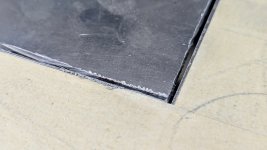
I used an angle grinder with a cutting wheel for the cutout. Although this method is basic, success is achievable with careful layout, slow cutting, and conservative cuts inside the final dimensions. Spending thirty minutes filing to achieve the final dimensions is preferable to removing too much material during the initial cut.
Given my focus on human factors and user-machine interaction, I carefully considered every aspect of the system’s design. Initially, I planned to position the Wallas unit several inches to the right, but after spending a few days in the camper with the Zarges K470 case temporarily in place, I realized the case’s edge served as a comfortable armrest. Consequently, I shifted the cutout several inches to the left to preserve space for my forearm when seated. Such details require time to identify, and overlooking this minor benefit would have been unfortunate.
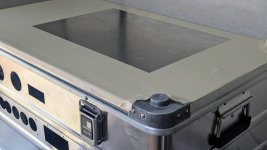
The Wallas unit fit precisely with minimal movement in any direction. The unit is shown with the lid raised, functioning as a cooktop, with the primary burner on the left and a secondary burner on the right used for simmering.

The unit is shown with the lid lowered, operating as a heater. A fan beneath the unit draws air from the rear, passes it over the heated surface, and exhausts it through the front. With a variable output of 3,000 to 6,400 BTU/h, the heater ensures the camper remains comfortable in extreme weather conditions.

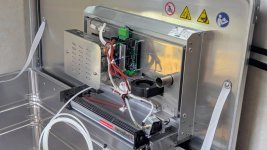
The image shows the underside of the Wallas unit with the lid open. Routing the power wires and fuel line should pose no challenges. However, I have explored multiple exhaust configurations and have not yet finalized a solution due to ongoing component rearrangements. Ideally, the 28 mm stainless steel exhaust hose, encased in a 30 mm fiberglass insulator, would remain connected when opening and closing the lid. This seems unlikely, though. Fortunately, the lid will only be opened every three to six months for inspection and maintenance.
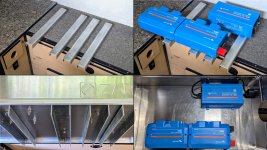
Another challenging aspect of this project was the installation site for the Zarges K470 case, which has two distinct heights and depths. The upper-left image shows the hard surface on the left, which is 3/4 inch higher than the carpeted surface on the right. Additionally, the hard surface is deeper than required, while the carpeted section is too shallow. These differences caused the K470 case to sit unevenly and overhang, prompting me to address the issue while reinforcing the case’s internal suspended floor.
The upper-right image shows the test fitting of the aluminum C-channel aligned with the component mounts. A chance encounter with a friend, a fabricator at Hampton Sheet Metal, led to a quick design sketch on a napkin, and I collected the fabricated parts the next morning. The lower-left image shows the C-channel installed, and the lower-right image shows the components securely bolted in place.
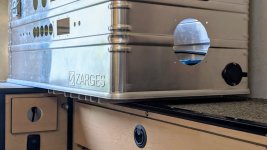
This image provides a clearer view of the aluminum C-channel functioning as cantilever beams. These beams serve two primary purposes: (1) they transfer the 24-pound weight of the three internal components directly to the underlying surface, and (2) they support the section of the case extending beyond the carpeted shelf. In a static environment, the case alone could likely support the load, but this installation, located just behind the rear axle, must withstand the dynamic forces of rough, bumpy trails.
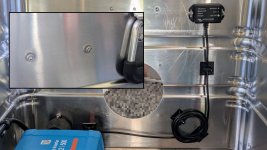
All Victron Energy components feature Bluetooth connectivity and communicate via the VE.Direct network, except for the inverter. Approximately one month ago, I purchased a Bluetooth Smart Dongle to enable the inverter to connect with other components and allow performance monitoring.
The smallest available socket head cap screw I had available, an 8-32 x 3/4, was a tight fit in the mounting slot. Using a small round precision file, I enlarged the slot to allow the screw to pass through easily.

The main image shows the Bluetooth Smart Dongle mounted inside the case, connected to the inverter in the lower left. An inset image displays the 8-32 screw heads and washers on the case’s exterior. This week, I will focus on mounting the remaining Victron Energy components, finalizing the wire and pass-through layout, and starting the wiring process.
At this point in the project, the thrill is gone. Endless revisions? As men we must lean forward and soldier through the chaos.
Aluminum is easy to work with, so I marked the corners, measured diagonals between non-adjacent corners to confirm 90° angles, scribed lines between corners, and applied masking tape around the perimeter. Since I was performing a manual layout and cutting freehand, I left extra material outside the scribed lines to allow for manual cleanup to the final dimensions.
I used an angle grinder with a cutting wheel for the cutout. Although this method is basic, success is achievable with careful layout, slow cutting, and conservative cuts inside the final dimensions. Spending thirty minutes filing to achieve the final dimensions is preferable to removing too much material during the initial cut.
Given my focus on human factors and user-machine interaction, I carefully considered every aspect of the system’s design. Initially, I planned to position the Wallas unit several inches to the right, but after spending a few days in the camper with the Zarges K470 case temporarily in place, I realized the case’s edge served as a comfortable armrest. Consequently, I shifted the cutout several inches to the left to preserve space for my forearm when seated. Such details require time to identify, and overlooking this minor benefit would have been unfortunate.
The Wallas unit fit precisely with minimal movement in any direction. The unit is shown with the lid raised, functioning as a cooktop, with the primary burner on the left and a secondary burner on the right used for simmering.
The unit is shown with the lid lowered, operating as a heater. A fan beneath the unit draws air from the rear, passes it over the heated surface, and exhausts it through the front. With a variable output of 3,000 to 6,400 BTU/h, the heater ensures the camper remains comfortable in extreme weather conditions.
The image shows the underside of the Wallas unit with the lid open. Routing the power wires and fuel line should pose no challenges. However, I have explored multiple exhaust configurations and have not yet finalized a solution due to ongoing component rearrangements. Ideally, the 28 mm stainless steel exhaust hose, encased in a 30 mm fiberglass insulator, would remain connected when opening and closing the lid. This seems unlikely, though. Fortunately, the lid will only be opened every three to six months for inspection and maintenance.
Another challenging aspect of this project was the installation site for the Zarges K470 case, which has two distinct heights and depths. The upper-left image shows the hard surface on the left, which is 3/4 inch higher than the carpeted surface on the right. Additionally, the hard surface is deeper than required, while the carpeted section is too shallow. These differences caused the K470 case to sit unevenly and overhang, prompting me to address the issue while reinforcing the case’s internal suspended floor.
The upper-right image shows the test fitting of the aluminum C-channel aligned with the component mounts. A chance encounter with a friend, a fabricator at Hampton Sheet Metal, led to a quick design sketch on a napkin, and I collected the fabricated parts the next morning. The lower-left image shows the C-channel installed, and the lower-right image shows the components securely bolted in place.
This image provides a clearer view of the aluminum C-channel functioning as cantilever beams. These beams serve two primary purposes: (1) they transfer the 24-pound weight of the three internal components directly to the underlying surface, and (2) they support the section of the case extending beyond the carpeted shelf. In a static environment, the case alone could likely support the load, but this installation, located just behind the rear axle, must withstand the dynamic forces of rough, bumpy trails.
All Victron Energy components feature Bluetooth connectivity and communicate via the VE.Direct network, except for the inverter. Approximately one month ago, I purchased a Bluetooth Smart Dongle to enable the inverter to connect with other components and allow performance monitoring.
The smallest available socket head cap screw I had available, an 8-32 x 3/4, was a tight fit in the mounting slot. Using a small round precision file, I enlarged the slot to allow the screw to pass through easily.
The main image shows the Bluetooth Smart Dongle mounted inside the case, connected to the inverter in the lower left. An inset image displays the 8-32 screw heads and washers on the case’s exterior. This week, I will focus on mounting the remaining Victron Energy components, finalizing the wire and pass-through layout, and starting the wiring process.
At this point in the project, the thrill is gone. Endless revisions? As men we must lean forward and soldier through the chaos.
Last edited:
@ramblinChet I'm considering a regular cab build for camper and had a few questions. How are you using the storage space behind the seats? Anything particular you like to store there? Early on I know you said you kept your recovery bag on the passenger footwell, I wouldn't have that option since my wife will be traveling with me.
Is there a noticeable difference in maneuverability from your friend with the Power Wagon and camper because of the wheelbase and overall length? How about the difference in the stability between the 2 setups? I know that the PW doesn't have much payload capacity and a lot of people complain about the coil spring setup when it comes to campers.
Is there a noticeable difference in maneuverability from your friend with the Power Wagon and camper because of the wheelbase and overall length? How about the difference in the stability between the 2 setups? I know that the PW doesn't have much payload capacity and a lot of people complain about the coil spring setup when it comes to campers.

Pearce
Well-Known Member
I am currently working on installing a 12" Garmin MFD flush on the dash of my friends boat. The boat's dash is literally the same outside vertical dimensions as the unit. Except the dash is curved at the top and bottom. The only way to make it fit correctly was to space the unit 1/2" off the dash with Starboard. Then many hours of gently refining the openings with a flapper wheel. And 2 hours of just getting the bottom back side edge of the starboard radiused to sit flush with the dash curve. A combination of hardware provided with the unit and my own selection of hardware. Not 100% with it yet but the cutting and flap wheel are done. I was channeling my inner Chet to be careful and precise 
ramblinChet
Drinks Alone
- Messages
- 650
- Reaction score
- 3,120
- Points
- 93
@ramblinChet I'm considering a regular cab build for camper and had a few questions. How are you using the storage space behind the seats? Anything particular you like to store there? Early on I know you said you kept your recovery bag on the passenger footwell, I wouldn't have that option since my wife will be traveling with me.
Is there a noticeable difference in maneuverability from your friend with the Power Wagon and camper because of the wheelbase and overall length? How about the difference in the stability between the 2 setups? I know that the PW doesn't have much payload capacity and a lot of people complain about the coil spring setup when it comes to campers.
Thanks for the questions, @ajn507! Payload is the critical factor in a camper build - far more important than cab type, wheelbase, or other specs. I’ve never heard anyone at a campfire wish they’d chosen a Power Wagon or a regular cab for lockers or wheelbase. The real struggle is always payload. Many try airbags or stiffer springs, but issues persist. My solution? A 3500 single-rear-wheel with a Hemi.
Start with a payload spreadsheet: list your camper’s weight (say, 1,500 lbs average), passengers, fridge contents, water, fuel, recovery gear, tools, clothes, and essentials. Total it up—let’s say 1,000 lbs for gear and people, so 2,500 lbs base payload. Add a 15% safety margin for future additions (2,500 × 1.15 = 2,875 lbs). Crucially, aim to use only 50-75% of your truck’s payload capacity to avoid overtaxing systems not designed for continuous max loads. For 2,875 lbs, your truck needs 3,833–5,750 lbs capacity (2,875 ÷ 0.75 or 0.50). A Power Wagon’s 1,600-lb payload falls short. My 3500 had 4,590 lbs before the AEV Prospector upgrade, though larger tires and lift reduce this slightly. I’ve met plenty of 2500 owners with campers who regret not going 3500, but never the reverse.
This is the storage behind my regular cab’s front seat:
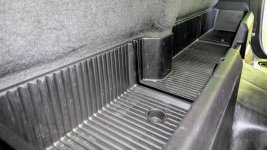
For storage behind my regular cab’s front seat, I keep (left to right, top to bottom):
- AEV Off-Road Jack Base
- Longacre Racing Magnum 3 ½” Tire Gauge
- Midland GXT67 PRO GMRS 5-Watt Walkie Talkie
- ARB Speedy Seal Tire Repair Kit
- GlueTread Full-Size Sidewall Kit
- Kishigo Premium Black Series Soft Shell Jacket
- Kishigo Premium Black Series Heavy Duty Vest
- Deadman Off-Road RUGGEDIZED Deadman V2
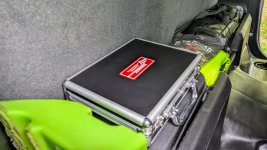
On wheelbase and maneuverability, these are minor concerns for overlanding compared to payload. As for stability, leaf springs (standard on 3500s) outperform coils (on 2500s) due to higher payload capacity and wider spacing, which improves leverage against camper weight. Your setup - regular cab, 2500, or 3500 - depends on travel frequency and destinations. What are you considering?
Last edited:
@ramblinChet Thanks for the repsonse. I would only consider a 3500 for the reasons you stated. I'm leaning towards the reg cab over the crew cab short bed just because it is a little shorter and will be easier to manuever. But the crew cab gives me more storage space. I know I don't want a crew cab long bed, its just too long. My offroad experience has been limited to my 392 Wrangler with a rooftop tent. I've owned crew cab and reg cab trucks but never used them offroad. I would be leaning towards an OEV pop up camper.
ramblinChet
Drinks Alone
- Messages
- 650
- Reaction score
- 3,120
- Points
- 93
@ramblinChet Thanks for the repsonse. I would only consider a 3500 for the reasons you stated. I'm leaning towards the reg cab over the crew cab short bed just because it is a little shorter and will be easier to manuever. But the crew cab gives me more storage space. I know I don't want a crew cab long bed, its just too long. My offroad experience has been limited to my 392 Wrangler with a rooftop tent. I've owned crew cab and reg cab trucks but never used them offroad. I would be leaning towards an OEV pop up camper.
It sounds like you have performing much research and optimizing for your intended use - excellent! One of the key decisions I had to make was regular cab long bed or crew cab short bed - I planned on spending most of my time camping so the additional space in the camper was much more valuable to me. The OEV is an amazing camper - I spent time with a buddy out in Arizona over a year ago that owned one and I was very impressed with his camper.
ramblinChet
Drinks Alone
- Messages
- 650
- Reaction score
- 3,120
- Points
- 93
The next component installed was the Victron Energy Blue Smart IP22 Charger 12/30 (1), intended for occasional use at campgrounds or locations with shore power. The inset picture highlights a design flaw: the 120-volt AC cable is centered directly over the mounting foot, just 0.5 inches above it. This positioning complicates installation in tight spaces, as it restricts the types of fasteners and tools that can be used.
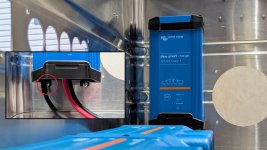
While securing the SmartSolar MPPT 100/30 Charge Controller with 18-8 stainless steel bolts and nylon lock nuts, I encountered galling and cold welding, requiring me to cut off one fastener and replace it. Galling, a type of adhesive wear, occurs when similar metal surfaces, such as 18-8 stainless steel, slide under pressure, leading to material transfer, surface damage, or seizing. Cold welding, a related phenomenon, involves atomic-level bonding of clean metal surfaces under high pressure without heat, exacerbating galling.

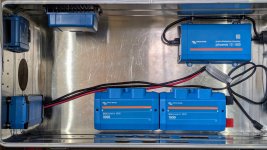
A top-down view shows all primary components installed. In the upper-right corner is a Phoenix 500-watt inverter. Below, center and right, are two Lynx Power In units equipped with MEGA fuses. The lower-left houses the IP22 Charger, while the upper-left features an Orion XS DC-DC charger, with the SmartSolar MPPT 100/30 Charge Controller just to its right. This layout differs from my latest drawing to provide a resting spot for my arm while seated, shifting the Wallas cooktop and heater 3-4 inches and necessitating internal reconfiguration.
To evaluate usability, I’ve kept the Zarges K470 box inside my camper for weeks without permanent installation. This allowed me to test interactions, such as sitting on the driver’s side or climbing into bed when extended. Given the time spent in the camper, addressing these minor details early prevents significant issues.
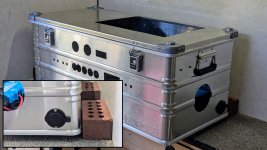
King bricks served as perfect spacers, positioning the K470 case 3.5 inches from the camper’s interior walls for three reasons: (1) to keep the lid open when lifted, (2) to ensure ventilation for the nearby fan, and (3) to enhance aesthetics by adding depth.
This picture shows the lid open with the Wallas Nordic DT temporarily installed, illustrating the increasingly confined space.To my knowledge, no one has previously integrated an entire electrical suite with a diesel cooktop and heater in a Zarges K470 case. Calculations suggest feasibility, but real-world testing across various climates will determine success or failure.

Reconfiguring the interior layout provided additional space for the solar charger and flexibility for a potential upgrade to a larger unit. While not anticipated, this option is valuable.
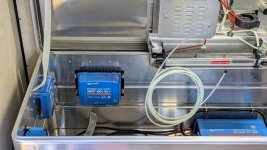
A side view with the lid closed reveals my concern about placing a diesel cooktop and heater above electrical components in the same case. Calculations support this setup, but a heat shield may be added if necessary. Wiring, fuel, and exhaust lines remain to be completed.
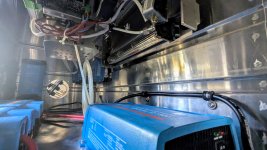
Wire congestion on the left side of the case led me to relocate some wiring to the unused right side, adding complexity. Initially, all electrical lines were to drop directly into the battery compartment on the left. Now, positive and negative lines drop on the right, where the case overhangs, into a narrow compartment beside the battery compartment. Pilot holes were drilled for Blue Sea Systems Feed Through Connections to facilitate this, with the inset picture showing precise alignment with camper holes despite tight spacing.
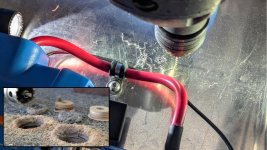
A nearly completed section shows the feed-through connectors on the bottom left, with the negative line running via Ancor 4 AWG wire to the Lynx Power In. On the positive side, a Victron Energy Smart BatteryProtect 12-volt 100-amp isolates the Blue Sea Systems ST Blade Fuse Block, enabling shutdown of connected devices (lights, fan, refrigerator, USB chargers) via a switch or Bluetooth. This preserves house batteries during extended parking by eliminating parasitic loads. An inset picture shows me crimping an Ancor 3/8" 4 AWG lug onto Ancor 4 AWG wire, emphasizing the value of proper tools.

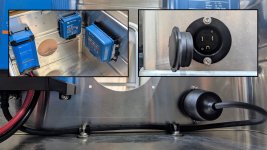
The 120-volt AC input, feeding shore power to the IP22 charger, connects to a storm-proof NOCO AC plug previously installed on the camper’s rear. The main picture shows the AC line running from the right-side plug to the left-side charger, secured by vibration-damping rubber loop clamps. Inset pictures depict the pre-installation area and the external input. My commitment to precise component alignment and tidy wiring reflects a professional approach, where attention to detail ensures quality. In my opinion, that's the way you do it...
While securing the SmartSolar MPPT 100/30 Charge Controller with 18-8 stainless steel bolts and nylon lock nuts, I encountered galling and cold welding, requiring me to cut off one fastener and replace it. Galling, a type of adhesive wear, occurs when similar metal surfaces, such as 18-8 stainless steel, slide under pressure, leading to material transfer, surface damage, or seizing. Cold welding, a related phenomenon, involves atomic-level bonding of clean metal surfaces under high pressure without heat, exacerbating galling.
A top-down view shows all primary components installed. In the upper-right corner is a Phoenix 500-watt inverter. Below, center and right, are two Lynx Power In units equipped with MEGA fuses. The lower-left houses the IP22 Charger, while the upper-left features an Orion XS DC-DC charger, with the SmartSolar MPPT 100/30 Charge Controller just to its right. This layout differs from my latest drawing to provide a resting spot for my arm while seated, shifting the Wallas cooktop and heater 3-4 inches and necessitating internal reconfiguration.
To evaluate usability, I’ve kept the Zarges K470 box inside my camper for weeks without permanent installation. This allowed me to test interactions, such as sitting on the driver’s side or climbing into bed when extended. Given the time spent in the camper, addressing these minor details early prevents significant issues.
King bricks served as perfect spacers, positioning the K470 case 3.5 inches from the camper’s interior walls for three reasons: (1) to keep the lid open when lifted, (2) to ensure ventilation for the nearby fan, and (3) to enhance aesthetics by adding depth.
This picture shows the lid open with the Wallas Nordic DT temporarily installed, illustrating the increasingly confined space.To my knowledge, no one has previously integrated an entire electrical suite with a diesel cooktop and heater in a Zarges K470 case. Calculations suggest feasibility, but real-world testing across various climates will determine success or failure.
Reconfiguring the interior layout provided additional space for the solar charger and flexibility for a potential upgrade to a larger unit. While not anticipated, this option is valuable.
A side view with the lid closed reveals my concern about placing a diesel cooktop and heater above electrical components in the same case. Calculations support this setup, but a heat shield may be added if necessary. Wiring, fuel, and exhaust lines remain to be completed.
Wire congestion on the left side of the case led me to relocate some wiring to the unused right side, adding complexity. Initially, all electrical lines were to drop directly into the battery compartment on the left. Now, positive and negative lines drop on the right, where the case overhangs, into a narrow compartment beside the battery compartment. Pilot holes were drilled for Blue Sea Systems Feed Through Connections to facilitate this, with the inset picture showing precise alignment with camper holes despite tight spacing.
A nearly completed section shows the feed-through connectors on the bottom left, with the negative line running via Ancor 4 AWG wire to the Lynx Power In. On the positive side, a Victron Energy Smart BatteryProtect 12-volt 100-amp isolates the Blue Sea Systems ST Blade Fuse Block, enabling shutdown of connected devices (lights, fan, refrigerator, USB chargers) via a switch or Bluetooth. This preserves house batteries during extended parking by eliminating parasitic loads. An inset picture shows me crimping an Ancor 3/8" 4 AWG lug onto Ancor 4 AWG wire, emphasizing the value of proper tools.
The 120-volt AC input, feeding shore power to the IP22 charger, connects to a storm-proof NOCO AC plug previously installed on the camper’s rear. The main picture shows the AC line running from the right-side plug to the left-side charger, secured by vibration-damping rubber loop clamps. Inset pictures depict the pre-installation area and the external input. My commitment to precise component alignment and tidy wiring reflects a professional approach, where attention to detail ensures quality. In my opinion, that's the way you do it...
Last edited:
ramblinChet
Drinks Alone
- Messages
- 650
- Reaction score
- 3,120
- Points
- 93
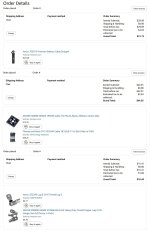
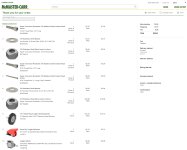
The last photo in my previous post showed a 120-volt AC input feeding shore power to the IP22 charger, so I wanted to capture my expenses associated with that input, along with two other feed-through studs I ordered.

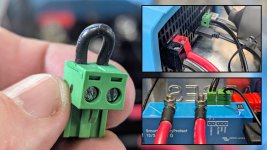
One of the many small details I appreciate about Victron Energy components is the push-in terminal blocks. It’s great to securely mount the component, pull out the small terminal block to connect 16 AWG wires securely, and then push the terminal block back into place. This often makes an otherwise difficult job in a congested space much easier. Perhaps they could consider offering the same for larger wires someday?
The inset pictures show push-in terminal blocks used on the Phoenix Inverter and Smart BatteryProtect. I’m using the 100-amp BatteryProtect in an unusual but valuable way: if I flip a remote toggle switch to the ON position, the BatteryProtect shuts down and stops exporting power to the 100-amp fuse block that powers lights, fans, refrigerators, etc. This allows me to eliminate all parasitic power for long-term storage with a single switch.
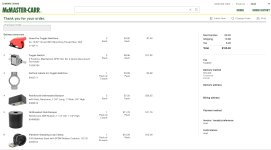
At this point in my project, time is more critical than money, so if I need a few parts, I don’t hesitate to order them. I’m using more 10-32 3/4" socket head screws than anticipated, but fortunately, the nuts and washers were sold in packs of 50 and 100, respectively, so I have enough remaining. The need for a single-pole-double-throw (SPDT) toggle switch arose from a mistake I made with the Smart BatteryProtect’s operation. I misread the Victron Energy manual and tried using a SPST toggle switch, which didn’t work as intended. This order fixed my error, and now I have a spare SPST toggle.

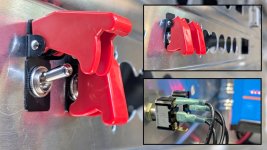
Toggle switches (3) and (4) are installed and operational. Following my aircraft cockpit layout design, these switches are grouped because they manage power to components. Toggle switch (3) activates the Phoenix Inverter when I plan to use it, which will be occasional. The inverter has a zero-load power consumption of 6 watts and can be set to ECO mode, consuming 1 watt while “waking up” every 2.5 seconds to check for a load. Neither is significant, but power consumption across multiple components adds up quickly. Toggle switch (4) deactivates the Smart BatteryProtect for long-term storage when flipped to the ON position. In the normal OFF position, it allows the BatteryProtect to export power to the fuse block mentioned earlier.
The top inset picture shows both switches in their normal position. Before leaving a campsite and hitting the trail, I aim to visually check that all switches are down in their normal position. If one is left on by accident, the safety cover will protrude and alert me. The covers also protect the switches from being bumped into an undesired position as I move around the camper. The bottom inset picture shows the backside of toggles (3) and (4), along with Ancor 16 AWG wire and nylon fully insulated disconnects.
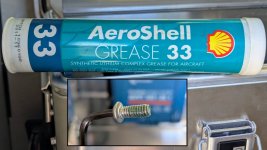
In my last post, I mentioned occasional galling and cold-welding issues with 18-8 stainless steel nuts and bolts during installation. Earlier this week, a close friend who worked with me at NASA LaRC suggested filling the initial threads on the bolt with grease to prevent this issue. In my shop, I had a tube of AeroShell 33 synthetic lithium grease, so I reviewed its specifications and decided it would work well. This grease has a wide temperature range, but its key feature for me was its benefit for sliding applications requiring molybdenum disulfide. Lubricating just the tip is sufficient when dealing with tight tolerances or forced insertion.
One of the first components to receive power was the Blue Smart IP22 Charger, and it felt great to connect it to the Lynx Power In bus bars, upgraded with MEGA fuses. I’m keeping the area between the charger and bus bar as open as possible since it will soon become congested. The inset picture shows a Fluke ST120 GFCI Socket Tester confirming the circuit is correct. These inexpensive testers are essential, as they instantly indicate issues like an open ground or reversed hot and neutral wires.

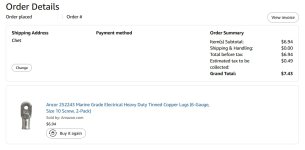
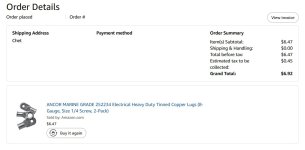
I’m not a fan of Amazon and never considered subscribing to Amazon Prime, but a few months ago, I realized I’d be ordering many small, inexpensive items for this project and needed them delivered within a day or two. I plan to cancel my membership once the project is complete, but the subscription has been helpful, as I’m not concerned about shipping costs or delivery times. In this case, I needed an odd-sized Ancor lug to connect 6 AWG wire to a #10 screw. I placed the order, and hours later, the part was delivered to my home.
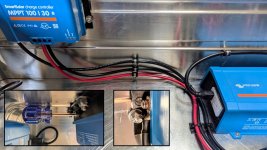
The next component connected was the SmartSolar MPPT 100/30 Solar Charge Controller. An MPPT (Maximum Power Point Tracking) solar charge controller optimizes power output from solar panels by dynamically adjusting voltage and current to match the battery’s charging needs. This unit is installed between the solar panels and the battery (bus bar).
The lower-left inset picture illustrates my luck, as I didn’t calculate the screwdriver’s length to ensure just enough room between components for it to fit. A properly engineered system would include such details, but since this is a one-off creation and I expected tight spaces, I left a reasonable amount of room, saving time on additional calculations and fitting. This is for the chassis ground, and the other inset picture shows the 6 AWG wire installed with a #10 screw. I could have used a slightly smaller 8 AWG wire, but some locations may require the chassis ground to match the largest wire in the system, so I chose to avoid potential issues and set a good example.
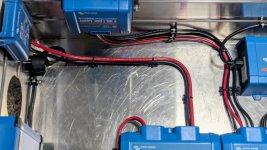
In closing, here is a picture of the Lynx Power In #2, upgraded with MEGA fuses and now fully occupied.
From left to right:

One of the many small details I appreciate about Victron Energy components is the push-in terminal blocks. It’s great to securely mount the component, pull out the small terminal block to connect 16 AWG wires securely, and then push the terminal block back into place. This often makes an otherwise difficult job in a congested space much easier. Perhaps they could consider offering the same for larger wires someday?
The inset pictures show push-in terminal blocks used on the Phoenix Inverter and Smart BatteryProtect. I’m using the 100-amp BatteryProtect in an unusual but valuable way: if I flip a remote toggle switch to the ON position, the BatteryProtect shuts down and stops exporting power to the 100-amp fuse block that powers lights, fans, refrigerators, etc. This allows me to eliminate all parasitic power for long-term storage with a single switch.
At this point in my project, time is more critical than money, so if I need a few parts, I don’t hesitate to order them. I’m using more 10-32 3/4" socket head screws than anticipated, but fortunately, the nuts and washers were sold in packs of 50 and 100, respectively, so I have enough remaining. The need for a single-pole-double-throw (SPDT) toggle switch arose from a mistake I made with the Smart BatteryProtect’s operation. I misread the Victron Energy manual and tried using a SPST toggle switch, which didn’t work as intended. This order fixed my error, and now I have a spare SPST toggle.
Toggle switches (3) and (4) are installed and operational. Following my aircraft cockpit layout design, these switches are grouped because they manage power to components. Toggle switch (3) activates the Phoenix Inverter when I plan to use it, which will be occasional. The inverter has a zero-load power consumption of 6 watts and can be set to ECO mode, consuming 1 watt while “waking up” every 2.5 seconds to check for a load. Neither is significant, but power consumption across multiple components adds up quickly. Toggle switch (4) deactivates the Smart BatteryProtect for long-term storage when flipped to the ON position. In the normal OFF position, it allows the BatteryProtect to export power to the fuse block mentioned earlier.
The top inset picture shows both switches in their normal position. Before leaving a campsite and hitting the trail, I aim to visually check that all switches are down in their normal position. If one is left on by accident, the safety cover will protrude and alert me. The covers also protect the switches from being bumped into an undesired position as I move around the camper. The bottom inset picture shows the backside of toggles (3) and (4), along with Ancor 16 AWG wire and nylon fully insulated disconnects.
In my last post, I mentioned occasional galling and cold-welding issues with 18-8 stainless steel nuts and bolts during installation. Earlier this week, a close friend who worked with me at NASA LaRC suggested filling the initial threads on the bolt with grease to prevent this issue. In my shop, I had a tube of AeroShell 33 synthetic lithium grease, so I reviewed its specifications and decided it would work well. This grease has a wide temperature range, but its key feature for me was its benefit for sliding applications requiring molybdenum disulfide. Lubricating just the tip is sufficient when dealing with tight tolerances or forced insertion.
One of the first components to receive power was the Blue Smart IP22 Charger, and it felt great to connect it to the Lynx Power In bus bars, upgraded with MEGA fuses. I’m keeping the area between the charger and bus bar as open as possible since it will soon become congested. The inset picture shows a Fluke ST120 GFCI Socket Tester confirming the circuit is correct. These inexpensive testers are essential, as they instantly indicate issues like an open ground or reversed hot and neutral wires.
I’m not a fan of Amazon and never considered subscribing to Amazon Prime, but a few months ago, I realized I’d be ordering many small, inexpensive items for this project and needed them delivered within a day or two. I plan to cancel my membership once the project is complete, but the subscription has been helpful, as I’m not concerned about shipping costs or delivery times. In this case, I needed an odd-sized Ancor lug to connect 6 AWG wire to a #10 screw. I placed the order, and hours later, the part was delivered to my home.
The next component connected was the SmartSolar MPPT 100/30 Solar Charge Controller. An MPPT (Maximum Power Point Tracking) solar charge controller optimizes power output from solar panels by dynamically adjusting voltage and current to match the battery’s charging needs. This unit is installed between the solar panels and the battery (bus bar).
The lower-left inset picture illustrates my luck, as I didn’t calculate the screwdriver’s length to ensure just enough room between components for it to fit. A properly engineered system would include such details, but since this is a one-off creation and I expected tight spaces, I left a reasonable amount of room, saving time on additional calculations and fitting. This is for the chassis ground, and the other inset picture shows the 6 AWG wire installed with a #10 screw. I could have used a slightly smaller 8 AWG wire, but some locations may require the chassis ground to match the largest wire in the system, so I chose to avoid potential issues and set a good example.
In closing, here is a picture of the Lynx Power In #2, upgraded with MEGA fuses and now fully occupied.
From left to right:
- SmartSolar Charge Controller
- 6 AWG positive and negative
- 6 AWG chassis ground
- Phoenix 12/500 Inverter
- 4 AWG chassis ground
- 6 AWG positive and negative
- Smart BatteryProtect 100-amp
- 4 AWG positive and negative
ramblinChet
Drinks Alone
- Messages
- 650
- Reaction score
- 3,120
- Points
- 93
The final major component installed in the revised electrical system is the Victron Energy Orion XS 12/12-50 DC-DC Charger. This unit draws 50 amps from the engine alternators while driving to charge the 200 Ah house batteries in my camper. Theoretically, if the batteries are nearly depleted, driving for about four hours could fully charge them. As with all components in this project, I’ve used the largest wire possible, in this case 4 AWG, to minimize voltage loss.
When specifying this truck, I anticipated installing a DC-DC charger, which led me to opt for dual alternators rated at 380 amps for $295 - a great value, in my opinion.
I recently ordered some tools and supplies for this project, and I highly recommend investing in specialized tools. The Ancor Premium Battery Cable Stripper is a great tool, eliminating the struggle of carefully cutting insulation without damaging the wire’s fine strands.
While Ancor Cable Tie Mounts and Thomas & Betts Cable Ties cost more than some alternatives, I’ve never understood why builders pair premium components with cheap wires, lugs, or ties. Budget options are fine if they work for you, but I’ve been living in this camper for years and plan to continue. My priority is securing components and wires to prevent loosening and potential fire hazards. Quality is worth the extra cost - for me and for you.
Early in the project, I tried listing the wire lugs I’d need, but the task was overwhelming. Instead, I purchased an Ancor 100-piece Tinned Copper Lug Kit and a 47-piece Adhesive Lined Heat Shrink Tubing Kit. These kits offer flexibility in selecting the right lug for each application, and I can easily reorder when supplies run low.
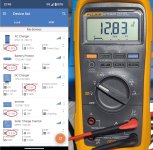
The Victron Connect app on my phone provides real-time monitoring of all components, which is incredibly convenient. Initially, I noticed slight voltage variations in the app, while my Fluke 77V MAX showed consistent readings at the wire terminals. After consulting the Victron Energy Community Knowledge Base, I learned that activating the BMV-712 Smart Battery Monitor will enable VE.Smart Networking, allowing components to share a common battery voltage and temperature reference.
Next, I ran positive and negative 1/0 AWG wires to the battery, air compressor, and chassis ground, connecting the Lynx Power In to Blue Sea Systems 3/8" Feed Through Connectors. I’ve been quiet lately because this section was challenging - space was tight, and I still have three Feed Through Connectors to install. I meticulously planned the box size, component layout, heat generation, and cooling needs but underestimated the space required for the wires. The Vibration-Damping Loop Clamps and Cable Tie Mounts consumed more room than expected.
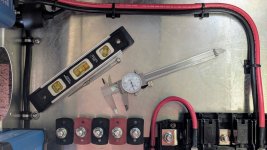
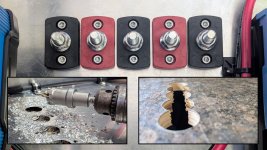
Space was so limited that I flipped the box to map the layout on the backside after drilling a pilot hole. Precision was critical - an 1/8" misalignment could jeopardize the project. I prefer a larger safety margin, but this was cutting it close.

Thankfully, everything turned out better than expected! Photos may suggest ample space, but the wide-angle lens distorts reality. The gap between Feed Through Connectors is a precise 0.075", perfectly uniform. The outer connectors appear misaligned due to lens distortion and proximity.
One inset photo shows me drilling 24mm holes, hoping for success - once metal is removed, there’s no going back. Another shows 38mm holes below, allowing wires to pass into the battery compartment.
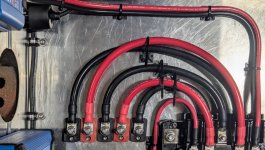
Five 1/0 AWG wires are laid out for reference, with Feed Through Connectors and zip ties loosely placed for test fitting. Once permanently installed, they’ll be secured tightly, helping me gauge space for additional wiring.
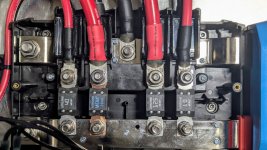
Here is a picture of the Lynx Power In #1, upgraded with MEGA fuses and now fully occupied.
From left to right:
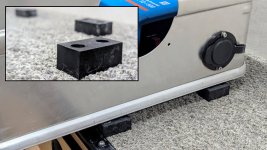
I’ve begun using recently ordered parts, including Reinforced Untreated Bumpers to support the box’s perimeter where it doesn’t contact the surface below. Neoprene is ideal for equipment exposed to sunlight, rain, and ozone, and is commonly used in industrial vehicles and heavy machinery. I chose these bumpers for their high hardness (Durometer 80A) and temperature range (-40 to 200°F).
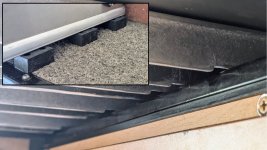
An inset photo shows me test-fitting three bumpers. The aluminum C-channel needed slight relief because the ledge’s 90° steel edge trim contrasted with the softer outdoor carpet, causing a minor imbalance. The reliefs resolved this, and all is well.
Progress continues daily, but on nights like this, I sometimes pause and wonder: where do we go now?
When specifying this truck, I anticipated installing a DC-DC charger, which led me to opt for dual alternators rated at 380 amps for $295 - a great value, in my opinion.
I recently ordered some tools and supplies for this project, and I highly recommend investing in specialized tools. The Ancor Premium Battery Cable Stripper is a great tool, eliminating the struggle of carefully cutting insulation without damaging the wire’s fine strands.
While Ancor Cable Tie Mounts and Thomas & Betts Cable Ties cost more than some alternatives, I’ve never understood why builders pair premium components with cheap wires, lugs, or ties. Budget options are fine if they work for you, but I’ve been living in this camper for years and plan to continue. My priority is securing components and wires to prevent loosening and potential fire hazards. Quality is worth the extra cost - for me and for you.
Early in the project, I tried listing the wire lugs I’d need, but the task was overwhelming. Instead, I purchased an Ancor 100-piece Tinned Copper Lug Kit and a 47-piece Adhesive Lined Heat Shrink Tubing Kit. These kits offer flexibility in selecting the right lug for each application, and I can easily reorder when supplies run low.
The Victron Connect app on my phone provides real-time monitoring of all components, which is incredibly convenient. Initially, I noticed slight voltage variations in the app, while my Fluke 77V MAX showed consistent readings at the wire terminals. After consulting the Victron Energy Community Knowledge Base, I learned that activating the BMV-712 Smart Battery Monitor will enable VE.Smart Networking, allowing components to share a common battery voltage and temperature reference.
Next, I ran positive and negative 1/0 AWG wires to the battery, air compressor, and chassis ground, connecting the Lynx Power In to Blue Sea Systems 3/8" Feed Through Connectors. I’ve been quiet lately because this section was challenging - space was tight, and I still have three Feed Through Connectors to install. I meticulously planned the box size, component layout, heat generation, and cooling needs but underestimated the space required for the wires. The Vibration-Damping Loop Clamps and Cable Tie Mounts consumed more room than expected.
Space was so limited that I flipped the box to map the layout on the backside after drilling a pilot hole. Precision was critical - an 1/8" misalignment could jeopardize the project. I prefer a larger safety margin, but this was cutting it close.
Thankfully, everything turned out better than expected! Photos may suggest ample space, but the wide-angle lens distorts reality. The gap between Feed Through Connectors is a precise 0.075", perfectly uniform. The outer connectors appear misaligned due to lens distortion and proximity.
One inset photo shows me drilling 24mm holes, hoping for success - once metal is removed, there’s no going back. Another shows 38mm holes below, allowing wires to pass into the battery compartment.
Five 1/0 AWG wires are laid out for reference, with Feed Through Connectors and zip ties loosely placed for test fitting. Once permanently installed, they’ll be secured tightly, helping me gauge space for additional wiring.
Here is a picture of the Lynx Power In #1, upgraded with MEGA fuses and now fully occupied.
From left to right:
- Blue Smart IP22 Charger
- 6 AWG positive
- 6 AWG negative
- Main to 200 Ah battery bank
- 1/0 AWG positive
- 1/0 AWG negative
- Chassis ground to vehicle frame
- 1/0 AWG negative
- ExtremeAire Magnum air compressor
- 1/0 AWG positive
- 1/0 AWG negative
- Orion XS 12/12-50 DC-DC Charger
- 4 AWG positive
- 4 AWG negative
I’ve begun using recently ordered parts, including Reinforced Untreated Bumpers to support the box’s perimeter where it doesn’t contact the surface below. Neoprene is ideal for equipment exposed to sunlight, rain, and ozone, and is commonly used in industrial vehicles and heavy machinery. I chose these bumpers for their high hardness (Durometer 80A) and temperature range (-40 to 200°F).
An inset photo shows me test-fitting three bumpers. The aluminum C-channel needed slight relief because the ledge’s 90° steel edge trim contrasted with the softer outdoor carpet, causing a minor imbalance. The reliefs resolved this, and all is well.
Progress continues daily, but on nights like this, I sometimes pause and wonder: where do we go now?
ramblinChet
Drinks Alone
- Messages
- 650
- Reaction score
- 3,120
- Points
- 93
I purchased the National Luna 80L refrigerator in 2019 and used it extensively during the first two years. Since late 2021, it has been running continuously without issues.
I chose this refrigerator primarily for its Danfoss BD35F compressor, manufactured in Denmark. This brushless, variable-speed, hermetically sealed compressor offers rapid cooling, low power consumption, and quiet operation. Secop, a German company, acquired Danfoss but continues to produce the compressor in Denmark. The Danfoss name remains well-regarded in the marine and RV industries, contributing to its widespread recognition.
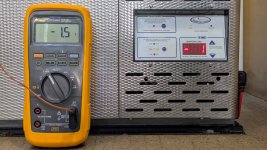
To verify the refrigerator’s temperature accuracy after years of use, I tested it with my Fluke 87V MAX multimeter, equipped with a Type-K thermocouple (-40 to 260 °C). Over an hour, I periodically checked the readings, which consistently matched the refrigerator’s display within 0.5 °C, confirming its reliability. I plan to schedule preventive maintenance in the near future to ensure continued performance.
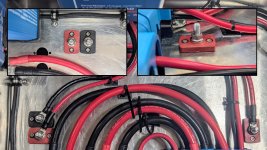
I recently installed the final three feed-through connectors, completing the major electrical components and wiring inside the Zarges K470 case. This milestone is a significant relief, as it concludes the complex internal wiring. Moving forward, most wiring will occur outside the case, with only minor internal connections remaining, allowing greater flexibility in routing.
Next, I drilled mounting holes to secure the case to the camper. The system, weighing approximately 75 pounds, is mounted above the roll axis and will endure off-road conditions. After calculations, I determined that four bolts would suffice but opted for six 3/8-inch bolts for added stability: two into the battery box below, two through the C-channel underneath, and two supported by cylindrical rubber bumpers for the floating floor.
The image shows seven of the ten feed-through connectors extending from the K470 case into the battery box below. Two additional bolts visible at the rear are part of the mounting system described earlier. Five of these feed-throughs will connect to 1/0 AWG wire, completing the power distribution setup.
The inset image depicts a 3/8-inch drill bit breaking through the camper’s overhang above the bed rail, forming one of the mounting holes. My power sources are limited to 200 watts of temporary solar and a 125-volt AC outlet for tools like a drill or vacuum. As all work occurs inside the camper, space is constrained, and supplies are limited.

A hardware store a few miles from my home has been invaluable. My routine involves waking up, eating breakfast, unpacking tools, and working until lunch. As the day heats up, I slow down, pack up, and secure the site. Afterward, I may drive to the store for supplies or visit the library for air-conditioned comfort. In the evening, I often walk at Yorktown Beach for an hour, return to set up camp, and occasionally perform minor tasks.
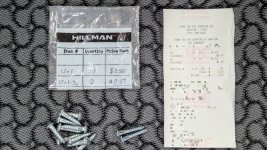
I used ten wood screws, recently purchased, to secure five reinforced untreated bumpers around the K470 case’s perimeter. The mounting setup is complex due to the case’s design: the floating floor, with 0.5 inches of clearance, supports the heaviest components and wiring, requiring reinforcement. The side walls and perimeter hold additional components, including the Wallas Nordic DT and Victron Energy equipment. The mounting surfaces vary, with 45% of the case resting directly on the battery box, 34% 0.875" above a carpeted shelf, and 21% overhanging unsupported space. This requires supporting the floor and perimeter across three horizontal planes for off-road durability.
To minimize shipping costs, I ordered additional supplies, including 2-inch screws for fans and a toggle switch, which will be installed soon. These components will complete the control panel setup.
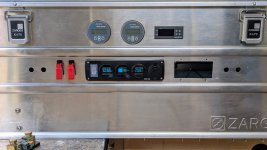
The project’s visible interface is taking shape, inspired by a cockpit design. Critical gauges are arranged across the top row, with secondary gauges and switches grouped below in a top-down, left-to-right layout. This afternoon, I plan to install the final four toggle switches and the Wallas Nordic DT control box, finalizing the control panel. Are you with me so far?
I chose this refrigerator primarily for its Danfoss BD35F compressor, manufactured in Denmark. This brushless, variable-speed, hermetically sealed compressor offers rapid cooling, low power consumption, and quiet operation. Secop, a German company, acquired Danfoss but continues to produce the compressor in Denmark. The Danfoss name remains well-regarded in the marine and RV industries, contributing to its widespread recognition.
To verify the refrigerator’s temperature accuracy after years of use, I tested it with my Fluke 87V MAX multimeter, equipped with a Type-K thermocouple (-40 to 260 °C). Over an hour, I periodically checked the readings, which consistently matched the refrigerator’s display within 0.5 °C, confirming its reliability. I plan to schedule preventive maintenance in the near future to ensure continued performance.
I recently installed the final three feed-through connectors, completing the major electrical components and wiring inside the Zarges K470 case. This milestone is a significant relief, as it concludes the complex internal wiring. Moving forward, most wiring will occur outside the case, with only minor internal connections remaining, allowing greater flexibility in routing.
Next, I drilled mounting holes to secure the case to the camper. The system, weighing approximately 75 pounds, is mounted above the roll axis and will endure off-road conditions. After calculations, I determined that four bolts would suffice but opted for six 3/8-inch bolts for added stability: two into the battery box below, two through the C-channel underneath, and two supported by cylindrical rubber bumpers for the floating floor.
The image shows seven of the ten feed-through connectors extending from the K470 case into the battery box below. Two additional bolts visible at the rear are part of the mounting system described earlier. Five of these feed-throughs will connect to 1/0 AWG wire, completing the power distribution setup.
The inset image depicts a 3/8-inch drill bit breaking through the camper’s overhang above the bed rail, forming one of the mounting holes. My power sources are limited to 200 watts of temporary solar and a 125-volt AC outlet for tools like a drill or vacuum. As all work occurs inside the camper, space is constrained, and supplies are limited.
A hardware store a few miles from my home has been invaluable. My routine involves waking up, eating breakfast, unpacking tools, and working until lunch. As the day heats up, I slow down, pack up, and secure the site. Afterward, I may drive to the store for supplies or visit the library for air-conditioned comfort. In the evening, I often walk at Yorktown Beach for an hour, return to set up camp, and occasionally perform minor tasks.
I used ten wood screws, recently purchased, to secure five reinforced untreated bumpers around the K470 case’s perimeter. The mounting setup is complex due to the case’s design: the floating floor, with 0.5 inches of clearance, supports the heaviest components and wiring, requiring reinforcement. The side walls and perimeter hold additional components, including the Wallas Nordic DT and Victron Energy equipment. The mounting surfaces vary, with 45% of the case resting directly on the battery box, 34% 0.875" above a carpeted shelf, and 21% overhanging unsupported space. This requires supporting the floor and perimeter across three horizontal planes for off-road durability.
To minimize shipping costs, I ordered additional supplies, including 2-inch screws for fans and a toggle switch, which will be installed soon. These components will complete the control panel setup.
The project’s visible interface is taking shape, inspired by a cockpit design. Critical gauges are arranged across the top row, with secondary gauges and switches grouped below in a top-down, left-to-right layout. This afternoon, I plan to install the final four toggle switches and the Wallas Nordic DT control box, finalizing the control panel. Are you with me so far?
ramblinChet
Drinks Alone
- Messages
- 650
- Reaction score
- 3,120
- Points
- 93
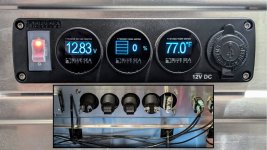
It was time to power up the Blue Sea Systems DC Accessory Panel to confirm everything functioned as expected. As previously noted, the DC voltmeter measures voltage at the 100A ST Blade fuse block, the tank meter monitors the diesel fuel level in my 30-gallon Titan auxiliary tank (which supplies my diesel heater and stove), and the temperature meter tracks the camper’s interior temperature. The two USB ports charge my phone, CR123 batteries for my Surefire flashlight, and other devices. The inset image shows the back of the accessory panel before wiring installation.
I purchased three Ancor products for wiring the back of the accessory panel described above. The double male-female adapters allowed me to connect power and ground to the two center-mounted gauges, which use mini push-in terminal blocks. Initially, I considered 10 AWG wire to maximize connection capacity and bought the appropriate connectors. However, the setup became too congested, so I ordered 25 female disconnects for 16 AWG wire instead. Amazon Prime proved invaluable, delivering the parts the next morning without shipping costs.

Originally, I planned to use the Victron Energy Smart BatteryProtect 12V 65A for another project, but after changing plans, it became available as a relay for the primary power wire to my Wallas Nordic DT diesel stove and heater. The Wallas draws 0.55–0.85 amps during operation but requires 8–10 amps for 5–10 minutes during ignition. The instructions recommend 10–6 AWG wire and states, “A main switch must be installed on the device’s positive (red) cord. Always disconnect power via the main switch after cooling is complete if the device will be unused for an extended period.” Since I had 8 AWG wire available, I used it for a one-foot run. The toggle switches I had were rated for 6 amps maximum, so I opted for the BatteryProtect instead of purchasing a 15-amp switch. This choice also allows me to monitor the Wallas’s energy consumption at various power settings via the Victron Connect app on my phone.
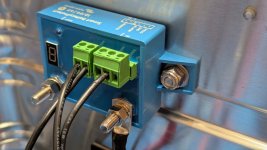
I used Ancor 8 AWG 1/4" screw lugs for the Smart BatteryProtect mentioned above. The convenience of ordering precise components online, with next-day delivery and no shipping fees, greatly simplifies the process.
By now, you may have noticed my enthusiasm for researching components and selecting the best options for my project - a habit developed during my career. For this phase, I needed a cable gland to safely pass multiple smaller wires without risking damage. While waterproofing to 300 feet isn’t necessary, the Sealcon gland I chose offers this capability, along with an operating temperature range of -40°F to 212°F and resistance to salt water, weak acids, weak alkalis, alcohol, esters, ketones, ether, gasoline, and more. I also ordered the Buna-N O-ring and locking nut to complete the setup.

In an earlier order, I purchased a pack of five reinforced unthreaded-hole bumpers to support the suspended floor in my Zarges K470 case. I selected 1-1/4" high bumpers, ideal for two bolts securing the case, but two other bolts required 5/8" bumpers. Instead of ordering an additional pack, I trimmed two bumpers by threading a rod partway into each, securing it in a drill, and using an angle grinder’s cutting wheel to shape the rubber while spinning. This unconventional method worked perfectly for the two bumpers needed.

Previously, I carefully laid out and drilled 24mm holes for the feed-through connectors, leaving 0.075" between each. When permanently installing the connectors, I needed a 0.075"-thick spacer to ensure uniform spacing. While this level of precision may seem minor, I value efficient, high-quality work that adheres to specifications. Spotting my drill set, I realized 5/64" bits (0.078" diameter) would work perfectly for the plastic components - and they did.

With the Wallas control panel and final four toggle switches installed, my project’s front panel was complete. Comparing the finished product to the original design, I’m pleased with the outcome. Thorough planning, multiple iterations, and careful research led to a satisfactory result. My advice: don’t settle on your first idea. Take time, research, consult others, explore options, and refine your plan until you’re confident in the design.
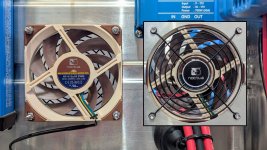
The Noctua fans and their controls are now permanently installed in a push-pull configuration. Based on my calculations, they should provide twice the required cooling volume in the worst-case scenario. As an experiment, I anticipate real-world results may vary slightly. I look forward to measuring and documenting performance over the next few years. The inset image shows a fan from the case’s exterior.
As I test system components, I’m learning to synchronize settings to ensure consistent battery treatment across power sources. Aligning absorption voltage, float voltage, storage voltage, temperature compensation, and low-temperature cut-off optimizes battery health, enhances system efficiency, and simplifies management. This approach minimizes risks like overcharging, undercharging, or temperature-related damage, making it ideal for reliable, long-term battery performance in applications like full-time adventure and exploration. Ah, sometimes I grow so tired, but I know I've got one thing I've got to do...

I purchased three Ancor products for wiring the back of the accessory panel described above. The double male-female adapters allowed me to connect power and ground to the two center-mounted gauges, which use mini push-in terminal blocks. Initially, I considered 10 AWG wire to maximize connection capacity and bought the appropriate connectors. However, the setup became too congested, so I ordered 25 female disconnects for 16 AWG wire instead. Amazon Prime proved invaluable, delivering the parts the next morning without shipping costs.
Originally, I planned to use the Victron Energy Smart BatteryProtect 12V 65A for another project, but after changing plans, it became available as a relay for the primary power wire to my Wallas Nordic DT diesel stove and heater. The Wallas draws 0.55–0.85 amps during operation but requires 8–10 amps for 5–10 minutes during ignition. The instructions recommend 10–6 AWG wire and states, “A main switch must be installed on the device’s positive (red) cord. Always disconnect power via the main switch after cooling is complete if the device will be unused for an extended period.” Since I had 8 AWG wire available, I used it for a one-foot run. The toggle switches I had were rated for 6 amps maximum, so I opted for the BatteryProtect instead of purchasing a 15-amp switch. This choice also allows me to monitor the Wallas’s energy consumption at various power settings via the Victron Connect app on my phone.
I used Ancor 8 AWG 1/4" screw lugs for the Smart BatteryProtect mentioned above. The convenience of ordering precise components online, with next-day delivery and no shipping fees, greatly simplifies the process.
By now, you may have noticed my enthusiasm for researching components and selecting the best options for my project - a habit developed during my career. For this phase, I needed a cable gland to safely pass multiple smaller wires without risking damage. While waterproofing to 300 feet isn’t necessary, the Sealcon gland I chose offers this capability, along with an operating temperature range of -40°F to 212°F and resistance to salt water, weak acids, weak alkalis, alcohol, esters, ketones, ether, gasoline, and more. I also ordered the Buna-N O-ring and locking nut to complete the setup.
In an earlier order, I purchased a pack of five reinforced unthreaded-hole bumpers to support the suspended floor in my Zarges K470 case. I selected 1-1/4" high bumpers, ideal for two bolts securing the case, but two other bolts required 5/8" bumpers. Instead of ordering an additional pack, I trimmed two bumpers by threading a rod partway into each, securing it in a drill, and using an angle grinder’s cutting wheel to shape the rubber while spinning. This unconventional method worked perfectly for the two bumpers needed.
Previously, I carefully laid out and drilled 24mm holes for the feed-through connectors, leaving 0.075" between each. When permanently installing the connectors, I needed a 0.075"-thick spacer to ensure uniform spacing. While this level of precision may seem minor, I value efficient, high-quality work that adheres to specifications. Spotting my drill set, I realized 5/64" bits (0.078" diameter) would work perfectly for the plastic components - and they did.
With the Wallas control panel and final four toggle switches installed, my project’s front panel was complete. Comparing the finished product to the original design, I’m pleased with the outcome. Thorough planning, multiple iterations, and careful research led to a satisfactory result. My advice: don’t settle on your first idea. Take time, research, consult others, explore options, and refine your plan until you’re confident in the design.
The Noctua fans and their controls are now permanently installed in a push-pull configuration. Based on my calculations, they should provide twice the required cooling volume in the worst-case scenario. As an experiment, I anticipate real-world results may vary slightly. I look forward to measuring and documenting performance over the next few years. The inset image shows a fan from the case’s exterior.
As I test system components, I’m learning to synchronize settings to ensure consistent battery treatment across power sources. Aligning absorption voltage, float voltage, storage voltage, temperature compensation, and low-temperature cut-off optimizes battery health, enhances system efficiency, and simplifies management. This approach minimizes risks like overcharging, undercharging, or temperature-related damage, making it ideal for reliable, long-term battery performance in applications like full-time adventure and exploration. Ah, sometimes I grow so tired, but I know I've got one thing I've got to do...
ramblinChet
Drinks Alone
- Messages
- 650
- Reaction score
- 3,120
- Points
- 93
The Noctua NA-FC1 is a compact controller designed for 4-pin PWM fans, enabling manual speed adjustment. By turning the NA-FC1’s speed control dial, users can set a PWM duty cycle from 0% to 100%. When the INKBIRD ITC-1000 Temperature Controller detects excessive heat inside the K470, it signals the NA-FC1 to activate both fans at the pre-set speed. This system is experimental, and I plan to test it under various conditions to determine the optimal fan speed settings.
The NA-FC1 controller is compact, measuring approximately 1.5 inches in length, and lacks mounting holes or tabs. To secure it, I used 3M VHB (Very High Bond) 5952 tape, which can support up to 80 pounds per square inch in static shear. For this application, I considered the dynamic load and applied a safety factor of approximately 4:1, meaning one square inch of tape can reliably hold a 15–20-pound object.

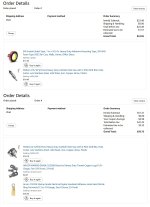
To track expenses for this project, I am documenting all purchases. These include the 3M VHB 5952 tape, a 21mm hole saw used to cut an opening for the Sealcon cable gland (referenced in my previous post), a 67mm hole saw, and several 1/0 AWG lugs and ring terminals.
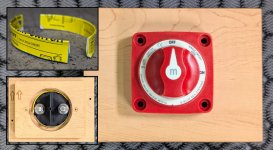
I used the 67mm hole saw to drill a precise hole in the battery box beneath the K470 case for mounting a Blue Sea Systems Manual Battery Switch. This switch allows me to isolate the battery bank from other electronics during maintenance or emergencies. Drilling this hole was challenging because I was enlarging an existing hole, leaving no material to guide the pilot bit.
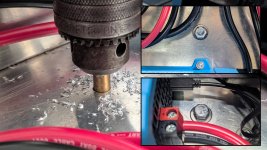
The accompanying image illustrates how I addressed this challenge: I used a scrap piece of wood as a backer to guide the pilot drill. After identifying the center of the existing hole and drilling alignment holes, I attached the backer, drilled a pilot hole to guide the hole saw, and created a perfectly centered hole in the battery box.

After drilling the hole, I test-fitted the battery switch and planned the placement of its four mounting holes. The 67mm hole, as specified by Blue Sea Systems, left a 1mm gap around the switch. To center it precisely, I folded two strips of thin cardboard and inserted them evenly around the switch’s circumference, acting as flexible spacers to ensure perfect alignment.
Additional expenses include socket head bolts and screws for mounting the battery switch. I also purchased two extra screws to prepare for installing the Victron Energy BMV-712 Battery Monitor shunt in the battery box.
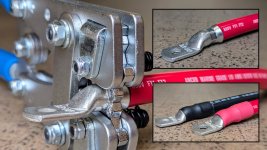
The Ancor Premium Battery Cable Stripper (703075) is designed to strip cables from 8 to 4/0 AWG, making it essential for this project. Its adjustable head optimizes blade depth for cutting through insulation, and a lever rotates the blade 90 degrees to remove the insulation efficiently in one motion.

For this project, I chose the Ancor 8 to 1/0 AWG Hex Lug Crimper, which has consistently produced reliable crimps. Measuring 15.4 inches, it fits easily in my tool bag, making it highly portable. Ancor offers a larger crimper for 8 to 4/0 AWG, but at 24.4 inches, it was unnecessary, as my calculations confirmed that 1/0 AWG wire meets the project’s requirements. The accompanying images show a precise crimp and finished wires with heat shrink tubing. I used Ancor marine-grade wire, tinned copper lugs, and adhesive-lined heat shrink tubing to ensure durability. My goal is to build a safe, cost-effective system, as substandard connections between premium components create vulnerabilities, much like weak links in a chain.
Balancing a new battery bank before use is essential for optimal performance, longevity, and safety. Batteries should have identical voltage and capacity, ideally from the same manufacturer and batch. To balance them, follow these steps: First, fully charge each battery and let it rest for several hours, disconnected from chargers or loads. Next, use a multimeter to verify that the open-circuit voltages are within 0.1V of each other. Then, connect the batteries in parallel using cables of identical length and gauge to ensure equal resistance and current sharing. Allow the connected batteries to rest for 12–24 hours, then integrate them into the system and charge them once more before use. The accompanying images show the open-circuit voltages for each battery before connection.
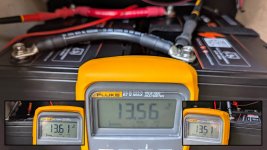
For this project, I repurposed a 6–7-year-old Victron Energy BMV-712 Smart Battery Monitor previously used in my Jeep. I cleaned areas with corrosion, circled in red in the accompanying images, using a Dremel and abrasive bit to eliminate resistance in the battery bank’s main circuit. The BMV-712 provides real-time monitoring of battery state of charge, voltage, current, and energy consumption via its built-in Bluetooth and VictronConnect app, enabling optimized battery usage and protection against over-discharging.
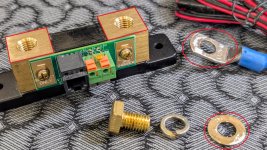
To mount the BMV-712 on a ¾-inch-thick exterior wall, I aimed to maximize screw depth without penetrating the outer surface. I measured carefully, selected appropriate screws, and prepared to drill pilot holes to the optimal depth. Since I needed only two holes and had #10 flat washers available, I fashioned an adjustable drill depth gauge to ensure precision. One of the best things about working for yourself is you get to call the shots and go your own way...

The NA-FC1 controller is compact, measuring approximately 1.5 inches in length, and lacks mounting holes or tabs. To secure it, I used 3M VHB (Very High Bond) 5952 tape, which can support up to 80 pounds per square inch in static shear. For this application, I considered the dynamic load and applied a safety factor of approximately 4:1, meaning one square inch of tape can reliably hold a 15–20-pound object.
To track expenses for this project, I am documenting all purchases. These include the 3M VHB 5952 tape, a 21mm hole saw used to cut an opening for the Sealcon cable gland (referenced in my previous post), a 67mm hole saw, and several 1/0 AWG lugs and ring terminals.
I used the 67mm hole saw to drill a precise hole in the battery box beneath the K470 case for mounting a Blue Sea Systems Manual Battery Switch. This switch allows me to isolate the battery bank from other electronics during maintenance or emergencies. Drilling this hole was challenging because I was enlarging an existing hole, leaving no material to guide the pilot bit.
The accompanying image illustrates how I addressed this challenge: I used a scrap piece of wood as a backer to guide the pilot drill. After identifying the center of the existing hole and drilling alignment holes, I attached the backer, drilled a pilot hole to guide the hole saw, and created a perfectly centered hole in the battery box.
After drilling the hole, I test-fitted the battery switch and planned the placement of its four mounting holes. The 67mm hole, as specified by Blue Sea Systems, left a 1mm gap around the switch. To center it precisely, I folded two strips of thin cardboard and inserted them evenly around the switch’s circumference, acting as flexible spacers to ensure perfect alignment.
Additional expenses include socket head bolts and screws for mounting the battery switch. I also purchased two extra screws to prepare for installing the Victron Energy BMV-712 Battery Monitor shunt in the battery box.
The Ancor Premium Battery Cable Stripper (703075) is designed to strip cables from 8 to 4/0 AWG, making it essential for this project. Its adjustable head optimizes blade depth for cutting through insulation, and a lever rotates the blade 90 degrees to remove the insulation efficiently in one motion.
For this project, I chose the Ancor 8 to 1/0 AWG Hex Lug Crimper, which has consistently produced reliable crimps. Measuring 15.4 inches, it fits easily in my tool bag, making it highly portable. Ancor offers a larger crimper for 8 to 4/0 AWG, but at 24.4 inches, it was unnecessary, as my calculations confirmed that 1/0 AWG wire meets the project’s requirements. The accompanying images show a precise crimp and finished wires with heat shrink tubing. I used Ancor marine-grade wire, tinned copper lugs, and adhesive-lined heat shrink tubing to ensure durability. My goal is to build a safe, cost-effective system, as substandard connections between premium components create vulnerabilities, much like weak links in a chain.
Balancing a new battery bank before use is essential for optimal performance, longevity, and safety. Batteries should have identical voltage and capacity, ideally from the same manufacturer and batch. To balance them, follow these steps: First, fully charge each battery and let it rest for several hours, disconnected from chargers or loads. Next, use a multimeter to verify that the open-circuit voltages are within 0.1V of each other. Then, connect the batteries in parallel using cables of identical length and gauge to ensure equal resistance and current sharing. Allow the connected batteries to rest for 12–24 hours, then integrate them into the system and charge them once more before use. The accompanying images show the open-circuit voltages for each battery before connection.
For this project, I repurposed a 6–7-year-old Victron Energy BMV-712 Smart Battery Monitor previously used in my Jeep. I cleaned areas with corrosion, circled in red in the accompanying images, using a Dremel and abrasive bit to eliminate resistance in the battery bank’s main circuit. The BMV-712 provides real-time monitoring of battery state of charge, voltage, current, and energy consumption via its built-in Bluetooth and VictronConnect app, enabling optimized battery usage and protection against over-discharging.
To mount the BMV-712 on a ¾-inch-thick exterior wall, I aimed to maximize screw depth without penetrating the outer surface. I measured carefully, selected appropriate screws, and prepared to drill pilot holes to the optimal depth. Since I needed only two holes and had #10 flat washers available, I fashioned an adjustable drill depth gauge to ensure precision. One of the best things about working for yourself is you get to call the shots and go your own way...
HarryN
Active Member
It was time to power up the Blue Sea Systems DC Accessory Panel to confirm everything functioned as expected. As previously noted, the DC voltmeter measures voltage at the 100A ST Blade fuse block, the tank meter monitors the diesel fuel level in my 30-gallon Titan auxiliary tank (which supplies my diesel heater and stove), and the temperature meter tracks the camper’s interior temperature. The two USB ports charge my phone, CR123 batteries for my Surefire flashlight, and other devices. The inset image shows the back of the accessory panel before wiring installation.
View attachment 86155
I purchased three Ancor products for wiring the back of the accessory panel described above. The double male-female adapters allowed me to connect power and ground to the two center-mounted gauges, which use mini push-in terminal blocks. Initially, I considered 10 AWG wire to maximize connection capacity and bought the appropriate connectors. However, the setup became too congested, so I ordered 25 female disconnects for 16 AWG wire instead. Amazon Prime proved invaluable, delivering the parts the next morning without shipping costs.
View attachment 86156
Originally, I planned to use the Victron Energy Smart BatteryProtect 12V 65A for another project, but after changing plans, it became available as a relay for the primary power wire to my Wallas Nordic DT diesel stove and heater. The Wallas draws 0.55–0.85 amps during operation but requires 8–10 amps for 5–10 minutes during ignition. The instructions recommend 10–6 AWG wire and states, “A main switch must be installed on the device’s positive (red) cord. Always disconnect power via the main switch after cooling is complete if the device will be unused for an extended period.” Since I had 8 AWG wire available, I used it for a one-foot run. The toggle switches I had were rated for 6 amps maximum, so I opted for the BatteryProtect instead of purchasing a 15-amp switch. This choice also allows me to monitor the Wallas’s energy consumption at various power settings via the Victron Connect app on my phone.
View attachment 86157
I used Ancor 8 AWG 1/4" screw lugs for the Smart BatteryProtect mentioned above. The convenience of ordering precise components online, with next-day delivery and no shipping fees, greatly simplifies the process.
View attachment 86158
By now, you may have noticed my enthusiasm for researching components and selecting the best options for my project - a habit developed during my career. For this phase, I needed a cable gland to safely pass multiple smaller wires without risking damage. While waterproofing to 300 feet isn’t necessary, the Sealcon gland I chose offers this capability, along with an operating temperature range of -40°F to 212°F and resistance to salt water, weak acids, weak alkalis, alcohol, esters, ketones, ether, gasoline, and more. I also ordered the Buna-N O-ring and locking nut to complete the setup.
View attachment 86159
In an earlier order, I purchased a pack of five reinforced unthreaded-hole bumpers to support the suspended floor in my Zarges K470 case. I selected 1-1/4" high bumpers, ideal for two bolts securing the case, but two other bolts required 5/8" bumpers. Instead of ordering an additional pack, I trimmed two bumpers by threading a rod partway into each, securing it in a drill, and using an angle grinder’s cutting wheel to shape the rubber while spinning. This unconventional method worked perfectly for the two bumpers needed.
View attachment 86160
Previously, I carefully laid out and drilled 24mm holes for the feed-through connectors, leaving 0.075" between each. When permanently installing the connectors, I needed a 0.075"-thick spacer to ensure uniform spacing. While this level of precision may seem minor, I value efficient, high-quality work that adheres to specifications. Spotting my drill set, I realized 5/64" bits (0.078" diameter) would work perfectly for the plastic components - and they did.
View attachment 86161
With the Wallas control panel and final four toggle switches installed, my project’s front panel was complete. Comparing the finished product to the original design, I’m pleased with the outcome. Thorough planning, multiple iterations, and careful research led to a satisfactory result. My advice: don’t settle on your first idea. Take time, research, consult others, explore options, and refine your plan until you’re confident in the design.
View attachment 86162
The Noctua fans and their controls are now permanently installed in a push-pull configuration. Based on my calculations, they should provide twice the required cooling volume in the worst-case scenario. As an experiment, I anticipate real-world results may vary slightly. I look forward to measuring and documenting performance over the next few years. The inset image shows a fan from the case’s exterior.
View attachment 86163
As I test system components, I’m learning to synchronize settings to ensure consistent battery treatment across power sources. Aligning absorption voltage, float voltage, storage voltage, temperature compensation, and low-temperature cut-off optimizes battery health, enhances system efficiency, and simplifies management. This approach minimizes risks like overcharging, undercharging, or temperature-related damage, making it ideal for reliable, long-term battery performance in applications like full-time adventure and exploration. Ah, sometimes I grow so tired, but I know I've got one thing I've got to do...
View attachment 86164
Nice work. I need to go through your build thread here some more and look at how you tapped into the fuel tank for the heater.

Rockcrawlindude
a rock crawlin’ dude
Nice work. I need to go through your build thread here some more and look at how you tapped into the fuel tank for the heater.

Today we installed a Titan auxiliary 30-gallon diesel fuel tank into my AEV Prospector with a 6.4L HEMI engine. Yes, you heard that correctly - I am installing a diesel fuel tank into my gas powered adventure vehicle so I am able to carry 30-gallons of diesel fuel. This auxiliary tank mounts in place of the spare tire and since I am running 37" tires I am unable to carry a spare under the bed so this space is available.

The exterior of the filler neck is in poor condition so I will call Titan and request a replacement. Unfortunately, this was the first of several...
The exterior of the filler neck is in poor condition so I will call Titan and request a replacement. Unfortunately, this was the first of several...

HarryN
Active Member
Thanks - that saved me a lot of time.Today we installed a Titan auxiliary 30-gallon diesel fuel tank into my AEV Prospector with a 6.4L HEMI engine. Yes, you heard that correctly - I am installing a diesel fuel tank into my gas powered adventure vehicle so I am able to carry 30-gallons of diesel fuel. This auxiliary tank mounts in place of the spare tire and since I am running 37" tires I am unable to carry a spare under the bed so this space is available.
The exterior of the filler neck is in poor condition so I will call Titan and request a replacement. Unfortunately, this was the first of several...
ramblinChet
Drinks Alone
- Messages
- 650
- Reaction score
- 3,120
- Points
- 93
After installing the Blue Sea Systems Battery Switch (#6006), I evaluated using the Benedikt & Jäger LS series DC disconnect switch I had previously purchased as a solar disconnect. My primary concern was its size, as space was limited. This led me to explore using another battery switch to disconnect the solar panels. My two RICH Solar MEGA 250 panels have an Open Circuit Voltage (Voc) of 22.8 Vdc, which, when wired in series, results in a system Voc of 45.6 Vdc at Standard Test Conditions (25°C or 77°F). This is significant because the BSS #6006 has a maximum voltage rating of 48 Vdc and 300 amps continuous, while the panels have a temperature coefficient of -0.29%/°C. For every degree Celsius above 25°C, the Voc decreases by 0.29% (e.g., at 35°C, Voc drops by approximately 2.9%). Conversely, at lower temperatures (e.g., 15°C), Voc increases by 2.9%. My calculations indicate that below 7°C (45°F), the system voltage could exceed the switch’s 48 Vdc rating. I installed the switch but will conduct further research and monitor it closely during cold weather.
The upper inset picture shows the 1/0 AWG wiring on the back of the battery disconnect, featuring an Ancor 90° tinned copper lug, necessary due to the battery cabinet’s front face being only inches away. The lower inset picture displays the factory Cerrowire 10 AWG wiring entering and the superior Ancor 6 AWG wire exiting.
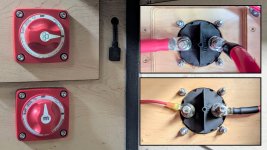
The Victron Energy BMV-712 Smart shunt, a low-resistance (500A/50mV) device, measures current flow into and out of the battery bank by creating a small voltage drop proportional to the current. This enables accurate tracking of battery state of charge (SoC), voltage, current, power, and other parameters. The shunt is wired in series with the negative battery terminal, with a short 1/0 AWG cable connecting the battery’s negative terminal to the “Battery Only” side to minimize voltage drop. No other connections should be made on this side to ensure accurate measurements. All loads (e.g., fuse box, inverter, air compressor) and charging sources (e.g., solar charge controller, DC-DC) connect to the “Load and Charger” side via the Lynx negative busbar.
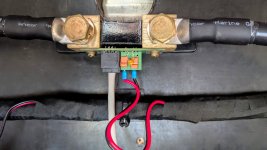
The battery box’s top holes were initially drilled using a 38mm hole saw, matching the Blue Sea Systems Feed-Through Connectors. Although I estimated sufficient space for the Ancor 90° lugs, the tight wiring made tool access difficult. I enlarged the holes to 52mm using another hole saw. To accurately center the larger hole over the existing one, I attached a scrap piece of wood as a backer plate and used the 38mm hole saw with a short bit to create a pilot hole. The 52mm hole saw with a longer bit then completed the task. Drilling the correct size initially would have been ideal, but the results were satisfactory, and I consider it a lesson learned.
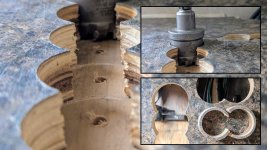
While removing the MES-K470 (Modular Energy System with Zarges K470 case), I photographed the two different-sized rubber spacers mentioned in a previous post. To avoid struggling with their positioning, I secured them using 3M double-sided VHB tape. The lower-left inset picture shows the Zarges box underside with ten feed-through connectors and four fabricated aluminum C-channels.
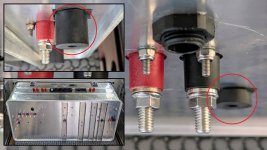
The case is mounted with the battery and solar disconnects positioned underneath. While some builds include disconnects, they are often not in visible or convenient locations, which could be problematic in emergencies. I placed mine to be accessible yet not front-and-center, aligning with the Four Wheel Camper’s raised faceplate and hole from a removed switch, making this a practical choice for my setup.
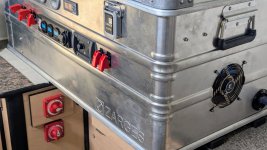
Additional components are now operational. The top row, from left to right, includes the BMV-712 for battery state monitoring, the MPPT Controller for solar reporting, and the INKBIRD ITC-1000 for case internal temperature monitoring and Noctua PWM fan control. The next row features a Blue Sea Systems Accessory Panel displaying the main fuse box voltage, diesel tank level (in my HEMI truck), and camper interior temperature.

While disassembling the Four Wheel Camper’s wiring harness, I noticed numerous green wires, later identified as amber and red clearance light positive wires, along with associated grounds. I repurposed the Blue Sea Systems Common 100A Mini Bus Bar, added a cover, and ordered another covered mini busbar for the negatives. Note the orange line with a 5-amp fuse, powered by the truck’s running lights. The negative wires, still slightly long and using nylon ring terminals, will be shortened and upgraded to Ancor adhesive-lined heat-shrink ring terminals.
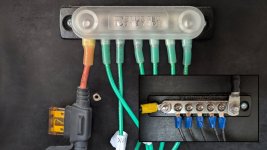
The Blue Sea Systems ST Blade Fuse Block is installed, with essentials like lights and the refrigerator connected. The 4 AWG wire supplying the 100A fuse block appears unusual as it drops and curls but remains relaxed. A key lesson was underestimating the space larger wires require for turns and fastening. This suggests I may be better suited to mechanical rather than electrical design.
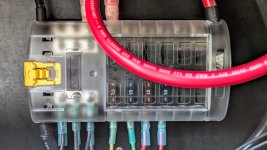
Receipts help track project costs. The Victron Energy RJ45 UTP cable was ordered in error; the BMV-712 required an RJ12 UTP of the same length, which was corrected without issue. The Ancor AWG 8 screw size #10 tinned copper lug, the smallest lug and hole size Ancor manufactures, was used to connect the AWG 8 wire to the National Luna Classic 80L refrigerator.

Despite recent heat and humidity, I’ve been living and working in my camper. As I prepared for sleep, I admired the colorful system and reflected on the energy flowing through it. This project has been enjoyable but time-consuming, primarily due to my own delays.
Nearing sixty, I feel older than I should, likely due to a “carefree, reckless, and self-destructive lifestyle” noted in a past military evaluation - a description I once took as a compliment. In my youth, I’d boldly approach women, claiming, “I’m one hundred sixty-two pounds of twistin’, turnin’ steel and massive sex appeal. I'm what every woman wants and every man wants to be!” Surgeries provided temporary relief, but the doctors were right: my body is breaking down faster than most. I’m grateful to be pursuing this project now and dream nightly of returning to the beauty, relaxation, and safety, of the mountains, forest, and desert.
I feel blessed to have experienced more than I deserve. My advice: if you’re dreaming of something, start now. Waiting too long may leave you looking back saying - and looking up I noticed I was late...
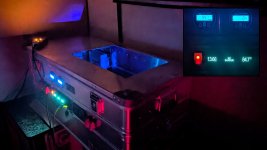
The upper inset picture shows the 1/0 AWG wiring on the back of the battery disconnect, featuring an Ancor 90° tinned copper lug, necessary due to the battery cabinet’s front face being only inches away. The lower inset picture displays the factory Cerrowire 10 AWG wiring entering and the superior Ancor 6 AWG wire exiting.
The Victron Energy BMV-712 Smart shunt, a low-resistance (500A/50mV) device, measures current flow into and out of the battery bank by creating a small voltage drop proportional to the current. This enables accurate tracking of battery state of charge (SoC), voltage, current, power, and other parameters. The shunt is wired in series with the negative battery terminal, with a short 1/0 AWG cable connecting the battery’s negative terminal to the “Battery Only” side to minimize voltage drop. No other connections should be made on this side to ensure accurate measurements. All loads (e.g., fuse box, inverter, air compressor) and charging sources (e.g., solar charge controller, DC-DC) connect to the “Load and Charger” side via the Lynx negative busbar.
The battery box’s top holes were initially drilled using a 38mm hole saw, matching the Blue Sea Systems Feed-Through Connectors. Although I estimated sufficient space for the Ancor 90° lugs, the tight wiring made tool access difficult. I enlarged the holes to 52mm using another hole saw. To accurately center the larger hole over the existing one, I attached a scrap piece of wood as a backer plate and used the 38mm hole saw with a short bit to create a pilot hole. The 52mm hole saw with a longer bit then completed the task. Drilling the correct size initially would have been ideal, but the results were satisfactory, and I consider it a lesson learned.
While removing the MES-K470 (Modular Energy System with Zarges K470 case), I photographed the two different-sized rubber spacers mentioned in a previous post. To avoid struggling with their positioning, I secured them using 3M double-sided VHB tape. The lower-left inset picture shows the Zarges box underside with ten feed-through connectors and four fabricated aluminum C-channels.
The case is mounted with the battery and solar disconnects positioned underneath. While some builds include disconnects, they are often not in visible or convenient locations, which could be problematic in emergencies. I placed mine to be accessible yet not front-and-center, aligning with the Four Wheel Camper’s raised faceplate and hole from a removed switch, making this a practical choice for my setup.
Additional components are now operational. The top row, from left to right, includes the BMV-712 for battery state monitoring, the MPPT Controller for solar reporting, and the INKBIRD ITC-1000 for case internal temperature monitoring and Noctua PWM fan control. The next row features a Blue Sea Systems Accessory Panel displaying the main fuse box voltage, diesel tank level (in my HEMI truck), and camper interior temperature.
While disassembling the Four Wheel Camper’s wiring harness, I noticed numerous green wires, later identified as amber and red clearance light positive wires, along with associated grounds. I repurposed the Blue Sea Systems Common 100A Mini Bus Bar, added a cover, and ordered another covered mini busbar for the negatives. Note the orange line with a 5-amp fuse, powered by the truck’s running lights. The negative wires, still slightly long and using nylon ring terminals, will be shortened and upgraded to Ancor adhesive-lined heat-shrink ring terminals.
The Blue Sea Systems ST Blade Fuse Block is installed, with essentials like lights and the refrigerator connected. The 4 AWG wire supplying the 100A fuse block appears unusual as it drops and curls but remains relaxed. A key lesson was underestimating the space larger wires require for turns and fastening. This suggests I may be better suited to mechanical rather than electrical design.
Receipts help track project costs. The Victron Energy RJ45 UTP cable was ordered in error; the BMV-712 required an RJ12 UTP of the same length, which was corrected without issue. The Ancor AWG 8 screw size #10 tinned copper lug, the smallest lug and hole size Ancor manufactures, was used to connect the AWG 8 wire to the National Luna Classic 80L refrigerator.
Despite recent heat and humidity, I’ve been living and working in my camper. As I prepared for sleep, I admired the colorful system and reflected on the energy flowing through it. This project has been enjoyable but time-consuming, primarily due to my own delays.
Nearing sixty, I feel older than I should, likely due to a “carefree, reckless, and self-destructive lifestyle” noted in a past military evaluation - a description I once took as a compliment. In my youth, I’d boldly approach women, claiming, “I’m one hundred sixty-two pounds of twistin’, turnin’ steel and massive sex appeal. I'm what every woman wants and every man wants to be!” Surgeries provided temporary relief, but the doctors were right: my body is breaking down faster than most. I’m grateful to be pursuing this project now and dream nightly of returning to the beauty, relaxation, and safety, of the mountains, forest, and desert.
I feel blessed to have experienced more than I deserve. My advice: if you’re dreaming of something, start now. Waiting too long may leave you looking back saying - and looking up I noticed I was late...
Last edited:
HarryN
Active Member
After installing the Blue Sea Systems Battery Switch (#6006), I evaluated using the Benedikt & Jäger LS series DC disconnect switch I had previously purchased as a solar disconnect. My primary concern was its size, as space was limited. This led me to explore using another battery switch to disconnect the solar panels. My two RICH Solar MEGA 250 panels have an Open Circuit Voltage (Voc) of 22.8 Vdc, which, when wired in series, results in a system Voc of 45.6 Vdc at Standard Test Conditions (25°C or 77°F). This is significant because the BSS #6006 has a maximum voltage rating of 48 Vdc and 300 amps continuous, while the panels have a temperature coefficient of -0.29%/°C. For every degree Celsius above 25°C, the Voc decreases by 0.29% (e.g., at 35°C, Voc drops by approximately 2.9%). Conversely, at lower temperatures (e.g., 15°C), Voc increases by 2.9%. My calculations indicate that below 7°C (45°F), the system voltage could exceed the switch’s 48 Vdc rating. I installed the switch but will conduct further research and monitor it closely during cold weather.
The upper inset picture shows the 1/0 AWG wiring on the back of the battery disconnect, featuring an Ancor 90° tinned copper lug, necessary due to the battery cabinet’s front face being only inches away. The lower inset picture displays the factory Cerrowire 10 AWG wiring entering and the superior Ancor 6 AWG wire exiting.
View attachment 86657
The Victron Energy BMV-712 Smart shunt, a low-resistance (500A/50mV) device, measures current flow into and out of the battery bank by creating a small voltage drop proportional to the current. This enables accurate tracking of battery state of charge (SoC), voltage, current, power, and other parameters. The shunt is wired in series with the negative battery terminal, with a short 1/0 AWG cable connecting the battery’s negative terminal to the “Battery Only” side to minimize voltage drop. No other connections should be made on this side to ensure accurate measurements. All loads (e.g., fuse box, inverter, air compressor) and charging sources (e.g., solar charge controller, DC-DC) connect to the “Load and Charger” side via the Lynx negative busbar.
View attachment 86658
The battery box’s top holes were initially drilled using a 38mm hole saw, matching the Blue Sea Systems Feed-Through Connectors. Although I estimated sufficient space for the Ancor 90° lugs, the tight wiring made tool access difficult. I enlarged the holes to 52mm using another hole saw. To accurately center the larger hole over the existing one, I attached a scrap piece of wood as a backer plate and used the 38mm hole saw with a short bit to create a pilot hole. The 52mm hole saw with a longer bit then completed the task. Drilling the correct size initially would have been ideal, but the results were satisfactory, and I consider it a lesson learned.
View attachment 86659
While removing the MES-K470 (Modular Energy System with Zarges K470 case), I photographed the two different-sized rubber spacers mentioned in a previous post. To avoid struggling with their positioning, I secured them using 3M double-sided VHB tape. The lower-left inset picture shows the Zarges box underside with ten feed-through connectors and four fabricated aluminum C-channels.
View attachment 86660
The case is mounted with the battery and solar disconnects positioned underneath. While some builds include disconnects, they are often not in visible or convenient locations, which could be problematic in emergencies. I placed mine to be accessible yet not front-and-center, aligning with the Four Wheel Camper’s raised faceplate and hole from a removed switch, making this a practical choice for my setup.
View attachment 86661
Additional components are now operational. The top row, from left to right, includes the BMV-712 for battery state monitoring, the MPPT Controller for solar reporting, and the INKBIRD ITC-1000 for case internal temperature monitoring and Noctua PWM fan control. The next row features a Blue Sea Systems Accessory Panel displaying the main fuse box voltage, diesel tank level (in my HEMI truck), and camper interior temperature.
View attachment 86662
While disassembling the Four Wheel Camper’s wiring harness, I noticed numerous green wires, later identified as amber and red clearance light positive wires, along with associated grounds. I repurposed the Blue Sea Systems Common 100A Mini Bus Bar, added a cover, and ordered another covered mini busbar for the negatives. Note the orange line with a 5-amp fuse, powered by the truck’s running lights. The negative wires, still slightly long and using nylon ring terminals, will be shortened and upgraded to Ancor adhesive-lined heat-shrink ring terminals.
View attachment 86663
The Blue Sea Systems ST Blade Fuse Block is installed, with essentials like lights and the refrigerator connected. The 4 AWG wire supplying the 100A fuse block appears unusual as it drops and curls but remains relaxed. A key lesson was underestimating the space larger wires require for turns and fastening. This suggests I may be better suited to mechanical rather than electrical design.
View attachment 86664
Receipts help track project costs. The Victron Energy RJ45 UTP cable was ordered in error; the BMV-712 required an RJ12 UTP of the same length, which was corrected without issue. The Ancor AWG 8 screw size #10 tinned copper lug, the smallest lug and hole size Ancor manufactures, was used to connect the AWG 8 wire to the National Luna Classic 80L refrigerator.
View attachment 86665
Despite recent heat and humidity, I’ve been living and working in my camper. As I prepared for sleep, I admired the system’s colorful wiring and reflected on the energy flowing through it. This project has been enjoyable but time-consuming, primarily due to my own delays.
Nearing sixty, I feel older than I should, likely due to a “carefree, reckless, and self-destructive lifestyle” noted in a past military evaluation - a description I once took as a compliment. In my youth, I’d boldly approach women, claiming, “I’m one hundred sixty-two pounds of twistin’, turnin’ steel and massive sex appeal. I'm what every woman wants and every man wants to be!” Surgeries provided temporary relief, but the doctors were right: my body is breaking down faster than most. I’m grateful to be pursuing this project now and dream nightly of returning to the mountains, forest, and desert.
I feel blessed to have experienced more than I deserve. My advice: if you’re dreaming of something, start now. Waiting too long may leave you looking back saying, and looking up I noticed I was late...
View attachment 86666
Very impressed. I build power systems inside of cases as well and completely understand the challenges. The wire bend radius is easy to underestimate. It is one of the reasons that I tend to build with 24 volt instead of 12 volt.
Added - the nice thing is that more or less all of your wiring and terminal related stuff can be used in 12 or 24 volt systems.
Last edited: