What's new
Ram Heavy Duty Forum

Register a free account today to become a member! Once signed in, you'll be able to participate on this site by adding your own topics and posts, as well as connect with other members through your own private inbox!

2021 RAM 3500 Tradesman | AEV Prospector | FWC Grandby

Thanks for the kind words men - everything has been taken care of and I will attempt to post a detailed follow up within the next day or two depending upon how darn cold it is and if I have interweb connectivity.

@Rockcrawlindude - I might be interested in talking to you more about your guy and maybe check out some of his work. I have a pretty good idea of the overall design and materials - it's just a matter of putting it all down on paper and talking to the right fabrication shop.
 
Eastern Kansas Flint Hills Overland Route

Part Two of Two

We are back on the Eastern Kansas Flint Hills Overland Route with a new BF Goodrich All Terrain T/A KO2 tire to replace the irreparable one. Correcting this problem was a combined effort between BF Goodrich and Discount Tire - here is exactly what took place:

When I damaged the tire I was in an area with spotty cellular service so I pulled up a map of the area which included topographical information. Using the map I identified the nearest city, which was Topeka, Kansas, which I estimated to be 075° at 30 miles direct, and then moved in that direction towards high ground. It wasn't too long before I had reliable signal and while walking towards my destination I thought of a few options and began to prioritize them - this is a good example of when things begin to go sideways and you have not trained for a situation, you must immediately begin to slow the process down and think it through. My first call was to the manufacturer and my goal was to accomplish two specific tasks.
  1. Express to BF Goodrich how disappointed I was with the performance of their tire considering I had just suffered a similar puncture from a rock in Texas just six months ago while navigating the 1,358 mile Five Tribes Overland Trail.
  2. Ask if I had any available roadside warranty or qualified for another program that would provide help in a situation such as this.
The young lady listened to my questions and then informed me that even though we were transitioning from afternoon to evening, she would initiate a claim and it would be processed immediately. Since I keep all of my paperwork I was able to provide her with all of the details she required and within twenty minutes or so we concluded our conversation and she stated that a local towing company would be arriving within the next hour to take me anywhere I desire for repair as long as it was within one hundred miles. I made sure to make it very clear that the last time my truck was on a certified scale it weighed 8,660 pounds and likely weight maybe 5-10% more right now, and I had a modified suspension, larger tires, and a pop-up camper in the bed. My goal was to avoid the tow company sending out the wrong truck for this application and thus refusing service.

Within a few hours we were loaded up and inbound to a Discount Tire in Topeka since that is the company I purchased these replacement tires from in Texas.

EKFHOR 008.jpg

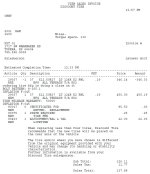
For the record, here is a copy of my invoice from Discount Tire - a new replacement tire cost me $137.88 and I consider that a bargain considering the tow was covered by BF Goodrich. Just to let you know, BFG also offered to provide a discounted replacement tire although the I opted for the Discount Tire offer since they were a few dollars cheaper. After all of this I am still somewhat disappointed the I had two tire failures within six months but then again I spend a ton of time on the trails compared to 99.997% of normal people so I can accept this as the "cost of doing business" to some degree. I really do appreciate BFG and Discount Tire being able to save my butt in a situation that I played a large part in creating. I most likely will try the new KO3s in a few years when these are due to be replaced.
EKFHOR 009.jpg

Okay, we have returned to the scene of the crime and are rolling back down the same rocky section of trail - I just could not drive around and let that section of trail defeat me. I figured although the odds were significantly against another flat occurring, if it did happen, I already knew exactly what to do this time since I was now trained. I believe it was the Greek philosopher Archilochus who stated, “We don't rise to the level of our expectations; we fall to the level of our training.” This is why training is so very critical when things go sideways in a hurry.
EKFHOR 010.jpg

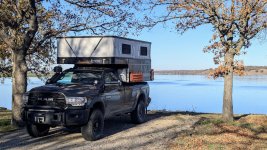
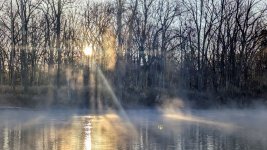
Much of my third day on the trail was a mixture of dirt or gravel farm roads with some occasional interesting sections - I was really enjoying traveling along the Eastern Kansas Flint Hills Overland Route and would recommend it to anyone willing to set aside two or three days of travel who was nearby or passing though the area. During the evening the sun was slowly falling and there is just something special about watching the sun slowly sink in the Midwest. Unfortunately the picture below does not include sound and feeling but imagine absolute silence with light airy winds just barely perceptible at 1-2 mph.
EKFHOR 011.jpg

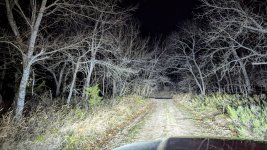
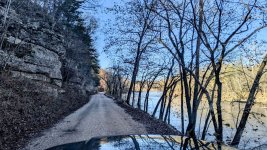
On my final night I elected to push into the night since I truly love exploring a new area at night part of the time - things take on an entirely different appearance. It is really interesting to form an opinion of a particular area late at night only to wake up in the morning and have it appear so very different compared to how you imagined it. If you are going to an area of the country where you have not been previously I would encourage you to set aside some time at night for exploration. Just make sure you have proper lighting - it makes all the difference in the world and increases your safety margin to a somewhat reasonable level even in dangerous terrain such as steep and narrow shelf-roads.
EKFHOR 012.jpg

I'm always up for a night water crossing and this one would be the perfect way to finish the night and the trail at the same time. This crossing was at the Caney River on the outskirts of Cedar Vale, Kansas, which is a small town of just over 400 residents. It always feels strange rolling into these small towns in a strange looking vehicle especially late at night since most all of the folks know everything about everyone else around and my AEV Prospector stands out like a ship from outer space. Although many folks are curious and take a long second look when I roll through most all are friendly and some even stop over to take a closer look. This was a calm and shallow river with a fairly firm bottom so I crossed in two-wheel drive and was just happy to be wrapping up this trail. When I began it seemed like it would be one of the easier ones I have done but a punctured tire threw quite a curve ball into the trip!
EKFHOR 013.jpg

The next morning I stumbled into Wah-Sha-She Park just across the order in Oklahoma. The weather was beautiful and being able to enjoy a nice hot shower after a week of being out in the wild was quite nice. When I began traveling it seemed like although I wanted to take a shower every single day it really was not that necessary. Many times a few baby wipes would work just fine, occasionally I would was my hair by boiling water and mixing it with some really cold water creating nice warm water pouring over my head - I find one part boiling and two parts cold seems to work well. Anyway, I average a full shower maybe every five days or so - sometimes more, sometimes less. Now if I happen upon an opportunity to take a legitimate shower a few days in a row I will not hesitate, especially this time of year. But in the end, I really don't think humans were designed to have a requirement for a full shower daily
EKFHOR 014.jpg

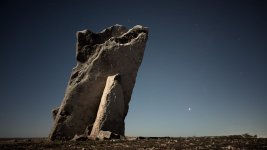
There are a few interesting places to visit along this overland route with one of them being the Tallgrass Prairie National Preserve just a few miles west of Emporia, Kansas. Of course I stopped in a spent a few hours observing, learning, and relaxing. Me, I sort of love to learn something new each and every day - if I am falling asleep and have not learned something, anything, I feel some degree of regret. My final shot below was taken on a moonlit night - this was a long exposure picture of Teter Rock, which can be found along the trail. It was a chilly night and the the wind varied from a gentle breeze to moderate, there were sounds this night which consisted of hoofs nearby and howls from afar.

Do me a favor, put on some headphones, click on the song below, and take time to study the picture below - I took it for you.

No one else was in the area, time began to distort, and slipped away and began to dream like a kid...

...I miss the earth so much, I miss my wife. It's lonely out in space, on such a timeless flight...

EKFHOR 015.jpg
 
Last edited:
Green Country Oklahoma Adventure Tour

Part One of Two

Earlier this year, after completing the five day, 300+ mile, Ouachita Traverse in Arkansas, a long time friend of mine reached out and wanted to plan a trip to the Ozarks with me later in the fall. Dennis lives in Delaware and we have been sharing trails all over the country for the past seven years or so. Our original plans were for September but between both of our schedules, our date slipped back to November which aligned with the schedule of another buddy. Paul is from Massachusetts and we met camping in the Ocala National Forest in Florida, nearly two years ago. He was completing the Mid-Atlantic Backcountry Discovery Route and I suggested he head over and meet us in the Ozarks for a few weeks.

No plan of operations extends with certainty beyond the first encounter with the enemy's main strength. ~ Helmuth von Moltke

We planned, we arrived, and as soon as we began, everything changed. There had been significant rain the first week of November in the Ozarks and the Buffalo River swelled from a normal 3.5' deep to over 35' deep in some areas. Of course, I had an alternate plan in my back pocket just in case and the Green Country Oklahoma Adventure Tour (GOAT) was that plan.
GOAT 001.jpg

Paul arrived first and then me - while we waited for Dennis to arrive the next day, we engaged in an old fashioned staring contest. Many times I stare at random men in public to gauge their reaction and the results can be quite entertaining - try it sometime. I won this battle when I whispered to Paul, "Did you ever think that you may be bisexual?" Paul smiled really big and blinked.
GOAT 002.jpg

The Green Country Oklahoma Adventure Tour makes a nearly 500-mile loop through some of eastern Oklahoma's most scenic lands. The verdant rolling hills are also home to numerous Native American tribes like the Cherokee Nation, Quapaw, Peoria, Miami, and Ottawa tribes. While the route can be easily managed by a stock 4x4 or AWD crossover, there are a few bumpier sections that will keep you on your toes. And like many other places in the Ozarks, expect tight trails with plenty of encroaching brush and low-hanging limbs (limb risers certainly don't hurt!).

Dennis arrived and we waited an additional day just to relax and check river levels one more time - still too high. The next morning we work up, drove a few hour to Siloam Springs, Arkansas, the eastern most section of the GOAT, gassed up, and our adventure began.

The town was officially founded in 1880 by Simon Sager, who had settled there years earlier, and it was initially called "Hico." The name was later changed to Siloam Springs, named after the Biblical Pool of Siloam, in recognition of the area's healing springs.
GOAT 003.jpg

I always love driving along side rivers and here we were along side the Illinois River which begins as a spring in the Ozark Mountains and then flows southwest into Oklahoma to join the Arkansas River, which is a major tributary of the mighty Mississippi River. It wasn't too long ago when rivers such as this and others serves as transportation routes for a wide variety of purposes. Maybe it's the way I am wired but I have always lived very near an ocean, lake, or river. This was another beautiful section of the trail and we were all amazed to find something such as this in Oklahoma.
GOAT 004.jpg

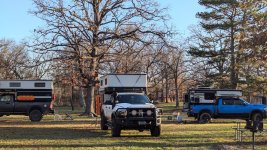
Since this trail switched between public and private land so frequently, finding a camping area large enough to fit three full-sized trucks took a bit more work compared to what I am accustomed to. Since I spend much of my time alone in the mountains, forest, or desert, finding a spot to camp alone is so easy I rarely even think about it. Now that we had three of us traveling together finding a large camp was more work. Here is one of the spots we found, the Round Hollow Public Access Area, just a few miles off the trail along the shore of the Illinois River.
GOAT 005.jpg

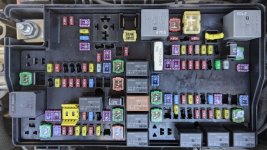
This is a picture of my fuse box, under the hood, on the drivers side. During our trip Paul didn't believe he was receiving any DC-DC power from his alternator to his house battery while driving. He began to diagnose the issue himself and was first removing fuses and visually inspecting them, something we have all done; he then realized that one of fuses he had just removed, he was unable to remember exactly where it belonged. For reference, I popped my hood, snapped this picture, and we compared it to his box and were able to confirm where the fuse should be reinstalled. I'll keep this picture here for me, just in case...
GOAT 006.jpg

Considering this is a 500+ mile trail passing through a nearly constant mixture of public and private land, there is a little bit of everything to enjoy - gravel, dirt, or paved roads; smooth or rocky trails, dozens of river crossings, some mild to moderately sized ones, others just a trickle. We were all very impressed after the first few days and a common call out on the radio was "I just can't believe we are in Oklahoma and seeing all of this." The creators of the route did a fantastic job.
GOAT 007.jpg

Breathtaking.

The J.T. Nickel Family Nature and Wildlife Preserve is the largest privately protected conservation area in the Ozarks thanks to a land gift from the John Nickel family in 2000. This 17,000 acre landscape rests in eastern Oklahoma's rolling Cookson Hills and overlooks the Illinois River where spring-fed creeks meander amid a rugged topography of steep slopes and narrow valleys harboring a mosaic of oak-hickory forest, lofty pine woodland, and a diverse mix of savanna, shrubland and prairie.
GOAT 008.jpg

Here is Paul crossing a stream in his beautiful blue Power Wagon with a Palomino pop-up camper in the bed. He has had the camper for a few years and is beginning to strongly consider purchasing a Four Wheel Camper like Dennis and I have. Although Paul loves his home on wheels and has spent quite a bit of money and time upgrading and modifying it, he still points out a few of it's shortcomings for our applications. I guess the three key issues he speaks of most often are:

  1. construction - Palomino are not all aluminum like the Four Wheel Camper and they weight quite a bit more. Even after adding airbags to the rear suspension he is still way over GVWR and the handling suffers.
  2. membrane roof - I never though much of this but now I understand why Paul has always been hesitant to explore some of the tighter trails with branches - he was worried about tearing his membrane roof. When he found out the FWC had a solid one-piece aluminum roof he was impressed. He has also experienced leaks a few times whereas Dennis and I have never experienced any.
  3. electric lift motors - If you ever meet Paul on the trail, ask him what he thinks of the electric motors used to lift his roof. All four had to be replaced at the dealership on the day he purchased the unit when brand new and this is not a joke but Paul now carries two extra motors and is very familiar with rebuilding and repairing them in the field.
GOAT 009.jpg

On a trip this long with multiple vehicles it is important to recognize the fact that different drivers, with nonidentical equipment, goals, and experience levels, travel at mismatched speeds over distinct sections. There is no right or wrong, it's just a simple fact that speeds vary and must be taken into account. It is important to sit down as a group before your journey begins, discuss options, and finalize some general guidelines.

In this case, we had a 500 mile trail ahead and our target was 100 miles per day. After the first day I noticed adjustments must be made or this trail was going to be a seven or eight day journey. In addition to varying speeds of travel through different sections we had other issues to resolve, one of us liked to sleep in late and begin the trail around 1000, another insisted on stopping for an hour for lunch, and another wanted to pull off the trail and set up camp site by 1500-1600 at the very latest. This left around four or five hours of travel time each day and with an average speed of 15 mph, adjustments had to be made. Things became a bit more interesting during the next few days.

Pushing late into the evening one night to stack up some miles, we found ourselves on an old stagecoach line near Sequoyah’s Cabin. Over centuries the trail has not changed much and as the sun slowly faded away I wondered if the trail could speak what it would say. Then ever so softly, over the mechanical drone of my engine and tires rolling over this old trail, I heard it whisper in my ear...I've watched you change...
GOAT 010.jpg
 
Last edited:
Since I am slowly heading back east and will be passing through my home in Virginia, it seemed like a good time to finalize details regarding upgrades I have been considering over the past year, and place the respective orders.

Over the past few years one question has really been on my mind quite frequently: should I install some running boards that attach to the rocker panel or should I opt for heavier, and more expensive rock rails, that mount directly to the frame? I guess my main decision gate centered around how often my rocker panels would be in contact with sand, dirt, and rocks. Based upon my last three years of experience on overland trails throughout these United States, the rockers have only made contact a few times and sustained very minor damage, so running boards would be fine for me.

My next questions to answer would be: should I select a 48-60" option that would cover the cab area or a 98" version covering wheel-to-wheel? What material: steel, aluminum, or plastic? How will the running boards be mounted: to the rocker panel, a body mount, or directly to the frame? What type of surface would be best for my application: smooth, textured, or rough metal grating?

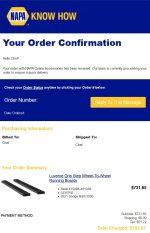
Ultimately, I selected the Luverne Grip Step 7" x 98" aluminum wheel-to-wheel running boards, which mount to the body bolts that attach to the frame. The surface is a very rough metal grating which is perfect for my needs and even though the 60" version would be sufficient I selected the 98" one since it utilized three mounts instead of two. Interestingly, the Luverne site shows this model available for a 2019 RAM 3500 regular cab long bed, but not anything manufactured after that such as my 2021 with the same options. I spent time downloading the factory PDFs, comparing parts, and even spoke with a factory representative.

Although the factory representative said this kit would not work with my 2021 the parts listed give me the impression that everything would be fine. At worst, I may be required to modify the rear-most bracket that attaches to the forward leaf spring mount. While searching for the retailer with the best price, I came upon the NAPA site which verified this kit would work with my 2021 so I decided to roll the dice.
NAPA Online Accessories Order #ACC1814074 Confirmation.jpg

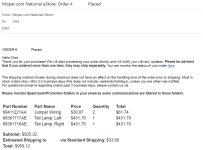
This next modification has been on my mind since upgrading my OEM halogen headlights to OEM LED Projector headlights with the Adaptive Forward Lighting System. It seemed logical to upgrade the halogen rear tail lights to OEM LED ones at the same time but I just had a tough time justifying the expense. In the end, this was one of those upgrades that cost a few dollars and is really not necessary, but after following my buddy Paul around in his tricked out Power Wagon, I fell in love with those OEM red and amber LEDs.

Based upon my research, the OME LED tail lights manufactured from 2019-2023 use a red brake light and amber turn signal whereas the 2024+ now use red for brake and turn signal. Both red/amber and red/red are available with, or without, blind spot detection and I decided to keep my truck as is, without blind spot detection. Also, note the two OEM jumper cords that will be used to connect the new LEDs. All that is necessary after that is a quick change to the body control module using AlfaOBD.

Mopar.com National eStore_ Order #759556 Placed.jpg

My final expense today has weighed on my mind beginning back when I selected the initial specifications for my AEV Prospector at AEV headquarters up in Wixom, Michigan. At that time I was not sold on the necessity of the AEV/Bilstein XP8100 Remote Reservoir Shocks for my application so I figured I would give the 5100s a try for a few years and then upgrade if I was not happy. Overall the 5100s have performed fine on the street and maintained roads, but are just okay when it comes to rougher surfaces and higher speeds, which is common out west. It will be interesting to tackle some of the same trails with everything being identical except for the shocks.

And yes, I already have Coyote tire deflators re-calibrated to 15 PSI, but these OK4WD tire deflators were 50% off so I decided to purchase them and set them for 25 or 30 PSI for trails that are not as rough. Basically, I will have two options for quickly airing down all four tires: OK4WD for 30 PSI applicatoins and Coyotes for 15 PSI ones.

Just in case you are interested, I already have two of the AEV anchor shackles that came with my AEV full size recovery gear package, but it's always nice to have just one more. Nearly one year ago I became stuck on the El Camino del Diablo trail in Arizona near the Mexican border. There was no cellular service, I was in the middle of a 150-mile three day trail, and there was noting available to connect my Warn 16.5Ti winch to. After freeing myself and reconnecting with cellular service a few days later, I decided to invest in a Ruggedized Deadman V2 earth anchor. I imagine there may be an event in my future where I am required to utilize several recovery tools simultaneously such as the AEV snatch block and Deadman earth anchor. One more anchor shackle might be worth it's weight in gold.
OK4WD AEV 8100s.jpg
 
Green Country Oklahoma Adventure Tour

Part One of Two

Paul arrived first and then me - while we waited for Dennis to arrive the next day, we engaged in an old fashioned staring contest. Many times I stare at random men in public to gauge their reaction and the results can be quite entertaining - try it sometime. I won this battle when I whispered to Paul, "Did you ever think that you may be bisexual?" Paul smiled really big and blinked.
View attachment 80081

JFC, I almost spit out my beer when I read this.
 
Green Country Oklahoma Adventure Tour

Part Two of Two

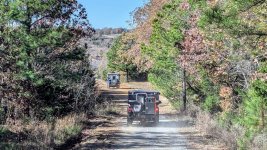
This picture shows a hint of dust being kicked up on the trail although at other times when the air is still and the sun is low, a dusty trail can have such low visibility it forces us to spread out very far. It's for this reason I installed a Sy-Klone engine pre-cleaner on my AEV Snorkel.
GOAT 011.jpg

During my travels I always enjoy jumping off the trail to explore interesting places nearby - this time we landed in Tahlequah, Oklahoma, which has been the capital of the Cherokee Nation since 1839. We enjoyed a lunch and then spent a few hours touring the Cherokee National History Museum which was very interesting. I am a big supporter of preserving and protecting history. Others, not so much...

“Every record has been destroyed or falsified, every book rewritten, every picture has been repainted, every statue and street building has been renamed, every date has been altered. And the process is continuing day by day and minute by minute. History has stopped. Nothing exists except an endless present in which the Party is always right." ~ George Orwell, 1984

GOAT 012.jpg

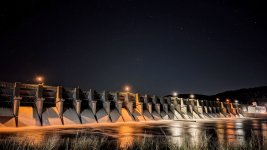
This is the Fort Gibson Dam on the Neosho (Osage Indian for "clear water") River where we slept one night. Since virtually ever night of the year I am sleeping somewhere I have never visited, I have become pretty good at finding places. In this case, whenever I see a river or lake I immediately begin searching maps for boat launches, overlooks, a dam, campground, etc. Once I locate several potential spots I begin to filter depending upon what my plans are. If I have been in the wild for a week I focus on finding places that have a flush toilet which means there is a high probability they also have potable water available. If they mention electric then there is a good chance they will also have warm showers.
GOAT 013.jpg

There was some confusion this night although everything worked out well. I had located this site just off of the trail and reviewed the information on the RECREATION.GOV site which stated "The campground is open for day use and free primitive camping." Soon after arriving and setting up the volunteer campground manager came over and informed us that camping was not permitted for a multitude of reasons but we were welcome to sleep overnight in the parking lot at the entrance to the campground. It was late, cold, we were all hungry, and tired after several days on the trail. We thanked the volunteer, crawled over to the parking lot, ate, and fell asleep listening to the roar of the dam just outside our windows. It was beautiful, and free.
GOAT 014.jpg

This is the unfinished church at Our Lady of Clear Creek Abbey which is home to fifty-five Benedictine monks who live a Consecrated life of chastity, poverty, and obedience. The traditional motto of the Benedictines is, Ora et Labora (Pray and Work), the monks come to the church seven times each day and once at night to praise God in liturgical prayer.

My good friend, I am going to ask a favor of you and I hope and pray you consider my request and within the next few days or weeks, experience something that is beyond your wildest dreams. Please understand that I am not trying to convert anyone over to a Traditional Catholic life, or begin a debate regarding this religion versus that - my goal is for you to experience something that 99.997% of people are unaware of.

I am asking you to attend a Traditional High Latin Mass so you will know what it feels like to hear the nearly continuous singing of prayer and Gregorian chant, the chant of the Priest and congregation in Latin, the smell of the incense, and the supernatural feeling of being in the presence of God. The "Mass is one continuous action, reproducing in a mysterious way the Life, Passion and Death of Jesus Christ." What I am attempting to explain is that time will disappear and you yourself will be present during these historic events which we believe took place two millennia ago. On the altar, every single movement that takes place, and word spoken, has a deep traditional meaning and significance. Everything means something.

This is my gift to you my friend - click on this link to find a High Mass (not a Low one), and don't worry about any details. Dress well, men can wear a tie if they wish, ladies can wear a modest dress with a veil. Just show up a mimic what others are doing; sit, kneel, bow, and stand as everyone else does. One key note: during the Consecration itself, the priest quietly prays the words of Consecration, in which the bread and wine are transubstantiated into the Body, Blood, Soul, and Divinity of Christ. Unless you are Catholic, in a state of Grace, and have fasted prior to Communion, you may not approach the altar, kneel, open your mouth, and receive Holy Communion. You can remain in your pew, and observe others. Trust me, if you have never attended a Traditional High Latin Mass, you will walk away speechless...

GOAT 015.jpg

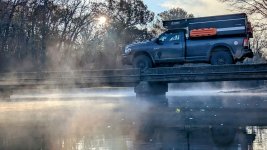
Crossing the Spavinaw Creek bridge on a frosty Oklahoma morning. The water level was a bit low during all of our crossing but that was fine with us!
GOAT 016.jpg

The weather became brutally cold for a few days so one of the nights we decided to take advantage of the Applegate Cove Campground on the shore Robert Kerr Lake. Our cost was $15 per night so once again I was able to plug into shore power and enjoy heat from my temporary electric heater. This is us posing for a group photo the next morning after taking long warm showers.
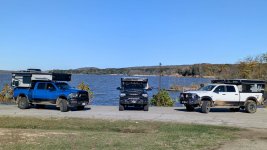
GOAT 017.jpg

A good trail will take you into places that require you to stop and think twice before continuing. We were on a maintained farm road with Paul leading when he stopped in the middle of the road and jumped on the radio stating he was not sure where to go. The area he was turning into was overgrown and seldom used, after a moment we could see some indication of a trail a bit in front of us so we continued.
GOAT 018.jpg

One of the primary rules I have on the trail is to constantly monitor my fuel state along with various other temperatures and pressures. I always begin a trail with a full tank of gas and once I drop below one-half tank, I begin to keep an eye out for a station nearby to refuel. Once I drop to one-quarter tank my mission immediately shifts to locating fuel. We were all just under one-half tank of fuel and we noticed Miami, just a few minutes off the trail, and it was time for lunch anyway. We topped off our tanks and enjoy really good burgers at Otter-Cove Diner, alongside historic Route 66.
GOAT 019.jpg

Near the end of the trail it became very dusty and slow so I opted to shift from tail-gunner to lead. My 6.4L Hemi was happy as the pace picked up on the home stretch - I was just on the ragged edge of communication with Dennis and Paul when out of the corner of my eye, I caught this beautiful sight. Immediately the following words came to mind...

And I saw Heaven opened, and behold a white horse; and He that sat upon him was called Faithful and True, and with justice doth He judge and fight. ~ Revelations 19:11

Yet another beautiful adventure came to a close with another 500+ miles of roads and trails taking us on an amazing tour of Green Country in Oklahoma. We have another week together before everyone goes their separate ways so we must talk about where to head next. Maybe we will cross the border and disappear into the Ozark Mountains once again, maybe not...
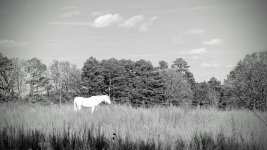
GOAT 020.jpg
 
Last edited:
Any opinions from the guy with the blue PW on his Palomino slide in? And what model is it?

I’ve been considering one of those for some extended travel with a bit of offroad, but nothing extreme. It’s obviously no Four Wheel Camper, but they’re also less than half the price.
 
Thanks again for joining me on my adventure - the clicks, comments, and interactions are always enjoyed!

Paul has enjoyed his Palomino camper but after a few years he is beginning to recognize the limitations for how he has begun to use it. In talking with Paul and sharing trails over the past two years I would break his concerns down into the following areas:

  • laminated roof
    • roof is thin laminate and susceptible to damage from tree branches so Paul avoids tighter trails
    • roof has experienced two leaks which had to be fixed in the field
  • electric roof lift
    • all four electric motors required replacement on the day the camper was installed
    • two electric motors have been replaced within the past year
    • two spare motors are carried
    • Paul is very familiar with disassembling and rebuilding motors in the field
  • overall construction
    • the Palomino is a nice camper but clearly not at the same level as a Four Wheel Camper
    • in general, after several years of use the camper seems to be encountering more problems, more frequently
    • it takes longer to deploy and pack-up the Palomino when compared to a FWC
  • size
    • the Palomino with AC up top, is 9'6" tall (for reference my FWC is 8'0" and Dennis is 8'3")
    • Paul has the model designed for mid-sized truck so the bottom is very narrow although there is excess space outside around the outside for storage

RC 24-146.jpg

The model Paul has is the Palomino SS-500 Backpack Truck Camper which we all agree is a really nice camper for the money. I guess what really matters regarding camper selection is how often do you plan to use it and how long do you believe you will keep it. This is my opinion so other owners may agree or disagree but if I were looking to purchase a camper at a reasonable price, for occasional use over the next 3-5 years, and spent most all of my time in campgrounds, maintained forest service roads, etc., I believe the Palomino is a great choice. Just keep in mind that even when exposed to light to moderate use you will be required to fix small issues on occasion and after several years it will begin to degrade.

As with most things in life - there are different solutions for different applications. It's not a matter of one being better better when compared to another - whats more important is how the item intends to be used and for how long. Here is a recent video from Paul so feel free to reach out to him for more detailed answers.

 
Last edited:
Wow, that was way more info than I was expecting. Thanks!

I wonder if there’s roof could be coated in bedliner to protect it? It would have course add some weight, but I’d think it would stand up to just about anything he could throw at it, while also preventing random leaks that “RV” roofs like that are prone to.

Shame about the electric lift motors. I wonder if there’s a better motor option out there that could be sourced.

Interesting choice on the mid-size truck camper. Makes it fit fully within the bed, but man, there is 0 floor space in there. I'm not sure that'd be an option for me as I'll have my wife and a 70 lb dog with me. We don't need a lot of space, but at least enough to walk past each other.

Given how we use our 27' travel trailer right now (80-100 nights a year, mostly out in the woods down semi-maintained forest service roads) I'd expect a slide in would be subjected to plenty of use under slightly rougher conditions. Our main plan for something like this is to go do Alaska and parts of Canada. Fixing small issues isn't a problem for me, since I'm used to that from years of travel trailers, but obviously I need something to not completely fall apart. A 4WC would probably be the best way to go, but man that price tag is painful. I wonder if there's something that falls somewhere in the middle.
 
Wow, that was way more info than I was expecting. Thanks!

I wonder if there’s roof could be coated in bedliner to protect it? It would have course add some weight, but I’d think it would stand up to just about anything he could throw at it, while also preventing random leaks that “RV” roofs like that are prone to.

Shame about the electric lift motors. I wonder if there’s a better motor option out there that could be sourced.

Interesting choice on the mid-size truck camper. Makes it fit fully within the bed, but man, there is 0 floor space in there. I'm not sure that'd be an option for me as I'll have my wife and a 70 lb dog with me. We don't need a lot of space, but at least enough to walk past each other.

Given how we use our 27' travel trailer right now (80-100 nights a year, mostly out in the woods down semi-maintained forest service roads) I'd expect a slide in would be subjected to plenty of use under slightly rougher conditions. Our main plan for something like this is to go do Alaska and parts of Canada. Fixing small issues isn't a problem for me, since I'm used to that from years of travel trailers, but obviously I need something to not completely fall apart. A 4WC would probably be the best way to go, but man that price tag is painful. I wonder if there's something that falls somewhere in the middle.

The pleasure and privilege are mine!

Although the bed liner being applied to the roof sounds like it might work my concerns are twofold. One, you already pointed out the additional weight, and those electric motors already struggle to lift the existing roof. And second, how would that impact repairs in the future because we can all agree that virtually every roof has a lifecycle with membrane types being much shorter when compared to metal. Personally, I am a strong proponent of Ockham's Razor which states the simplest solution is usually the best one. In this case, there is no need to add complexity to a faulty system, the best solution is to identify a better solution such as a camper with a one-piece metal roof. Problem solved.

The electric motor and telescopic shaft lifting system is a flawed design and should be scrapped. Again, they are creating a system that is unnecessarily complex and prone to failure and this is for a system that will be used away from home, in a remote location. And the main reason it is necessary is because the roof assembly is too heavy to be lifted manually. Do you see the path of failure where one poor design feature leads to another? Paul has been stranded several times where he was unable to lower or raise his roof and there is no manual way to override the system. When you are arriving or departing camp for a fun weekend or hitting the trail, that is the worst time to encounter an issue with raising or lowering the roof.

And you are correct regarding floor space - even with Paul alone being in there, he always complained about the lack of space. Since you already have a really nice travel trailer you might wish to consider a FWC Hawk of Grandby shell. Both of those are under $20k brand new and there is a ton of room. Like me, you can add when you need, when you need it. Or keep is simple and open for maximum flexibility. Anyway, I do wish you the best and happy trails!
 
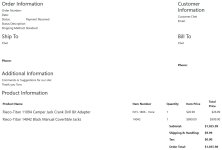
When I ordered my Four Wheel Camper back in late 2020, I did not see the need for camper jacks since I planned on having the camper permanently installed and never removing it. Well, one of the reasons I have been delaying my electrical upgrade has to do with me not being able to remove the camper and perform the necessary work. Sure, I could run the wires around here or there but I want to avoid sloppy shortcuts and perform the best installation. This same inability to remove the camper and perform work has also delayed the permanent installation of my on-board air system and diesel heater/stove. With this in mind, I finally bit the bullet and purchased camper jacks.

Along the way I considered purchasing used ones, identifying another manufacturer, or even making them myself. In the end, a set of four Rieco-Titan Convertible Jacks (black) appeared best for me. I guess my only consolation is the fact that if I had purchased the set of four originally from Four Wheel Camper, they would be white and not convertible (to electric). The great thing is now I will be able to safely uninstall and reinstall my camper when I visit my home and need to perform upgrades or preventative maintenance. It cost a few dollars but in the end, this is the safest and best solution for me.

RC 24-150.jpg

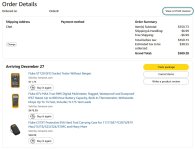
And since I will be revising and upgrading my entire electrical system it was also necessary for me to purchase a few additional tools to support my work. As some of you may know, I am more of a mechanical guy than an electrical one, so I have never owned a good multimeter. Over the past year or so I have been planning what electrical upgrades, and maintenance, I would be performing, and what specialized tools would be required. Of course there have been various wire cutting and crimping tools I have purchased but at the top of the list has always been a respectable multimeter.

After much research and consideration it became apparent that for my immediate and future needs, a Fluke 87V MAX True-RMS Digital Multimeter would satisfy all of my requirements, and then some. This is a good tool for general automotive and home maintenance. I also ran my selection by a close friend who is an electrical genius and holds fifty patents for precision electro-mechanical devices and he assured me that this tool would deliver everything I required, and then some. I am also a big proponent of protecting sensitive instruments so I did not hesitate to include a Fluke C37XT Protective EVA Hard Tool Case in my purchase. This case has enough room so that I will be able to safely store my multimeter and other support equipment in the case.

One more small addition to my order was the Fluke ST120 GFCI Socket Tester and it was purchased so that I am able to perform a quick and basic test on electrical outlets at campgrounds or other power sources. Probably my worst nightmare would be plugging my upgraded electrical system into an unknown and untested power source and it becoming damaged or creating a fire. Yes, I realize the chances of either happening are small although quickly plugging in a $18 socket tester will provide me with some assurance. If I am still in doubt and really need the power, I can always use my multimeter to perform additional testing. And it will also help to identify if the circuit is live or not since there have been a few times where I have pulled up to a power source only to discover it was dead and this was after pulling out my extension, plugging it in, etc.

All things considered, these tools will help me during my upgrades and scheduled maintenance, but they will also be used to reduce the chances of damaging my system when plugging into an unknown power source. They are cheap insurance.

RC 24-151.jpg

Here is a Fluke video with a general overview of the 87V MAX:

And here is a video detailing how to perform basic component checks with the 87V:

And finally, here is video discussing secret function on the 87V multimeter:
 
Last edited:
If you don't already have an onboard EMS, I'd suggest getting a plug in portable one as it will not only test for faults before turning on, but provides constant surge and fault protection. I prefer the plug in over onboard as I know I can bypass if needed. As I understand, not all onboard have bypass capability. It also serves as a tester for all faults possible. I know it's potentially saved us damage to our systems when I've rolled up on site's that have open grounds, neutral faults, etc.
 
Agreed on the EMS. Those things have saved my electrical system more than once. I consider them a requirement for a system that is getting plugged into unknown grids. My personal go to is anything from Progressive.
 
Agreed on the EMS. Those things have saved my electrical system more than once. I consider them a requirement for a system that is getting plugged into unknown grids. My personal go to is anything from Progressive.

I have the portable Progressive 50A for my RV.

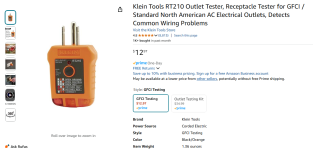
For a small 5-15 tester, I have one of these Klein tools I keep handy.

1734821873445.png
 
The day after completing the Green Country Oklahoma Adventure Tour we crossed back over from Oklahoma into Arkansas and returned to Tyler Bend Campground along the Buffalo National River. Although this was a campground with showers and flush toilets within a National Park and normally there is normally a fee to camp, if you visit during the off-season (November 15 - March 15) you may stay for free. After performing some additional research using the graph for a NOAA gauge located at our first river crossing at Saint Joe, it was decided that we should scuttle our plans for the Ozark Overland Adventure Trail and make other arrangements. We had spoke with locals and most agreed that the Saint Joe river level was a critical measurement and generally, it represents one of the deepest of several dozen river crossings.

From what I was able to gather, the few locals we spoke with agreed that a river level between 2.5 to maybe 3.5 feet was okay but above that level would lead to problems. Although we plan to return to complete the OOAT one of these days one thing I plan to complete would be additional research on the river levels during different times of the year. As you can see from the graph below there was a significant flooding event in early November and it appeared to still be impacting the local river system.

RC 24-152.jpeg

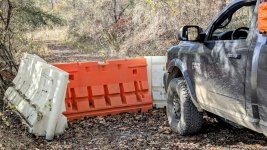
Since our campground was just a few miles from the beginning the the trail we decided to drive down to the Buffalo River crossing at Saint Joe to confirm how accurately the gauge measurement reflected the actual depth at the crossing. Within a few hundred yards of the river we encountered these barriers and although we were all somewhat disappointed, we were also happy that none of us ended up fifty miles deep into the Ozark Mountains, during very cold weather, broke down or stuck.
RC 24-153.jpg

As you might have expected, I had yet another plan in place so after scrubbing the OOAT we hit the road and began to knock down some miles. Along the way we stopped into a nice Mexican restaurant for lunch and I took advantage of snapping this funny picture of Dennis and Flor. The great thing about overlanding is it represents the essence of vehicle based adventure and exploration. It's not just rugged trails with a mixture of campfires and primitive food and drink. It's a little bit of everything to include eating in restaurants, sleeping in motels, and driving on pavement. Overlanding is more about the spirit of adventure and exploration than big fancy rigs with satellite connectivity so don't limit yourself because you don't have this or that - just get outside and go places. Have fun and seek the joy in life.
RC 24-154.jpg

The sun has begun to set on the shore of Lake Columbia in SW Arkansas near the borders with Texas and Louisiana. It's warmer down here and life moves just a bit slower - everything feels good. Many thanks to Paul for finding this location and I guess this is a good time to discuss group size for events such as this. Over the past three decades of off-roading and now overlanding, I have noticed that there are three major metrics that generally define how long it will take to accomplish a trail - they are trail length, trail conditions, and size of group. It's easy to see how trail length and conditions impact the speed of travel but many people do not accurately consider how group size can slow down, or speed up, a trail.

On long trails, with a group, I usually like to cover at least 50-75 miles per day which is a fairly quick pace but keep in mind some of the group members have a limited amount of time. For me, two or three vehicles total seems to work best. As mentioned in my Green Country Oklahoma Adventure Tour, there are also minor metrics that impact the speed of travel on the trail but these deal more with individual vehicles and include driver experience level, vehicle configuration, and overall goals. Within a small group it is easy to make adjustments for these minor metrics although the larger the group becomes the more complex the solutions must become. If I was to lead a large group I guess the most logical solution would be to create smaller sub-groups that share many common traits. Send the most experienced and fastest group off first, followed by the next fastest, etc.
RC 24-155.jpg

You may notice I occasionally like to include pictures of the stars. I guess the reason I do it because many of the areas I find myself in have very limited amounts of light pollution so I am able to view the heavens much like our ancestors have for thousands of years. There is something primitive and beautiful about being outside on a very dark night, enjoying the silence, and the beautiful show above. I smile knowing that I am literally looking back in time, with my naked eyes, at light that began traveling from stars between five and fifteen thousand years ago. Yes, there are many much farther but we are unable to see them with our naked eyes. I would encourage you to get outside when there is no moon, and find a place with low light pollution - here is a map to help you.
RC 24-156.jpg

So, here is another funny story-within-a-story; we pulled into a populated area in Arkansas to gas up and Matt from Ozark Overland Adventures happened to see us rolling by so he stopped in to say hello, ask where we were heading, and chat it up a bit. I had met Matt for the first time at the 2022 Rendezvous in the Ozarks and spent an evening sitting around the fire. In general, I think he is a nice guy and provides some semi-useful information since he hit trails frequently and has been able to put hands on a wide variety of equipment - much like a overland shop. Well, that sounded quite inflammatory...semi-useful information!

Why do I use the term semi-useful? I guess my main gripe is all these social media influencers, not necessarily Matt, pass themselves off as independent and objective, yet they do this for a living and are being paid or compensated for their work. Again, kind of like a dealer - "of course, the aftermarket lights I have available are the greatest!" I'm sorry, money influences people, some more and some less; money has an unfair impact on virtually everyone it comes into contact with. And to rub salt into an open wound, in general they have limited experience with the products they promote or the real world application and use of the products. After talking with a few key influencers face-to-face, I have been shocked to hear that when the produce a report on a popular trail they often only complete sections, not the full trail. And it's even more frustrating to see them promote gear and equipment after "testing it" or "using it a few times." My gosh, people are preparing to spend their hard-earned money! I guess it's just a numbers game to some, more companies, more equipment, more sections of famous trails, and more videos with click-worthy tags equals more cash.

Throughout my career I have been accustomed to receiving and sharing information with subject matter experts - maybe this is why I am a bit biased. Me, I like to complete entire trails because guess what - the primary reason I am out there is to enjoy the trail and have some fun. I may snap a few pictures and share a few paragraphs with friends and family but I certainly am not doing any of this for money or compensation of any sort. I am doing this because I love what I am doing and hope to encourage others to get out and adventure. Maybe some day I will talk about how my choices of equipment or upgrades have worked over the past few years, maybe not. But rest assured, every single piece of my vehicle and upgrades have been selected and paid for by me - no discounts, no buddy deals; just a man who worked hard, saved a few bucks to spend hitting the trails and having fun. And sharing a few pics and paragraphs...
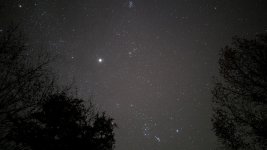
Man is enslaved by vanities and luxuries. He forgets that happiness is in the simple things. ~ Don Quixote​

RC 24-157.jpg
 
Last edited:
For the past year or so I have been wrestling with exactly how I would permanently install my Wallas NORDIC DT diesel heater/cooktop, Victron Energy electrical gear, and ExtremeAire Magnum compressor with ARB 1-gallon aluminum air tank. The standard solution would be to purchase plywood, cut it up, apply wood veneer, and that would work just fine - but it weighs quite a bit and is susceptible to moisture, and in the case of a fire, it provides more fuel. Ideally, I desire something that would help contain an unexpected diesel or electrical fire since I sleep inside my vehicle every night - some times with the heater running, and always with a live electronic system.

The picture below is of a buddy, Todd Greenberg (Go Native Overland), who suffered burns over the majority of his body and lost his two dogs in an overland vehicle fire in early September of this year. Interestingly, earlier this year I completed the 1,358 mile Five Tribes Overland Trail (part one / part two) that was created by Todd. He is a really good guy who coordinated helping me when I experienced my first irreparable flat in the middle-of-nowhere, Texas. I'll pray for Todd tonight and look forward to joining him on a trail somewhere soon.
RC 24-161.jpg

I considered working with a custom metal fabricator back home in Virginia that is really good but the logical side of me argued against that. When producing a one-of-a-kind product in a metal fabrication shop it takes much time so the price is very high and since this is the first time the initial prototype may not be the best overall design. With that in mind I shifted my focus to searching for a product that was mature, produced in large volume, was light, durable, and available right now.

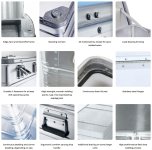
For years I have owned and used my seven Zarges heavy duty aluminum cases (three 40568 / four 40678) and they have never let me down - I exercise them daily. Naturally, I began to consider the possibly of using Zarges once again since they met virtually all of my criteria but there was one catch, would they have the correct size for my application. The good thing is that the K470 lineup has thirty different sizes available. Here are some details provided on their site:

RC 24-159.jpg

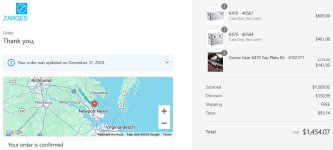
For this application I selected one 40564 and one 40567, along with two Goose Gear top plates for my 40568s. The 40564 (23"L x 15"W x 16"H) will possibly house a small sink, water pump, and dispenser, on the passenger side to the rear. The 40567 (39"L x 19"W x 16"H) is much larger and will contain the Wallas unit along with most of the Victron Energy gear and be placed on the drivers side towards the rear. One of my goals was to separate all of the electronic equipment from any water source while also containing it in a largely fire-proof container just in case. If an unexpected spark or overheating of an electrical component does take place I would much rather have that occur inside a sealed metal container than a wooden structure.

Many are shocked when they initially view the prices but if you are looking for a permanent storage solution that has proven itself worldwide in every condition, and can be passed down to your offspring, there is none better than Zarges. If you are unsure of what they are able to withstand - I visited Zarges USA two years ago and examined two abused but fully functional cases that had traveled the world for three-plus decades.

RC 24-158.jpg

My most critical measurement for this application was the overall height of the installed containers since their top surface would be used as a work space while standing in front and cooking, cleaning, etc. For kitchens a height of 36" is preferred while in industrial applications 33-36" is an acceptable range; some say the height of your hip should be flush with the top. Since the height of the shelf along the interior of my Four Wheel Camper was fixed at 21.75" these cases end up with an acceptable 37.25" top surface height. If I were going to be standing there for many hours ever day, I might make some modification but for my intermittent use, a surface height of 37.25" should be fine.

The Goose Gear tops have been on my mind for a few months now since there have been times when I wanted a flat surface on top of my 40568s for preparing meals, a shelf for my laptop, etc. They were only a few dollars more and there was a bit of savings to be recognized so what the heck - we will try them out and see how useful they are for what I do. It may have taken me quite some time to decide upon this solution but I think it is the right one for me. These are premium commercial off-the-shelf aluminum cases and delivery will take place within days, they may not perfect, but are well above good enough for this application. What I really like is the fact that they are durable, lightweight, and I can easily pop the top to examine and perform maintenance on the equipment mounted inside. They also offer a level of protection from bad things happening outside, like water, and inside, like fire, should something unfortunate take place.

Here is the Goose Gear top plate - picture taken by Goose Gear:
RC 24-160.jpg

Through the years I have noticed that in general there are two categories of overland folks: one is the builder while the other is the adventurer. Of course there is always some degree of overlap and one is should not be considered superior to the other. For some, the project itself is the joy - creating something, building it over months or years, and then finally completing it! For others, their joy is found outdoors and the technical details and project completion are not that big of a deal - they love exploration and adventure! Me, I guess I'm maybe 20% builder and 80% adventurer - sure, I like projects and such but at this point in my life, I just wanted to cobble something together and hit the trails.

Sometimes we need to step back and reassess what we are doing and how we are doing it: are you a builder who loves projects or an explorer who melts into the forest, mountains, and desert? Again, there is nothing wrong with either one...

And here are a few videos which provide additional details regarding the Zarges cases:


Last edited:
The Arkansas Overland Route - Trail Hawk Loop

Life is funny sometimes and when things take an unexpected turn, I just laugh. Dennis, Paul, and I had been planning the Ozark Overland Adventure Trail for a good portion of the past year, had set a few weeks aside to complete it, and now we were exploring two different trails that only one of us had ever heard of. But you know something; what really mattered was that we were together, having fun adventuring and exploring, knocking down hundreds of miles over dirt and gravel roads, stopping to visit interesting museums, experiencing local culture and cuisine, and creating wonderful memories. Folks, it's not so much about the trail, or the rigs, or how many expensive shiny parts someone has, it's mainly about a small group of people spending time together, outdoors for most of the time, relaxing, smiling, laughing, and living life.

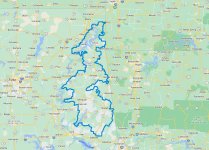
The Arkansas Overland Route Trail Hawk Loop is 461 miles long, starts off HWY 82 near Falcon Bottoms WMA , circles the Ouachita River from Moro State Park, and ends back at Moro State Park. This adventure will require a long weekend and there is plenty of dispersed camping and two state parks. This route has mixed terrain and difficulties and although most of the trail is gravel and dirt, there are sections of pavement. The gravel/dirt roads can be flooded, muddy, with ruts, dusty and/or unmaintained - some water crossing or reroutes could be possible. This is not a off-roading route where obstacles are the goal but a overlanding route that puts some dirt road miles under your wheels. There are places to restock, refuel, and grab a bite to eat if so desired.

If you use onX Offroad you can find a link here.

AORTHL 001.jpg

With Dennis needing to depart within a few days we were not sure if he was going to complete the entire trail but we were a bit farther south, enjoying slightly warmer weather, and there were many opportunities for Dennis along this route to jump off, hit pavement, and begin his trek home. Shortly after this picture was taken we drove down a spur to explore a waypoint titled "oil derrick and oil." We passed an older man alone in a truck while driving in towards the oil derricks, and on the way out another younger man rushed in driving another truck, pulled broadside to block our exit, and stepped out to have a few words with Paul, who was in the lead vehicle.

We were spread out just a bit and as I pulled up I sensed something unusual was taking place. As I contemplated stepping out and walking forward to better understand why this young man felt the need to block our travels Paul radioed back that everything was resolved and we would begin rolling in just a moment. As I drove by I slowed to make eye contact with the two scoundrels, and it was beyond obvious to me that these boys were back here hiding something in the woods and were up to no good. Thinking back, those few moments were like a scene in a movie where there was an immense amount of tension with everything just on the verge of breaking loose. Me being retired military and somewhat hyper-vigilant, I'm always prepared to jump into the ring and kick some sand.

Be polite, be professional, but have a plan to kill everybody you meet. ~ General James Mattis

AORTHL 002.jpg

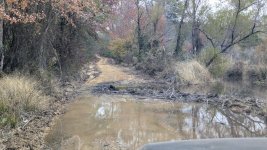
Although the trail was turning out to be a relaxing ride through the forest occasionally there were surprises such as this muddy and watery section. If you plan to explore the wilderness my recommendation is for you to first purchase these three items:
  • one engineered extraction point on the front of your rig and one on the rear
    • if your five to ten thousand pound vehicle becomes stuck, the only safe place to hook to is an engineered extraction point
    • it's best to have two factory tow points up front
    • a hitch can be used for the rear but just make sure to have proper rigging
  • a recovery gear set
    • extraction points do not good if there is nothing solid to pull on
    • spend the few dollars and start off with gloves, a kinetic strap, add a few shackles, then a tree saver, maybe a static strap also
    • of just purchase a complete recovery kit and have everything that is necessary
  • an electric winch
    • you can buy the ultimate lift, lockers, huge tires, and still become stuck
    • an electric winch will always save you when you only need to be pulled s short distance occasionally
    • if you are into long pulls that are endless, invest in a hydraulic winch like I used back in the 90s

AORTHL 003.jpg

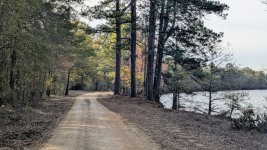
Along the trail there are a number of disbursed and organized camp sites which are marked on the map using waypoints. This evening we decided to drive a few more miles and camp along the bank of the Ouachita River.
AORTHL 004.jpg

The next day we were off and running with Paul in the lead, Dennis in the middle, and me bringing up the rear. I enjoy pushing others to take charge, make decisions, and lead our team since most of the time when nothing is moving I just naturally take the lead and make things happen - it's been that way most of my life. It's good to switch things around on the trail so everyone is able to experience different roles and develop a wide range of skills such as navigation, logistics, communication, where to camp, meal selection or preparation, etc.

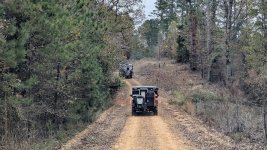
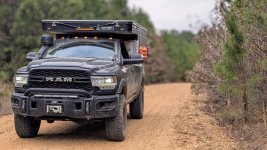
Nothing fancy here, just truck on a dirt road.
AORTHL 005.jpg

I'm sure I have ever met anyone who has talked much about overland adventures in southern Arkansas or Louisiana but if you are anywhere between Little Rock, Arkansas; Shreveport, Louisiana; and Jackson, Mississippi; I would encourage you to give this trail a try. I'll never forget when we rolled into a small town to gas up and an older local man confronted Paul and just asked him - what are you doing here? My guess is that not too many folks pass through in a Power Wagon with Massachusetts plates hanging on the bumpers.
AORTHL 006.jpg

These ruts reassured me that this section near the infamous Hooker Hole can get really wet and sloppy at times. We all took note of this area and talked on the radios about how happy we were it was beat-up but dry right now - it didn't look pretty but we were only here temporarily. This is definitely one small section that could prove to be a full day of fun when wet since it stretched for miles.
AORTHL 007.jpg

Well, it was time for Dennis and Flor to begin heading back east so we decided to jump off the southern end of the trail and stop into Monroe, Louisiana, for a farewell dinner. It was late in the day and although Dennis planned on hitting Interstate 20 for a few miles we convinced him to find a nice hotel nearby, shower up, warm up, and relax for the evening. Paul and I checked a few nearby spots to camp but we really wanted to be back out camping the wild under the stars. The picture below was taken at Cheniere Lake Park in West Monroe, Louisiana, which was one of the places we initially checked.

Paul and I drove an hour or so to the north and spent the night near a boat ramp in the D'Arbonne National Wildlife Refuge. We pulled into a nice level spot deep in the woods, stepped out of our rigs, and smiled. Even though we were only in town for a short period - it felt good to be back out in the wilderness. The more time you spend out exploring the better you become at scanning a map to identify potential camping spots.
AORTHL 008.jpg

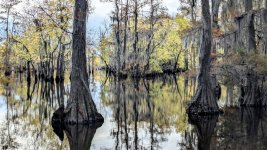
A few hours and many miles later we drove down another spur trail and ended up at Lake Georgia Pacific, in Arkansas. It looked like a great place to camp but it was just a bit too early for us to stop and we were motivated to wrap up the trail soon. We continued the trail and began to head north on the final leg of our journey. With only two vehicles we were moving just slightly faster and combined with our desire to complete the trail, we were making good time.

While traveling I am always checking maps for key phrases such as National Forest, State Park, etc. It was lunch time and I noticed Chemin-A-Haut State Park was not too far away so I radioed Paul and suggested we stop there for an hour or so to relax and enjoy a meal. While exploring new places I always take time to ask questions and learn a bit so while rolling into the park I asked the Ranger what Chemin-A-Haut meant. She smiled and said it was a blend of Native American and French that meant "high road."
AORTHL 009.jpg

Dennis had already departed and was heading back to Delaware, Paul had plans to be in Florida soon, and I was heading to I-don't-know-where. Our hearts take us on wild and unpredictable journeys throughout life and create memories so strong, sometimes we just can't shake them. I'm not sure when it will be, or who it will be with, but I'm going back some day...
AORTHL 010.jpg
 
Last edited:
Back
Top