What's new
Ram Heavy Duty Forum

Register a free account today to become a member! Once signed in, you'll be able to participate on this site by adding your own topics and posts, as well as connect with other members through your own private inbox!

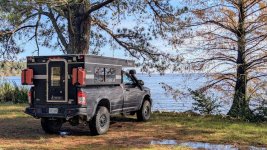
2021 RAM 3500 Tradesman | AEV Prospector | FWC Grandby

The truck on the dirt road pic looks like a model car/ toy. I love however you edited or shot that photo.

Thank you for your compliment @Rockcrawlindude and just in case you are interested in learning more, I will layout the steps I took from the original photo to the finished one.

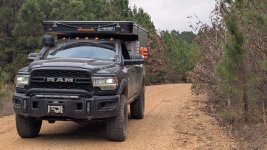
Here is the original photograph taken by me on a Google Pixel 7 cellular phone that I carry. If was in December 2022 that I decided it was time for a new phone and since I was taking more pictures and sharing them I took time to research which particular phone provided best picture quality for the lowest price. This led me to a review of the Pixel 7 published at DXOMARK which I had used previously when purchasing semi-professional DSLR cameras and professional lenses. And no, I don't carry around all of my gear since it's big and bulky, and since I live in my truck that makes it a prime target for theft - I keep it simple.

Anyway, the original picture looks okay and maybe around 35% of the time I publish a picture as-is. Sure, this would work but a minute of two of editing might make it look a bit better.
RC 24-162.jpg

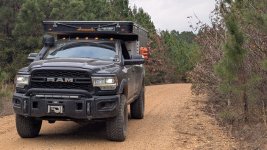
This is my most common modification to a picture - cropping. When I step back to compose a picture I always like to leave a bit of room around the edges in case I want to crop and tighten things up, or move my primary object just a bit. In this case my goal was to move the truck up more towards the viewer and farther towards the edge so give it a more imposing presence.
RC 24-163.jpg

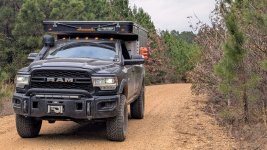
This picture may appear to be identical to the one above but if you look just to the right of the bed, in the shot above, you will see two tiny sticks laying horizontally in the gravel - one is close to the truck and the other much farther back. These are not a big deal but since they are alone and isolated they might draw your eye away for a moment so you can verify what that tiny irregular object is. I would say that in maybe 10% of the picture I publish have something edited out - it may be a stick, or a random telephone pole against a clear blue sky, or maybe even a single person sitting at a picnic table at a park. Sometime I like to clean up the scene a bit to avoid distractions.
RC 24-164.jpg

Next I enhance the nearly complete picture just a bit to make it seem more alive. Although camera sensors are really good they are still far off compared to our human eyes that are able to process a nearly endless number of relationships between bright lights and shadows, subtle variations in color, depth of field, etc. I would say enhancement of the contrast and color is the most common post-processing technique I perform, along with cropping, and this is done to the majority of my pictures. If you study the pines to the rear, the grill of my truck, the brightness and contrast of the gravel in the road, and compare them against the picture above - you will see just a touch of difference.
RC 24-165.jpg

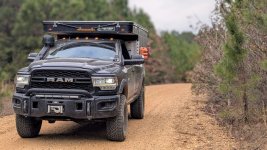
And finally, in this case, I attempt to digitally control the depth-of-field and blur the background to once again, draw attention to the main object in this photograph, the truck. This technique is common with traditional cameras where you are able to adjust the control the depth-of-field through manipulation of the shutter speed, ISO, and most importantly, the aperture. The Google Pixel 7 has a feature called "portrait blur" where you are able to identify the object to keep in focus, and adjust the depth, and amount of blur, around it. I believe this was mainly intended for portraits of people where you soften everything around them except their face but it also seems to work on objects such as a truck. It is rare that I use this feature but once in awhile I pull it out and see how it looks. In this case, I liked it and figured you might also. Happy trails!
RC 24-166.jpg
 
Last edited:
Thank you for your compliment @Rockcrawlindude and just in case you are interested in learning more, I will layout the steps I took from the original photo to the finished one.

Here is the original photograph taken by me on a Google Pixel 7 cellular phone that I carry. If was in December 2022 that I decided it was time for a new phone and since I was taking more pictures and sharing them I took time to research which particular phone provided best picture quality for the lowest price. This led me to a review of the Pixel 7 published at DXOMARK which I had used previously when purchasing semi-professional DSLR cameras and professional lenses. And no, I don't carry around all of my gear since it's big and bulky, and since I live in my truck that makes it a prime target for theft - I keep it simple.

Anyway, the original picture looks okay and maybe around 35% of the time I publish a picture as-is. Sure, this would work but a minute of two of editing might make it look a bit better.
View attachment 80871

This is my most common modification to a picture - cropping. When I step back to compose a picture I always like to leave a bit of room around the edges in case I want to crop and tighten things up, or move my primary object just a bit. In this case my goal was to move the truck up more towards the viewer and farther towards the edge so give it a more imposing presence.
View attachment 80872

This picture may appear to be identical to the one above but if you look just to the right of the bed, in the shot above, you will see two tiny sticks laying horizontally in the gravel. These are not a big deal but since they are alone and isolated they might draw your eye away for a moment so you can verify what that tiny irregular object is. I would say that in maybe 10% of the picture I publish have something edited out - it may be a stick, or a random telephone pole against a clear blue sky, or maybe even a single person sitting at a picnic table at a park. Sometime I like to clean up the scene a bit to avoid distractions.
View attachment 80873

Next I enhance the nearly complete picture just a bit to make it seem more alive. Although camera sensors are really good they are still far off compared to our human eyes that are able to process a nearly endless number of relationships between bright lights and shadows, subtle variations in color, depth of field, etc. I would say enhancement of the contrast and color is the most common post-processing technique I perform, along with cropping, and this is done to the majority of my pictures. If you study the pines to the rear, the grill of my truck, the brightness and contrast of the gravel in the road - you will see just a touch of difference.
View attachment 80874

And finally, in this case, I attempt to digitally control the depth-of-field and blur the background to once again, draw attention to the main object in this photograph, the truck. This technique is common with traditional cameras where you are able to adjust the control the depth-of-field through manipulation of the shutter speed, ISO, and most importantly, the aperture. The Google Pixel 7 has a feature called "portrait blue" where you are able to identify the object to keep in focus, and adjust the depth, and amount of blur, around it. I believe this was mainly intended for portraits of people where you soften everything around them except their face but it also seems to work on objects such as a truck. It is rare that I use this feature but once in awhile I pull it out and see how it looks. In this case, I liked it and figured you might also. Happy trails!
View attachment 80875
Almost gives it that tilt-shift effect but don't know if any decent in phone processing is available for that in any of them.
 
Have you ever taken the time to research tire chains?

A few years ago I began collecting information on the subject and talking to people occasionally - nothing big, just a bit of information here and there. Last fall and winter I spent all my time down south with much of it being spent out in Arizona, California, and New Mexico, and Texas, so there was no real need for chains at that time. Interestingly, there were a few mountain passes out west I passed through which had designated areas to install snow chains when required.

Roads such as the one below are not necessarily bad although growing up in the Great Lakes region and learning to drive through feet of lake effect snow taught me that conditions change quickly and it is always a good idea to be prepared for the unexpected. Through the years I have run summer radials, all-terrain, mud-terrain, studded tires, and chains - on and off road in all sorts of conditions: snow, ice, frozen ground, slush and mush, mud, etc.
RC 25-001.jpg

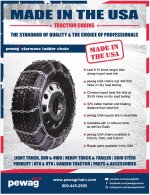
This time my goal was to procure quality chains that would last me for several years, had repair parts available for purchase, and were routinely used by professionals. It may have taken me a few years but it sounds like I found a solid company with a great history and reputation that are experts in all sorts of chains to include tire chains. Allow me to introduce you to the company pewag, the leading supplier of traction chains worldwide, who began a forging plant in Brueckl, Austria in 1479.
RC 25-002.jpg

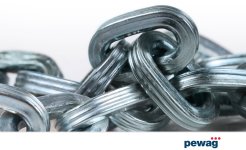
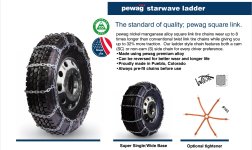
Here is a closeup of their premium alloy square link which is available in 7.0 and 8.2 mm for my tire size (37"x12.5"x17"). Note the grooves in the links which provide additional traction.
RC 25-003.jpg

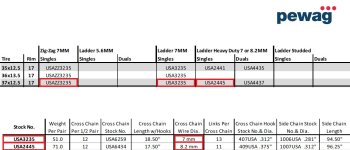
This morning was decision time and I spent around one hour on the telephone with the regional representative from pewag discussing my specific requirements along with the pros and cons of each type of chain configuration available. The Zig-Zag 7.0 mm singles (USAZZ3235) were the first to be removed from consideration mostly due to their high price and focus on smoothing out the ride. The representative explained that if I had a smaller car sized tire and drove frequently on chains this would be a great choice due to their comfortable ride and more affordable price for regular sized tires.
RC 25-004.jpg

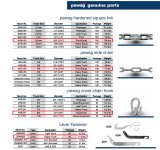
Edit - here is some additional technical information to supplement the picture above.
RC 25-008.jpg

The Ladder 7.0 mm Singles (USA3235) seem best overall and were my top choice prior to speaking with the representative. If I expected most of my chain use to be on paved roads that were packed snow or ice I believe these would be the best choice but when I shared how much time I spend off-road the representative he agree that there was an even better choice.
RC 25-005.jpg

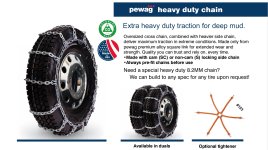
My ultimate choice were the Ladder Heavy Duty 8.2 mm Singles (USA2445) based upon my projected use of 25% on road and 75% off-road. The 8.2 mm square links are larger and provide more of a paddle type of traction off road compared to the 7.0 mm links plus I drive a heavy duty 3500 truck. We both agreed that for mostly off-road exploration these would benefit me in snow, mud, and sand, although the tradeoff might be a slightly rougher ride on pavement. We then took into account the weight of my vehicle and size of my tires and the representative agreed that even on road my ride should be acceptable.
RC 25-006.jpg

For reference, here is a copy of my order placed through etrailer. The Ladder 7.0 mm Singles were approximately 25% less cost compared to the 8.2 mm that I selected although I judge the additional cost worth it for my intended use. You can also see I also included two pair of the Glacier Tire Chain Tensioners since they were only a few dollars more and recommended by many.
RC 25-007.jpg

Here is a video that provides a nice overview of pewag:

 
Last edited:
One thing we did with chains back home in Montana was to add additional cross chains.

Standard most chains have three unused side chain links between each cross chain. We added another cross chain centered between the original cross chains.

I also prefer just a hook on the inside side chain rather than a coupler/latch.

Another good idea is to make the outside side chain a few links longer so that if stuck you can drop the chains over the tire and still get them fastened.

It’s best to get chains for all four corners.
 
I’m sure you have considered this, but do you think you will have any rubbing while using the chains on the front? Square link chains bite better but also stand up more on the tire which may increase the chance of rubbing.
You bring up a very valid point and it will be interesting to see if there is any rubbing at full lock. My guess is that the closest point would be the control arm that runs between the frame and axle. Since the AEV rims and BF Goodrich tires are key engineered components within the suspension system, when AEV designed the package they should have taken into account the use of snow chains. Ultimately, if there is any contact that can be alleviated by making a series of shallow turns instead of locking the wheel to the side.

One thing we did with chains back home in Montana was to add additional cross chains.

Standard most chains have three unused side chain links between each cross chain. We added another cross chain centered between the original cross chains.

I also prefer just a hook on the inside side chain rather than a coupler/latch.

Another good idea is to make the outside side chain a few links longer so that if stuck you can drop the chains over the tire and still get them fastened.

It’s best to get chains for all four corners.

Thanks for your reply - when I talked with the pewag representative I did ask about the Double Spaced Ladder 7.0 mm Singles (USA3235S-DS) and he surprised me by stating that they didn't add as much additional traction as compared to how they smoothed the ride since there were more links. The Double Spaced are advertised as "excellent traction in extreme conditions...in snow, ice, and mud" whereas, the Heavy Duty I opted for are designed for "extreme conditions and in boggy off-road areas." The Double Spaced also cost $93 more per pair and weigh a ton more.

The inside of these are designed with a hook while the outside uses a latch.

And you bring up a good point - extra links on the outside chain. This one has them and the pewag representative strongly encouraged me NOT to cut off any excess links since those links may be needed in certain conditions. He said with some folks they fit the chains to the tires in ideal conditions such as a perfectly level vehicle on a garage floor and then cut off the excess links. Again, he strongly suggested that I leave the additional links that can aid in installation in the field. He also suggested carrying around small zip ties to secure the additional links if there was any concern.

And yes, I purchased chains for all four corners and I'm looking forward to reporting on how effective they are.
 
Last edited:
You bring up a very valid point and it will be interesting to see if there is any rubbing at full lock. My guess is that the closest point would be the control arm that runs between the frame and axle. Since the AEV rims and BF Goodrich tires are key engineered components within the suspension system, when AEV designed the package they should have taken into account the use of snow chains. Ultimately, if there is any contact that can be alleviated by making a series of shallow turns instead of locking the wheel to the side.


Thanks for your reply - when I talked with the pewag representative I did ask about the Double Spaced Ladder 7.0 mm Singles (USA3235S-DS) and he surprised me by stating that they didn't add as much additional traction as compared to how they smoothed the ride since there were more links. The Double Spaced are "excellent traction in extreme conditions...in snow, ice, and mud." whereas the Heavy Duty I opted for are designed for "extreme conditions and in boggy off-road areas." The Double Spaced also cost $93 more per pair and weigh a ton more.

The inside of these are designed with a hook while the outside uses a latch.

And you bring up a good point - extra links on the outside chain. This one has them and the pewag representative strongly encouraged me NOT to cut off any excess links since those links may be needed in certain conditions. He said with some folks they fit the chains to the tires in ideal conditions such as a perfectly level vehicle on a garage floor and then cut off the excess links. Again, he strongly suggested that I leave the additional links that can aid in installation in the field. He also suggested carrying around small zip ties to secure the additional links if there was any concern.

And yes, I purchased chains for all four corners and I'm looking forward to reporting on how effective they are.
Go out there and get stuck!
 
You bring up a very valid point and it will be interesting to see if there is any rubbing at full lock. My guess is that the closest point would be the control arm that runs between the frame and axle. Since the AEV rims and BF Goodrich tires are key engineered components within the suspension system, when AEV designed the package they should have taken into account the use of snow chains. Ultimately, if there is any contact that can be alleviated by making a series of shallow turns instead of locking the wheel to the side.


Thanks for your reply - when I talked with the pewag representative I did ask about the Double Spaced Ladder 7.0 mm Singles (USA3235S-DS) and he surprised me by stating that they didn't add as much additional traction as compared to how they smoothed the ride since there were more links. The Double Spaced are advertised as "excellent traction in extreme conditions...in snow, ice, and mud" whereas, the Heavy Duty I opted for are designed for "extreme conditions and in boggy off-road areas." The Double Spaced also cost $93 more per pair and weigh a ton more.

The inside of these are designed with a hook while the outside uses a latch.

And you bring up a good point - extra links on the outside chain. This one has them and the pewag representative strongly encouraged me NOT to cut off any excess links since those links may be needed in certain conditions. He said with some folks they fit the chains to the tires in ideal conditions such as a perfectly level vehicle on a garage floor and then cut off the excess links. Again, he strongly suggested that I leave the additional links that can aid in installation in the field. He also suggested carrying around small zip ties to secure the additional links if there was any concern.

And yes, I purchased chains for all four corners and I'm looking forward to reporting on how effective they are.

I always used a small 'biner to secure the end of the extra link.
 
Natchez Trace

Part One of Three

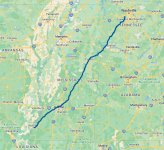
A Drive through 10,000 Years of History - The Natchez Trace Parkway is a 444-mile recreational road and scenic drive through three states. It roughly follows the "Old Natchez Trace," a historic travel corridor used by American Indians, "Kaintucks," European settlers, slave traders, soldiers, and future presidents. Today, people can enjoy a scenic drive as well as hiking, biking, horseback riding, and camping along the Parkway.
Time for some truth telling - when I was a young buck and made lots of money jumping out of helicopters wearing custom fit wet suits wrapped in nylon webbing with all sorts of gear hanging off, I had an older lady friend. I laugh now since I was in my early 20s and she was in her late 20s. Kathy heard that I had been out diving in Hawaii, then grabbed a Space-A hop into NAS Point Mugu in SoCal, and was spending time with another friend who was a Navy Nurse at Balboa Naval Medical Center and lived in Pacific Beach. My plans were to have fun with the nurse for a bit and visit a close buddy who was at NAB Coronado. It had been some time since we hung out and Kathy was dying to see me so she suggested I grab another hop into NAS Meridian or maybe even Keesler AFB so she could pick me up and we could hang out together in Jackson, Mississippi. My only question was, what was she doing in Jackson?

Some time later I was packing my gear one morning so my Navy Nurse acted surprised and asked what I was doing - I told her I was rambling on and needed a ride to NAS Miramar to catch a hop. She asked why and without blinking an eye, I told her I was heading out to spend quality time with another female friend. Well, there was no ride for me and the next thing I knew I was humping two parachute bags filled with wet gear onto a city bus that was heading out to Miramar. A day or so later I arrived in Mississippi, Kathy picked me up, and the first thing I asked my petite Florida beach girl was what the hack was she doing in Jackson, Mississippi?

Let's just say little Kathy had a plan and when she drove me out for a scenic walk along Natchez Trace I fell right into her trap!

NATRA 001.jpg

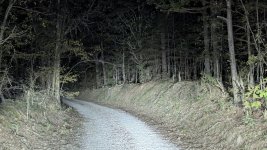
Fast forward to today and then let's back up to the night prior to Paul and myself arriving in Natchez, Mississippi. Being this time of the year the days are short and the nights are really cold - with that in mind, Paul called on the radio and said he found what appeared to be a nice place for us to camp around less than an hour northwest of Natchez in J.C. “Sonny” Gilbert WMA. There's nothing like rolling down a gravel road at night into a forest you have never visited, in the deep south, with a guy the size of a bear from Massachusetts.
NATRA 002.jpg

The next morning we woke up with the sun and explored a few of the local trails during daylight. It was actually a beautiful little place and I still am not sure how Paul finds some of these places but he does, and they are really good.
NATRA 003.jpg

The sun was climbing and I called over the radio to suggest we get out of the woods and make the final push into Natchez so we could enjoy a Cajun lunch at one of the local restaurants. As I have mentioned previously, one of the things I really enjoy during my travels is diving into local history, culture, and cuisine.
NATRA 004.jpg

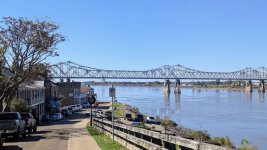
This is the Under-the-Hill section of Natchez right along the banks of the mighty Mississippi River. Paul and I smiled at each other when we arrived and spent most of our time in this area - it felt warm and comfortable, like an old winter coat.

This area of Natchez was described by numerous nineteenth-century travelers as one of the rowdiest ports on the Mississippi River. Taverns, gambling halls, and brothels lined the principal street. Here, rumor has it, the only thing cheaper than the body of a woman was the life of a man.

NATRA 005.jpg

And before I knew it, Paul was gone - he turned his ship east and was heading to Florida. Here I was, alone at the beginning of the 444 mile historic Natchez Trace - this was a paved road without a single stop sign or traffic light along the entire road. My guess was that it would take me maybe two or three days total; but the history, oh the magnificent history of this trail that has been traveled for thousands of years by countless men. It sucked me in and each day I scratched my head since knowing I spent a full day of driving and visiting sites, but I was barely moving along the trail. Nashville seemed like weeks or even months away - I was experiencing the exact same feeling that may of the men of the past felt while traveling along this route.
NATRA 006.jpg

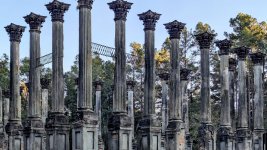
Here are the remains of one of the largest plantations in the area along the Natchez Trace called Windsor Ruins.

Windsor Plantation was built for Smith Coffee Daniell II in 1861. In 1849, Smith Daniell married his cousin Catherine Freeland and the couple had six children, with three surviving to adulthood. The house, one of the largest private residences in the state before the Civil War, was constructed near the town of Bruinsburg, where Union soldiers crossed the Mississippi River to begin their quest to capture Vicksburg. The Windsor plantation once sprawled over 2,600 acres and legend says that from a roof observatory, Mark Twain watched the Mississippi River in the distance.
NATRA 007.jpg

I'll close with a shot of the Old Natchez Trace where you can walk in the footsteps of "Kaintucks" and other adventurers who walked this highway for thousands of years. There's something primitive and animalistic about this area - I'm not quite sure exactly what it is or how to explain it. But I understand why Kathy brought me here so many years ago, it's a feeling you get that's different from just walking through the forest, or even along an old path. This is an ancient highway, and it has countless stories that only it can remember.

I always smile when I hear the song Kat was playing as we slowed to a stop along the trace...t-t-t-t-twistin' like a flame in a slow dance, baby!
NATRA 008.jpg
 
Last edited:
I’m betting you are (I meant NOT) testing your tire chains on this route. Unless you’re catching the small bit heading north.
 
Last edited:
Natchez Trace

Part Two of Three

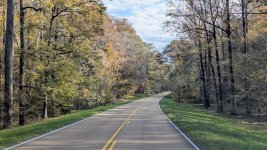
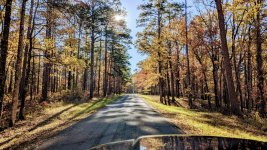
This picture is a beautiful representation of what it looks like while driving along the Natchez Trace. In short, it's a 444 mile long two-lane road with light traffic that has no stop signs or traffic lights, and commercial vehicles are prohibited. There are countless historical places and parks along the way to stop and explore, camp, hike, etc.
NATRA 009.jpg

While driving north and reviewing my maps of the area I noticed Vicksburg was just forty-five miles west of Jackson, Mississippi, along the banks of the Mississippi River. This would be my last opportunity to see that mighty river for many months and for years I have wanted to visit Vicksburg to learn more about her role the War of Northern Aggression. If you consider the fact that I am retired military, have a home near the Yorktown Battlefield and have visited other battlefields such as Antietam and Gettysburg, an initial visit to Vicksburg is entirely logical. Each of these locations, and many more, are of supreme historical significance which should be visited, talked about, and openly discussed in an effort to prevent future unnecesary battles which are a result of lies, propaganda, and greed.

Here is a picture inside the Visitor's Center. If you plan to visit, set aside maybe an hour for the visitors center, an hour for the USS Cairo Museum and Outdoor Exhibit, and several hours to tour the park. This would be a great place to tour around on a bicycle and stop for a picnic - the battlefield is rich with green grass and flowing hills.
NATRA 010.jpg

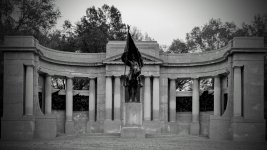
Here is a beautiful example of one of the memorials - this is the Iowa State Memorial. If you enjoy monuments and memorials then you will really enjoy that fact that there are nearly 1,400 monuments, memorials, bronze statues, regimental markers, relief portraits, busts, and iron tablets and guide posts throughout this military park.

The Iowa State Memorial is located in the South Loop portion of the park on Union Avenue. This memorial was dedicated on November 15, 1906, at a cost of $100,000, honors the 38 infantry units, three artillery units, and three cavalry units from Iowa that served in the Vicksburg Campaign. Mounted in the middle of the Memorial is bronze statue of a solider mounted on a stallion and carrying a flag. Surrounding this statue, is Vermont White Granite and six bronze relief panels which depict successive engagements in the Vicksburg Campaign.
NATRA 011.jpg

Sometimes I take chances and venture into dangerous areas where I simply do not belong. This time I decided to drive my rig deep into the inner-city of Jackson, Mississippi, in search of some soul food. A friend warned me that the owners wife had been charged with first degree murder back in 2021 and to "lock your doors and not stop for any reason" while visiting this part of the city. As I walked in the owner, Tyrone Bully, greeted me with a smile and said to sit wherever I liked - the interior was a mixture of forty years of used restaurant furniture and local artwork, with a cool vibe that is impossible to describe.

Although the menu contained chitterlings, turkey wings, meatloaf, mac and cheese, rice and gravy, tomatoes and okra, yams, and greens such as collards, turnips, and mustards, I opted for a soul food classic - ham hocks. Note the inset picture in the lower left corner. As I left with a full belly, Tyrone mentioned that since it was after dark I should "get out of the city real quick." I paid my bill in cash and rolled out through the cold dark night to find a location outside the city to sleep. It was all worth it and I would do it again.
NATRA 012.jpg

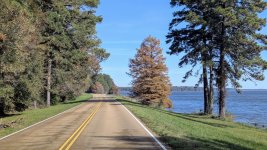
One thing I really liked while traveling along this route were the many roadside pull outs where you could park, read about local history, enjoy a snack, or hike.

For centuries, American Indians traveled and traded along this corridor, which traverses the homelands of the Natchez, Chickasaw, and Choctaw nations. By 1785, the Old Trace was used as a transportation route for boatmen who floated down the Mississippi River to sell their goods in Natchez and New Orleans. Their flatboats were useless against the current of the Mississippi so these "Kaintucks" sold their boats as lumber and walked or rode horses home along the Old Trace. Accommodations for these and other travelers sprang up along the trade route and were known as "stands."

NATRA 013.jpg

Along the parkway there are three free campgrounds managed by our National Park Service. These are primitive camgrounds without electricity, showers, or dump stations, are first-come, first served, and you are able to stay at a campground for up to fourteen days. All sites have drinkable water and flush toilets. The free campgrounds along the Natchez Trace are:
  • Rocky Springs at Milepost 54.0
  • Jeff Busby at Milepost 193.1
  • Meriwether Lewis at Milepost 385.9

NATRA 014.jpg

If you spend some time clicking through all the layers of pages on the National Park Service web site you will discover much useful information regarding this parkway. The really nice thing is that each area of interest contains a nearby milepost and brief description. Some highlights of the list are waterfalls, graveyards, horse trails, a cave, and even a boardwalk into a Cyprus swamp.
NATRA 015.jpg

I have really been enjoying my trip along the Natchez Trace and it has turned out to be so much more than I expected. Although I have never heard anyone suggest taking a vacation to specifically travel the length of this parkway I can see how a trip like this would be lots of fun. It's a long beautiful drive with no congestion, there are so many places to pull off of small towns to explore along the way, free campgrounds and some of the richest history in these United States.

Allow me to leave you with another one of my snap shots taken along the way. And in case you haven't guessed yet, we having lots of fun along the 'trace.
NATRA 016.jpg
 
Last edited:
Natchez Trace

Part Three of Three

I have been enjoying my travels along the historic Natchez Trace for four full days now and it still feels like I am rushing - there is just so much to see and do along the way. Nonetheless, it is looking like I will be finishing sometime later tomorrow. For a 444 mile drive along a paved road this is sure taking me much longer than I expected but I have been really enjoying the ride. Along the way I have noticed occasional dirt roads that crossed the trail so I decided to jump off and explore a bit - it felt good to hear and feel the gravel under my tires while rolling along at 10-20 mph for a little bit. Sometimes I wish all the roads were gravel or dirt - life would slow down and everyone would learn to smile again, and wave.
NATRA 017.jpg

This morning I am leaving David Crockett State Park in Tennessee after spending the night and I am already making plans to stop back again. If you are planning a trail make sure and spend a fair amount of time researching the area to locate federal, state, and county, forests, parks, etc. I like to mark interesting locations on my map that are within a reasonable distance of the trail just in case I am looking for a spot to pull off and have lunch, camp, grab a shower, fuel up, tour a museum, etc. Don't get me wrong - the trails themselves are fun but many times jumping off and rolling into something interesting a few minutes off the trail can be the icing on the cake.
NATRA 018.jpg

If you remember a month or so ago after completing Eastern Kansas Flint Hills Overland Route and then again after completing Green Country Oklahoma Adventure Tour; Dennis, Paul, and I, spent several nights at Tyler Bend Campground in the Ozarks near Buffalo River. While we were there a couple pulled in from Virginia in a white van and while we said hello, we never stopped to talk much since we were busy making plans for the trail, checking river crossing levels, fixing meals, etc. So here I am, a month plus later, and I pull into a free campground 350 miles to the southeast in a different state, and guess who is also camping there - the same folks from Virginia that we met at Tyler Bend.

This time I pulled over to say hello, listen to where they were heading next, what their plans were for the near future. They were great and one of these days I will tell some other stories related to meeting folks on a trail, or beach, in a parking lot, and crossing paths with them months, or even years later, in places so far away from where we originally met. The statistical probability of chance meetings such as these must be slim to none but it has happened several times over the past few years.
NATRA 019.jpg

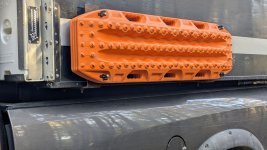
Here is my mount for the Maxtrax that I have been running for a year or two now. My main goal was to keep the traction boards out of the way so they do not interfere with daily operations while at the same time keeping them easily accessible. It seems like most mounting options placed them on the roof or the rear swing away tire carrier which may work for most. For me, being on the roof they were out of the way but difficult to access; while on the swing away they needed to be handled daily, but were easy to access. Mounting them on the side of my camper meant that the only time I interacted with them was when they were needed, and when I did, they were right there. Yeah, it made things a little bit wider but overall this has not been an issue.
NATRA 20.jpg

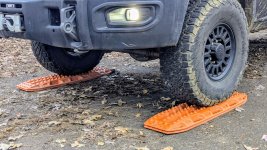
Since my Maxtrax are so easy to access I don't even hesitate to use them for all sorts of tasks. In this case I was setting up to camp for the night in one of the free campgrounds and the spot I had picked out had my truck angled nose down ever so slightly. My solution was to pull out the Maxtrax and bump the nose up a degree to even things out. I guess the moral of this part of my story is that I really like to surround myself with items that can serve multiple purposes. In this case I can use these traction boards to assist me, or someone else in mud, sand, or snow; I can also use them to bridge washed out or rocky areas on the trail, use them as a rudimentary shovel in sand or snow, as a backboard for a child or small person, or to level my vehicle. One item, multiple uses.
NATRA 021.jpg

I stopped by this monument to pay my respects to a man that most know very little about - Meriwether Lewis. Most, including myself, associate his name with the Lewis and Clark Expedition which by itself was an achievement unlike any other. The broken shaft on his monument represents a life cut short - I encourage you to watch this five minute video to learn the story of this amazing man. Dig deeper, learn history, pass it on to others young and old - it's up to you to keep our dream alive.

That men do not learn very much from the lessons of history is the most important of all the lessons of history. ~ Aldous Huxley

NATRA 022.jpg

It cold as heck this time of the year but stopping on a sunny day to spend some time along the water is always a good thing. I'm going to ask a favor of you - go out for a few hours this weekend and park along side some water - an ocean, lake, pond, river, stream, anything. Just take some time for yourself and get out to relax a bit. If you have a wife or children and they wish to join then being them along also. Let the kids run wild, chase each other with sticks, throw stones in the water, take their shoes off and get some mud between their toes. It's good for everyone and we all know it - break free from the matrix and enjoy some nature!!!
NATRA 023.jpg

This was me driving over the Tennessee River as the sun was setting on my second to last day on the Natchez Trace. I am able to summarize this trip by saying this historic route was so much more than I expected and I hope one day you too will be able to join the brotherhood of men who have traveled the 'trace. Although my journey was nothing compared to those taken one hundred, or one thousand, years ago - I still was able to see, hear, feel, taste, and smell, many of the same things those men did. I was able to walk in their footsteps, close my eyes, and imagine being home, home again...


NATRA 024.jpg
 
Last edited:
One of the great things about driving along the backroads of these United States is you sometimes are able to take a peek into the past. Here is Skip's Garage along Route 62 in Russelleville, Ohio. When I see these old places I take a moment to try and imagine what it was like decades ago - what sorts of vehicles pulled in - what were the customers like - who was the owner?
RC 25-009.jpg

Nothing like rolling by your local VFW post and seeing a Bell AH-1S Cobra sitting outside. If you are interested in finding an old US Army helo near you this link may help.
RC 25-010.jpg

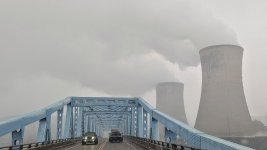
Crossing the Shippingport Bridge, which is a cantilevered through truss bridge, spanning the beautiful Ohio River. Just to the right is the Beaver Valley Nuclear Power Station. A few miles upstream from here, in downtown Pittsburgh, the Ohio River begins; and nearly 1,000 miles later, she ends as she joins the mighty Mississippi. Just in case you are curious, the Allegheny and Monongahela rivers join together in downtown Pittsburgh to form the Ohio - hence the reference to Three Rivers with regards to the 'Burgh. Thanks @Eatonpcat!
RC 25-011.jpg

Socks, socks, and socks. Back around a decade ago I purchase several hundred dollars worth of Point6 merino wool socks and although they lasted me for a long time - the last few years they have been totally destroyed being stretched out, holes all over, etc. So it was time for some new socks and my beautiful sister recommended these. One hundred dollars later and I am enjoying five new pair of socks: two are light, two medium, and one heavy. We'll see how these feel in a decade but right now they are amazing!!!
RC 25-012.jpg

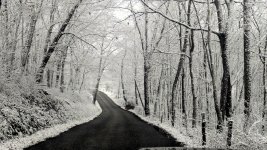
Rolling through the hills on my birth-state, Pennsylvania. Growing up in these parts was sort of strange since no one really liked the cold and the snow, but everyone loved it in their own special way. Yeah, it's cold and nasty and quite the pain the rear but there is something tough about living and working in these conditions for months every year. I'm happy to be back in the nasty weather - strange as it sounds, it hurts but feels good. After all, pain is weakness leaving your body.
RC 25-013.jpg

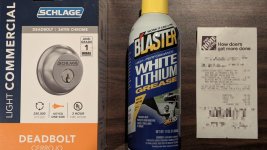
My favorite part of this post - field repairs! The lock on the back of my camper is well beyond its useful life and it has been nearly inoperable for many months now. Since it is mounted on the back of my camper it routinely ingests dust and dirt while driving down the trails - especially out west. My plans are to devise a method to protect my new lock from dust while on the trail but to also schedule maintenance in the form of disassembly, cleaning, reassembly, and lubrication; maybe annually?

I read about deadbolt locks for some time and ultimately decided on a stronger and more durable Schlage B60N6 for a fair price. The lock is Certified ANSI Grade 1 for use in light commercial applications, including multifamily, office, and retail. Here is a video by Mr. Locksmith that helped me make my decision.
RC 25-014.jpg

No, I am not planning to use the white lithium grease pictured above for my lock. I am one of those geeks who actually read my entire RAM Owners Manual and noted there are parts of our truck which require maintenance, that are not listed in the maintenance section. If your drivers door, or any other, occasionally groans when being opened or closed - a shot of white lithium grease will provide silky smooth action and keep it quiet.
RC 25-015.jpg

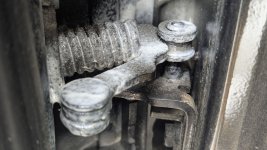
Here is some white lithium grease sprayed on the drivers door lower hinge assembly. It's not pretty right now but in the future I will clean the area and apply grease in a more controlled manner. Right now, passing through the Steel City, I was just takin' care of business.
RC 25-016.jpg
 
Last edited:
Everyone has an opinion about locks and hinges, but I like a dry film PTFE spray like the one CRC offers. For me, it's like Frank's RedHot - I put that sh*t on everything. A friend in the RV repair biz swears by the WD40 brand (no, not just plain old WD-40) but their PTFE lube. It flushes but then lubes without collecting dirt and dust.

Like with guns, I stick to the "if it slides, grease it, if it rotates, oil it."
 
Back
Top