What's new
Ram Heavy Duty Forum

Register a free account today to become a member! Once signed in, you'll be able to participate on this site by adding your own topics and posts, as well as connect with other members through your own private inbox!

2021 RAM 3500 Tradesman | AEV Prospector | FWC Grandby

Much of this weekend was spent installing my AEV Snorkel, OEM projector LED headlights, and custom harness built by Jimmy07. Here is my good buddy Ed using a Starrett automatic center punch to reference where we will be drilling pilot holes on the template supplied by AEV.
View attachment 61387

As expected, we progressively worked up from 1/8" pilot holes to two 1/2" and nine 1" holes. We spent nearly an hour moving the paper slightly, checking, etc. All the holes were placed perfectly.
View attachment 61388

The blue strips of tape were used to cover the 1/2" holes to we did not mistakenly drill one out to 1" - that would have been catastrophic. When you are deep into a job and so close to the work a seemingly small mistake can create an unrecoverable error. Taking a few minutes to reference the template and placing tape over the holes you do not want to drill is a simple and effective solution. Probably the most challenging part of working on the fender was balancing pressure and rotational speed while the fender wanted to flex.
View attachment 61389

Here is Ed cutting lines between the finish holes.

Has anyone had their battery go bad after only three years and 50k miles? On Saturday when we finished work I attempted to start my truck and the battery was dead. We jumped it and I was able to move it and let it idle for a bit pushing 14.0-14.1 Vdc. Sunday morning we tried to start her again and it was no joy. Since we were going to grab breakfast I figured I would let my Renogy Solar Suitcase try to charge the main battery and see if I was able to get her started. Surprisingly, it worked!
View attachment 61390

Drilling holes in the a-pillar where two 1/2" rubber expansion well nuts will be used to hold the upper section of the snorkel body in place. The instructions called for 1/2" holes and although we progressively worked up, our finish hole was 31/64", or approximately 0.016" under. We placed some black RTV on the rubber expansion plugs and they fit very snugly into the holes.
View attachment 61391

The AEV snorkel installation is not for the faint-of-heart. My recommendation is that if you are having an AEV Prospector built, pay the additional $420 and have the snorkel installed by AEV. Unfortunately, when my truck was manufactured in mid-2021, the snorkel was still many months away from being produced. Some of the most challenging parts of the installation centered around the removal of the trim piece under the front grill without disconnecting the front bumper and the installation of the new AEV airbox which is a combination of metal and plastic. Overall, it is a pretty impressive kit for the money although there is always room for improvement. Was it perfect, no. But for the money I consider it a great value.
View attachment 61392
My battery was getting tired at 32,000 miles 3.5 years old truck. Long crank times for a few days and then the tailgate pop wouldn’t pop unless the truck was running. Replaced with a Duracell AGM (east penn/ deka batteries)
 
Overall, the AEV snorkel is a nice package although my primary complains are directed at these two areas:

AEV bumper - this piece interferes with the OEM front lower trim piece and should not. Being required to spend an hour wrestling with a 1/4-ton bumper and winch combo should not be required when removing a two pound plastic trim piece that normally takes five minutes to remove.

AEV snorkel - the airbox is a combination of metal and plastic which itself is not good. TO make matters worse, they expect the installer to place the disassembled airbox into where it will reside and perform final assembly which includes maybe a dozen rivets. The rivet hat should penetrate first through the plastic while the stem goes through the metal - this is the strongest method of assembly since it is easy for the plastic to deform while the stem is pulled through. Around half of the joints are correct whereas the other half are not so this leads to failed joints. It would have been better to develop a single piece box or maybe one with an angled horn that passes through one of the walls with metal rings on the outside of each. In summary, the piece is unnecessarily complex and much time is wasted on an inherently weak component.

As previously mentioned above, some have complained about how the snorkel attaches to the a-pillar. If installed properly I do not expect to have problems with this although if I do I will be happy to share. I came upon this video titled "How to fix the weakest part on the AEV snorkel - upgrade the mounting hardware." Here are sections that raised questions in my mind:

0:26-0:36 - Installer only has one 1/2" rubber expansion well nut installed while the instructions specify two. The single 1/2" rubber expansion well nut is installed backwards (the shoulder should be up top with the brass threaded insert on the bottom) so when you tighten the screw the brass insert compressed the rubber above and it expands. In his defense, the AEV instructions do not specify how to properly install a rubber expansion well nut.

2:30-2:40 - Installer confirms that he ignored AEV instructions and only installed one rubber expansion well nut.

4:30-5:40 - Installer set in place two Nutserts into curved surface of unknown thickness. At first I was concerned of using a Nutsert on a curved surface since I have only used on flat ones - I was wrong and they can be used on curved surfaces. What I am not sure about is how thick the surface is since Nutsert specifies a minimum surface thickness of 0.030" which is awfully close to the thickness of the a-pillar. I would have measured it first and talked with the manufacturer if I had any additional questions.

I do like how he was innovative and did not remove the entire fender just to deal with this issue - he simply loosened most every thing up and pulled the snorkel out of the way to perform that work. I also like how he applied a waterproof sealer to the Nutserts, bolts, and washers. The AEV instructions do not specify this although I did the same since I would not want water to leak into the a-pillar.

Others have suggested using 3M VHB Tape which sounds like it too might be a successful application although I would contact a 3M technical representative to discuss which tape would work best and how to properly prepare the surfaces.
 
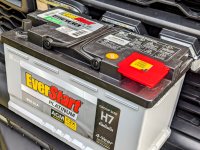
My new AGM battery has been installed and my truck is operational once again. I selected a battery from Walmart for several reasons. First, I recall reading an article in Consumer Reports several years ago where many batteries were tested and the EverStart was ranked the highest regarding value. Secondly, since I travel all around these United States, there are Walmarts everywhere and if I have a problem they generally have fair customer service. My cost with tax was $192.43 and it took me all of five minutes to install. I also took time to clean up dirt and debris in the battery compartment area.

EverStart Platinum AGM Battery, Group Size H7 (12 Volt 850 CCA)

image000000(423).jpg
 
Overall, the AEV snorkel is a nice package although my primary complains are directed at these two areas:

AEV bumper - this piece interferes with the OEM front lower trim piece and should not. Being required to spend an hour wrestling with a 1/4-ton bumper and winch combo should not be required when removing a two pound plastic trim piece that normally takes five minutes to remove.

AEV snorkel - the airbox is a combination of metal and plastic which itself is not good. TO make matters worse, they expect the installer to place the disassembled airbox into where it will reside and perform final assembly which includes maybe a dozen rivets. The rivet hat should penetrate first through the plastic while the stem goes through the metal - this is the strongest method of assembly since it is easy for the plastic to deform while the stem is pulled through. Around half of the joints are correct whereas the other half are not so this leads to failed joints. It would have been better to develop a single piece box or maybe one with an angled horn that passes through one of the walls with metal rings on the outside of each. In summary, the piece is unnecessarily complex and much time is wasted on an inherently weak component.

As previously mentioned above, some have complained about how the snorkel attaches to the a-pillar. If installed properly I do not expect to have problems with this although if I do I will be happy to share. I came upon this video titled "How to fix the weakest part on the AEV snorkel - upgrade the mounting hardware." Here are sections that raised questions in my mind:

0:26-0:36 - Installer only has one 1/2" rubber expansion well nut installed while the instructions specify two. The single 1/2" rubber expansion well nut is installed backwards (the shoulder should be up top with the brass threaded insert on the bottom) so when you tighten the screw the brass insert compressed the rubber above and it expands. In his defense, the AEV instructions do not specify how to properly install a rubber expansion well nut.

2:30-2:40 - Installer confirms that he ignored AEV instructions and only installed one rubber expansion well nut.

4:30-5:40 - Installer set in place two Nutserts into curved surface of unknown thickness. At first I was concerned of using a Nutsert on a curved surface since I have only used on flat ones - I was wrong and they can be used on curved surfaces. What I am not sure about is how thick the surface is since Nutsert specifies a minimum surface thickness of 0.030" which is awfully close to the thickness of the a-pillar. I would have measured it first and talked with the manufacturer if I had any additional questions.

I do like how he was innovative and did not remove the entire fender just to deal with this issue - he simply loosened most every thing up and pulled the snorkel out of the way to perform that work. I also like how he applied a waterproof sealer to the Nutserts, bolts, and washers. The AEV instructions do not specify this although I did the same since I would not want water to leak into the a-pillar.

Others have suggested using 3M VHB Tape which sounds like it too might be a successful application although I would contact a 3M technical representative to discuss which tape would work best and how to properly prepare the surfaces.
You could probably use VHB instead of the drilled holes in the A pillar entirely. I use it to secure solar panels mounts to the roofs of RVs without any screws. We do cover it in sealant as well, but the sealant is just to protect the tape and prevent water from pooling, not adding much in the way of structural support.
 
This week has been spent performing modification and maintenance on my AEV Prospector in preparation for departing Virginia and heading south, then west, for the next six to nine months. There have been some major projects such as the auxillary diesel fuel tank and AEV snorkel along with smaller projects such as the front light bar, LED headlights, etc.

Here I am plugging in part of my custom LED headlight and fog lamp wiring harness into the Power Distribution Center plug C6 spot 28 in the engine bay. This was actually much easier than I had anticipated. Here is a good post detailing the addition of fog lights on a 2019+ HD Ram.
image000000(424).jpg

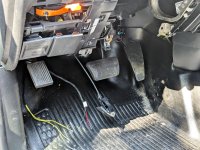
After examining my options I decided to route the remaining four wires through the clutch block off plate. It was very easy to access this area after removing the battery which only takes a few moments. With the battery already removed, it was easy to disconnect a few additional accessories mounted on the inside fender and route the new wires along side existing ones for a very clean installation. These small details only take a bit of extra time but are well worth it in my opinion.
image000000(425).jpg

Here are the four wires waiting to be connected. The wires for the projector LEDs (red & black) along with the LED fog lights (yellow x2) have been pulled though the clutch block off plate and are waiting to be connected. The red (pin 1) and black (pin 2) are inserted into a small white two-pin connector and then plugged into the CANBUS junction block which is located just behind the headlight switch under the dash (green with black base). The fog light connectors (yellow x2) will plug into the C1:1 and C4:13 on the BCM under the dash which was the most challenging phase of this evolution.
image000000(426).jpg

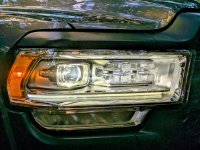
I am very impressed with the factory LED projector headlights now that I have them installed. The Adaptive Forward Lighting System is really useful since the headlight beam is able to turn up to 15-degrees while the vehicle navigates around a corner. It will be interesting to see how it functions off-road at night.
image000000(427).jpg

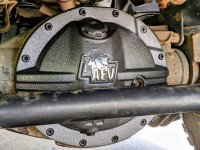
AEV front differential cover manufactured out of high-strength nodular iron now protecting my AAM 9.25" axle
image000000(428).jpg

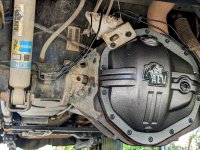
AEV rear differential cover on my rear AAM 11.50" axle.
image000000(429).jpg

Currently I am preparing to wire lights and other accessories to my OEM auxiliary switches. Here is a great video for reference:

 
Last edited:
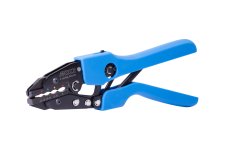
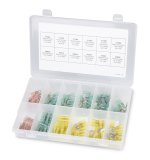
Now that my 30" light bar and A-pillar (ditch) lights are in place it is time to make the electrical connections. In a previous post I already ordered the Ancor 10 AWG wire so today I took time to research and order an Ancor Single Crimp Ratchet Tool and Ancor Heat Shrink Terminals & Connectors Kit. Initially I was going to only purchase a small number of ring terminals and butt connectors that I required right now although the difference in overall price was so small I and I received so much more in the kit it was an easy decision.

If I took time to research and select the proper wire it only makes sense to invest additional time in researching the connectors and tools required. I considered other offerings by other companies but concluded offerings by the same company (Ancor Products) that manufactured the wire would balance nicely.

Ancor Single Crimp Ratchet Tool
ancor 03.jpg

Ancor Heat Shrink Terminals & Connector Kit
ancor 04.jpg

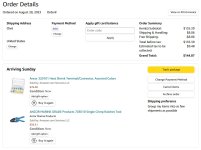
Here is a reference copy of my invoice for the record:
ancor 05.jpg
 

Attachments

Last edited:
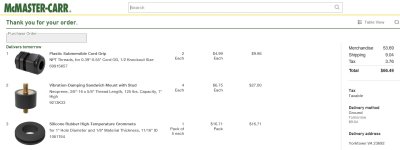
Today I ordered parts that will be used to install my ExtremeAire Magnum air compressor. There are many places to install this unit and I believe I have selected one of the best for my particular application. If my calculations are correct it should take me approximately three minutes and thirty second to inflate one of my 37" tires from 15 to 45 psi. This compressor flows 6.0 CFM at 0 psi and 3.9 at 50 using a 100% continuous duty motor. For a long time I have wanted an Oasis 12 Vdc air compressor which flows 15 CFM at 0 psi and 10 CFM at 50 psi but it is just too large and I am not sure saving five minutes on airing up my tires can really justify losing that much room.

The plastic submersible cord grips will be used to pass the Ancor 2 AWG tinned copper battery cable which has a nominal OD of 0.47" while the vibration-damping sandwich mounts with studs will be used to mount the compressor to the body. Since we are passing the heat dissipation hose through the same surface this is where we will be utilizing the silicone rubber high-temperature grommet. After performing some research I was able to confirm the hose is manufactured using Gates LOC Lock-On Hose which has an OD of 0.64".

mcmaster carr 001.jpg
 

Attachments

Last edited:
Much work has been completed recently on my adventure vehicle. Working from the top down first you will notice the AEV snorkel, then if you look closely you will see A-pillar (ditch) lights from Diode Dynamics (SS3 Max with combo optic) installed on SDHQ A-pillar mounts. Down a bit more you will see the factory LED projector headlights with the Adaptive Forward Lighting System which are beyond amazing and worth every penny. Below the tube on the front bumper you will see a Diode Dynamics Stage Series 30" lightbar with combo optic. Down in the bumper itself you will also see fog lights which are Diode Dynamics (SS3 Sport with SAE fog optic).
image000000(5).jpg

Here is a close up for some additional detail. Note there are no wires on the A-pillar lights as I am still waiting for Ancor supplies to arrive this weekend. I will share details regarding the harnesses I build and what specific materials I use.
image000000(3).jpg

My OEM projection LEDs are up and running fine. I am so glad I selected the Tradesman package when specifying this truck and then was able to add high-end parts such as these LEDs. Thanks again to Jimmy07 for the custom wiring harness which permitted me to install both these and fog lights all using factory switches.
image000000(4).jpg

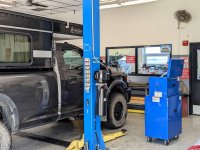
Here I am taking advantage of an "auto hobby shop" nearby military installation. The cost is $10 per hour to use a lift bay and that includes a full set of Snap-On tools. They have specialty tools such as air tools, torque wrenches, etc. available to use that are stored in a central location.
image000000.jpg

Note the sign on the window that specifies this lift is rated for 9,000 pound capacity. My rig with a full bag of gas, all supplies, and myself, weighs in at 8,660 as recorded on a certified scale. I have access to another lift nearby that is rated for 12,000 although I prefer this garage.
image000000(1).jpg

I finished up the day with a tour of the American Encampment at the Yorktown Battlefield here at the Colonial National Historic Park. After this stop I continued on to General George Washington's Headquarters, the French Encampment, and then down into Yorktown proper. Here is some additional information regarding the Siege at Yorktown which is considered by many to be a turning point in our Revolutionary War which lasted from 1775 through 1783. Keep your powder dry...
image000000(6).jpg
 
This weekend has been beautiful so I wanted to take a break from performing upgrades on my vehicle and just relax for a day in my hometown of Yorktown, Virginia. This small area of south-east Virginia is commonly referred to as the Historic Triangle and is composed of Jamestown, Williamsburg, and Yorktown. Jamestown is where the first permanent English settlement was established. Colonial Williamsburg is where the American Revolution first started. And Yorktown is where the British surrendered. This is my home and I wanted to share a beautiful little trip with you that I have driven maybe a hundred times.

In short, this route is the complete Yorktown Battlefield tour which includes both the Battlefield (red arrow signs) and American Encampment (yellow arrow signs). As an added bonus I included a short trip down to the York River to visit the Yorktown Beach Picnic Area and the Yorktown Waterfront. This is a twenty mile drive and will take approximately 1.5 hours without any stops. There are dozens of historical markers along the way so this could easily be a half day excursion.

The route can be viewed and downloaded here - I will also include the GPX file as an attachment to this post.
CNHP.jpg

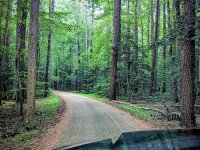
This is what the majority of your relaxing drive will look like: a one-way paved road through the forest and alongside the battlefield and encampments. It is really a relaxing drive since there is little traffic, virtually no signs, and only occasional two-way traffic for short stretches near some of the loops.
image000000(15).jpg

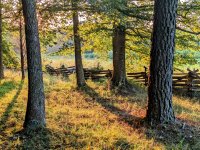
This is a typical view from the road while driving adjacent to one of the many fields. This picture was taken in the American Artillery Park area.
image000000(12).jpg

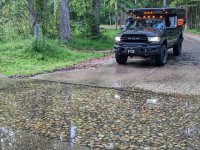
For those who enjoy water crossings - this route actually includes one a few inches deep and maybe a dozen feet in width. This stream is created from a natural spring just a few hundred feet away and the loop near the spring was General George Washington's Headquarters during the battle.
image000000(13).jpg

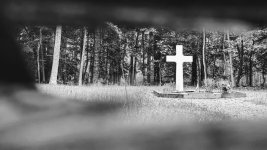
This is the French Cemetery deep in the forest where approximately fifty French soldiers were buried in an previously unmarked common grave. It's actually rather sad to imagine young men dying so far away from home and never to return. Yes, they felt pain for a period of time but their loved ones and friends felt their own pain for so much longer. War is a racket.
image000000(14).jpg

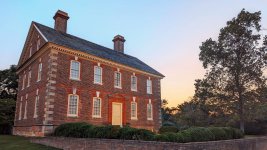
This is the Nelson House in Yorktown. Thomas Nelson, Jr. (1738-89), was one of the signers of the Declaration of Independence and as a brigadier general, he also commanded the Virginia militia at the Siege of Yorktown.
image000000(16).jpg

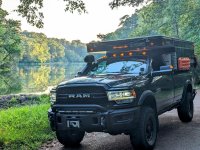
Wormley Pond is one of my favorite places along the route. It's just a beautiful area to watch turtles, great blue heron, deer, turkey, etc. It's also the place where a smokin' hot skinny blonde I worked with at NASA LaRC lost control and kissed me for the first time. Lord, I was born a ramblin' man...
image000000(11).jpg
 
Although the summer is fading away and fall temperatures will be cooling things down soon my plans are to spend much time down south once again this winter so the sun and temperatures will be a bit higher at the lower latitudes. For the past few years I have been meaning to order a sunscreen for my truck although I just have never found one that I really liked.

Companies I have researched over the past few years included Husky and WeatherTech. Maybe I was not using their web site correctly but Husky was only able to return a universal sun shade and to me that was unacceptable. WeatherTech was nice since they required vehicle options such as: cab style (regular, crew, mega), windshield mounted sensor (none, small, large), and rear window (solid or sliding). The WeatherTech was a roll-up and I decided that it was not the best options for me.

Recently I happened upon Covercraft Industries who manufacture custom UVS100 Premier Series Custom Suncreens. They also ask you to down-select the submodel (Big Horn, Laramie, Tradesman, etc.) and type of windshield mounted sensor (none, small 5", or large 10"). They are custom fit, are rigid, have foam insulation, a black backing so I am able to reverse it at night to black out my interior, and have three different colors available: chrome camouflage, galaxy silver, and white. Here is a Covercraft video which details the manufacturing process:


Here is a nice video which compares WeatherTech and Husky.


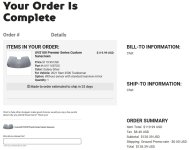
Keep in mind since these are made-to-order I am not expecting this to arrive for 3-4 weeks:

covercraft.jpg
 
Last edited:
The past week has not been as productive as I had imagined although I can sense things beginning to fall into place as I prepare for the next phase of improvements. With that in mind I decided to order some additional electrical supplies and tools. You may have noticed I have purchased all of my wire, splices, and some tools, from Ancor - they specialize in marine grade electrical components. When I purchase a series of components I often like to source many parts from the same company since I would expect them to share additional information and hopefully work better together. I realize this is not always true but I like to stack the deck in my favor if possible.

Here is a quote regarding their marine grade wire:

"Ancor is the original Marine Grade® wire. This means that all of our wire and cable is built to withstand the harsh marine environment. Proprietary jacketing material is extremely UV and corrosion resistant. Individually tinned wire strands ensure optimal conductivity. We have everything you need from primary wire to battery cable and specialty wire. We carry all ABYC recommended colors in a variety of sizes to handle any wiring project."

And here is a quote discussing the butt splices I selected from Ancor:

"Ancor heat shrink connectors offer heat activated adhesive built into the sleeve of the heat shrink tubing. When heated, these connectors form a water tight seal and the ultimate vibration and strain relief."

When reordering components such as butt splices it would be very easy and cheaper to stop by local store but once I begin moving in a particular direction I generally remain in that same direction unless something significant changes my view. Sure, these splices cost a bit more and will take more time to arrive but my projects are worth the slight additional effort and I will be happy with my decision for years to come. And as we all know, it's all about the details.
ancor 10.jpg

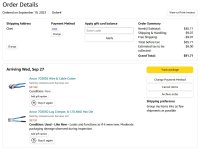
The tools below were purchased in preparation for addressing the heavier wiring included in my system. The wire and cable cutter below will handle wire from 22AWG through 2/0 AWG and should cover all of my applications. I went out on a limb and ordered a "damaged" lug crimper which normally retails from $150-200 and crimps wire from 8 AWG to 1/0 AWG. This will save me much in the long run since I will be able to crimp the cable for my air compressor, DC-to-DC charging circuit, etc.

From what I am able to gather it sounds like the packing was damaged or open so it will be interesting to see when it arrives. In an earlier post I ordered an Ancor single crimp ratchet tool which services wire sizes between 22 AWG and 8 AWG so between that tool and the one ordered today I am covered crimping wire and cable from 22 AWG through 1/0 AWG. If I ever share a trail with any of you and you would like to crimp some wires please don't hesitate to ask.
ancor 21.jpg

For quite some time I have been planning to relocate my OEM backup camera but handing over $199 for a plastic box, a few screws, and a special wire just didn't excite me. Based upon my research it appears that there are just a few companies such as Rostra, Voxx, and Zorg, who offer kits to relocate back-up cameras. As I dug further down the backup camera relocation rabbit hole it appeared that there was some level of relationship between a few of these companies but in the end I just wanted to resolve my issue for a reasonable price.
rostra 2508663-small-1.jpg

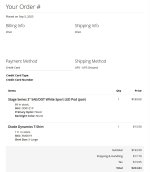
While revisiting the issue again this morning I came upon M&R Electronics in Michigan who appear to be selling the Rostra kit for a somewhat reasonable price. A few clicks later and I am not a full step closer to seeing what is behind me once again as I back up. This camera relocation kit in conjunction with my Diode Dynamics SS3 pod lights mounted in my rear bumper should be quite nice.
rostra 250 8663.jpg
 
Last edited:
I found it very hard to pull the trigger on the camera housing too Chet. Like you found, there are very few options.
Eventually caved and it's nice to have the rear camera, but man...$$$$$!!!
 
I found it very hard to pull the trigger on the camera housing too Chet. Like you found, there are very few options.
Eventually caved and it's nice to have the rear camera, but man...$$$$$!!!

Any tips regarding installation? I am concerned with the small amount of space available inside the housing that must also contain the OEM camera and LVDT cable attaching to the rear of the camera. Seems like it might be a tight fit since my plan is to redirect the cable 90-degrees to exit the side of the housing.
 
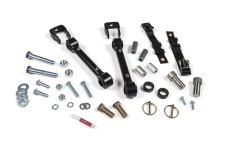
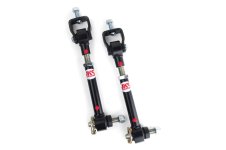
For a few years I have been waiting for JKS Manufacturing to manufacture anti-sway bar disconnects for my RAM 3500 based AEV Prospector. I was waiting since I have a long history with JKS components extending back into the '90s and consider them a quality manufacturer. Recently I discovered that JKS are now owned by Sport Truck USA, a Division of Fox Factory Inc., who also manufactures and distributes BDS, Crawltek, etc. As I examined the BDS disconnects (#122414) I noted many similarities between them and JKS so I decided to purchase a pair.

This system will permit me to drive on pavement with the anti-sway bar connected to maintain safe handling. While off-road, I can quickly disconnect the same bar to take advantage of increased ride comfort and suspension travel. The additional articulation of the front axle helps to keep both front tires in contact with the ground thus maintaining traction. Yes, back in the early '90s I ran one of my Jeep Cherokee XJs for some time with the front anti-sway bar removed - I was a fool back then. It was in the mid-90s that I began installing discos on my vehicle from Rubicon Express, Teraflex, etc. and there was no going back. For a few hundred dollars you too can enjoy safe handling on road with increased comfort and travel off-road.

The parts below provide you with a manual version of the Power Wagon, or Jeep Rubicon, electronic anti-sway bar disconnect. Instead of an electronically driven coupling that slides over splined shafts on the anti-sway bar to disconnect, and reconnect, this system disconnects the entire shaft from the mounting tabs on each side of the axle.
BDS disco pic.jpg

Below are a pair of the JKS Quicker disconnects that I have installed on my Jeep TJ. The most significant difference is that the JKS are adjustable in length and that is one feature I was not a fan of so I was happy to discover the BDS were fixed length. If you compare the BDS above to the JKS below you might suspect they are being manufactured at the same location - I do. Many of the parts are of similar design such as: upper u-strap, spherical bushing, click pin, Zerk fittings, etc. The only obvious differences between the bodies is the fact that one is adjustable whereas the other is fixed length. The JKS stainless steel post on the bottom has a slight taper while the BDS has a chamfer.
jks.jpg

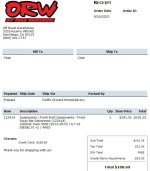
Here is my receipt for reference:
BDS disconnect.jpg


Another consideration I had was for the AutoLynx disconnects produced by Apex Design and Performance Products. They are currently only available for Jeeps although I spoke with the company and they referred me to a few men who have modified them for use on their HD Rams. What I really like about this innovative design is that instead of crawling under the front of the vehicle to muscle off a dirty and greasy fitting, you simply reach into the upper section of the wheel well and rotate the blue know on top 180-degrees. That is an awesome design and I still may consider them in the future although for right now the BDS will work just fine.
07625393-F091-4C0B-AF64-2422D13482B1.jpg
 
Last edited:
Any tips regarding installation? I am concerned with the small amount of space available inside the housing that must also contain the OEM camera and LVDT cable attaching to the rear of the camera. Seems like it might be a tight fit since my plan is to redirect the cable 90-degrees to exit the side of the housing.
I had no issues at all, but my housing may be a tad larger. Plenty of room.
Mounted and drilled hole through rear door of camper in the same location tailgate camera would be.
Took wire to side and through floor, all sealed well.
Plug and play and worked right off the bat.
 
For a few years I have been waiting for JKS Manufacturing to manufacture anti-sway bar disconnects for my RAM 3500 based AEV Prospector. I was waiting since I have a long history with JKS components extending back into the '90s and consider them a quality manufacturer. Recently I discovered that JKS are now owned by Sport Truck USA, a Division of Fox Factory Inc., who also manufactures and distributes BDS, Crawltek, etc. As I examined the BDS disconnects (#122414) I noted many similarities between them and JKS so I decided to purchase a pair.

This system will permit me to drive on pavement with the anti-sway bar connected to maintain safe handling. While off-road, I can quickly disconnect the same bar to take advantage of increased ride comfort and suspension travel. The additional articulation of the front axle helps to keep both front tires in contact with the ground thus maintaining traction. Yes, back in the early '90s I ran one of my Jeep Cherokee XJs for some time with the front anti-sway bar removed - I was a fool back then. It was in the mid-90s that I began installing discos on my vehicle from Rubicon Express, Teraflex, etc. and there was no going back. For a few hundred dollars you too can enjoy safe handling on road with increased comfort and travel off-road.

The parts below provide you with a manual version of the Power Wagon, or Jeep Rubicon, electronic anti-sway bar disconnect. Instead of an electronically driven coupling that slides over splined shafts on the anti-sway bar to disconnect, and reconnect, this system disconnects the entire shaft from the mounting tabs on each side of the axle.
View attachment 62748

View attachment 62749


Another consideration I had was for the AutoLynx disconnects produced by Apex Design and Performance Products. They are currently only available for Jeeps although I spoke with the company and they referred me to a few men who have modified them for use on their HD Rams. What I really like about this innovative design is that instead of crawling under the front of the vehicle to muscle off a dirty and greasy fitting, you simply reach into the upper section of the wheel well and rotate the blue know on top 180-degrees. That is an awesome design and I still may consider them in the future although for right now the BDS will work just fine.
View attachment 62750
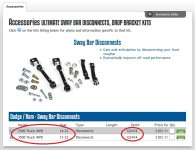
Let us know how the BDS links workout. I have the AEV suspension under my 2500 and would like to be able to disconnect the swaybar. I notice the set you've got ordered is for 3500, 13 to 15, any problem installing on 19 and newer trucks? Thanks
 
Let us know how the BDS links workout. I have the AEV suspension under my 2500 and would like to be able to disconnect the swaybar. I notice the set you've got ordered is for 3500, 13 to 15, any problem installing on 19 and newer trucks? Thanks

Good catch - I noticed that also while checking out although the BDS site could be cleaned up a bit. Here is another page for the same part number:
bds web.jpg
 
Back
Top