What's new
Ram Heavy Duty Forum

Register a free account today to become a member! Once signed in, you'll be able to participate on this site by adding your own topics and posts, as well as connect with other members through your own private inbox!

A/C Issues? Anyone else

I haven't read through this whole thread, but is anyone with a 2021 having crappy AC performance. Just curious if it seems to be resolved on the builds after the TSB was released.
I've seen comments here and on FB groups from people with 2020/2021 trucks who complain about performance...
 
I’m curious if they will end up revising the TSB if people with 2021s are still unhappy
 
I had the TSB done by my dealer as my air wasn't cool. Now, with over 100 degrees of heat, the thing rocks. I can't have it in Max for more than a few minutes before I am freezing and have to turn it to auto. I took the attached picture and the laser was pointed into the opening before the air hits the cab. I took a reading at the opening and it was around 34 degrees. If your dealer hasn't done the TSB, find one that will. Mine did it on my word during the winter.View attachment 18064
What was the exterior temp and what region are you in? And how long had your truck been running when this picture was taken?
 
I’m curious if they will end up revising the TSB if people with 2021s are still unhappy

At some point eventually... I had the same problem with my 2019 1500 I bought in late 2018.
The TSB was issued in 2020 so that will give you an idea on how long it takes for them to work and figure it out...

Every time I took the truck to the dealer I had them annotate that the A/C performance was inadequate... trying to avoid saying 'it doesn't work' because if it is within spec, then it is 'working' according to them... my 2 cents.
 
I’m curious if they will end up revising the TSB if people with 2021s are still unhappy
That wouldn’t do any good because the 2021s are built using the same parts that the TSB parts are (ie, the TSB replacement parts are current production parts).
 
I haven't read through this whole thread, but is anyone with a 2021 having crappy AC performance. Just curious if it seems to be resolved on the builds after the TSB was released.
Mine is s 2021 and it is as bad as my 2019 was.
 
You assume. And, maybe it is true. But I have clear evidence my system is DRIVING the temp UP to the 54 Deg spec. So they just set the spec to something that is easily achievble and Wala! They systems performs as expected. In my Opinion you can BARELY call it an AC system. Shameful.
No, that’s not an assumption. The 2021s are built using the part numbers from the TSB.
 
That wouldn’t do any good because the 2021s are built using the same parts that the TSB parts are (ie, the TSB replacement parts are current production parts).
What I meant is if they do another/or revise the TSB such that it is an improvement over the existing version, and encompasses 2019, 2020, 2021 (and 2022?) models.
If their next swing at the AC system ends up being even better/a notable improvement over the current, I’d rather wait to get that fix done on my truck.
 
I don't want to argue. But have you taken a 2021 apart? All kinds for crazy stuff happens at a factory assembly line. Especially when they are having trouble with suppliers/covid etc. Parts books can be wrong, wiring diagrams can be wrong etc. I have seen it.

Here is a fact. I already said this once a while back. I have downloaded and read the AC System Description for the 2021 RAM 3500 with MTC AND the wiring diagram and the Parts diagram. They ALL show a "in car tempature sensor". My Dash has a place for the sensor. No sensor is there and as far as I can see there is no provision in the wiring harness.

Do I have a 2021 that is broke? Or do I have a 2021 with 2019 parts in it?? 54 deg is not really a challenge. I have evidence my system is way more capable but controls to 54 deg.

You're arguing with the guy that knows the pieces, parts, and electronics on these trucks forwards and backwards...

If @Jimmy07 says the part numbers are the same, they're the same.

P.S. It's "Voila!" not "Wala!"
 
What I meant is if they do another/or revise the TSB such that it is an improvement over the existing version, and encompasses 2019, 2020, 2021 (and 2022?) models.
If their next swing at the AC system ends up being even better/a notable improvement over the current, I’d rather wait to get that fix done on my truck.
I gotcha now, I thought you meant revise to include 2021s. I wouldn’t hold my breath on a new improved TSB, and I wouldn’t hold out on getting the current one done in hopes for a different one. You really have nothing to lose by getting the current one done, except if you wait long enough that your out of bumper to bumper warranty, you’ll probably have to pay for the fix, since it’s a TSB and not a recall.
 
I don't doubt that. So he just happened to leave out a few words, that's all. "supposed to be". And, even though I said right up front I did not want to argue, you are calling it an argument. I am clearly saying what they are supposed to be built with and what they actually are built with might not be the same. Parts books can be wrong too. It could easily be that the supplier could not get it done and they had all these pre/TSB parts laying around. Shut down the assembly line, and stare at those old parts sitting there?? I cannot stress this enough. C O V I D and there seems to be a few 2021 with the exact pre/TSB symptoms popping up. I find it hard to beleive this is a coincidence. What are the odds that they would come out with a fix, integrate it into production, and then still have quite a few bitching about weak AC. I have probably bought 50 new Vehicles in my lifetime and I have NEVER had this issue. In fact I am usually down to fan speed one and blending in some warm air on my own. What percentage of new vehicles coming off an assembly line would have AC issues. I bet it is usually VERY small. Honestly.

Oh and you made me look this one up. Not sure why you would nit pick this. But, YES it is "Wala".
Sounds like you got it all figured out, I guess. All the new part numbers have replaced the old part numbers before 2021 production started up. Between the TSBs, and 2021 builds, those parts have never gone on restriction because of shortages, and have been readily available. There have even been multiple people I’ve helped upgrade from single zone to dual zone, and they’ve had no issue obtaining the new parts. Basically, the only old part numbers laying around would be old stock that dealers/ parts houses would have laying around, which definitely wouldn’t be called back down to Saltillo to use “in a pinch”.
 
We all found out about it here. I took mine in for diagnosis and was approved. After a trip for spring break, I took it back in for the work. It took a week and was given a loaner. I marked the original air box so I would know they actually replaced it.

Sent from my SM-N950U using Tapatalk
How did and where did you mark the air box as I'm gonna take mine in as well. Thanks
 
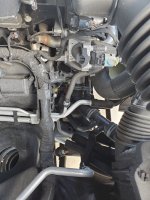
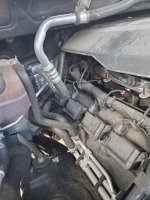
Anyone see the location i should install the valve at?
20210622_162527.jpg

20210622_162520.jpg

This is 2020 2500 hemi
 
I believe the top hose is the intake for the heater core...
If you follow the hose back to the water pump it should say "ENG OUT"

Are you putting in a manual valve or the electric one?
 
I believe the top hose is the intake for the heater core...
If you follow the hose back to the water pump it should say "ENG OUT"

Are you putting in a manual valve or the electric one?
Manual. I trace most of them and the only one I could find is on drivers side that says ENG. Other hoses there are no tags
 
So another question. To test to make sure I work with the right hose I am going to put a temporary clamp on the one I think I should use. What should I watch for in case I clamped the wrong one? Will the engine temperature go up?
 
I have been following this issue (*Ram's AC performance on 2019+ platforms) somewhat closely since the Gen5-1500 deliveries began last year. In fact, I delayed my buying decision as a direct result of the Ram AC issue in the hopes FCA would come forward with a real fix (I'm losing that hope, but not completely). On the positive side of that, the purchase decision delay has allowed my new truck interest to expand upstack from the half tons to HD's (Ram 2500 & Sierra AT4 HD). Over the months, I've test driven too many RAM vehicles , a small handful of Sierra 1500 AT4's & an even smaller handful of AT4 HD's (only recently have they hit lots in my area).

Hoping to save folks some time with my attempt at summarizing the numerous AC Performance/Problem threads (a couple of the threads are extremely long) from 5th GenRams Forum:
  • Ram's AC performance from the new 5th gen 1500 & 4.5 2500 is a disappointment to many owners (and some potential owners, self included).
  • The most important fact per my readings & experience with the new Ram trucks: FCA changed the physical architecture of the RAM AC systems from the prior gen models. New RAM AC systems appear to be entirely dependent on an electronically-controlled blend door. Whereas, previous gen vehicles also had a heater core valve that helped ensure the truck's heater core was not bleeding too much heat into the AC system vents/airflow.
  • The behavior of the new gen AC is not particularly consistent from one vehicle to the next. I directly observed this in back to back test drives, multiple times. Owners' experience as reported in 5thGenRam forums reads similarly to what I saw in person.
  • I originally hoped the RAM AC issue was isolated to the 5th gen half-tons, but the Blend Door dependency also appears to be the paradigm RAM/FCA used for the 2500's. I have not directly confirmed this on the 2500's, but anecdotally based on the ac performance... it appears to be the case.
  • Some owners in the threads reported that the AC performance on their trucks changed over the course of time... from 1st date great to horrible... average to below average. Some have said their AC started good and stayed good. Others reported the AC started bad and stayed bad.
  • At present, it seems as though the new RAM AC systems are a box of chocolates. Unit variance of this degree scares me as a buyer. At least until their is a factory-backed solution reducing ac perf variance down to a more reasonable level.
  • Ram's blend door dependency for their HVAC has been a proven problem source (many times over) via various Ram owner-designed AC system hacks which employ clamps & valves to isolate the heater core. These home brew fixes immediately improve AC system performance via significant airflow temp reduction. Observed 8-12 degree vent airflow temp reductions appear to be a fair expectation after the AC hack of choice is performed.
  • Ram Dealers seem to have been effectively trained by FCA or some other Wizard of OZ in charge to say they have not "heard of any AC issues with the new trucks". It's almost comical how consistent they are with this message, even when 5 trucks are rolling out of their service bay for AC issues.
  • Fear not, the dealership service team will most likely tell you ,the owner, that the AC is 'normal' after their AC test protocol is complete.
  • The 'new' govt mandated coolant type is a frequent scapegoat for the dealerships. The truck's software version/settings are another common scapegoat for the AC issue. A software upgrade & coolant recharge failed to help most of the forum users experiencing the AC issue. It sounds like the software reflash primarily targets fan speed.
  • Ensuring your coolant charge pressure sounds like it is worthwhile though... given some users reported trucks delivered with inadequate charge pressures. But it doesn't remediate the issue for those with inadequate blend doors.
  • The driver side vent & the left center vent are the most common offenders of uncomfortable AC vent temps. Users often reporting upwards of double-digit temp differences from those vents as compared to the passenger vents. It's amusing that the FCA engineers would let the driver vent be the offenders. I mean, be craftier and hide it in the passenger or rear vents;)
  • Setting aside all the dealership theatrics, isolating the heater core via hose clamps &/or valves has proven 100% effective at markedly reducing the AC vent temps.
Outlook related points:
  • At present, it doesn't feel likely (to me) that Ram & FCA will admit that there is a 'problem' or issue an AC system 'recall' any time soon
  • There are handful of apologists that point out (rightfully so) that many of these trucks' vent temps test out as 'normal' when using the RAM AC test protocol.
  • Unfortunately for Ram owners, the temperature performance thresholds in the current RAM AC test protocol are an absolute cake walk to hit. 'Passing' the RAM AC test is so easy, my lawnmower could probably pass it too! It reminds me of a time when I let my engineers choose the perf thresholds for their own work. Guess what, their code somehow was ALWAYS performant! haha
  • The layup RAM AC test appears to be designed to pass just about every truck that doesn't have complete AC system failure. This goal appears to have been accomplished & presently the performance test serves as a stable crutch for dealerships & FCA to say everything is 'Normal'. As consolation, the 'software flash' is then offered to the customer in hopes a placebo effect victory is achieved courtesy of leaf blower velocity coming through the vents with the new fan speed settings.
  • The other crutch (which deserves a seat at the table) is overall cabin cooling capability. This would factor in air volume, not just specific vent temps from the driver vents. If air volume of non-ideal temps is high enough... it can still cool the cabin the same as cooler vent temps flowing at lower airflow volume. i.e. garden hose versus firehose filling a pool, small turbo versus large turbo, etc. On the point of total air volume, regardless of total cabin temp... blowing a higher volume of less than comfortable air on the truck's driver is a bad customer sat approach.
  • Admitting the existence of an AC problem when the physical architecture of a system (blend door dependency) is the likely root is a very expensive admission. Particularly given how many units are already in customer hands. What's more, the issue is not safety related (e.g. airbags, axle failure, brake failure, etc)... so the prioritization of ideal AC performance is probably at the bottom of Ram's pile . Unless it begins to affect sales in a material way, ac performance will not be at the top of the issue list.
  • I love that the customer-developed AC hacks well-documented on 5thGenRams are almost guaranteed to work. This is the one thing that is allowing me to keep Ram in the equation instead of just buying the HD AT4 (which will have it's own issues, so I wouldn't want to jump that shark too early).
  • I am concerned about the AC hacks negatively impacting the warranty though, even though removing the hose clamp before service is not too difficult. Although, going with a permanent valve would be my preference for a number of reasons... but that would assuredly crush the Ram warranty.
  • The current blend door's sourced by RAM for these new gen trucks are either faulty from the jump, have short lifespans of effectiveness, or are just not adequate. Only time will tease out that answer.
  • Time will also tease out what (if any) other contributing factors may be.
In the end, I am thankful I didn't need to rush the buying decision thanks to other owned vehicles, but I would love to just hit the fast-forward and be done with the decision. I've test driven enough trucks this past year for a lifetime!

cheers all
Thank you, great post
 
After having the AC TSB done early this year, I was still not happy with the AC performance. While better than pre-TSB, I am still seeing a low of 50* driver's center vent and 46* passenger's center vent. On a 90*+ day, the truck meets specs, but on a 70-80* day it does not, as I see the same vent temps. Specs are 45* on a 70-80* day and 55* on a 90*+ day, with all temps taken from the Driver's side center panel vent.

I recently took the truck to a different dealer for a second opinion, and the tech ran through all the checks and it passed everything except the vent temps on cooler days. They did provide me a bit more information than I had previously gotten, such as the lowest recorded temp of the evap temp sensor of 38*. In the next few days, I decided to look on my own some more, mainly to see if I could verify if the evap temp sensor was really reading 38*. I borrowed a DVM with a quick reading temp probe and attached it to the low side line coming out of the evaporator (as close as possible) on the engine side of the firewall. What I saw has me very confident in a theory...
  • These observations are after the initial cooldown of the system, when the compressor starts cycling. This was also done with MAX AC on. This is very repeatable, at least on my truck.
  • The lowest recorded temp I see on the line is right at 38*, this corresponds directly to the 38* referenced by the tech.
  • Every time I saw 38*, the compressor cycled off.
  • The line temp quickly rose to 44*.
  • Every time I saw 44*, the compressor cycled on.
  • This ON-ON cycle happened between 10-15 seconds. I could easily hear the ON click of the compressor.
  • When the temperature was dropping, at 39* it seemed to drop slower than at other temperatures. It seemed to take longer to drop from 39* to 38*, than from 41* to 40*.
    • I think this is where the H-Block\TXV was beginning to meter refrigerant...

This leads me to my theory. I believe the evap temp sensor is cycling the compressor based on a software setpoint of 38*. I believe this value is set artificially high, thus not allowing the H-Block\TXV time to properly adjust and meter the refrigerant. In everything I know and have researched about this, I believe the H-Block\TXV should be able to sufficiently meter refrigerant flow under a high cooling load without freezing up the evaporator. Therefore the evap temp sensor cutting the compressor out at 38* is greatly reducing the cooling ability of the system. The evap temp sensor should only be cutting the compressor out under lower cooling loads, when the evaporator is actually at risk of freezing up.

My belief is that if the evap temp sensor cutout was set lower, say to 34*, the H-Block\TXV may now have enough time to properly meter the refrigerant before the compressor is forced to cycle. The other possibility is the H-Block\TXV was not properly spec'ed, or had a defect in manufacturing, for the 38* evap temp sensor cutout and does not function at the proper setpoint.

If the evap temp sensor cutout temp was dropped to 34* and the H-Block\TXV did regulate the evap temperature at 36-38*, the compressor would no longer cycle and greatly increase the cooling ability of the system. By having the compressor run continuously under a high cooling load, I could see this reducing vent temps by at least 6*. This would put both of my vent temps under spec at all outside temps with nothing more than a slight software change.

If anyone wants to replicate this experiment, I would be happy to hear the results. See if others are experiencing the same compressor cycling as I am and see if this is part of the poor cooling performance puzzle too many of us are struggling with.

 
Back
Top