What's new
Ram Heavy Duty Forum

Register a free account today to become a member! Once signed in, you'll be able to participate on this site by adding your own topics and posts, as well as connect with other members through your own private inbox!

RCV Axle Shafts

stickshifter

Active Member
Messages
159
Reaction score
188
Points
43
Has anyone swapped out their stock axle shafts and U-Joints for RCV axle shafts?

A lot of the trails I drive involve steep rocky climbs with hairpin turns. The binding from the factory U-Joints is pretty bad. It makes me want to get out of 4-Lo and into 2-High, but its too steep to maintain traction in 2-High.

The RCVs are expensive, and will probably void my drive-train warranty, but I am seriously considering them. For those not familiar, RCV claims that their axle shafts are twice as strong as the OEMs when driving in a straight line, but they truly shine when you are making tight turns because they are much smoother than the OEM U-Joints and they do not lose any strength. When in a tight turn, the OEM U-Joints bind and hop, and they lose a lot of strength.

In summary: the RCV axle shafts will provide smoother delivery of power and much greater strength when making tight turns.

 
RCVs us CV joints vice U joints. That's why they are so smooth. They also use 300M for the splined shafts. Not sure if anyone else is making them for our trucks .
Lots of rock crawlers use them.
They are good, but not cheap
Can't see what it would void the warranty.
 
RCVs us CV joints vice U joints. That's why they are so smooth. They also use 300M for the splined shafts. Not sure if anyone else is making them for our trucks .
Lots of rock crawlers use them.
They are good, but not cheap
Can't see what it would void the warranty.
Hey Crusty, thanks for your reply!

Yeah, I am familiar with the difference in design between the constant velocity joint in the RCV and the OEM U-joint. A long time ago I drove a Jeep Wrangler with RCVs and I really liked how it handled off road. I'm hoping to find folks who have installed the RCVs in their Ram 2500. While the Power Wagon platform is mechanically similar to the Jeep (solid axles, u-joints, etc.) everything is so much bigger and heavier, I'd like to get some first-hand accounts from folks who are running RCVs in a PW.

Regarding the warranty: I don't know for sure, and I've got an inquiry in to the local dealer here. But my local dealer is notorious for voiding warranty work after any modifications to the vehicle. They have a terrible reputation, and I now travel pretty far to get to a better dealer when I need to. I've also got a call in to the dealer I travel to. I'm curious if I'll get two different answers...
 
You are unlocking the lockers for these hairpin turns?

RCVs are super strong. They occasionally need to be rebuilt. Mine need it pretty often because I have a spool in the front axle (cuz that’s what my spare third was) and my RCVs complain pretty loudly about that. Never broken one, though.

FYI there is a 2wd low mod
 
Last edited:
You are unlocking the lockers for these hairpin turns?

RCVs are super strong. They occasionally need to be rebuilt. Mine need it pretty often because I have a spool in the front axle (cuz that’s what my spare third was)

FYI there is a 2wd low mod

"You are unlocking the lockers for these hairpin turns?" - Oh for sure, but even without the diff locks engaged (locked) I get binding, and I end up doing a three-point turn. I'm fairly certain I'd be able to make the turns without reversing if I had RCVs.

Just FYI: I'm new to heavy duty trucks, but I've been driving off-road for over 40 years. I learned to drive at age 13 in a 3-speed manual International Scout on the beach. My first vehicle was a 1978 Jeep CJ-7 (also a 3-speed manual), which I drove on the beach over 300 days. I also drove that Jeep on some technical trails (I did a suspension lift, and ran 33s - which were a big tire on a two-door Jeep back in the day). In my foolish youth, I rolled that Jeep into a frozen ditch while navigating a BMX course at 2:00 am in a foot of fresh snow. It took a few hours to get it back on all-four tires, but it started right up. I broke some more stuff on that Jeep, and replaced it with a 1975 FJ-40 Landcruiser (4-speed manual). But I regret selling that CJ-7. I've had a bunch of other Jeeps and Toyota 4x4s over the years, most of which were slightly modified and used regularly off-road.

"They occasionally need to be rebuilt." - Yeah - the rebuild seems like a 90-minute job (maybe two hours the first time you do it). It seems like if you grease them every oil change using the RCV proprietary grease, you can get pretty far without a rebuild - but that will vary depending on how much you drive off road. After talking to the good folks at RCV, it seems like the one thing you absolutely have to avoid, is modifying your stock steering stops. If you move the steering stops, you will over-stress the constant velocity joint, and then you get a clicking sound, and need to rebuild the joint.

What's your overall evaluation of your RCVs?
 
Last edited:
Unless they can prove that the mod you did caused the issue, they can't legally void the warranty. But then again, it's usually you that has to prove it didn't. Lots of money and lawyers get involved.
The Magnuson/Moss act is supposed to help with that. But then again, lawyers get involved.
 
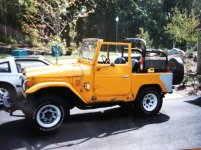
I don't have a digital photo of my CJ-7, but here is my FJ-40 with a very sad rear end. I replaced the leaf springs in all four corners with Downey Leafs that rode much better and lifted the truck about 1.5 inches. This thing was geared like a tractor...

1975_FJ-40.jpg
 
"You are unlocking the lockers for these hairpin turns?" - Oh for sure, but even without the diff locks engaged (locked) I get binding, and I end up doing a three-point turn. I'm fairly certain I'd be able to make the turns without reversing if I had RCVs.

"They occasionally need to be rebuilt." - Yeah - the rebuild seems like a 90-minute job (maybe two hours the first time you do it). It seems like if you grease them every oil change using the RCV proprietary grease, you can get pretty far without a rebuild - but that will vary depending on how much you drive off road. After talking to the good folks at RCV, it seems like the one thing you absolutely have to avoid, is modifying your stock steering stops. If you move the steering stops, you will over-stress the constant velocity joint, and then you get a clicking sound, and need to rebuild the joint.

What's your overall evaluation of your RCVs?
will you be able to keep the same amount of steering angle as you have now?

My Toyota has always had a lot less steering angle than a jeep does. I assumed it was because of the CVs (a Toyota has birfield axles so they’re already CV axles before I went to RCVS) I use a 6” Ram for my hydraulic assist steering and jeepers use an 8” Ram typically. I’ve always needed to make three + point turns even before the front spool.

They are very strong. I’ve never broken one and I’ve broken a lot of parts.
 
I don't have a digital photo of my CJ-7, but here is my FJ-40 with a very sad rear end. I replaced the leaf springs in all four corners with Downey Leafs that rode much better and lifted the truck about 1.5 inches. This thing was geared like a tractor...

View attachment 90535
Mmm gearing.

Can confirm that Toyota guys do like their gearing

~230:1 in the lowest of 20 forward gears the yota crawler

IMG_7382.jpeg
 
Marlin Crawler is where its at if you want to creep! In first gear Lo, these won't stall even if you have it running against a brick wall. It will just lug away trying to climb. I've been missing the simplicity of the old mechanical/analogue 4x4s.
 
will you be able to keep the same amount of steering angle as you have now?

My Toyota has always had a lot less steering angle than a jeep does. I assumed it was because of the CVs (a Toyota has birfield axles so they’re already CV axles before I went to RCVS) I use a 6” Ram for my hydraulic assist steering and jeepers use an 8” Ram typically. I’ve always needed to make three + point turns even before the front spool.

They are very strong. I’ve never broken one and I’ve broken a lot of parts.
Yes - according to RCV, I won't lose any steering angle.

Agreed - my Jeeps all cut much tighter than my Toyotas. That is certainly true when comparing IFS Toyotas to SFA Jeeps, but it was also true even comparing the 1978 CJ-7 to the 1975 FJ-40, which were basically the same design (solid axles front and rear, leaf springs front and rear, and both powered by the venerable 4.2 liter inline 6). Of course, the FJ-40 was built like a tank, and weighed at least 1,000 pounds more. I think Toyota cut the steering angle to minimize the risk of breaking a U-joint. The goal of Toyota engineers was to make the Landcruiser run forever; the goal of the Jeep engineers was to make a 4x4 that was capable and fun, but longevity didn't seem high on the list of priorities. Toyota really built those FJ-40s to run in the outback for a long time without any service. Even the engine - which had the same displacement as the Jeep - took two more quarts of oil.

Great to hear that your RCVs are holding up well to abuse!
 
Last edited:
Yes - according to RCV, I won't lose any steering angle.

Agreed - my Jeeps all cut much tighter than my Toyotas. That is certainly true when comparing IFS Toyotas to SFA Jeeps, but it was also true even comparing the 1978 CJ-7 to the 1975 FJ-40, which were basically the same design (solid axles front and rear, leaf springs front and rear, and both powered by the venerable 4.2 liter inline 6). Of course, the FJ-40 was built like a tank, and weighed at least 1,000 pounds more. I think Toyota cut the steering angle to minimize the risk of breaking a U-joint. The goal of Toyota engineers was to make the Landcruiser run forever; the goal of the Jeep engineers was to make a 4x4 that was capable and fun, but longevity didn't seem high on the list of priorities. Toyota really built those FJ-40s to run in the outback for a long time without any service. Even the engine - which had the same displacement as the Jeep - took two more quarts of oil.

Great to hear that your RCVs are holding up well to abuse!
If you can keep all the steering angle then I don’t see a downside if you have the budget to swallow the cost of them.

Seems like it would fix your issue although it certainly is an expensive fix. The whole point of CV is constant velocity compared to u-joints that have acceleration and deceleration phases. Smoother means less binding and less wheel hop
 
Is it your u-joints that you feel are binding / hopping, or just the driveline bind/wind up in general? I have found that this truck definitely feels like it binds up easily in 4WD, even on snowy parking lots. I am guessing it normally releases thru rear tire slip/hop rather than the front. I suspect the rear LSD is part of the reason it binds up easily.

While I know RCV axles have a great rep, I haven’t really heard of anyone popping OEM axles or busting u joints on these trucks
 
Is it your u-joints that you feel are binding / hopping, or just the driveline bind/wind up in general? I have found that this truck definitely feels like it binds up easily in 4WD, even on snowy parking lots. I am guessing it normally releases thru rear tire slip/hop rather than the front. I suspect the rear LSD is part of the reason it binds up easily.

While I know RCV axles have a great rep, I haven’t really heard of anyone popping OEM axles or busting u joints on these trucks
That's an important question. The main symptom is jerking during tight turns, which leads me to believe it is U-joint binding, but after your question, I wouldn't bet the farm on it being the U-joints.

I feel the jerking when trying to make hairpin turns in switchbacks; it is more noticeable going uphill, but I also feel it coming downhill. It makes me hesitant to crank the wheel all the way, as the feedback I'm getting is a little disconcerting. It feels like something might break if I give it gas, in full turning lock, going uphill, in a tight rocky turn. To be clear, I'm not romping on the gas at all - I'm taking it quite slow and steady. But I will also readily admit that I am not used to wheeling a HD truck, and maybe that is the main issue. In past experience with lots of other 4x4s, I've felt general driveline bind that is less jerky in a tight turn, and more... just bound up - like in your example of making turns in a snowy parking lot: general driveline binding. I might need to get out wheeling with some other power wagons, to get a better sense of what's normal.

For context: I'm driving OnX grade 4 and 5 trails. These are not technical rock crawling trails, but can be steep, lots of rocks, sometimes getting pretty flexed-out but not lifting a tire.
 
Last edited:
I asked earlier about you having the front unlocked during these turns. I was sorta thinking what el barto is saying but I tend to come off as abrasive on here so I didn’t want to come off as argumentative. Also, I can’t think of a good way to rule out either one for sure

If the front is unlocked I am inclined to think the binding is not necessarily from the front axle u-joints. Front axle U-joints have more phasing as you get further into the turning angle. usually just the inside one is biting enough to give feedback and you’d be feeling the acceleration and deceleration phases of the u-joint as it goes through non constant velocity acceleration and deceleration phases but that is usually felt more as “wheel hop” than binding to me.

Driveline binding is always going to happen on hard surfaces in 4x4 when you turn. That’s why some people install the 2Lo kit if they use Low range to back a trailer up a driveway but it’s paved etc.
 
Last edited:
I asked earlier about you having the front unlocked during these turns. I was sorta thinking what el barto is saying but I tend to come off as abrasive on here so I didn’t want to come off as argumentative. Also, I can’t think of a good way to rule out either one for sure

If the front is unlocked I am inclined to think the binding is not necessarily from the front axle u-joints. Front axle U-joints have more phasing as you get further into the turning angle. usually just the inside one is biting enough to give feedback and you’d be feeling the acceleration and deceleration phases of the u-joint as it goes through non constant velocity acceleration and deceleration phases but that is usually felt more as “wheel hop” than binding to me.

Driveline binding is always going to happen on hard surfaces in 4x4 when you turn. That’s why some people install the 2Lo kit if they use Low range to back a trailer up a driveway but it’s paved etc.
I didn't think you were abrasive. You never know who you're talking to, so asking if I had the front axle locked made sense. Of course, anyone with any experience off road would know that you can't make turns with the front axle locked - but you don't know me from Adam, so - no harm, no foul. On the contrary, I appreciate your replies and thoughts.

In my last post, I described the sensation from the front end in tight turns as "jerking", which is sort of like the little brother to wheel hop. If I was a little more aggressive with the skinny pedal, I'd be fully into wheel hop.

In my last post, where I used the word "binding", I was talking about that typical feeling of "general drive line binding" one gets in any 4x4 when you are on a surface that provides moderate traction. The example I used was in a snowy parking lot. I'm thinking about a parking lot covered in cold dry snow - which is super-grippy; often times you pull in to a parking lot in 4x4 because the roads are crappy, but then you have too much traction to make tight turns in the parking lot; this provides that sense of "binding" in the drive line that is pretty different from the "jerking" or wheel hop I've been feeling making tight turns off road in the power wagon. I've felt that "general drive line binding" in every 4x4 I've ever driven from 1970s Jeeps and Landcruisers, to the Jeep JKU, and much more recent-model Toyota Tacomas and 4-Runners.

Having thought it through, I do think I'm feeling some feedback from the U-joints in switchbacks. I fully understand the acceleration/deceleration that ocurs with a U-joint, and which results in "jerking" or "wheel hop", and I'm pretty sure that is what I'm feeling. But I'm not 100% sure, because the HD platform is pretty different than the mid-size 4x4s I'm used to driving. This conversation with you and @el_barto is super-helpful, because I do not want to buy some RCV axle shafts, only to find that the drive line feedback I'm feeling is in the central drive train, and not out in the U-joints at the end of the axle shafts.
 
Last edited:
That’s why some people install the 2Lo kit if they use Low range to back a trailer up a driveway but it’s paved etc.

I should look into this for backing the camper in and up the driveway. It’s stone so I can get away with 4lo but don’t need it.


Edit: I see it’s around $200. I don’t have aux switches so I’d have to run their switch. No big deal I suppose. Going on the wishlist of to-do’s.
 
Last edited:
Have you pulled your axle joints apart? Miles? My truck had 70k and both axlejoints were completely dry. I also had the binding during left turns on the road. Just something to think about before shelling out the money. Unfortunately, the spicers that went in were smooth for awhile but are starting to bind at 87k.
 
Have you pulled your axle joints apart? Miles? My truck had 70k and both axlejoints were completely dry. I also had the binding during left turns on the road. Just something to think about before shelling out the money. Unfortunately, the spicers that went in were smooth for awhile but are starting to bind at 87k.
I have not. The truck only has 7,000 miles on it. I don't think the U-joints are worn, but they could need some grease. I'll do that this weekend. Thanks!
 
Back
Top