What's new
Ram Heavy Duty Forum

Register a free account today to become a member! Once signed in, you'll be able to participate on this site by adding your own topics and posts, as well as connect with other members through your own private inbox!

High Oil Temps —- Oil Cooler??

AH64ID

Moderator
Staff member
Messages
5,185
Reaction score
5,383
Points
113
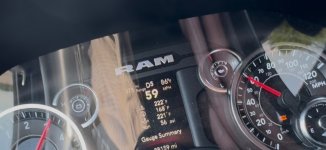
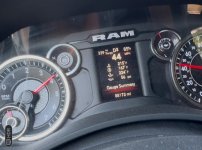
Was Towing with my ‘17 6.4 today and my oil got hot, real hot, twice. I hit 280° on two separate grades, one at 87° ambient and the other at 105°. I was running just over 18K GCW. When the oil hit 280° the rpms were limited to ~4200.

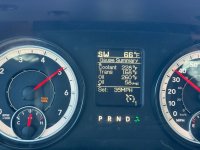
Normal cruising on flat ground, same 18K GCW, coolant is ~204° and oil is ~245°. Highest coolant temp I saw all day was 222° but generally much cooler than that.

I even had a P1521, incorrect engine oil type, active after the first bump of 280° but not the second. It didn’t light the CEL but was active when I scanned. No dash warnings at all.

So I’m thinking the oil cooler isn’t keeping up and it’s time to replace it. How big of a job is it? The oil only has 1500 miles on it, but it’s getting changed after these temps. I’m using PUP 0w-40 and pressure never dropped, even with the temps, and held 53-55 (unlike my 05 Cummins where pressure would fall fast as oil got above 230° with aftermarket pressure and temp gauges).

Anything else I can look at?
 
I don’t think it’s a sensor. ECT, oil, and trans temp were all 77-81° this morning after sitting overnight.
 
It looks like the oil cooler is plumbed from the lower radiator hose, but only gets part of the coolant flow. Also, if you're running ECTs that hot, coolant coming from the radiator isn't all that cold and probably above thermostat temperatures.

Hose to/from the oil cooler could be blocked?

Anyone make a bigger oil cooler? (More surface area and more volume to get oil to coolant deltas down.) That thing is about the same size as a BMW N52 unit.
 
It looks like the oil cooler is plumbed from the lower radiator hose, but only gets part of the coolant flow. Also, if you're running ECTs that hot, coolant coming from the radiator isn't all that cold and probably above thermostat temperatures.

Hose to/from the oil cooler could be blocked?

Anyone make a bigger oil cooler? (More surface area and more volume to get oil to coolant deltas down.) That thing is about the same size as a BMW N52 unit.

From what I gather 221-222° isn’t all that hot. The fan isn’t commanded full until 230°, so I don’t think there are any thermostat/coolant issues. Even on flat ground at ~204° ECT the oil is hotter than I’d expect.

Based on where the oil cooler sits I don’t think it would have an airlock.

On flat ground, what is the rpm ?

This is flat ground.

IMG_7044.jpeg
 
From what I gather 221-222° isn’t all that hot.
If the radiator isn't saturated (engine not working hard) and the oil cooler is getting coolant from the radiator outlet, that coolant is anywhere from ambient to somewhere theoretically well below engine temperature.

If you're running at 220 ECT and the 205 thermostat is full open and the radiator is only knocking that down 15 degrees, your oil cooler is getting 205 degree water.

What I'm saying is, the oil cooler may be getting coolant well below engine coolant outlet temperatures, until it isn't. Then again, maybe I have my coolant flow routing all wrong. It's different for different engines and I'm wrong pretty often.
 
If the radiator isn't saturated (engine not working hard) and the oil cooler is getting coolant from the radiator outlet, that coolant is anywhere from ambient to somewhere theoretically well below engine temperature.

If you're running at 220 ECT and the 205 thermostat is full open and the radiator is only knocking that down 15 degrees, your oil cooler is getting 205 degree water.

What I'm saying is, the oil cooler may be getting coolant well below engine coolant outlet temperatures, until it isn't. Then again, maybe I have my coolant flow routing all wrong. It's different for different engines and I'm wrong pretty often.

At the end of the day I’m not sure specific temps or routing really matter since these engines are known to run around 220° towing and not have high oil temp. I’d think that pulling a 7% grade at 105°F at 18K GCW and stabilizing below full fan speed shows the cooling system is working properly.

EDIT: the oil cooler appears to be inline with the heater core. Maybe there is a vapor lock in the heater core? I did change the coolant about 1500 miles ago.
 
I have a 4.5 gen 6.4L so it may not be relevant, but I don’t see oil temperatures that high more like mid 220s.

Also, I’m lighter at a gross combined truck and trailer with tractor on it is a bit more than 16,400 pounds.
 

Attachments

  • IMG_2060.jpeg
    IMG_2060.jpeg
    278.9 KB · Views: 6
  • IMG_2059.jpeg
    IMG_2059.jpeg
    240.4 KB · Views: 6
  • IMG_2058.jpeg
    IMG_2058.jpeg
    217.4 KB · Views: 7
  • IMG_2057.jpeg
    IMG_2057.jpeg
    327.1 KB · Views: 7
I have a 4.5 gen 6.4L so it may not be relevant, but I don’t see oil temperatures that high more like mid 220s.

Also, I’m lighter at a gross combined truck and trailer with tractor on it is a bit more than 16,400 pounds.

I've definiatly got more weight and drag with the 10K 5th wheel, but you're temps are more where I'd expect to be.

So do I have a heater core flow issue or just an oil cooler issue? The air blows hot, haven't measure it yet, when I turn up the heat but maybe not as hot as it should be.
 
I might consider bypassing the heater core completely and test it. If your oil temperatures stay down then I would back flush the heater core.

There internet posts on 6.4L with heater cores being plugged.
 
I might consider bypassing the heater core completely and test it. If your oil temperatures stay down then I would back flush the heater core.

There internet posts on 6.4L with heater cores being plugged.

I’ve seen those, so that’s a great idea.
 
I bypassed the heater core today and took a smaller trailer, 5.5-6K, for a 30 mile loop. The oil took longer to warm up so I was initially optimistic, but that didn’t last long. After a few miles at 55 on a 1-2% grade the oil was back at 239° then climbing a short steep grade in 1st at 35 mph (could have done 2nd, but I wanted the rpms high since high rpms is when the oil got the hottest) and I was back above 260° and outside temps are in the 60’s today.

So that’s leading me to think it’s the oil cooler itself. I have a back flushing tool on order, but not sure how effective it will be.

IMG_7558.jpeg
 
Little update. I back flushed the heater core (not the main culprit since nothing changed with it bypassed) and the oil cooler. I got a decrease in temps, not down to what I think is normal but it definitely points to a plugged oil cooler.

Ambient temps are cooler, but I don’t think that’s the main reason for decreased oil temps.

I towed the 5th wheel up the same hill I originally noticed the issue on with my first derate. Ambient was 72° vs 87°, but the speed was faster and the weight was within 1K. Oil only got to 262° and took almost all the way up the hill to there vs 280° within the first mile last time. Also the oil cooled off very fast when power was reduced, unlike last time. Coolant temps were the same as last time.

The rest of the tow saw lower oil temps, but ambient got as low as 28°. I have noticed my empty cruising oil temps are down 10-20° depending on speed, etc.

So it seems that the oil cooler was plugged and still is partially. My heat output is also better, but I haven driven this truck in the cold much. I did notice a huge difference between 198° coolant and 210° coolant in heat output though, I don’t recall that much variance with my 6.7’s but they also had auto HVAC.

I’ll likely replace the oil cooler in the spring and probably the heater core too based on the track record of them in these trucks.
 
I’d shoot the oil filter or oil pan with a IR gun to compare actual temps to reported temps. I’ve had different instruments work well at one end of their operating range and not so good on the other.

Also is this reading algorithm based or actual?
 
I’d shoot the oil filter or oil pan with a IR gun to compare actual temps to reported temps. I’ve had different instruments work well at one end of their operating range and not so good on the other.

Also is this reading algorithm based or actual?

Good idea. I know cold it’s good, and hot seems accurate until it’s climbing really fast.

From what I’ve read it’s actual. I don’t think an algorithm would go that high with normal coolant temps.
 
Back
Top