
I don't know if this is what is going on. I had a similar problem with my 2021 2500 Ram. I had a hard time figuring it out. My trailer brake wiring is ran thru the axel to connect both wheels to the brakes I clipped the wires by the outside brake hub and pulled the wire out. The brake wires were warn in several places with exposed wire causing the error message. I got new wires zipped tied them to the outside of the axel shaft and reconnected them to the clipped brake wires. I did this to both axels and have not had any more problems . I was shocked how warn the old brake wires were and all the exposed wire must have cause some kind of a short in the brakes.Awesome info, would make a great sticky.
Ram Heavy Duty Forum
You are using an out of date browser. It may not display this or other websites correctly.
You should upgrade or use an alternative browser.
You should upgrade or use an alternative browser.
Brake Controller Troubleshooting/Technical Info
- Thread starter Tom2531
- Start date

CdnHO
Well-Known Member
Given the cheap wire that most trailer manufacturers use as well as the constant vibration and movement of the axles while towing I am surprised that there are not more issues with shorted brake wires. These wires just flop around the inside of the metal axle tube. One would think that the manufacturers would have figured out a better way by now since it really is a safety issue. Nope.I don't know if this is what is going on. I had a similar problem with my 2021 2500 Ram. I had a hard time figuring it out. My trailer brake wiring is ran thru the axel to connect both wheels to the brakes I clipped the wires by the outside brake hub and pulled the wire out. The brake wires were warn in several places with exposed wire causing the error message. I got new wires zipped tied them to the outside of the axel shaft and reconnected them to the clipped brake wires. I did this to both axels and have not had any more problems . I was shocked how warn the old brake wires were and all the exposed wire must have cause some kind of a short in the brakes.

H3LZSN1P3R
You're doing it wrong
Dexter sells the axles with the wire inside already then trailer manufactures just play the stupid card, they make them overly cheap to begin with no surprise they wont change the wire dexter supplysGiven the cheap wire that most trailer manufacturers use as well as the constant vibration and movement of the axles while towing I am surprised that there are not more issues with shorted brake wires. These wires just flop around the inside of the metal axle tube. One would think that the manufacturers would have figured out a better way by now since it really is a safety issue. Nope.
CdnHO
Well-Known Member
I don't have this issue since I have electric over hydraulic. However if I had regular electric brakes, I would be tempted to rewire it using stranded wire through a plastic conduit attached to the outside of the axle as a pre-emptive measure. That's just me. On the other hand expecting Dexter to use some sort of protective jacket on the wire running inside the axle tube would be like expecting a big payout from the tooth fairy.Dexter sells the axles with the wire inside already then trailer manufactures just play the stupid card, they make them overly cheap to begin with no surprise they wont change the wire dexter supplys

H3LZSN1P3R
You're doing it wrong
I run the pvc double jacketed wire for all my brake wiring its some tough stuff and is ment to be buried so it will out last the trailers lolI don't have this issue since I have electric over hydraulic. However if I had regular electric brakes, I would be tempted to rewire it using stranded wire through a plastic conduit attached to the outside of the axle as a pre-emptive measure. That's just me. On the other hand expecting Dexter to use some sort of protective jacket on the wire running inside the axle tube would be like expecting a big payout from the tooth fairy.

Wichita Dave
Member
I appreciate the time and effort you took to create this post I will be studying your description of indicator cycles again. I bought a new connector, I'll probably try that first but then I'll have to pull the drums if that doesn't work.Part 2:
I did some more tests. After gathering data with the scope, I tried to see what was available via OBDII. Luckily, you can query the PIDS on the ITBM (Integrated Trailer Brake Module). I have a OBDLink MX+ and I needed to use the FCA extended diagnostics add-on to get to them. This helped, as there is a PWM % PID and I could abandon the scope. I also found braking is in relation to the “Brake Pedal Status – Primary Circuit Pressure” in the ABS module. That combined with some manual readings, I was able to make the following observations.
All trailer modes will output 100% PWM above 10MPH with a gain of 10.0 when the dash indicates 100% brake. At speeds below 10MPH down to 0MPH, it gets reduced linearly to somewhere between 50% and 70% depending on the trailer type selected.
The manual lever doesn’t output PWM the same way the brake pedal does. 50% as indicated on the dash with the brake pedal uses the braking curves (a later chart) to determine what to output. The manual lever is proportional to the PWM output, taking into consideration the gain and vehicle speed.
It’s worth noting that the dash brake % isn’t the same for different trailer types. It’s pretty linear as compared to brake pressure, but there are some subtle differences between the trailer types. LE=Light Electric, HE=Heavy Electric, LEOH=Light Electric Over Hydraulic, HEOH=Heavy Electric Over Hydraulic.
View attachment 19019
800 inHg is what I could call “medium” brake pressure. 1500 inHg is what I could call “high” brake pressure. The braking curves below kind of follow these lines, but there are some nuances, so I generally ignore the dash percentage from here on and use inHg as my measured data for brake pressure. I posted this chart merely for reference.
View attachment 19020
The chart above shows the braking pressure vs the PWM output. The chart doesn’t go higher than 62% because the truck was stopped. That’s the whole 0-10MPH mentioned earlier. Let’s look at each trailer type. LE comes on slow at first, then goes up to the max with medium brake pressure. HE also comes on slow at first, but gets up to the max with a lighter brake pressure. LEOH stays on flat at about 4% PWM at first. Then it takes a high braking pressure to get to full output. HEOH comes on flat at about 8% PWM at first, and comes up to full output a little faster.
Lowering the gain has two effects. You can see this by looking at LE 10.0 and LE 5.0 in the chart. First, it delays the brakes coming on by increasing the pressure needed to first get them to activate. Second, it drops the maximum output down proportionally. A 5.0 gain will never output more than 50% PWM (above 10MPH). For hydraulic brakes at lower gains, they still have that low PWM when the brake is initially depressed – that doesn’t change. But the point at which it will ramp up is effectively delayed, as is the max output.
I wanted to know what this looked like while moving. Armed with the data logger, I came up with this chart:
View attachment 19021
The solid lines are the same LE and HE data from the previous chart done at 0MPH at 100 inHg intervals. The dashed lines are data recorded while moving above 10MPH. The data isn’t perfect because it would only poll at 500ms intervals, so I had to brake and accelerate at the same time over a 10-15 second period to get enough data. Generally, it looks scaled up as I would expect while moving, although HE seems a little more aggressive at first. Based on this, I would expect the braking curve to scale down between 10 and 0 MPH. It’s too hard to hold the truck at 5MPH and brake between 0 and 100% to determine if that is the case. I just wanted to do a test while moving and compare results.
Hopefully this helps someone, or at least you find it interesting.

TW720HVY
Active Member
- Messages
- 118
- Reaction score
- 80
- Points
- 28
I run my 16K load on LE usually around 4-5 gain depending on in town or highway.
The way HE ramps up faster, it was too abrupt/harsh in town.
Glad I am not alone.
I'd like to add my experience, we have a 2022 3500 DRW and had a 2022 2500, and now a 2024 2500, the 2500 and 3500 stop ALL our trailers completely different. The 3500 stops our trailers the way I'd expect them to stop, both 2500s stop our trailers terribly, even in LE. Anything above 3.5 loaded is going brake way too aggressively. With the first trailer that was locking up I chased and replaced the magnets due to past experiences, and like someone mentioned it helped for a moment. But then we purchased 2 new trailers and both were locking up, in fact I even got a replacement brake assembly from Dexter for one of them thinking it was bad, all the while it was the 2500 controller. Our dealership replaced the 2500's brake controller, however it solved nothing.
My thoughts, all 3 are in a race to out pull one another, and in the process they've made the 2500s stop the trailers harder. Or I just got lucky with our 3500 DRW trailer brake system that works normally.

dblackwell
Active Member
- Messages
- 161
- Reaction score
- 146
- Points
- 43
I’m having an issue with my 2025. Here is a video of the multimeter when I was testing. Ever had a trailer hooked up so it’s obvious that it’s a truck issue. The dealer has thrown a trailer brake control module at it and it didn’t solve the issue. I saw a Facebook post in a group of someone having a similar issue. Turns out the trailer brake switch on the dash was their issue. I’m planning on calling my dealer to let them know of that persons fix. Maybe they haven’t checked that… it’s kind of frustrating that I have to deal with this. We have a trip planned ti go from Indiana to the Grand Canyon with the kiddos in a week and a half.

flan
Well-Known Member
- Messages
- 4,857
- Reaction score
- 10,872
- Points
- 113
Just fyi no video showed up in your postI’m having an issue with my 2025. Here is a video of the multimeter when I was testing. Ever had a trailer hooked up so it’s obvious that it’s a truck issue. The dealer has thrown a trailer brake control module at it and it didn’t solve the issue. I saw a Facebook post in a group of someone having a similar issue. Turns out the trailer brake switch on the dash was their issue. I’m planning on calling my dealer to let them know of that persons fix. Maybe they haven’t checked that… it’s kind of frustrating that I have to deal with this. We have a trip planned ti go from Indiana to the Grand Canyon with the kiddos in a week and a half.
H3LZSN1P3R
You're doing it wrong
Are you saying you are testing things without a trailer hooked up?I’m having an issue with my 2025. Here is a video of the multimeter when I was testing. Ever had a trailer hooked up so it’s obvious that it’s a truck issue. The dealer has thrown a trailer brake control module at it and it didn’t solve the issue. I saw a Facebook post in a group of someone having a similar issue. Turns out the trailer brake switch on the dash was their issue. I’m planning on calling my dealer to let them know of that persons fix. Maybe they haven’t checked that… it’s kind of frustrating that I have to deal with this. We have a trip planned ti go from Indiana to the Grand Canyon with the kiddos in a week and a half.
dblackwell
Active Member
- Messages
- 161
- Reaction score
- 146
- Points
- 43
Yes, getting the trailer brake error and not had the trailer hooked up yet. Issue is 100% truck side.Are you saying you are testing things without a trailer hooked up?
Can’t get it to upload for some reason. Basically the gauge pulsates. I have since gotten a tester you plug in and it’s the brake pin that is pulsating. my dealer threw the brake control module at it, and that did not help. I found someone else with the same problem on a Facebook group, and apparently the engineers went to their dealership after their dealership through wiring harness and the module with no luck. Turns out their issue was the brake control on the dash. Fingers crossed the part comes in tomorrow and it fixes my truck also. I’ll update once I know in case somebody else has this issue in the future.Just fyi no video showed up in your post
dblackwell
Active Member
- Messages
- 161
- Reaction score
- 146
- Points
- 43
Here is a linkJust fyi no video showed up in your post
Nothing else works. I did finally hook the trailer up and the lights are dim and they pulsate just like the multimeter is… - hopefully the brake control switch is the issue.
H3LZSN1P3R
You're doing it wrong
Dim lights wont have anything to with the brake controller its more likely a grounding issue. But without the trailer attached you wont get proper readings with these trucks its not like your crappy add on brake controller setup. Connect the trailer and test the brakes by actually driving a bit.Here is a link
Nothing else works. I did finally hook the trailer up and the lights are dim and they pulsate just like the multimeter is… - hopefully the brake control switch is the issue.

dblackwell
Active Member
- Messages
- 161
- Reaction score
- 146
- Points
- 43
Believe it or not, it does have something to do either way the flickering. There was someone else who was having the same issue on a FB group and had videos. I talked to the service manager who worked on there truck in Prescott, AZ and the said tried harnesses, modules, checked the wiring…. Finally ended up having 2 Ram engineers come to their shop and after their testing, it was the brake control switch. I will report back if it solves my issue. Hopefully the part is in today. I have no other lights… no turn signals, brake lights etc. when I plugged into the camper. Only running lights that were dim and pulsating in the same rhythm as the multimeter.Dim lights wont have anything to with the brake controller its more likely a grounding issue. But without the trailer attached you wont get proper readings with these trucks its not like your crappy add on brake controller setup. Connect the trailer and test the brakes by actually driving a bit.
The pulsing doesn’t surprise me. If you hook up a trailer you’ll hear the brake magnets clicking as the brake controller pulses them to detect when they’re connected.
dblackwell
Active Member
- Messages
- 161
- Reaction score
- 146
- Points
- 43
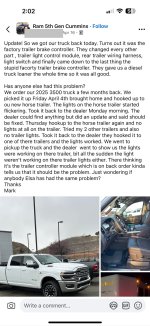
H3LZSN1P3R
You're doing it wrong
Ah I misunderstood I thought it was just the brakes.Believe it or not, it does have something to do either way the flickering. There was someone else who was having the same issue on a FB group and had videos. I talked to the service manager who worked on there truck in Prescott, AZ and the said tried harnesses, modules, checked the wiring…. Finally ended up having 2 Ram engineers come to their shop and after their testing, it was the brake control switch. I will report back if it solves my issue. Hopefully the part is in today. I have no other lights… no turn signals, brake lights etc. when I plugged into the camper. Only running lights that were dim and pulsating in the same rhythm as the multimeter.
dblackwell
Active Member
- Messages
- 161
- Reaction score
- 146
- Points
- 43
At the dealer now. Fingers crossed my issue is fixed in an hour. I’ll report back in case someone needs the info in the future.Ah I misunderstood I thought it was just the brakes.
dblackwell
Active Member
- Messages
- 161
- Reaction score
- 146
- Points
- 43
Well, the parts guy ordered the wrong part. He got the switch that goes under the 12” screen that has the -+ buttons also…. The 14” has the -+ as buttons on the screen, not the switch…. New part ETA tomorrow or Friday….Ah I misunderstood I thought it was just the brakes.
Last edited:
CdnHO
Well-Known Member
Hard to find competent help these days. You end up wearing out the truck driving to the dealership. LOLWell, the parts guy ordered the wrong part. He got the switch that goes u see the 12” screen that has the -+ buttons also…. The 14” has the -+ as buttons on the screen, not the switch…. New part ETA tomorrow or Friday….