What's new
Ram Heavy Duty Forum

Register a free account today to become a member! Once signed in, you'll be able to participate on this site by adding your own topics and posts, as well as connect with other members through your own private inbox!

Automatic Regen too often

I did. My average speed is ALWAYS causing regens before any possible 24 hour timer could kick in. As far as I can tell the timer must reset the 24 hour clock after a regen.
This has been the case on my '18 and on my '22. A have a friend that pulls his comparable 5th wheel toy hauler on every trip with us too. His '17 4:10 HO dually and now his '22 4:10 dually HO is virtually identical in both DEF usage, fuel mileage and regen distance as my trucks have been. Also the exact same fuel stations at the same time as I.

As far as people easily getting 1,000+ miles before regen. The only thing I can think of is the runs we do which goes through mountain passes along with the weight and drag resistance of the trailers we pull causes the regens in the mid 800's along with the fuel stations we use. Neither he or I use the trucks for anything but towing.

The dash gauge almost never showed any soot load except at 15k miles when suddenly everything went crazy. It turned out a faulty MAF which either damaged the DPF or it had a fault too. As soon as both were replaced the truck was back to normal. The Scangauge shows a fairly linear increase in the percentage with it usually dropping pulling mountain passes and climbing going down the back side while settling right back to a linear increase on the flats.

He too has said he's never seen the 24 hour bit either since he regens before that timer runs out. He's pretty OCD and keeps even more detailed and exacting records than I do.

Better than the old DMax I had, it was programmed to regen every 400 miles regardless of when it had regened. Seemed rather dumb to me. Actually the 24 hour bit seems stupid, are the sensors not accurate enough for proper regen frequency or what?
To get 1,000+ miles between 24 hour regenerations you need a pretty high average speed in that duration. In the winter months, my truck consistently achieves 24 hour regeneration cycles with an average distance between of about 850-900 miles. Thats mostly shorter trips, unloaded, predominately highway. Average speed during those intervals works out to around 38-40mph or so.
 
To get 1,000+ miles between 24 hour regenerations you need a pretty high average speed in that duration. In the winter months, my truck consistently achieves 24 hour regeneration cycles with an average distance between of about 850-900 miles. Thats mostly shorter trips, unloaded, predominately highway. Average speed during those intervals works out to around 38-40mph or so.
I'll have to run out and check now but it was 56.
 
I did. My average speed is ALWAYS causing regens before any possible 24 hour timer could kick in.

Your average speed doesn't have any direct impact on active regen frequency. The only real impact it might have is if it was too low and you didn't build any heat in the system. Your described use does not match that potential issue.

As far as I can tell the timer must reset the 24 hour clock after a regen.

Every active regen resets the 24 hour clock, so soot based, timer based, or manually started.

This has been the case on my '18 and on my '22. A have a friend that pulls his comparable 5th wheel toy hauler on every trip with us too. His '17 4:10 HO dually and now his '22 4:10 dually HO is virtually identical in both DEF usage, fuel mileage and regen distance as my trucks have been. Also the exact same fuel stations at the same time as I.

Distance is not a factor that determines active regen frequency. I know lots of people post about short and long regen distances, but it's not a factor much like average speed.


As far as people easily getting 1,000+ miles before regen. The only thing I can think of is the runs we do which goes through mountain passes along with the weight and drag resistance of the trailers we pull causes the regens in the mid 800's along with the fuel stations we use. Neither he or I use the trucks for anything but towing.

To get 1000+ miles per regen you only need to average 41.7 mph and have driving that in conducive to passive regen.

The weight and drag resistance of the trailers is a perfect condition to get only 24 hour regens, especially if you don't use the truck for things other than towing. 850 miles in 24 hours is still a 35.4 mph average, and not bad for mountain towing.

The dash gauge almost never showed any soot load except at 15k miles when suddenly everything went crazy. It turned out a faulty MAF which either damaged the DPF or it had a fault too. As soon as both were replaced the truck was back to normal. The Scangauge shows a fairly linear increase in the percentage with it usually dropping pulling mountain passes and climbing going down the back side while settling right back to a linear increase on the flats.

Linear increase in percentage usually means that the PID is timer based, the dropping on passes indicates soot based.

I have found, while towing, that the PID will go up and down with soot loading until about 12 hours since the last active regen. After 12 hours the PID just slowly climbs towards 100% since the 24 hour timer is then driving the PID.
He too has said he's never seen the 24 hour bit either since he regens before that timer runs out. He's pretty OCD and keeps even more detailed and exacting records than I do.

Based on how you have said you use your truck if it truly never makes the 24 hour mark before an active regen them something is wrong. Your truck should only be doing 24 hour regens.

How are you tracking the 24 hour interval?

What does your dash gauge show right before your PID shows 100% and the active regen starts?

Actually the 24 hour bit seems stupid, are the sensors not accurate enough for proper regen frequency or what?

The purpose of the 24 hour regen is to prolong DPF life. Even when constantly towing the DPF will gain some soot, so the timer lets it regen and burn that down without accumulating too much that becomes difficult to clean out. On a 24 hour based regen when the regen starts the PID drops rapidly to a number that indicates the current soot loading of the DPF, I've seen that number be as low as the 30's when towing and as high at the 60's when I haven't towed much recently. When a soot based regen drives the PID to 100% the PID doesn't drop like that since it's soot based, but it will slowly decrease as the regen cleans the DPF.

I'll have to run out and check now but it was 56.

Are you saying your lifetime average speed is 56? Or your moving average is 56?
 
Well, I have no idea what to say. Four trucks, ALL regen roughly mid 800 miles on the trips we take. One 2017, one 2018, two 2022 trucks. Virtually no difference between them.

You're claiming all four of the trucks are defective in some manner.

Uh, huh.
 
I went 674.6 miles in between 24 hr regens, it then took less than 20 miles to complete the regen at speeds between 62-66 MPH, all miles are mixed stop go city/ hwy this time about 50/50 with maybe a bit more city than hwy
 
Well, I have no idea what to say. Four trucks, ALL regen roughly mid 800 miles on the trips we take. One 2017, one 2018, two 2022 trucks. Virtually no difference between them.

You're claiming all four of the trucks are defective in some manner.

Uh, huh.

Then most likely they are 24 hour regens, as they should be for your use, and you’re misinterpreting the PID data.

You didn’t answer the other questions I asked.
 
Then most likely they are 24 hour regens, as they should be for your use, and you’re misinterpreting the PID data.

You didn’t answer the other questions I asked.
This is just stupid, 24 hour regens always happen before 24 hours. None of my trucks has EVER made it 24 hours before a regen.

I'm done with this. I'm positive if you ran your truck the same routes at the same time, same fuel stations with the same trailers your truck would do exactly the same.

Most likely if I took my truck and drove it exactly the same as you do yours on the same routes with the same fuel it would do what yours does.
 
This is just stupid, 24 hour regens always happen before 24 hours. None of my trucks has EVER made it 24 hours before a regen.

I'm done with this. I'm positive if you ran your truck the same routes at the same time, same fuel stations with the same trailers your truck would do exactly the same.

Most likely if I took my truck and drove it exactly the same as you do yours on the same routes with the same fuel it would do what yours does.

If you’re so confident then answer the questions that you’re avoiding.

What does the dash DPF gauge show as the PID hits 100% on these towing trips?

How are you tacking hours between regens? Total engine hours or driving hours?

24 hour regens cannot happen before 24 hours, that’s why they are called 24 hour regens.

I’m 100% confident that if I ran my truck as you are describing it would do nothing but 24 hour regens, without issue or exception. So something is wrong with your data or your truck(s).

You can get upset, or you can realize multiple people are trying to help you understand that either your interpretation of the PID info is wrong or something is amiss with your truck.
 
This is just stupid, 24 hour regens always happen before 24 hours. None of my trucks has EVER made it 24 hours before a regen.
“24 hour regens” are based on engine total hours. Not clock hours.

If you are towing a travel trailer or larger RV continuously at highway speeds over a period of several days, limiting your idle time, and not doing any non-towing or slow speed stop and go driving during that period, then the truck should only need to initiate an active regeneration cycle when the engine total hours have reached 24 engine hours from the previous active regeneration cycle. Your DPF soot gauge should read zero during that time period as well.

If the truck is initiating an active regeneration sooner than 24 engine total hours under the continuous towing duty cycle, there exists at least one malfunction or issue within the engine or emissions system that’s causing it to “load up” or force a regen sooner.

It isn’t rocket science, nor is it “stupid”.

Multiple people here who are extremely knowledgeable on this subject have attempted to explain this to you. The fact that yours have always “done it sooner than 24 hours” isn’t a basis of fact to determine proper operation. If the truck runs a regen cycle sooner than 24 engine hours in a continuous highway towing duty cycle, the truck has an issue. Period.
 
“24 hour regens” are based on engine total hours. Not clock hours.

If you are towing a travel trailer or larger RV continuously at highway speeds over a period of several days, limiting your idle time, and not doing any non-towing or slow speed stop and go driving during that period, then the truck should only need to initiate an active regeneration cycle when the engine total hours have reached 24 engine hours from the previous active regeneration cycle. Your DPF soot gauge should read zero during that time period as well.

If the truck is initiating an active regeneration sooner than 24 engine total hours under the continuous towing duty cycle, there exists at least one malfunction or issue within the engine or emissions system that’s causing it to “load up” or force a regen sooner.

It isn’t rocket science, nor is it “stupid”.

Multiple people here who are extremely knowledgeable on this subject have attempted to explain this to you. The fact that yours have always “done it sooner than 24 hours” isn’t a basis of fact to determine proper operation. If the truck runs a regen cycle sooner than 24 engine hours in a continuous highway towing duty cycle, the truck has an issue. Period.
What you think it should do versus what 4 different trucks, a '17, '18 and 2 '22 trucks say different.

I have utterly no idea why you would state with authority the trucks have an issue. You haven't taken your truck and driven under the exact same circumstances.

At no time have I EVER told another member their results are bogus as you have. I have very good records for over 6 years. This is what they do.

To say with authority ALL FOUR trucks are defective is in fact nonsense. Statistically it's impossible that all four spread through three different year models have defects that result in the exact same thing. One '22 truck did have a defect that very suddenly showed up at 15k miles. The dealer replaced the MAF and DPF and it's right back to the way it was before and the same as the other three are/were.

Like I posted, roughly mid 800's regen, 9.6 mpg, it rarely varies. Virtually 100% interstate @ 68 mph. You have no idea the fuel type used (I haven't kept track of that either), ambient temperatures, road conditions, altitude, nothing. All have an impact.

The nice thing is so far every single trip has been with an identical '22 truck now that's always within .2 mpg and regens within 50 miles of each other, his a touch longer and fractionally better mileage since his trailer is ~1k lighter. He keeps very good records too.

Oh, knowledgeable people? Am I dismissed for good recordkeeping so my results are irrelevant?
 
What you think it should do versus what 4 different trucks, a '17, '18 and 2 '22 trucks say different.

I have utterly no idea why you would state with authority the trucks have an issue. You haven't taken your truck and driven under the exact same circumstances.

At no time have I EVER told another member their results are bogus as you have. I have very good records for over 6 years. This is what they do.

To say with authority ALL FOUR trucks are defective is in fact nonsense. Statistically it's impossible that all four spread through three different year models have defects that result in the exact same thing. One '22 truck did have a defect that very suddenly showed up at 15k miles. The dealer replaced the MAF and DPF and it's right back to the way it was before and the same as the other three are/were.

Like I posted, roughly mid 800's regen, 9.6 mpg, it rarely varies. Virtually 100% interstate @ 68 mph. You have no idea the fuel type used (I haven't kept track of that either), ambient temperatures, road conditions, altitude, nothing. All have an impact.

The nice thing is so far every single trip has been with an identical '22 truck now that's always within .2 mpg and regens within 50 miles of each other, his a touch longer and fractionally better mileage since his trailer is ~1k lighter. He keeps very good records too.

Oh, knowledgeable people? Am I dismissed for good recordkeeping so my results are irrelevant?

Where are the engine hours at the start of each regen? Your records are meaningless without them as miles don’t matter.

9.8 mpg average towing is more than sufficient at 68 mph for passive regen, meaning only 24 hour regens would be normal. Anything short of 24 hour regens would be a concern, regardless of what you want to think. You need to talk in hours and not miles as an indicator of regen frequency.

You keep stating you have never seen a 24 hour regen, but you have yet to post hours between regens and your description of the PID shows confusion on what it’s telling you.

Once again, what does the DPF gauge show just prior to the start of an active regen?
 
For me the easy way to keep track of my hours in between regens is to use my trip B mileage counter, photo...

Edit: I left out I reset my trip B mileage counter after a regen is completed...
 

Attachments

  • IMG_4872.jpg
    IMG_4872.jpg
    564.6 KB · Views: 12
Last edited:
Where are the engine hours at the start of each regen? Your records are meaningless without them as miles don’t matter.

9.8 mpg average towing is more than sufficient at 68 mph for passive regen, meaning only 24 hour regens would be normal. Anything short of 24 hour regens would be a concern, regardless of what you want to think. You need to talk in hours and not miles as an indicator of regen frequency.

You keep stating you have never seen a 24 hour regen, but you have yet to post hours between regens and your description of the PID shows confusion on what it’s telling you.

Once again, what does the DPF gauge show just prior to the start of an active regen?
I'll try to be nice here. Average speed 56 mph, regens mid 800's, which translates to roughly 15-16 hours between regens, WAY less than 24 hours. Why would I have to post hours, it's simple math?

Let's work the math. 850 miles / 56 mph = ~15.18 hours. 24 - 15.18 means it regens ~8,8 hours before the 24 hour timer. It's very obvious the 24 hour timer must reset after a full regen or the truck would rapidly regen again when it hit 24 hours, wouldn't it? It doesn't do that, it'll regen again at ~ 15-16 hours or mid 800 miles.

How could this possibly be so hard to understand? The dash DPF gauge always shows zero unless on the extremely rare occasions it's been driven in to town with no trailer. It almost immediately goes back to zero as soon as it's towing as one would expect.

Now, as far as the truck never needing to regen because it's towing. Maybe that's true under some circumstances. It's not in our situation. Four trucks from different years are not defective. Like I clearly posted, fuel, altitude, temperatures, all factors that may well be different than others. A wild card here is I never noted when we used biodiesel or what percentage it was. I called some OTR truckers we know today and was told it can have a significant affect on mileage and regens. Thinking about this I've seen some diesel pumps that say premium diesel and they charge a bit more. I figure it's a scheme to get more money for basically the same thing since nobody seems to know what might be in it.

Along those lines. I own a KTM TPI dirt bike. I get roughly a 100:1 oil to fuel ratio riding. Some of my friends with identical bikes will get as low as around 50:1. Same bike, same oil. The difference is where and how hard it's ridden. It would be ludicrous to make a statement the bikes get say 90:1 because "the authorities" say it does.

One cannot make blanket statements saying it "always" does something when it's patently not true.
 
I'll try to be nice here. Average speed 56 mph, regens mid 800's, which translates to roughly 15-16 hours between regens, WAY less than 24 hours. Why would I have to post hours, it's simple math?

Let's work the math. 850 miles / 56 mph = ~15.18 hours. 24 - 15.18 means it regens ~8,8 hours before the 24 hour timer. It's very obvious the 24 hour timer must reset after a full regen or the truck would rapidly regen again when it hit 24 hours, wouldn't it? It doesn't do that, it'll regen again at ~ 15-16 hours or mid 800 miles.

How could this possibly be so hard to understand? The dash DPF gauge always shows zero unless on the extremely rare occasions it's been driven in to town with no trailer. It almost immediately goes back to zero as soon as it's towing as one would expect.

Now, as far as the truck never needing to regen because it's towing. Maybe that's true under some circumstances. It's not in our situation. Four trucks from different years are not defective. Like I clearly posted, fuel, altitude, temperatures, all factors that may well be different than others. A wild card here is I never noted when we used biodiesel or what percentage it was. I called some OTR truckers we know today and was told it can have a significant affect on mileage and regens. Thinking about this I've seen some diesel pumps that say premium diesel and they charge a bit more. I figure it's a scheme to get more money for basically the same thing since nobody seems to know what might be in it.

Along those lines. I own a KTM TPI dirt bike. I get roughly a 100:1 oil to fuel ratio riding. Some of my friends with identical bikes will get as low as around 50:1. Same bike, same oil. The difference is where and how hard it's ridden. It would be ludicrous to make a statement the bikes get say 90:1 because "the authorities" say it does.

One cannot make blanket statements saying it "always" does something when it's patently not true.
You’re right. The math is not hard. But neither is resetting the B trip meter at the end of the regen and noting the engine hours at the start of the next regen.
 
The dash DPF gauge always shows zero unless on the extremely rare occasions it's been driven in to town with no trailer.

This is all that anyone needs to read to know that you are going 24 hours between active regens. If you were getting soot based regen the dash DPF gauge would read ~45% as that is what's required to go into a soot based regen, period. If the dash gauge always shows zero your passive regen is sufficient to make 24 hour regens, period.

Why would I have to post hours, it's simple math?

Because you aren't tracking your regens frequency correctly, that's the simple answer.

If you want to properly track your regens then wait until your next active regen completes and then write down the total engine hours from the evic (not driving). Monitor the PID, when it approaches 100% look at engine hours and they should be 23-26 from the completion of the last active regen. It's 23-26 because of the way the dash hour meter works, we don't have decimals so it can read 23 or 25 and still be 24 actual engine run hours. The duration of the regen will also effect end to end hours.

Let's work the math.

Lets, what are you current odometer miles and total engine hours (not driving hours)?

Let's see your good record keeping that shows engine hours at the completion of each active regen, we'll wait. Driving hours aren't what matters, only total engine hours.


Many of the variables you're discussing will make differences on engine soot production, but the bottom line is that 9.8 mpg at 68 mph (your numbers) will create sufficient EGTs to passively regen and allow for 24 hours regens all the time on a properly functioning truck, period. Your dash DPF gauge is telling you this.

Bottom line is you're not understanding how these trucks work, and all 4 of the trucks you referenced worked the same. That part is easy to understand, what's difficult to understand is that you're not willing to learn something here from the people that are spending a lot of time trying to properly explain this to you.

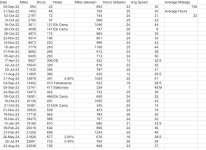
Just for fun, here are my records on regens. Nothing fancy. Miles are for fun, hours are what matters. Using the DPF % PID on my CTS3 and cross referencing the dash DPF gauge I am able to verify a regen is a 24 hour regen even with the dash hour meter shows something slightly different. Soot based regens have the S next to avg speed and the M is for a manual/stationary regen.

IMG_3066.jpeg
 
This is all that anyone needs to read to know that you are going 24 hours between active regens. If you were getting soot based regen the dash DPF gauge would read ~45% as that is what's required to go into a soot based regen, period. If the dash gauge always shows zero your passive regen is sufficient to make 24 hour regens, period.


Because you aren't tracking your regens frequency correctly, that's the simple answer.

If you want to properly track your regens then wait until your next active regen completes and then write down the total engine hours from the evic (not driving). Monitor the PID, when it approaches 100% look at engine hours and they should be 23-26 from the completion of the last active regen. It's 23-26 because of the way the dash hour meter works, we don't have decimals so it can read 23 or 25 and still be 24 actual engine run hours. The duration of the regen will also effect end to end hours.


Lets, what are you current odometer miles and total engine hours (not driving hours)?

Let's see your good record keeping that shows engine hours at the completion of each active regen, we'll wait. Driving hours aren't what matters, only total engine hours.


Many of the variables you're discussing will make differences on engine soot production, but the bottom line is that 9.8 mpg at 68 mph (your numbers) will create sufficient EGTs to passively regen and allow for 24 hours regens all the time on a properly functioning truck, period. Your dash DPF gauge is telling you this.

Bottom line is you're not understanding how these trucks work, and all 4 of the trucks you referenced worked the same. That part is easy to understand, what's difficult to understand is that you're not willing to learn something here from the people that are spending a lot of time trying to properly explain this to you.

Just for fun, here are my records on regens. Nothing fancy. Miles are for fun, hours are what matters. Using the DPF % PID on my CTS3 and cross referencing the dash DPF gauge I am able to verify a regen is a 24 hour regen even with the dash hour meter shows something slightly different. Soot based regens have the S next to avg speed and the M is for a manual/stationary regen.

View attachment 76594

I've noticed on mine simply having 2 things - mostly highway driving, and keeping my avg MPG below 17 keeps the passive regen going. I think what has happened is the engines are so efficient due to the engine size vs the unloaded weight of the truck they don't create the EGTs sufficient for regular passive regens. Yesterday I hooked a 16' unloaded flatbed trailer and within 12 miles at about 15 mpg the DPF gauge was back at zero from the 12.5% mark.

With that said I do believe there are tuning issues as well, but if I excluded regen MPG then I legitimately get about 20-21 mpg in unloaded pure highway driving

I'm about to get new tires (295-65-20). I'm hoping (for the first time in my life) for slightly worse fuel mileage so that the EGTs are hot enough with 35s vs 33s to do passive regen regularly
 
I've noticed on mine simply having 2 things - mostly highway driving, and keeping my avg MPG below 17 keeps the passive regen going. I think what has happened is the engines are so efficient due to the engine size vs the unloaded weight of the truck they don't create the EGTs sufficient for regular passive regens. Yesterday I hooked a 16' unloaded flatbed trailer and within 12 miles at about 15 mpg the DPF gauge was back at zero from the 12.5% mark.

I agree. My general rule of thumb is

22+ mpg there isn't any passive regen
18-22 mpg is more of a net neutral
anything less than 18 mpg will have continious passive regen.
Below 12 mpg and you're cleaning it failry quickly.

That’s not absolute, but a good generalization

Even at 15-16 mpg and 75-85 mph I’ve seen my truck take 100 miles to go from ~33% on the DPF gauge to 0%

I'm about to get new tires (295-65-20). I'm hoping (for the first time in my life) for slightly worse fuel mileage so that the EGTs are hot enough with 35s vs 33s to do passive regen regularly

Possible, curious how it works out for you
 
I agree. My general rule of thumb is

22+ mpg there isn't any passive regen
18-22 mpg is more of a net neutral
anything less than 18 mpg will have continious passive regen.
Below 12 mpg and you're cleaning it failry quickly.

That’s not absolute, but a good generalization

Even at 15-16 mpg and 75-85 mph I’ve seen my truck take 100 miles to go from ~33% on the DPF gauge to 0%


Possible, curious how it works out for you
I'll definitely update. I'm getting toyo open country rt tires.
 
What you think it should do versus what 4 different trucks, a '17, '18 and 2 '22 trucks say different.

I have utterly no idea why you would state with authority the trucks have an issue. You haven't taken your truck and driven under the exact same circumstances.

At no time have I EVER told another member their results are bogus as you have. I have very good records for over 6 years. This is what they do.

To say with authority ALL FOUR trucks are defective is in fact nonsense. Statistically it's impossible that all four spread through three different year models have defects that result in the exact same thing. One '22 truck did have a defect that very suddenly showed up at 15k miles. The dealer replaced the MAF and DPF and it's right back to the way it was before and the same as the other three are/were.

Like I posted, roughly mid 800's regen, 9.6 mpg, it rarely varies. Virtually 100% interstate @ 68 mph. You have no idea the fuel type used (I haven't kept track of that either), ambient temperatures, road conditions, altitude, nothing. All have an impact.

The nice thing is so far every single trip has been with an identical '22 truck now that's always within .2 mpg and regens within 50 miles of each other, his a touch longer and fractionally better mileage since his trailer is ~1k lighter. He keeps very good records too.

Oh, knowledgeable people? Am I dismissed for good recordkeeping so my results are irrelevant?
I don't know how you are calculating your average MPH, but is likely inaccurate. Take your Total Engine Hours and divide by your total miles. This will likely give you something closer and make your math work better. I expect you will be nowhere near 68mph. But everyone else is correct, you are very likely experiencing 24 hour regens although you don't realize it as your "record keeping" is not complete. If you wanted to take complete records, you can easily record engine hours from the truck.
 
Wow. Where do I start with this one….
What you think it should do versus what 4 different trucks, a '17, '18 and 2 '22 trucks say different.
Its not what I “think” it should do. Its what I know it is programmed and designed to do.

Active regeneration cycles only start one of three ways. One is when the onboard timer reaches 24 engine hours since the last cycle finished, another is when soot load in the DPF reaches the trigger threshold (which displays at 45% on the in-dash DPF gauge or 100% on the DPF % REG PiD, and the final way is if the truck is parked and is commanded to operate a regeneration cycle via a scan tool.
I have utterly no idea why you would state with authority the trucks have an issue. You haven't taken your truck and driven under the exact same circumstances.
Drive cycles in this case are irrelevant. You’ve clearly explained you are towing for long distances on the highway and not using the truck for short trips in between. Towing is towing whether you’re flat out in the desert or climbing and descending grades. In either case, the work load on the truck is sufficient to keep the DOC and DPF temperatures high enough to perform almost continuous passive regeneration. Thereby eliminating the need for a soot-based active regen except within the 24 engine hour mark.

You mentioned “fuel quality” or composition in another reply. Citing biodiesel as a potential for this issue. If you have poor quality fuel causing the truck to run inefficiently, that would be considered an issue (as I stated earlier). Could fuel be part of the issue? Sure. Could it cause all four trucks to function poorly? Sure. But here’s the thing, the fuel condition would not change the way the trucks are programmed. The only way fuel plays a part here is if the fuel caused the trucks to run less efficiently and generate more soot. If they’re generating more soot, then you would see this on the DPF display as the soot load in the DPF would rise as you continue to operate, ultimately getting to the point where a soot load initiated regeneration would take place. Since you already said that the DPF gauge rarely, if ever, shows any appreciable soot reading, then we can eliminate fuel quality as a potential factor since this is the only way it would impact the regen schedule.
At no time have I EVER told another member their results are bogus as you have. I have very good records for over 6 years. This is what they do.
You’ve repeatedly claimed you have excellent records but you continuously evade posting them or providing a factual basis to support the claim you are making (which flies in the face of the very nature of the way the truck is programmed and design to function)
To say with authority ALL FOUR trucks are defective is in fact nonsense. Statistically it's impossible that all four spread through three different year models have defects that result in the exact same thing. One '22 truck did have a defect that very suddenly showed up at 15k miles. The dealer replaced the MAF and DPF and it's right back to the way it was before and the same as the other three are/were.
I have a spreadsheet with 370+ trucks on it that all functioned (and failed) in the same manner. (k1 snap ring failures in Aisin trucks). This is now a known issue with a full-scale NHTSA investigation into the issue. The fact that four trucks do the same thing isn’t a basis of fact to establish proper operation. It simply means four trucks are doing the same thing. You cannot assume this is correct solely by association.
Like I posted, roughly mid 800's regen, 9.6 mpg, it rarely varies. Virtually 100% interstate @ 68 mph. You have no idea the fuel type used (I haven't kept track of that either), ambient temperatures, road conditions, altitude, nothing. All have an impact.
Again, as @AH64ID and I have stated repeatedly, the mileage between regeneration cycles is an irrelevant number. It is the total engine hours between active regen cycles that is the determining factor.
The nice thing is so far every single trip has been with an identical '22 truck now that's always within .2 mpg and regens within 50 miles of each other, his a touch longer and fractionally better mileage since his trailer is ~1k lighter. He keeps very good records too.

Oh, knowledgeable people? Am I dismissed for good recordkeeping so my results are irrelevant?
Where are the records? Let’s see them.
total Engine hours when the cycle started, total engine hours when the cycle completed, and then total engine hours when the next cycle started. I’m not asking for you to “calculate” those hours based on other parameters, I’m talking about actual hard numbers taken from the trucks ECM.

You continue to dance around this but fail to provide clear facts to support your claim. You do realize that what you’re trying to claim is literally impossible unless there’s some malfunction on the truck right?

You say the DPF gauge constantly reads 0% and yet the truck is regenerating sooner than 24 engine hours?….this is quite literally impossible unless there’s a malfunction or issue causing it to operate outside of normal parameters.

I still think you’re misunderstanding the way these function, or misinterpreting / miscalculating the data.
 
Back
Top