What's new
Ram Heavy Duty Forum

Register a free account today to become a member! Once signed in, you'll be able to participate on this site by adding your own topics and posts, as well as connect with other members through your own private inbox!

Automatic Regen too often

In your case it is Exxon . The point being that the guy down the street goes to Chevron and thinks he is buying Chevron diesel when he is actually buying Exxon .
The raw gas is nobody's. When the Exxon truck delivers raw gas to Chevron the driver adds the Chevron additives, which makes it Chevron
 
The raw gas is nobody's. When the Exxon truck delivers raw gas to Chevron the driver adds the Chevron additives, which makes it Chevron
We actually have a fuel terminal and a barge terminal in the same location locally. “Supposedly“ Exxon injects their additives into the fuel at the refinery as opposed to delivery drivers dumping it in at the terminal while loading. I’m not saying yea or nay, just what Exxon advertises. We also have an Exxon refinery in the state about 180 miles away so they could be hauling the fuel here by truck. IDK
 
Update on my 19 Limited. So far I've thrown the China Maf sensor and a new differential pressure sensor at it. The new differential pressure sensor I put on bought me 50 more miles before regening. Drove the truck 60 miles to the dealer and dropped it off for a week. They threw another differential pressure sensor at it and drove the truck 250 miles on the highway while they had it. The truck passive regened and is sitting at 1G of soot only the whole time. They stated the readings were still off with the original and second sensor I put on the truck. This new sensor brought the truck into spec of DPS Picked up the truck and drove 60 miles home with it. Dpf stayed at 1G/ 0% on the dpf guage the whole time. Hopefully it's fixed. Huge shout out to this shop for going the extra mile and putting some serious miles on the truck in 2 days.

This issue originally started due to the dealer who did the cp4 recall did not load the 2 out of the 5 pcm Calibration files when doing the recall. This caused excessive fueling and soot
I have really wondered about this being an issue with our '22 trucks.....like someone accidentally picked up some cp4 code and put it in and no one has been able to figure it out. That should be an easy flash, but there is also some change between '21 and '22 ECMs that prevent anyone from successfully tuning the '22 ECM. It all seems to point to tune issues at the end of the day. I really wish I could get a '21 tune unlocked for the truck, but stock. I'm sure it's possible, but also costly.
 
The raw gas is nobody's. When the Exxon truck delivers raw gas to Chevron the driver adds the Chevron additives, which makes it Chevron
The difference with diesel is all additives are added at the refinery then distributed to different customers as I understand it everyone gets the same package .
 
The difference with diesel is all additives are added at the refinery then distributed to different customers as I understand it everyone gets the same package .
Umm no, I have a cousin who until a few months ago delivered fuel for many years to both branded an unbranded gas stations all over IA & southern MN, all start with a base fuel, additives if any are mixed when loading the fuel for said customer, now days all additives are computer controlled, the driver no longer has to pull a lever or 2 when loading his truck..
 
Umm no, I have a cousin who until a few months ago delivered fuel for many years to both branded an unbranded gas stations all over IA & southern MN, all start with a base fuel, additives if any are mixed when loading the fuel for said customer, now days all additives are computer controlled, the driver no longer has to pull a lever or 2 when loading his truck..
It’s kind of a mix. There are additives put in that help it flow through the pipeline. And there are additives injected as the truck is loaded at the terminal to meet federal guidelines (know it on the gas side don’t remember on the diesel side of it was federal requirement or company spec). That said if it goes on a pipeline that crosses state lines it has to be fungible any refinery can put it on the pipeline and it meets spec to be taken off the pipeline at any terminal.
 
It’s kind of a mix. There are additives put in that help it flow through the pipeline. And there are additives injected as the truck is loaded at the terminal to meet federal guidelines (know it on the gas side don’t remember on the diesel side of it was federal requirement or company spec). That said if it goes on a pipeline that crosses state lines it has to be fungible any refinery can put it on the pipeline and it meets spec to be taken off the pipeline at any terminal.
Not sure of current requirements not taking time to bug family over this, but it use to be anything going down the pipe line was standard base gas/diesel then additives per buyer requirements are added at the time of loading truck for delivery.
 
Not sure of current requirements not taking time to bug family over this, but it use to be anything going down the pipe line was standard base gas/diesel then additives per buyer requirements are added at the time of loading truck for delivery.
That is what fungible means.
 
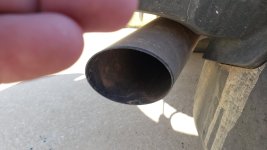
My DPF has about 3k miles on it now, and decided to check the tailpipe. Seems to be some black soot that has developed
 

Attachments

  • 20240827_095211.jpg
    20240827_095211.jpg
    261.2 KB · Views: 13
Are you incapable of reading? Mine's never made it to the 24 hour mark before it does a regen.
If the truck does a soot based regen at, say, 20 hours, does the 24 hour timer reset to 0 and start over? Or will it do the 24 hour regen even if there have been intermediate soot based regens?
 
I've noticed the soot load going up on the back side of passes and dropping climbing. The dash DPF gauge never shows anything. Climbing creates a lot of heat and could help with passive regen, coming down the backside it rapidly cools even with the heavy exhaust braking.

What I do know is two different identical 1,600mile trips, one with Archoil and one without, showed zero difference. Seems some don't believe that this actually happened. Maybe for city pavement queens Archoil does something, I didn't test that, only towing, the only real use for a diesel, where it did nothing.

Oh, the 2022 mileage and soot reports are extremely close to our 2018. Maybe I have two bad trucks from different years with nearly identical readings. The 2018 never made it 24 hours without a regen either. This might surprise you but at some point regen frequency goes up due to load and higher fuel consumption. With our trailer pulled by a 2018 HO and a 2022 HO the mileage and soot loading were very close. My neighbor that has gone on the same trip with a 2022 HO pulling 24k triple regens even more frequently. I believe he's around 8 mpg. This makes perfect sense, more fuel, more soot probably somewhat balanced by more heat for passive regen. I too have noticed this in heavy headwinds getting 7 or less mpg, soot goes up a bit faster. Heavy tailwinds at 12 mpg or so it climbs much more slowly. This might amaze you but generally more fuel burned, more particulates.

With a 7k trailer I probably wouldn't hit regens either until 24 hours, not enough fuel burned to cause a soot based regen. It's possible if I wasn't towing in mountains it might actually hit the 24 hour mark. Don't know, never towed with either truck anywhere but higher altitudes and/or mountains.

I can assure you, whatever you think, both trucks were doing exactly as intended.

Unless I've missed something somewhere, this is counter to what almost everyone (actually everyone?) experiences - more load, fewer or no active regens. More fuel use produces higher EGTs and less soot accumulation.
 
So the latest on my truck is 550 miles at 18 hours without a Regen, with mostly city driving. I can definitely tell a difference between fuel station and I believe I have found the one that I will stick with and also with the 2-3oz per 10 gal of Archoil 6500. I have never seen a 24 hr regen since I bought the truck new in January, but I believe I might just see it this tank. I'll post this to the correct thread this time :cool:
 
Screenshot_20240826_122710_AlfaOBD.jpg

Well I'm heading back to the dealer again. 350 miles and some massive spikes on the dpf gauge. With alphaobd you can see the massive spikes. Outside temps have been 104F this week with lots of Highway driving. No spikes or gains while in town driving. Only on the highway. They overnighted a particle matter sensor to throw at it. Next is a DPF if the pm sensor doesn't fix it. They agreed with my photos inside the dpf that the only cause could be internal failure between the doc and dpf.

Dpf guage is sitting at just over 25% which equals 4G according to alfaobd currently. The truck historically goes to regen at 5g, which is just below 50%. Have to see how it spikes the next few days here
 
Unless I've missed something somewhere, this is counter to what almost everyone (actually everyone?) experiences - more load, fewer or no active regens. More fuel use produces higher EGTs and less soot accumulation.
That's exactly what I posted. Up the passes soot load drops, backside it increases.
 
If the truck does a soot based regen at, say, 20 hours, does the 24 hour timer reset to 0 and start over? Or will it do the 24 hour regen even if there have been intermediate soot based regens?
The 24 hour timer resets any time an active regen cycle completes successfully. It doesn’t matter wether that regen is initiated by soot loading or by engine timer.
 
If the truck does a soot based regen at, say, 20 hours, does the 24 hour timer reset to 0 and start over? Or will it do the 24 hour regen even if there have been intermediate soot based regens?
It resets based on what 've seen on two newer trucks. Both the '18 (sold now) and the '22 did/does a regen around 800 to 850 miles pretty consistently. I made the exact same trips every year at the same time with both trucks and the same trailer so it's extremely easy to keep track of regens, fuel and DEF use. The vast majority of the trips are interstate with cruise set at 68.

No additive from any vendor has made any difference on regens or mileage. I replace the air filter well before recommended so I haven't seen any difference there. Both trucks did oil and fuel filter changes at 15k almost always using Amsoil. Also not seen the reported mileage increase people claim at 50k miles or so. The first 5k the mileage seems to be maybe a couple of tenths less. I've seen no difference in mileage using 10w30 or 5w40 either.

Mileage if there's no wind is always 9.6 +/- .1. Of course wind has varied mileage from roughly 6 to 12 or so on a single tank. It evens out.
 
@Deltron did you see my comment to you about the DPF %age PID last week?
I did. My average speed is ALWAYS causing regens before any possible 24 hour timer could kick in. As far as I can tell the timer must reset the 24 hour clock after a regen.
This has been the case on my '18 and on my '22. A have a friend that pulls his comparable 5th wheel toy hauler on every trip with us too. His '17 4:10 HO dually and now his '22 4:10 dually HO is virtually identical in both DEF usage, fuel mileage and regen distance as my trucks have been. Also the exact same fuel stations at the same time as I.

As far as people easily getting 1,000+ miles before regen. The only thing I can think of is the runs we do which goes through mountain passes along with the weight and drag resistance of the trailers we pull causes the regens in the mid 800's along with the fuel stations we use. Neither he or I use the trucks for anything but towing.

The dash gauge almost never showed any soot load except at 15k miles when suddenly everything went crazy. It turned out a faulty MAF which either damaged the DPF or it had a fault too. As soon as both were replaced the truck was back to normal. The Scangauge shows a fairly linear increase in the percentage with it usually dropping pulling mountain passes and climbing going down the back side while settling right back to a linear increase on the flats.

He too has said he's never seen the 24 hour bit either since he regens before that timer runs out. He's pretty OCD and keeps even more detailed and exacting records than I do.

Better than the old DMax I had, it was programmed to regen every 400 miles regardless of when it had regened. Seemed rather dumb to me. Actually the 24 hour bit seems stupid, are the sensors not accurate enough for proper regen frequency or what?
 
Actually the 24 hour bit seems stupid, are the sensors not accurate enough for proper regen frequency or what?
I’m pretty sure it’s just a built in fail safe to ensure the DPF stays good and clean regardless if you have good passive regen occurring or not, that way it “minimizes problems” someone may have with the DPF plugging up.
 
Back
Top