

Toyotaguy
Active Member
I think I need to try and test it again but plug off the Crank case vent this time.
Sent from my iPhone using Tapatalk
Sent from my iPhone using Tapatalk


A charge air leak will definitely impact engine performance and regeneration as well. Hopefully that’s all it was.Okay, I'm cautiously optimistic that my regen issues is fixed. The techs did an intake system leak test and found an air leak at the charge air cooler duct (item #3 in the attached diagram). They discovered that the tension clamp (item #16 in the diagram) was missing so they replaced the entire tube and got the proper clamps.
I had one full regen within the first hour of driving, but it's over 5 hours now without one (longest it went before was 2.5 hrs) and I'm seeing passive regens where I wasn't seeing any previously. The DPF gauge in the EVIC screen floats between 25 - 40%. I'll update again in a few days
View attachment 64650

I’ve yet to be able to acquire any sort of specific documentation or information on how that gauge operates. It’s done some incredibly peculiar things on my 2022 that left me dumbfounded. Sometimes it’ll show a reduction in soot in situations where I highly doubt passive regeneration has occurred. Other times it’ll shoot up quickly after driving in situations where I fully expected passive regen to have been taking place. It would be interesting to know how often that information is updated, or if it’s a live reading, as well as what data contributes to the percentage shown? Is it solely based on differential pressure readings? Is there an estimate built into its logic? Does historical data play a role? I’ve asked countless sources and got nothing but crickets and an occasional hypothesis. Nothing concrete though.I was surprised to see my DPF gauge only go from 25% down to 10% pulling my 5th wheel out to a friend's shop ~32 miles. It usually clears as much as 40-50% after about 20 miles of towing as it's hilly here once we get out of town. Even more surprising was it did a passive regen on the way home on a couple slow 2-lane roads that cleared the 10% down to 0.
Sorry you guys are having issues, but hopefully they all get resolved - air filters, boost leaks, and probably also a little code update.
I’ve yet to be able to acquire any sort of specific documentation or information on how that gauge operates. It’s done some incredibly peculiar things on my 2022 that left me dumbfounded. Sometimes it’ll show a reduction in soot in situations where I highly doubt passive regeneration has occurred. Other times it’ll shoot up quickly after driving in situations where I fully expected passive regen to have been taking place. It would be interesting to know how often that information is updated, or if it’s a live reading, as well as what data contributes to the percentage shown? Is it solely based on differential pressure readings? Is there an estimate built into its logic? Does historical data play a role? I’ve asked countless sources and got nothing but crickets and an occasional hypothesis. Nothing concrete though.
I don’t blame you. I wouldn’t either normally. Unfortunately these 2022’s (or a nice chunk of them) seem to be having issues more readily than previous years. I started logging data in order to be proactive and just have a healthy baseline on what “normal” looked like for my truck. I never imagined I’d have to deal with regeneration issues in less than two years of ownershipYea, TBH I don't actively monitor or log any data since my truck has never given me any problems.
It’s handy to have this kind of data to go from. Here’s my latest update on my regeneration cycles. I’ve been seeing an upswing in performance. The red line Indicates when I stopped using Hotshots EDT and switched where I buy my fuel.I wish I would have monitored mine a little more closely before I started having issues. 110k miles trouble free kinda lulled me into a false sense of security.
Sent from my iPhone using Tapatalk
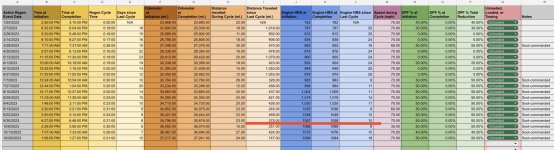
Absolutely. Constant regeneration will kill your fuel economy (and put your engine at a significantly higher risk for fuel dilution in the oil). All that extra fuel shot into the exhaust is used to make heat, not push the truck forward so it’s a real drag on efficiency.One more thing I've noticed is that my calculated fuel usage has ticked up a couple of mpg's. I guess not doing a regen every 2 engine hours really helps with fuel economy.


For that clamp to be completely missing is mind boggling. Your engine would have close to zero boost from the turbocharger and should of run like a complete dog. For one to be loose from a CP4.2 recall truck is somewhat understandable. I don’t think yours fits into that category.Okay, I'm cautiously optimistic that my regen issues is fixed. The techs did an intake system leak test and found an air leak at the charge air cooler duct (item #3 in the attached diagram). They discovered that the tension clamp (item #16 in the diagram) was missing so they replaced the entire tube and got the proper clamps.
I had one full regen within the first hour of driving, but it's over 5 hours now without one (longest it went before was 2.5 hrs) and I'm seeing passive regens where I wasn't seeing any previously. The DPF gauge in the EVIC screen floats between 25 - 40%. I'll update again in a few days
View attachment 64650
It ran fine, but that's what he said and he's a pretty good mechanic. And I routinely peg the boost hitting the highway, especially towing. I guess it was just a thang.For that clamp to be completely missing is mind boggling. Your engine would have close to zero boost from the turbocharger and should of run like a complete dog. For one to be loose from a CP4.2 recall truck is somewhat understandable. I don’t think yours fits into that category.
Possibly something was miscommunicated. I’ve had a boot slip out from under a clamp and basically your naturally aspirated at that point. The boot usually comes off from where it’s supposed to be clamped to, if somehow it stays most air from the turbocharger still ends up venting to the atmosphere.It ran fine, but that's what he said and he's a pretty good mechanic. And I routinely peg the boost hitting the highway, especially towing. I guess it was just a thang.
I'll drop by next week and confirm. What you're saying makes sense because something similar happened to my wife's old Ford Excursion with a 6.0.Possibly something was miscommunicated. I’ve had a boot slip out from under a clamp and basically your naturally aspirated at that point. The boot usually comes off from where it’s supposed to be clamped to, if somehow it stays most air from the turbocharger still ends up venting to the atmosphere.
I wish I would have monitored mine a little more closely before I started having issues. 110k miles trouble free kinda lulled me into a false sense of security.
Sent from my iPhone using Tapatalk
When you do this, you cap the boost tube at the turbo and cap the boost tube on the other side where it hooks to the intake. Then pressurize the boost tubes and the intercooler. It will never make pressure going through the turbo. And the CCV being connected to the turbo just puts all of air you put in, go into the crankcase. Hope you didn’t blow some seals out.My truck went from regens only on the 24hr schedule to regens every 200 miles. I tried to boost leak test the truck and all the pressure was coming out of the oil fill cap if I had it off. If I left it on I could get pressure up to about 15 psi then I kinda just sounded like are moving through the engine out the exhaust? I couldn’t tell it sounded like air was escaping out the back drivers side of the engine.
I sprayed soapy water on every boost pipe I could see and saw no leaks or bubbles. But it seems like there’s definitely a boost leak somewhere.
Did I miss any obvious areas to check at the back of the engine?
Sent from my iPhone using Tapatalk