

Airstreams are an odd duck, in that the frames aren’t very strong on their own, because the entire body is structural, like an airplane. They can be affected strangely when loads come in a direction that they didn’t engineer for. WDH shouldn’t be a problem for that, but it’s possible they didn’t account for the changes when they moved something around on some models.
Ram Heavy Duty Forum
You are using an out of date browser. It may not display this or other websites correctly.
You should upgrade or use an alternative browser.
You should upgrade or use an alternative browser.
Setting up Equalizer WD Hitch - those that have please chime in
- Thread starter Electronut
- Start date

H3LZSN1P3R
You're doing it wrong
I have seen/ repaired enough tongues bent from people over doing it with WDH bars usually on aluminum trailers but also 1/8 steel frames so that does not surprise me if the frame is not well madeInteresting.
Heavy bars meaning too big for the weight, or just heavy rated bars?
Contents inside my trailer stay more put with WDH, and my bars have been 1200-1400 but so has the TW, than without and there is less jarring of the truck over rough roads with the WDH. That makes it hard for me to see how WDH could be the culprit, unless they are using 1400lb bars with 600 lbs of tongue weight.

tyler2you
Well-Known Member
A lot of folks are blaming Equal-i-zers with the 1K bars and up on heavily sprung HD trucks. I haven't seen anything definitive to say whether or not they're right. They're suggesting that round bars are slightly more flexible/forgiving than the Equal-i-zer square bars and that if you have a HD truck, you probably don't need that much WD, so might as well use the 600 lb Equal-i-zer bars.Interesting.
Heavy bars meaning too big for the weight, or just heavy rated bars?
Contents inside my trailer stay more put with WDH, and my bars have been 1200-1400 but so has the TW, than without and there is less jarring of the truck over rough roads with the WDH. That makes it hard for me to see how WDH could be the culprit, unless they are using 1400lb bars with 600 lbs of tongue weight.
tyler2you
Well-Known Member
It's actually not the frame that's suffering the damage. The connection between the frame and the shell is getting damaged and causing additional damage to the shell when it shifts around.I have seen/ repaired enough tongues bent from people over doing it with WDH bars usually on aluminum trailers but also 1/8 steel frames so that does not surprise me if the frame is not well made
tyler2you
Well-Known Member
I'd say it's more an issue of the "skin/shell" not being strong on its own. I haven't seen any issues in regards to the actual frame being weak. The skin needs to be riveted/attached to the frame/ribs to maintain its rigidity.Airstreams are an odd duck, in that the frames aren’t very strong on their own, because the entire body is structural, like an airplane. They can be affected strangely when loads come in a direction that they didn’t engineer for. WDH shouldn’t be a problem for that, but it’s possible they didn’t account for the changes when they moved something around on some models.

I believe this particular problem is a result of Airstream changing the design of the front storage and not beefing up the frame to shell connection points.

- Messages
- 5,240
- Reaction score
- 5,462
- Points
- 113
A lot of folks are blaming Equal-i-zers with the 1K bars and up on heavily sprung HD trucks. I haven't seen anything definitive to say whether or not they're right. They're suggesting that round bars are slightly more flexible/forgiving than the Equal-i-zer square bars and that if you have a HD truck, you probably don't need that much WD, so might as well use the 600 lb Equal-i-zer bars.
I know they have a good reputation and often last a long time, but this thread sure puts a negative light on their durability.
tyler2you
Well-Known Member
Yeah, I think the reason you see so many older ones still around is because folks are willing to put the money into fixing them due to their desirability where they wouldn't with a standard travel trailer. Having owned a couple, I wouldn't put durability at the top of the list of "pros". Ever seen one that's been through a significant hail storm?I know they have a good reputation and often last a long time, but this thread sure puts a negative light on their durability.

Last edited:

Electronut
Active Member
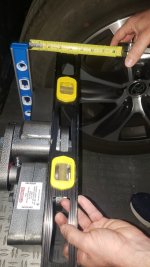
So back to the GenY issue. Spoke to the Sales Manager. They will support me down the line and do whatever necessary to accommodate. He wanted me to try and put at least the 500 mile break-in period on the BOSS. The engineers have an opinion that once the hitch pulls under load it will straighten out. Also wanted me to take photos with straight edges to show the difference. It's worse than I thought. 1/2 inch off from front to back. I can't see how the torsion mechanism will correct itself for this difference but I'll try it. I'm not optimistic.
Attachments

Last edited:
tyler2you
Well-Known Member
Sorry for the derail . . .So back to the GenY iasue. Spoke to the Sales Manager. They will support me down the line and do whatever necessary to accommodate. He wanted me to try and put at least the 500 mile break-in period on the BOSS. The engineers have an opinion that once the hitch pulls under load it will straighten out. Also wanted me to take photos with straight edges to show the difference. It's worse than I thought. 1/2 inch off from front to back. I can't see how the torsion mechanism will correct itself for this difference but I'll try it. I'm not optimistic.

Hopefully it will pull itself straight

I'd say it's more an issue of the "skin/shell" not being strong on its own. I haven't seen any issues in regards to the actual frame being weak. The skin needs to be riveted/attached to the frame/ribs to maintain its rigidity.
View attachment 54990
I believe this particular problem is a result of Airstream changing the design of the front storage and not beefing up the frame to shell connection points.
I wouldn’t call the frames weak, it’s just that they’re smaller and lighter weight because they don’t have to support the entire load like a traditional trailer frame.
They may not be indestructible, but they’ll definitely outlast any white box trailer. If my current 2022 TT lasts 10 years I’d be impressed. The 2020 Airstream I got rid of will probably be on the road for the next 30-40 years if someone doesn’t wreck it.
Electronut
Active Member
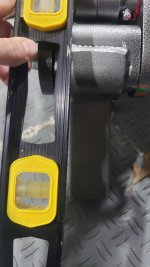
Error on my part after making and submitting last measurements. Clearly the difference should be 1/2 inches because the receiver connection is 2.5 inches and the hitch ball side is 2 inches. What I needed to show is the rate of angle and not being square so best way to do that was butt the level on hitch ball large angular steel side and let it run towards the 2.5" tube. You can see the square is off. Not by much but you can see how where it starts from the weld of the receiver connection to the Torsion mechanism and gets worse as you follow to the end.
Attachments


Aketay
Well-Known Member
- Messages
- 229
- Reaction score
- 281
- Points
- 63
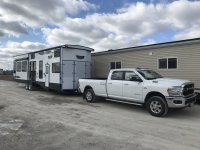
The weight police are going to hammer me for what I’m about to type. The little trailer in the picture has a tongue weight of 1875 lbs and UVW of 13053 lbs. I do not use a WDH. I do not use the factory hitch as it is mounted at the end of the frame rails and is prone to bending down over time. I do use the Curt 22k heavy duty class 5 hitch that is bolted to the frame. I also use an aluminum adjustable ball rated at 2200 lbs pin weight and 15k total weight. In the bed is a B&W puck mounted fifth wheel hitch, 90 gallon fuel tank and a toolbox with at least 350 lbs of useful crap. The most pressure I ever set the airbags at is 45 psi. I do this for a living and regularly scale this setup all over the US and Canada with no problems. I have been level 1 inspected multiple times and found to have no violations each time. Flame suit is on, fire away.
Attachments
H3LZSN1P3R
You're doing it wrong
I have been waiting for you to show up! LolThe weight police are going to hammer me for what I’m about to type. The little trailer in the picture has a tongue weight of 1875 lbs and UVW of 13053 lbs. I do not use a WDH. I do not use the factory hitch as it is mounted at the end of the frame rails and is prone to bending down over time. I do use the Curt 22k heavy duty class 5 hitch that is bolted to the frame. I also use an aluminum adjustable ball rated at 2200 lbs pin weight and 15k total weight. In the bed is a B&W puck mounted fifth wheel hitch, 90 gallon fuel tank and a toolbox with at least 350 lbs of useful crap. The most pressure I ever set the airbags at is 45 psi. I do this for a living and regularly scale this setup all over the US and Canada with no problems. I have been level 1 inspected multiple times and found to have no violations each time. Flame suit is on, fire away.
Being within legal limits and doing something smartly are not necessarily the same thing.
Also, doing something for a living also doesn’t mean you’re doing it the best way. There are plenty of people out there that are terrible at their jobs. Not that I’m saying you are, but saying you do it for a living doesn’t mean anything in this topic.
Edit to add: The frame has changed on the 4.5 gen trucks, and the factory hitch is now rated to 20k. I see a handful of reports of bent hitches on 4th gens, but I can’t find anything for 4.5s.
Also, doing something for a living also doesn’t mean you’re doing it the best way. There are plenty of people out there that are terrible at their jobs. Not that I’m saying you are, but saying you do it for a living doesn’t mean anything in this topic.
Edit to add: The frame has changed on the 4.5 gen trucks, and the factory hitch is now rated to 20k. I see a handful of reports of bent hitches on 4th gens, but I can’t find anything for 4.5s.
Last edited:
Aketay
Well-Known Member
- Messages
- 229
- Reaction score
- 281
- Points
- 63
My definition of do this for a living, 18 years over the road with almost 2 million miles accident and damage free. I’ll rate this as a BIC lighter flame, not enough to feel.Being within legal limits and doing something smartly are not necessarily the same thing.
Also, doing something for a living also doesn’t mean you’re doing it the best way. There are plenty of people out there that are terrible at their jobs. Not that I’m saying you are, but saying you do it for a living doesn’t mean anything in this topic.
My definition of do this for a living, 18 years over the road with almost 2 million miles accident and damage free. I’ll rate this as a BIC lighter flame, not enough to feel.
Sounds like you’re pretty experienced then.
I’m not sure what a lighter has to do with anything?
tyler2you
Well-Known Member
Trying to line a straight edge along that welded on plate isn't possible on mine due to the bead. It would probably be more accurate to lay the straight edge along one of the flat side plates and use calipers to take measurements of the space along hitch insert at a couple of points.What I needed to show is the rate of angle and not being square so best way to do that was butt the level on hitch ball large angular steel side and let it run towards the 2.5" tube. You can see the square is off. Not by much but you can see how where it starts from the weld of the receiver connection to the Torsion mechanism and gets worse as you follow to the end.

H3LZSN1P3R
You're doing it wrong
You missed the flaming reference clearly lolSounds like you’re pretty experienced then.
I’m not sure what a lighter has to do with anything?
You missed the flaming reference clearly lol
Ahh, that must be it. My post was certainly not intended as a “flame”. Just pointing out that “I do this for a living” does not necessarily mark someone as an expert. Now if he’d said “I design hitches”, or “I’m a recognized expert on towing safety” that may have been a different matter.

EdduardFrt
New Member
- Messages
- 1
- Reaction score
- 0
- Points
- 1
Thank you for your advice. I will try to measure itTrying to line a straight edge along that welded on plate isn't possible on mine due to the bead. It would probably be more accurate to lay the straight edge along one of the flat side plates and use calipers to take measurements of the space along hitch insert at a couple of points.
View attachment 55061