

I don't see where John mentioned anything about the injection being into the actual exhaust.Not on these trucks its not injected into the exhaust
Ram Heavy Duty Forum
You are using an out of date browser. It may not display this or other websites correctly.
You should upgrade or use an alternative browser.
You should upgrade or use an alternative browser.
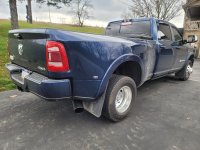
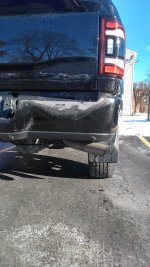
Diesel exhaust regen set bumper on fire!

John Jensen
Well-Known Member
- Messages
- 1,274
- Reaction score
- 1,154
- Points
- 113
Injected into the cylinder, and burned there. As far as I know the only diesel that injects diesel into the exhaust post turbo is the (junk) caterpillars with the ARD head.
You are both correct, however, I never said fuel was injected into the exhaust. Re-read my post.Not on these trucks its not injected into the exhaust
I posted to clarify that fuel is injected to activate a passive regen and the reason why.

flan
Well-Known Member
- Messages
- 4,876
- Reaction score
- 10,928
- Points
- 113
Your post left room for interpretation that was the reason I posted, and probably why Mr Sniper did as well. No biggie.You are both correct, however, I never said fuel was injected into the exhaust. Re-read my post.
I posted to clarify that fuel is injected to activate a passive regen and the reason why.

With the trailers - I suspect this happens when the trailer is being backed in and the truck exhaust is to close to the corners(when truck is 45 degrees)of the trailers and perhaps left idling for extended period of time. All the melting seems to happen on the passenger side but this doesn't mean it happened while towing - its just to far away.
Thank you for the facts.Fuel is injected. Not to clean the filter, to raise the exhaust temps.
Active regeneration - is triggered when the DPF exhaust back-pressure reaches a certain back pressure point and is interpreted as 80% soot for the 6.7. Then the ECU initiates a fuel injection designed to increase the exhaust temperature in the DPF to over 662 degrees F in order to oxidize the particulate deposits. When completed, the ECU assumes a some small amount of residual soot and resets the value to 9%.
That scientific publication shows data that suggests temps near 800° at the outlet on a 5500 model. That's over 150° higher than Fiat says it gets internally.Some interesting data on actual exhaust temperatures on DPF equipped vehicles:
https://www.fs.fed.us/eng/pubs/pdf/08511816.pdf

H3LZSN1P3R
You're doing it wrong
Your reply was to the talk about injecting in to the exhaust i think thats where i got the confusionYou are both correct, however, I never said fuel was injected into the exhaust. Re-read my post.
I posted to clarify that fuel is injected to activate a passive regen and the reason why.

jetrinka
Well-Known Member
- Messages
- 1,929
- Reaction score
- 2,527
- Points
- 113
Are you able to see EGT levels on these trucks during regen and compare them to what is normal? Cruising, idling, WOT EGT?
800 degrees is not terribly hot for a diesel IMO depending on where it’s measured. My old 01 Cummins would kiss 1000 degrees under sustained WOT or loaded towing conditions up hill. It had RV injectors and an upgraded HX35 turbo (from the stock HY) but other than that fueling was stock. EGT probe located in manifold collector.
I’d imagine regen would have to get things quite a bit hotter?
800 degrees is not terribly hot for a diesel IMO depending on where it’s measured. My old 01 Cummins would kiss 1000 degrees under sustained WOT or loaded towing conditions up hill. It had RV injectors and an upgraded HX35 turbo (from the stock HY) but other than that fueling was stock. EGT probe located in manifold collector.
I’d imagine regen would have to get things quite a bit hotter?

I've seen this happen on equipment...
One with an injector (fuel) at the DPF, it over fueled
The DPF bricks broke apart and pieces came out as sparks/spray, melted some plastic
Before they had DEF quality sensors, someone would have put fuel the DEF tank.
Most stuff anymore has a lot of fail safes so if one parameter isn't correct it will shut the entire operation down. This is with off-road equipment I would imagine on-road vehicles have as much or more going on.
One with an injector (fuel) at the DPF, it over fueled
The DPF bricks broke apart and pieces came out as sparks/spray, melted some plastic
Before they had DEF quality sensors, someone would have put fuel the DEF tank.
Most stuff anymore has a lot of fail safes so if one parameter isn't correct it will shut the entire operation down. This is with off-road equipment I would imagine on-road vehicles have as much or more going on.

IndyRamMega
Well-Known Member
- Messages
- 596
- Reaction score
- 932
- Points
- 93
That was up in the manifold tho...by the time it gets all the way to the exhaust tip it's significantly cooler...Are you able to see EGT levels on these trucks during regen and compare them to what is normal? Cruising, idling, WOT EGT?
800 degrees is not terribly hot for a diesel IMO depending on where it’s measured. My old 01 Cummins would kiss 1000 degrees under sustained WOT or loaded towing conditions up hill. It had RV injectors and an upgraded HX35 turbo (from the stock HY) but other than that fueling was stock. EGT probe located in manifold collector.
I’d imagine regen would have to get things quite a bit hotter?
IndyRamMega
Well-Known Member
- Messages
- 596
- Reaction score
- 932
- Points
- 93
Yup.... remember when Ford first added the split tailpipe after the dpf? there were flames coming out of the exhaust tip....I've seen this happen on equipment...
One with an injector (fuel) at the DPF, it over fueled
The DPF bricks broke apart and pieces came out as sparks/spray, melted some plastic
Before they had DEF quality sensors, someone would have put fuel the DEF tank.
Most stuff anymore has a lot of fail safes so if one parameter isn't correct it will shut the entire operation down. This is with off-road equipment I would imagine on-road vehicles have as much or more going on.
H3LZSN1P3R
You're doing it wrong
Ford only added a dual tip not a complete dual tailpipe…Yup.... remember when Ford first added the split tailpipe after the dpf? there were flames coming out of the exhaust tip....
H3LZSN1P3R
You're doing it wrong
It cools some going through the turbo then heats up after the cat then heats up after the dpf then cools through the scr the temps are much hotter after the manifold in newer diesels its interesting seeing the different numbers on all the EGT probesThat was up in the manifold tho...by the time it gets all the way to the exhaust tip it's significantly cooler...

Lary0071
Well-Known Member
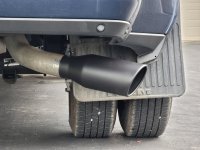
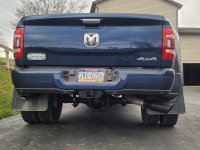
Here is an easy solution and a very affordable visual modification. $34 on Amazon for a 4" to 6" bolt on exhaust tip that you can extend your exhaust gasses out into the airflow with. I have mine pushed onto the pipe so that the tip exit is just even with the outermost bulge of the dually fender lines, so this should mix the exhaust gasses into the passing airflow and reduce the concentrated air temp compared to the stock tailpipe that exists a bit inside of the planer airflow path. I could easily loosen the clamp bolt and pull it outward almost 10" more if I wanted to get crazy with it. I may pull it 3" more out from the truck when I hook to the fifth wheel camper just to get it into more turbulent airflow and get more temp reduction.
Link to Amazon is below. It is a 30 second direct fit install.
$34 Black or Stainless 4" to 6" bolt on exhaust tip.
Link to Amazon is below. It is a 30 second direct fit install.
$34 Black or Stainless 4" to 6" bolt on exhaust tip.
Attachments
jetrinka
Well-Known Member
- Messages
- 1,929
- Reaction score
- 2,527
- Points
- 113
Thats my point though, that in order for the tip temps to get to the point of doing this the regen process would have to be seriously hot.That was up in the manifold tho...by the time it gets all the way to the exhaust tip it's significantly cooler...
NOTE:
I want to thank everyone for posting on this. I appreciate all the input.
I will post more pictures as soon as the weather lets me get my truck clean enough.

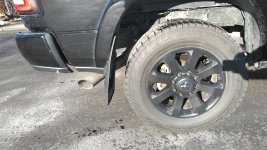
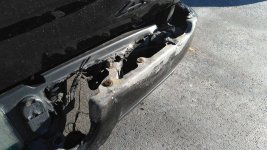

Darkone
Well-Known Member
Yea i agree I would expect the molding along the bottom of the bumper and the mud flap to have some degree of excessive heat.

elephantrider
Hydraulic Lifter Crew
- Messages
- 2,438
- Reaction score
- 3,327
- Points
- 113
interesting the lack of damage closest to the pipe.
No other plastic melted closest to the tailpipe, but burnt wires up near the damage. Electrical fire?
Or, the crosswind forced the extreme heat into a pocket, swirling above all the lower stuff, and that melted/burned the rear facia harness.Yea i agree I would expect the molding along the bottom of the bumper and the mud flap to have some degree of excessive heat.
This is definitely not an unbelievable circumstance that happened.