What's new
Ram Heavy Duty Forum

Register a free account today to become a member! Once signed in, you'll be able to participate on this site by adding your own topics and posts, as well as connect with other members through your own private inbox!

Wire Harness Schematic

TexMarQue

Active Member
Messages
116
Reaction score
86
Points
28
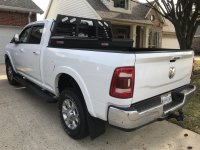
Can anyone point me in the right direction to find a wiring schematic for the tail lights? I'm adding some STT and reverse lights to my headache rack and I don't want to take the normal trial and error route if I don't have to. Thanks in advance!
 
I was very surprised I didn't get a response on this. I figured plenty of people had reason to tap into their taillight wiring. I didn't want to tap in at the trailer connections out of fear that it would make the truck think I had a trailer attached. Here is what I figured out:

Stop Lights - White wire with green stripe
Turn Lights - White wire with yellow stripe
Tail Lights - White wire with orange stripe
Reverse Lights - White wire with purple stripe

There are about 12 wires going into the taillight, and I didn't tap into any others to figure them out. Keep in mind the blind spot detection is also mounted in the taillight, so be careful what you go clipping.

I found some 6" oval lights that have clear lenses, and the LEDs are red and white. This lets me use all four in my headache rack for reverse lights. I wired the outside two as taillights, brake lights, and reverse lights. I wired the inside two as taillights, turn signals, and reverse lights.

I hope somebody finds this helpful.

 

Attachments

  • 89A863D5-37A2-43CC-A398-8BDFC37D7258.jpeg
    89A863D5-37A2-43CC-A398-8BDFC37D7258.jpeg
    562 KB · Views: 72
Your truck senses a trailer from the brake circuit. Tapping into the trailer lighting gives you the signal and saves you from having to cut wires. In addition, there are harnesses that plug in between the outlet and the factory harness that will give you those wires with absolutely zero cutting.

I'd be surprised if your Canbus doesn't give you issues running things off of the light wiring. It uses the current to sense whether or not lights or out.
 
I wish I had known that the trailer was sensed off the brake circuit. I was warned at the place that I purchased the headache rack that they recommended against tapping into the trailer wiring for that reason. That has been how I've wired things on past vehicles, but I've never had as many smart features as this truck has. I have not had any warning lights on the dash other than when I moved the truck with the taillights removed. The system reset itself the next time I started it up, and it doesn't seem to be taking exception to the extra power being used. Maybe since I went with LED's the additional power draw is small enough to not cause it to sense a problem. Something to keep an eye out for going forward, though. Thanks for the input!
 
I wish I had known that the trailer was sensed off the brake circuit. I was warned at the place that I purchased the headache rack that they recommended against tapping into the trailer wiring for that reason. That has been how I've wired things on past vehicles, but I've never had as many smart features as this truck has. I have not had any warning lights on the dash other than when I moved the truck with the taillights removed. The system reset itself the next time I started it up, and it doesn't seem to be taking exception to the extra power being used. Maybe since I went with LED's the additional power draw is small enough to not cause it to sense a problem. Something to keep an eye out for going forward, though. Thanks for the input!
Yep, most CANBUS system sensors are designed for detecting higher current levels used by incandescent lights. Your LEDs probably don't draw enough to trigger the detector circuitry.
 
Yep, most CANBUS system sensors are designed for detecting higher current levels used by incandescent lights. Your LEDs probably don't draw enough to trigger the detector circuitry.

Just make sure you used heat shrink butt connectors to do your tap. Any corrosion will increase the current draw and wick up the wires.


Sent from my iPhone using Tapatalk
 
Hello fellow 2020 HD Ram 2500 Diesel owners, I just wired my truck with my newer Lance Truck Camper and I am blowing the $5.00 fuses. Fuse #29 20 Amp Cartridge fuse (Trailer Tow Park). I taped into the wires just behind the rear bumper 7 way. It will take about 5 to 10min then the fuse blows. ANY info would be great. Thanks
 
Please don't cross-post in multiple threads.

Either ask here, or in the thread you started:

 
Just make sure you used heat shrink butt connectors to do your tap. Any corrosion will increase the current draw and wick up the wires.


Sent from my iPhone using Tapatalk

I like to use marine heat shrink and non-insulated butt connectors properly crimped if I have to splice into anything. Heat shrink butt connectors are great, but too many use the wrong crimp tool and cut them.

I just rewired a Ford factory 12-pin harness for my custom trailer camera build. The top splice is factory. The bottom hasn't been heated yet.

20201122_140225 (2).jpg
 
The best way to join two wires together is the mil-spec method. First you must have a good mechanical connection, so first tin both wires, bend a hook on each one, join them and crimp the two hooks together. Then you can solder and sleeve with marine heat shrink. That kind of connection will never fail if done correctly.

Butt crimp splices = Trash can.
 
The best way to join two wires together is the mil-spec method. First you must have a good mechanical connection, so first tin both wires, bend a hook on each one, join them and crimp the two hooks together. Then you can solder and sleeve with marine heat shrink. That kind of connection will never fail if done correctly.

Butt crimp splices = Trash can.

I try to avoid solder on vehicles. Solder makes for brittle joints and I’ve seen a lot of them crack over the years. A *proper* crimp is far more reliable, especially if you use marine grade adhesive lined heat shrink over the top.

 
I try to avoid solder on vehicles. Solder makes for brittle joints and I’ve seen a lot of them crack over the years. A *proper* crimp is far more reliable, especially if you use marine grade adhesive lined heat shrink over the top.

Similar, I don’t avoid solder all together. When I build harnesses, there are instances where I’ll solder for interior immobilized use. Otherwise, I use these splice joints with the proper “W” crimp with sealed heat shrink- https://www.te.com/usa-en/product-4...MIz6WB1tab7QIVR_HACh39hQCpEAQYASABEgLuuPD_BwE
 
Yep, most CANBUS system sensors are designed for detecting higher current levels used by incandescent lights. Your LEDs probably don't draw enough to trigger the detector circuitry.
Thanks for the replay, I wonder if they make a separate stand alone relay control circuit for the trailer wiring circuit that would allow more amperage. I have talked to Lance camper AND Ram about this issues and no solutions yet...
 
Some of you, those not discussing crimping/splicing techniques, are conflating two different applications.

@Trophy Truck tapped into the trailer wiring, not the truck wiring. The OP was wiring directly to the truck tail circuits.

I suggest any replies related to the OP's trailer circuit wiring issue continue on the other thread and limit this one to truck circuits/methods.

 
I use military aviation - style solder splicing with heat shrink. The end-to-end type of splice is called the "Western Union Splice" or "Lineman Splice." I've seen splices that lasted 35-40 years on jets that were flown regularly and in high-g maneuvers. If a wire is too short to do it, I'll either run new wire, or splice in a longer piece, keeping the two in-line splices at least several inches apart. NASA uses the same style for their aviation work.
Example video:

When I need to splice a tap into a wire, I use the knotted tap splice. Again, used in military aviation. I've never seen either of these splices fail.
 
I was very surprised I didn't get a response on this. I figured plenty of people had reason to tap into their taillight wiring. I didn't want to tap in at the trailer connections out of fear that it would make the truck think I had a trailer attached. Here is what I figured out:

Stop Lights - White wire with green stripe
Turn Lights - White wire with yellow stripe
Tail Lights - White wire with orange stripe
Reverse Lights - White wire with purple stripe

There are about 12 wires going into the taillight, and I didn't tap into any others to figure them out. Keep in mind the blind spot detection is also mounted in the taillight, so be careful what you go clipping.

I found some 6" oval lights that have clear lenses, and the LEDs are red and white. This lets me use all four in my headache rack for reverse lights. I wired the outside two as taillights, brake lights, and reverse lights. I wired the inside two as taillights, turn signals, and reverse lights.

I hope somebody finds this helpful.
Thanks for this information Tex. I installed bed lights in my Ram yesterday and from your information, tapped into my taillights and it is all working great !!
 
well i just purchased that harness from etrailer and going to try to get my lights on my headache rack to work on monday. thanks for everyones input. FYI trying to tap into the factory loom isnt a good idea at all...long story short, i hiiiiighly warn against it!!
 
Back
Top