What's new
Ram Heavy Duty Forum

Register a free account today to become a member! Once signed in, you'll be able to participate on this site by adding your own topics and posts, as well as connect with other members through your own private inbox!

Why has heater grid bolt failure not been fully addressed

Whether the grid heater is used or not isn't the issue. It WILL fail regardless...just a matter of time.

If we're going to be pedantic, the grid heater can still cycle whether you bypass it at start or not. I disagree that failure is inevitable on every truck.
 
I understand that the problem may be somewhat rare, but it evidently happens and the life of my family is my first priority. I just met a guy who had this happen to him. Luckily no one injured but cost him $10,000 to fix it. I just don’t understand how in today’s world a company can get away with this sort of an engineering failure. I will not keep my 3500 Ram past 150,000 miles and will never buy a new one again, even if this issue is fixed on current models . I do love the truck and it is awsome for pulling my RV. It just seems wrong to me that a known engineering defect is not corrected by the maker.
Referencing post above, can someone tell me how to do the wiggle test and do you have photo of what and where to wiggle? Also, how does one start the truck without using the heater grid. As far as I know it is automatic when needed and there is no way to bypass it. As for what I hope to accomplish, I guess I would like Ram to address this issue under a recall since it is their engineering problem.

Complains about grid heater bolt problem.

Does not know where grid heater bolt is located.

= America in 2025.
 
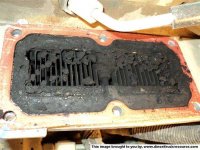
The grid heater may not fail on every truck, but clearly Cummins/Ram knew it wasn't a great design and went back to the glow plugs. I'm curious to those guys that aren't concerned about it... Have you ever pulled the assembly off your truck? I can't imagine most people have. My reason for asking was the other reason no one has brought up yet... the actual grid itself. I don't have a Cummins, but I have seen plenty of pics online of nearly plugged grids with the soot from the EGR. So it would seem something like the Banks (Don't flame me for brand naming), would help eliminate another area for build ups in the intake system, especially for those that don't drive their trucks hard all the time.
Also, because I'm not a Cummins owner, does Ram have a service interval for addressing any of the soot accumulation? I kind of look at this like those people that get their direct injection gas engines cleaned with walnuts for the back side of the valves/intake runners. It might not be in the owners manual, but many techs in the industry may recommend a cleaning service like this.

DSC002801.jpg
 
The grid heater may not fail on every truck, but clearly Cummins/Ram knew it wasn't a great design and went back to the glow plugs. I'm curious to those guys that aren't concerned about it... Have you ever pulled the assembly off your truck? I can't imagine most people have. My reason for asking was the other reason no one has brought up yet... the actual grid itself. I don't have a Cummins, but I have seen plenty of pics online of nearly plugged grids with the soot from the EGR. So it would seem something like the Banks (Don't flame me for brand naming), would help eliminate another area for build ups in the intake system, especially for those that don't drive their trucks hard all the time.
Also, because I'm not a Cummins owner, does Ram have a service interval for addressing any of the soot accumulation? I kind of look at this like those people that get their direct injection gas engines cleaned with walnuts for the back side of the valves/intake runners. It might not be in the owners manual, but many techs in the industry may recommend a cleaning service like this.

View attachment 90428

I’ve pulled many in the past several decades.
Not once did I ever encounter one that had failed, or was even close to failure. And we’re talking about low mileage and high mileage trucks, POV’s and gas well fleet trucks that get flogged repeatedly.

Does the bolt fail sometimes? Yes.
Does it fail a lot? No.

Wiggle test regularly (which takes two seconds)
Is it loose? (If yes, cease use and rectify)
(If no, move on with life)

As for the soot accumulation on the grid heater (and subsequent intake plenum), the vast majority of trucks I’ve worked on where soot accumulation there was high, were trucks with high idle hours and very low calculable average speeds (see gas well fleet truck reference above). Trucks that are being operated under correct drive cycles should not see substantial accumulation there. Obviously upstream malfunctions like EGR cooler leaks, or abysmal maintenance (not changing CCV filter on schedule) will exacerbate the intake soot fouling issue. Old service intervals for the 2018 and older trucks was to clean the EGR cooler, valve, and plumbing every 67,500 miles (when CCV filter was due for changing) but that hasn’t been “a thing” since the introduction of DEF / SCR technology to these pickups in 2013.
 
The grid heater may not fail on every truck, but clearly Cummins/Ram knew it wasn't a great design and went back to the glow plugs. I'm curious to those guys that aren't concerned about it...
FYI to the best of my knowledge the Cummins diesel engines that were put into Dodge and Ram trucks never had or used Glow Plugs they have always had/used the grid heater until the 2025 model years engines and then its said/claimed that Cummins only went to glow plugs because of emissions....
 
FYI to the best of my knowledge the Cummins diesel engines that were put into Dodge and Ram trucks never had or used Glow Plugs they have always had/used the grid heater until the 2025 model years engines and then its said/claimed that Cummins only went to glow plugs because of emissions....
I think it’s a multi-faceted approach. The glow plugs allows them to eliminate the restriction caused by the intake air heater, thus allowing them to get a cleaner intake and improve their ability to meet emissions across the operating range of the engine. But, this also allows them to have the capability to support larger HP / TQ numbers in the future. They will be increasing those numbers on this current platform, I’d bet the farm on it. I think the only reason they set the bar low this time around was that the ZF was being introduced, and they had 5+ years of pre-development under their belt to contend with. That transmission was tested with the previously available HP / TQ numbers in the HO/Aisin trucks. They built their foundation around 385-400hp and 900-1000’ish torque for several years. Probably didn’t want to push the envelope seeing as how they already had a new engine and a new transmission to contend with. With very little they’ve already pushed 100+ more out of it. The engine is capable of more, we’re going to get more at some point. I’ll wager $5 on it. :D
 
I think it’s a multi-faceted approach. The glow plugs allows them to eliminate the restriction caused by the intake air heater, thus allowing them to get a cleaner intake and improve their ability to meet emissions across the operating range of the engine. But, this also allows them to have the capability to support larger HP / TQ numbers in the future. They will be increasing those numbers on this current platform, I’d bet the farm on it. I think the only reason they set the bar low this time around was that the ZF was being introduced, and they had 5+ years of pre-development under their belt to contend with. That transmission was tested with the previously available HP / TQ numbers in the HO/Aisin trucks. They built their foundation around 385-400hp and 900-1000’ish torque for several years. Probably didn’t want to push the envelope seeing as how they already had a new engine and a new transmission to contend with. With very little they’ve already pushed 100+ more out of it. The engine is capable of more, we’re going to get more at some point. I’ll wager $5 on it. :D
Nope not going to do a bet being you get insider Info like congress ;)
 
Back
Top