What's new
Ram Heavy Duty Forum

Register a free account today to become a member! Once signed in, you'll be able to participate on this site by adding your own topics and posts, as well as connect with other members through your own private inbox!

Taking care of your truck - Heavy Winter Considerations

No one has talked about fuel yet. Either winterized fuel or adding fuel conditioner for the temperatures you expect. I am guilty of adding conditioner at every fill up in the winter even if the place says they have winterized fuel. I am still scarred by gelling up with fuel from a station that proudly promoted their winterized fuel.
 
Regarding cavity and underbody protection:
I used to live in an area where they heavily used salt on the roads, and unprotected metal suffers hard from that. So some kind of protection was required (unless you had a premium car with zinc-coated body panels, but our RAM's don't have that).

The underbody is sprayed with a heated bitumen-based coating that prevents water/salt mixture from sticking to the metal and in crevices. A bit like the spray-in bedliner.
For the cavities, mostly the doors, fenders and such, a heated wax is sprayed inside the lower part that does the same, prevents accumulations of saltwater that would start corrosion.

Not sure if that's still the way it's being done these days, but from the rusted-through cars and truck's I've seen in the upper Midwest, it seems like a good idea.

 
Regarding cavity and underbody protection:
I used to live in an area where they heavily used salt on the roads, and unprotected metal suffers hard from that. So some kind of protection was required (unless you had a premium car with zinc-coated body panels, but our RAM's don't have that).

The underbody is sprayed with a heated bitumen-based coating that prevents water/salt mixture from sticking to the metal and in crevices. A bit like the spray-in bedliner.
For the cavities, mostly the doors, fenders and such, a heated wax is sprayed inside the lower part that does the same, prevents accumulations of saltwater that would start corrosion.

Not sure if that's still the way it's being done these days, but from the rusted-through cars and truck's I've seen in the upper Midwest, it seems like a good idea.
undercoating like that sucks in my experience a good annually sprayed undercoating like fluid film or corrosion free is the best solution. Here in northern canada thats what keeps the older vehicles from rotting out
 
I park in my un-insulated detached garage and don't drive my truck very often in the winter but didn't want to pay for the electricity to have it plugged in all the time. The solution I came up with a few years back that is fairly simple was a wifi outlet plug with an extension cord run to the block heater. I can turn the block heater on an hour or so before I go somewhere or schedule the on/off times on my phone. I run the extension cord down from the rafters and loop it over my driver's side mirror so I can't forget to unplug it before leaving. I don't think that wifi outlet was even $20.
 
I've only ever used the block heater during extended winter stays, or any length of time in beautiful colorado. I can see where the winter cover may keep the shutters clean during icy westher, but they stay closed at any temp below 30 or so.

I do keep it plugged in all night.
 
I like to pay attention to my battery in the winter. I have an SAE connector on the battery that I run out to make it easy to plug in to my battery tender.
 
I'd say the most important preparation for winter and salty roads is a good underbody and cavity protection.
If he is like us here in MT, they do NOT use salt. Basically in areas where they can never get ahead of the snow, they just sort of plow it down to a few inches and you drive on it other than the interstate highways. So, usually from late Dec till sometime in March. The worst is when it gets "polished" and slick, black ice on a few roads with wind where the snow never gets a hold and the thaw freezes as the winter lets up...
 
Tires! If you have the stock Transforce, swap them out for for some good winter rated tires.
I cannot agree more. I got rid of mine after one winter and got some KO2's for this winter. They have the "blizzard" symbol and having had them on 1500's, I loved everything about them particularly Montana winter driving. The only thing I did not like was the tread life. They were "good" for around 30K miles and then began quickly to lose their advantages. If they were hitting 30K just before winter, you needed to keep close track of what was going on. Those were the old ones without any tread life warranty, I don't know if the newer ones with the tread life warranty are any "different" yet for winter. When "new," the AT's were...OK...but I didn't even bother to rotate the AT's. I ran em from delivery for 16K miles before getting the KO2's. The rear ties (towing stress/8K miles) were down to the wear bar on the tire. The front ones looked great lots o miles left. I could have done one more trip on em but decided to get the KO2's a couple months early just to test them out.

My towing is around 50% of all the miles I do. The truck is primarily a tow beast, yard stuff hauler and transfer station duty. I wondered about the impact of the KO2's with varied reviews online. First they are a bit softer ride wise around town at 64 rear psi and 60 front from the installer. I bumped em up to 70 rear 65 psi front for the towing trip. At that level they were very similar to the AT's in terms of ride sans trailer. I didn't have em long enough to assess mpg in town driving but it appeared similar to the AT's according to the lyometer with...perhaps...a hint of improvement? This winter will tell that tale I'm thinking. I just did my last trip with the travel trailer around 1700 miles so got to really assess them towing my 7K loaded trailer with about 800 tongue weight on my 22 Laramie 6.4 Hemi 3K payload, 15K max tow.

They were great AND...I actually got .3/4 mpg better than the AT's. Last year was 7.8 mpg. This year was 8.2 mpg. That was a very pleasant surprise. You add that up over a long trip and that's like 40 bucks back in the pocket. That's like a 4% improvement. With a 6.4 gasser, towing that is golden... I was actually able to compare apples to apples as I had tracked the same trip a year ago same route with the AT's when they had like 6 or 7K miles on them. I also saw 10mpg on the lyometer a few times which I do not remember seeing with the AT's on long flat interstate runs of a hundred miles or so. This trip was from Helena MT to Custer South Dakota. The KO2's were just as quiet or loud depending upon your point of view as the AT's. Further, the AT's are roughly the same price on Tire Rack as the KO2's. There is NO comparison in my mind. The only real competition for the KO2's imho are the Falken Wildpeaks also winter rated. I put them on my Jeep Renegade and they are great tires. So, that is another angle.
 
Last edited:
undercoating like that sucks in my experience a good annually sprayed undercoating like fluid film or corrosion free is the best solution. Here in northern canada thats what keeps the older vehicles from rotting out
I don't know about now days, but undercoating was the big thing 30 years ago and the dealers would do them before you bought and force you to buy it that way for on the lot units. What would happen, is that they would not fully adhere in some cases and pull away from the underbody leaving a cavity that would fill with water and being a perfect rust incubator then rot the frame. Same with the old front "bra's" people would put on cars. Sure it protected against dings, but took the paint right off with a similar "dynamic" to the undercoating... An annual fluid films sounds dramatically superior. A zinc paint layer even better. Stainless steel best of all if you could afford it and it could be made equal to or superior to specialized frame metals.
 
Hi All,
I live up high 8000ft in Colorado. I just got a new 3500 Laramie SRW, will turn it into a Prospector (not XL) and add a camper. There's no way I can fit the truck in my garage once I have to install the spare in the back, and height could be an issue as well. The truck is likely staying outside during winter. The care with the block engine heater. Here're some questions:

1. Are there any measures I can take in order to minimize the effects of winter if any?
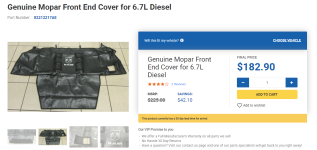
2. Should I get the front grill winter cover by MOPAR. How to use?

Thanks a lot. H
You should also put a battery maintainer on it . Battery tender , Charge Genius . There are many others just don't go cheap ! Get one that has a float mode ( maintains charge without overcharging) an anti sulfate option is nice also . Block heaters work as do winter fronts but you still need well charged batteries to roll !
 
I don't know about now days, but undercoating was the big thing 30 years ago and the dealers would do them before you bought and force you to buy it that way for on the lot units. What would happen, is that they would not fully adhere in some cases and pull away from the underbody leaving a cavity that would fill with water and being a perfect rust incubator then rot the frame. Same with the old front "bra's" people would put on cars. Sure it protected against dings, but took the paint right off with a similar "dynamic" to the undercoating... An annual fluid films sounds dramatically superior. A zinc paint layer even better. Stainless steel best of all if you could afford it and it could be made equal to or superior to specialized frame metals.
Yep i remember the old Undercoating it was brutal RAM still offers a wax coating they tried selling it to me i said fawk no
 
Yes i keep the winter front on all winter towing or not i just open the flaps accordingly. Mine will be going on in the next couple of days actually as we have had some snow already
So you have to use a winter cover, what temps are you seeing, and i thought the shutter system blocked the air flow if not what is its purpose, just curious if you want to answer , I,m on Van Island don,t usually see much below 0
 
Back
Top