
6100D
Member
Boy this topic sure got side tracked from short tripping to truck weights and registration. Want cheaper come to Wisconsin and fill under Farm.
45 bucks for 2 years and 12,000 gross.
45 bucks for 2 years and 12,000 gross.

I stopped reading several posts ago and this is MY thread............Boy this topic sure got side tracked from short tripping to truck weights and registration. Want cheaper come to Wisconsin and fill under Farm.
45 bucks for 2 years and 12,000 gross.

Was* we have invaded lolI stopped reading several posts ago and this is MY thread............
you're welcomeI stopped reading several posts ago and this is MY thread............
Just a thought - I've done some temperature logs and if we consider there is a DOC right at the turbo outlet - there must be a second DOC integrated with DPF with one body. It looks like 7-th injector mouted at the input of DPF is in fact in front of this second DOC.Re: the 7th injector, it is mentioned here: https://www.turbodieselregister.com/threads/first-review-2025-cummins-engine.275739/
TDR: Explain the changes to the diesel particulate filter (DPF).
Ram/Cummins: I’d say the biggest thing that’s changed on the DPF is that we are now using an external hydrocarbon doser to do the regeneration of the DPF and we’re not as dependent on the upstream components as we once were. So, in that respect, we have the ability to better to improve the soot loading and the soot accumulation on the DPF with this architecture.
TDR: What is the external hydrocarbon doser?
Ram/Cummins: So, during the regeneration cycle we are using a separate nozzle, a seventh injector if you will, that’s spraying diesel fuel in the exhaust stream directly upstream of the DPF to provide the extra fuel for its regeneration. Collectively, putting the DOC closer in the exhaust stream and implementing the doser at the DPF has definitely reduced any DPF clogging concerns.

Just a thought - I've done some temperature logs and if we consider there is a DOC right at the turbo outlet - there must be a second DOC integrated with DPF with one body. It looks like 7-th injector mouted at the input of DPF is in fact in front of this second DOC.
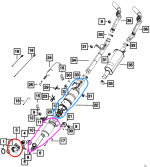
There's no secondary DOC.
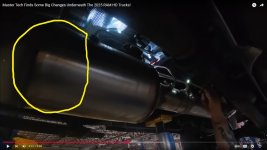
If there is no secondary DOC then how is the fuel being oxidized after it's sprayed from the doser? Just spraying the face of the DPF isn't going to do anything unless they are using some kind of hybrid ceramic media that will oxidize and also filter the exhaust stream.
Looking at a picture of the DPF there is quite a bit of room before where the differential pressure tube is at, it would be interesting to see the inlet of one of these to see it there is a catalyst there.
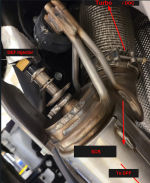


Happen to note multiple parts are discontinued? How are they building trucks if the parts are already discontinued?Holly hell the SCR prices have skyrocketed. $5.5k
Note that they are calling the DOC a DPF in the parts description.
Apart from this - there is second DOC just after 7-th injector in one body with the DPF.There's no secondary DOC.
The system is DOC-SCR-DPF.
Exhaust System
TDR: Explain the engine-mounted DOC and how the downpipe has changed in 2025.
Ram/Cummins: The exhaust system on the ’25 engine is far different from those used on previous Cummins diesels. We moved the diesel oxidation catalyst (DOC) right up to the turbo, so it lights-off fast and heats up quicker than it would if it were farther downstream (like in the previous engines). That’s better for emissions. Additionally, we went to the close-coupled DOC for better thermal management of the overall after-treatment system. So, to your point, having that catalyst there does give us a better and faster control over the exhaust temperature, which is of course is what’s needed for the diesel particulate filter (DPF) that is a little bit further downstream.
TDR: Explain the changes to the diesel particulate filter (DPF).
Ram/Cummins: I’d say the biggest thing that’s changed on the DPF is that we are now using an external hydrocarbon doser to do the regeneration of the DPF and we’re not as dependent on the upstream components as we once were. So, in that respect, we have the ability to better to improve the soot loading and the soot accumulation on the DPF with this architecture.
TDR: What is the external hydrocarbon doser?
Ram/Cummins: So, during the regeneration cycle we are using a separate nozzle, a seventh injector if you will, that’s spraying diesel fuel in the exhaust stream directly upstream of the DPF to provide the extra fuel for its regeneration. Collectively, putting the DOC closer in the exhaust stream and implementing the doser at the DPF has definitely reduced any DPF clogging concerns.
DOC
SCR
DPF
View attachment 88949
Exactly - you've marked the part where second DOC is located.If there is no secondary DOC then how is the fuel being oxidized after it's sprayed from the doser? Just spraying the face of the DPF isn't going to do anything unless they are using some kind of hybrid ceramic media that will oxidize and also filter the exhaust stream.
Looking at a picture of the DPF there is quite a bit of room before where the differential pressure tube is at, it would be interesting to see the inlet of one of these to see it there is a catalyst there.
View attachment 88953

Correct and confirmedUpdate - as I mentioned there are two DOCs in this AFT:
View attachment 93137

Update - as I mentioned there are two DOCs in this AFT:
View attachment 93137


I get it that, if he is correct, sellers will be able to market the products without risk of prosecution. But how does that help someone in a state that needs to pass emissions for inspection? Here in NH they have gotten rid of inspections so it wouldn't be an issue (for now anyway) but in other states I would think it might be.This guy is a defense contractor, but a lot of the time he ends up being correct. So for whatever it's worth...

This guy is a defense contractor, but a lot of the time he ends up being correct. So for whatever it's worth...