
I understand that and still like my pickup but I shouldn’t have to constantly have a trailer hooked up for it to function properly. It’s my understanding that past and even current years aren’t having to regen this often and they aren’t constantly towing. I was towing a couple days ago and am hooking up one of my trailers tomorrow. I watched the gauge go back down to zero the other day. These are made to be a powerhouse and I bought it to tow my equipment. Would downshifting to 5th and keeping the RPMs up have the same effect as going 75 in 6th or would the EGT’s be much lower compared to being in 6th? Funny comparison lol.It’s all a derivative of design. These trucks are designed to be worked. When they’re unloaded, they’re not working hard enough. Prior to the advent of DPF’s, that unloaded efficiency meant better fuel economy. That is still the case today. The side effect of that today, is that the EGT’s don’t get hot enough to burn the soot out when the truck isn’t loaded and isn’t working. When you push the truck to 75mph, it’s being labored enough moving its own mass at that speed, that there’s just enough load to generate high enough EGT’s. Those EGT’s are still lower than what they would be if the truck was towing, but high enough to burn out trapped soot. Its one of those, you can’t have your cake and eat it too scenarios. The little passenger car diesels can get away with it because they’re so horrendously underpowered, they’re labored enough just moving down the highway. These 420 / 1075 behemoths are overpowered when they’re unloaded and aren’t working. It’s like a body builder lifting empty cardboard boxes versus 600 pound dead lifts when towing.
Ram Heavy Duty Forum
You are using an out of date browser. It may not display this or other websites correctly.
You should upgrade or use an alternative browser.
You should upgrade or use an alternative browser.
Regens at alarming rate!
- Thread starter NVYCHF
- Start date

This has nothing to do with the robustness of the engine. You’re at the mercy of the emissions system. The truck doesn’t make enough exhaust heat when it isn’t under load. No load means low EGT’s. Low EGT’s means no passive regeneration. No passive regeneration means the soot builds up in the DPF. Ultimately the truck has to rely on active regeneration. If you’re not towing with the truck routinely, you either have to work it harder (by increasing road speed) or you rely on more active regeneration cycles, which drives up your fuel dilution in the engine oil, shortens your maintenance intervals, reduces your fuel economy, and ultimately takes service life off of the DPF. Personally I’d rather push the truck a little harder. The speed limit on I-70 is 55mph in my neck of the woods. If you’re doing less than 70mph at any given time on that road, you’re more of a hazard than someone doing 75mph. It is what it is.Having to drive a vehicle over the speed limit, or any other convoluted parameter for it to function properly is ridiculous. Yes, diesel engines need to be worked and thrive under loads, but they are robust by design and are, or should be, very tolerant of mixed driving techniques. We all know emissions ******** hampers that, but that doesn't adequately explain why these current batches of 6.7's are such crap.
Dropping down to 5th and increasing RPM may not work, as the mechanical advantage would change, and thus change the load on the engine. Without having an aftermarket device to monitor EGT’s, I would be reluctant to make a guess as to wether or not that would work.I understand that and still like my pickup but I shouldn’t have to constantly have a trailer hooked up for it to function properly. It’s my understanding that past and even current years aren’t having to regen this often and they aren’t constantly towing. I was towing a couple days ago and am hooking up one of my trailers tomorrow. I watched the gauge go back down to zero the other day. These are made to be a powerhouse and I bought it to tow my equipment. Would downshifting to 5th and keeping the RPMs up have the same effect as going 75 in 6th or would the EGT’s be much lower compared to being in 6th? Funny comparison lol.
No one is saying you have to have a trailer hooked up constantly. However you have to break the paradigms of the past. Before emissions, we could all afford to have diesels and drive them around at our leisure. It cost us nothing. We weren’t at the mercy of a government mandated emissions device beneath our feet. The times have changed. This is the same discussion I’ve had to have with no less than a dozen older farmers who all went out and bought brand new John Deere farm tractors as a result of the gas and oil boom in my area. Within the first year, mostly every one of them had numerous emissions related issues. Why? Because they all thought you could operate them the same way as they did their old workhorses from the 60’s through the 90’s. It just wasn’t the case. They’ve all had to either change their operating techniques or trade them back off for older machines. No idling, no putting around, and when it gets to the field, the throttle goes to 2,100 and stays there until it’s either out of fuel, or the work is done.
Last edited:
Thanks for the reply and insight. I’ve been debating an Edge CTS3 or the idash but haven’t decided if I even want another screen to look at while driving.Dropping down to 5th and increasing RPM may not work, as the mechanical advantage would change, and this change the load on the engine. Without having an aftermarket device to monitor EGT’s, I would be reluctant to make a guess as to wether or not that would work.
No one is saying you have to have a trailer hooked up constantly. However you have to break the paradigms of the past. Before emissions, we could all afford to have diesels and drive them around at our leisure. It cost us nothing. We weren’t at the mercy of a government mandated emissions device beneath our feet. The times have changed. This is the same discussion I’ve had to have with no less than a dozen older farmers who all went out and bought brand new John Deere farm tractors as a result of the gas and oil boom in my area. Within the first year, mostly every one of them had numerous emissions related issues. Why? Because they all thought you could operate them the same way as they did their old workhorses from the 60’s through the 90’s. It just wasn’t the case. They’ve all had to either change their operating techniques or trade them back off for older machines. No idling, no putting around, and when it gets to the field, the throttle goes to 2,100 and stays there until it’s either out of fuel, or the work is done.
Well…either would be a good purchase if you’d like to tinker around with different driving styles in an effort to help find a sweet spot for passive regeneration. I was going to buy one myself, but have been able to figure it out with the just the minimal factory gauge and some seat of the pants testing.Thanks for the reply and insight. I’ve been debating an Edge CTS3 or the idash but haven’t decided if I even want another screen to look at while driving.

CaptainMike
Well-Known Member
Matt, you don't need to re-repeat this line of reasoning. I have driven and operated all manner of diesel powered vehicles and equipment for 50 years and I have never, NEVER, EVER experienced what I'm experiencing with this 2022 Cummins. At the risk of re-repeating myself, it is ridiculous to expect someone to operate these vehicles outside of normal and lawful parameters for them to function properly. Period! I understand what you are saying, and I have great respect for you and what you do for all of us, but by doing so you are encouraging people to essentially break the speed laws. That is unacceptable to me, and it should be to you as well. Stellantis and Cummins, urged by the EPA and CARB, got this all wrong, and I'm afraid they're going to pay dearly for it.This has nothing to do with the robustness of the engine. You’re at the mercy of the emissions system. The truck doesn’t make enough exhaust heat when it isn’t under load. No load means low EGT’s. Low EGT’s means no passive regeneration. No passive regeneration means the soot builds up in the DPF. Ultimately the truck has to rely on active regeneration. If you’re not towing with the truck routinely, you either have to work it harder (by increasing road speed) or you rely on more active regeneration cycles, which drives up your fuel dilution in the engine oil, shortens your maintenance intervals, reduces your fuel economy, and ultimately takes service life off of the DPF. Personally I’d rather push the truck a little harder. The speed limit on I-70 is 55mph in my neck of the woods. If you’re doing less than 70mph at any given time on that road, you’re more of a hazard than someone doing 75mph. It is what it is.
Is your truck one of the ones that is regenerating too frequently?Matt, you don't need to re-repeat this line of reasoning. I have driven and operated all manner of diesel powered vehicles and equipment for 50 years and I have never, NEVER, EVER experienced what I'm experiencing with this 2022 Cummins. At the risk of re-repeating myself, it is ridiculous to expect someone to operate these vehicles outside of normal and lawful parameters for them to function properly. Period! I understand what you are saying, and I have great respect for you and what you do for all of us, but by doing so you are encouraging people to essentially break the speed laws. That is unacceptable to me, and it should be to you as well. Stellantis and Cummins, urged by the EPA and CARB, got this all wrong, and I'm afraid they're going to pay dearly for it.
CaptainMike
Well-Known Member
Every 100 miles/2 hrs. Estimating 1 qt of diesel dilution per 250 miles and I'm doing frequent oil changes to keep up with that. I'm limiting my use and I drive it hard when I drive it, but it makes no difference. The dealership has changed the boost tube and MAFS which hasn't fixed anything. I have long suspected a fuel system problem and it's now likely an injector issue. However, this is just the latest in a long series of problems with this truck and it's not going to remain too much longer in my possession.Is your truck one of the ones that is regenerating too frequently?
Yeah in that situation it doesn’t matter how you drive the truck. The result will be the same. What I was referring to earlier would only apply to a truck that was operating as intended. With the amount of fuel you’re seeing, bad injector(s) very likely. The tragedy is having to be at the mercy of the dealership to try and figure it out.Every 100 miles/2 hrs. Estimating 1 qt of diesel dilution per 250 miles and I'm doing frequent oil changes to keep up with that. I'm limiting my use and I drive it hard when I drive it, but it makes no difference. The dealership has changed the boost tube and MAFS which hasn't fixed anything. I have long suspected a fuel system problem and it's now likely an injector issue. However, this is just the latest in a long series of problems with this truck and it's not going to remain too much longer in my possession.
jak
Member
How do you know when a regen is happening? Does something come up on the dash? 6500mi and every time I check DPF it is on 0. 2022 Tradesmen. Thanks.
When the truck starts an active regeneration cycle this message will appear in place of the DPF gauge, and remain there until the cycle is finished:How do you know when a regen is happening? Does something come up on the dash? 6500mi and every time I check DPF it is on 0. 2022 Tradesmen. Thanks.
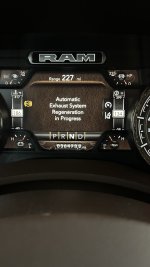

Every 100 miles/2 hrs. Estimating 1 qt of diesel dilution per 250 miles and I'm doing frequent oil changes to keep up with that. I'm limiting my use and I drive it hard when I drive it, but it makes no difference. The dealership has changed the boost tube and MAFS which hasn't fixed anything. I have long suspected a fuel system problem and it's now likely an injector issue. However, this is just the latest in a long series of problems with this truck and it's not going to remain too much longer in my possession.
Recently changed fuel filters and got my best regen cycle of 350 miles (100) miles more than before. Went back to the same old BS after that, 150 miles cycles, no change in driving style. Seems to back up your theory. Getting pretty sick of changing my oil every month. Appointment w/ dealer in 3 weeks, need to remind mytself to me kind to those service advisors...
CaptainMike
Well-Known Member
It's beginning to look more and more like a bad batch of injectors for many of these trucks. In my case, it seems to be a bad batch of many components including the front driveshaft, transmission, wiper linkage, and who knows what else.Recently changed fuel filters and got my best regen cycle of 350 miles (100) miles more than before. Went back to the same old BS after that, 150 miles cycles, no change in driving style. Seems to back up your theory. Getting pretty sick of changing my oil every month. Appointment w/ dealer in 3 weeks, need to remind mytself to me kind to those service advisors...
And yes, be kind to your service people, but don't let them BS you. I find it difficult to understand that when we have these nebulous problems we're all trying to figure out, some dealership people give out BS answers and excuses, even blaming the consumer for a manufacturer's problem. It's okay if they don't know, even if we don't like that answer at least it's truthful. I feel very fortunate to have direct access to the techs at my dealership, cuts out the middle guys who might not have the whole picture or understanding.
A funny side note: I stopped into my dealership shop yesterday to have them check and document yet another CEL (it was the P2459 code), and as I was talking to the tech he tongue-in-cheek asked me if I wanted to trade my truck straight across for a 2024. I told him heck yeah, whereupon he reached into his toolbox and handed me a Matchbox Ram pickup. It was pretty funny and very well played! I replied it's probably more dependable than the one I have.
It's beginning to look more and more like a bad batch of injectors for many of these trucks. In my case, it seems to be a bad batch of many components including the front driveshaft, transmission, wiper linkage, and who knows what else.
And yes, be kind to your service people, but don't let them BS you. I find it difficult to understand that when we have these nebulous problems that we're all trying to figure out, some dealership people give out BS answers and excuses, even blaming the consumer for a manufacturer's problem. It's okay if they don't know, even if we don't like that answer at least it's truthful. I feel very fortunate to have direct access to the techs at my dealership, cuts out the middle guys who might not have the whole picture or understanding.
A funny side note: I stopped into my dealership shop yesterday to have them check and document yet another CEL (it was the P2459 code), and as I was talking to the tech he tongue-in-cheek asked me if I wanted to trade my truck straight across for a 2024. I told him heck yeah, whereupon he reached into his toolbox and handed me a Matchbox Ram pickup. It was pretty funny and very well played! I replied it's probably more dependable than the one I have.
Ditto, also have failed pinion bearing and related components on order (going on 4 months now) to be replaced. Now I also suspect lifter failure as a tapping has developed. Fuel dilution I imagine would be the culprit. On top of that after last tire rotation sounds like my front drivers side wheel bearing is going. 2022 with 28k.
CaptainMike
Well-Known Member
Funny you mention the left front wheel bearing. My spidey-senses are starting to tingle about mine as well. Something I can't quite put my finger on, but something doesn't seem right. A barely perceptible low vibration that could easily be tire hum, but it's a new sensation. I drive a lot twisting mountain roads and I felt a very slight clunk in a right turn last week. It could have been something on the road, and I haven't felt it since, but still....Ditto, also have failed pinion bearing and related components on order (going on 4 months now) to be replaced. Now I also suspect lifter failure as a tapping has developed. Fuel dilution I imagine would be the culprit. On top of that after last tire rotation sounds like my front drivers side wheel bearing is going. 2022 with 28k.

I noticed you have cruise control activated, when you hit the auto regen, was there noticeable momentary change in how the engine ran when it initiated?When the truck starts an active regeneration cycle this message will appear in place of the DPF gauge, and remain there until the cycle is finished:View attachment 68595

Blackpowder
Active Member
You might consider an OBD scanner that uses your phone when you want to view/monitor something. I use the OBDLink Mx+ and have dashboards set up to view EGT, DPF, and DEF info. I leave the scanner plugged into the OBD port, so I just pull the app up on my phone when I want to view something. Yes it's another screen to look at, but it's not always present.Thanks for the reply and insight. I’ve been debating an Edge CTS3 or the idash but haven’t decided if I even want another screen to look at while driving.
Attachments


Not that I have ever noticed.I noticed you have cruise control activated, when you hit the auto regen, was there noticeable momentary change in how the engine ran when it initiated?
Seems to transition in and out of regeneration mode without any real noticeable changes.
At low speed it’s a little more noticeable on the sound of the engine, but at 70-75mph I really don’t notice anything different.
It almost reminds me of when the the mds would kick on in my 6.4l but it’s only momentary. Can definitely tell when it goes into regen. Maybe I’m being paranoid. IDK.Not that I have ever noticed.
Seems to transition in and out of regeneration mode without any real noticeable changes.
At low speed it’s a little more noticeable on the sound of the engine, but at 70-75mph I really don’t notice anything different.

OLEJOE
Well-Known Member
I got my Y43 recall done this morning and asked the SA how many trucks he has had come in with regen issues and he said 2. One with a bad EGR and another with loose boost hose clamp.
The one with the boost hose clamp had already had the DPF changed at another dealer. Sounds like some are competent and some not.
The one with the boost hose clamp had already had the DPF changed at another dealer. Sounds like some are competent and some not.