What's new
Ram Heavy Duty Forum

Register a free account today to become a member! Once signed in, you'll be able to participate on this site by adding your own topics and posts, as well as connect with other members through your own private inbox!

Hemi versus 7.3

Deltron

Active Member
Messages
239
Reaction score
182
Points
43
I've absolutely had it with my '22 Cummins. Absolutely by far and away the worst vehicle I've ever owned with endless emissions issues. That's saying a lot, I bought a new Vega back in the day.

Anyway, exclusive use towing a 14k 5th wheel TH.

Looking at the Hemi with the 4:10 or the Ford with the 7.3 and 4:30.

Unbiased opinion. Towing in mountains up to 11k in Colorado, not too much flatland towing. .
 
The 7.3 fords are great trucks.

I’ve blown up enough nearly new Hemi Ram work trucks to never want one for a personal rig. Your mileage may vary.
 
Not knocking the Hemi, but I had one and it ate the cam and lifters. IMHO other than the interior of the Ford, I feel like the 7.3l is the better choice. Both are a straight push rod designs, but the Hemi has the mds to contend with which I believe is a weakness. Just want to add I’ve never owned a Ford. My .02.
 
I will check back in on this one later….

But…I own a Hemi truck and pull a 12k 5er in the flatlands (for the most part - we have hills not mountains) of NY. While I like a lot about my truck, I dislike the MDS and I wouldn’t want too much more trailer behind me, especially in real mountains. I’ve bagged the rear for towing duty which helps the 2500.

When I ordered my ‘21 I tried pretty hard to get into a Ford 7.3 truck. They were just too much money. Times may be different but I wouldn’t hesitate to look again, especially after they did some(still not Ram nice but…) interior updates.

Sorry for your Cummins troubles. There are good ones and bad ones of every brand and model.


Sent from me
 
There are some good comparison videos for towing on youtube.

Normally aspirated engines have a tough time in the mountains.

The gasoline available sometimes is a fairly low octane rating, which adds the risk of pre-detonation, especially at high altitudes.

Consider the idea of using a 450 or 550 to get closer to your needs. Usually these can be configured more specifically from a ratio viewpoint and offer a tighter turning radius.
 
Last edited:
Have been cross shopping Super Dutys and Rams for the last few months. Seems to be a "pick your poison". The 7.3 will serve better for your intended use than the 6.4 Hemi. Issue is I see about as many posts regarding blown 10R100s and 10R140s as I do chewed up cams and lifters. If you get a 10R140 (All 7.3 F350s and the 7.3 F250 Tremors) it seems the 7.3 doesn't mesh as well with the gear ratios Ford intended for the diesel trucks, the truck seems more upset with its own transmission.

I'm going to end up in a Ram, the 10yr coverage offered this year serves well as a CYA, the ZF is in my opinion, superior to the 10R series and up front cost is about 2-6k less depending on incentives for the Rams. I drove a couple 7.3s, the transmission was not for me, seemed to hesitate and opt for higher gears than desired. The 6.4 is down on power but I didn't notice it with the ZF being noticeably smoother.

Caveat is, I don't tow, so YMMV, but that's all I've been reading about for the last few months. There are more posts about transmission issues over at the Ford Truck Enthusiast forum than chewed up cams over here.
 
Have been cross shopping Super Dutys and Rams for the last few months. Seems to be a "pick your poison". The 7.3 will serve better for your intended use than the 6.4 Hemi. Issue is I see about as many posts regarding blown 10R100s and 10R140s as I do chewed up cams and lifters. If you get a 10R140 (All 7.3 F350s and the 7.3 F250 Tremors) it seems the 7.3 doesn't mesh as well with the gear ratios Ford intended for the diesel trucks, the truck seems more upset with its own transmission.

I'm going to end up in a Ram, the 10yr coverage offered this year serves well as a CYA, the ZF is in my opinion, superior to the 10R series and up front cost is about 2-6k less depending on incentives for the Rams. I drove a couple 7.3s, the transmission was not for me, seemed to hesitate and opt for higher gears than desired. The 6.4 is down on power but I didn't notice it with the ZF being noticeably smoother.

Caveat is, I don't tow, so YMMV, but that's all I've been reading about for the last few months. There are more posts about transmission issues over at the Ford Truck Enthusiast forum than chewed up cams over here.

I put over 1,000 miles on the 7.3 with the 10 speed and did not like it either.

Delton, I think you got a lemon. Your next Cummins could be problem free. You have 100,000 miles or 10 years to find out.
 
I put over 1,000 miles on the 7.3 with the 10 speed and did not like it either.

Delton, I think you got a lemon. Your next Cummins could be problem free. You have 100,000 miles or 10 years to find out.
Unfortunately that warranty doesn't apply to virtually anything that's been problems with this truck.

Emissions has only been part of it. Endless electrical parts have been replaced too. Only 3/36 on that stuff.

Really upsetting, our 2018 was a great truck.
 
Unfortunately that warranty doesn't apply to virtually anything that's been problems with this truck.

Emissions has only been part of it. Endless electrical parts have been replaced too. Only 3/36 on that stuff.

Really upsetting, our 2018 was a great truck.
Does your state require emissions testing? Sounds like a new Cummins with a weight reduction is a good combination.
 
We tow with a 2014 Ram 2500 Cummins with a G56 and a 2024 Ram 3500 Cummins with an Aisin in the Rockies. The exhaust brakes can't be understated. Sorry, that your diesel didn't work out, but both the 6.4L and 7.3L gas aren't the best towing choice in the Rockies.

Our 2016 Ram PW 6.4L with 4.10-1 and 6 speed and 1998 Chevrolet K1500 5.0L with 3.73-1 and NV3500 5 speed are naturally aspirated. Driving across our local flat top mountain at the posted 55 MPH it's with a noticable feel of power loss, even without towing. It's all at high altitude at and above 10K feet. Regearing or adding more transmission gears with the latest 2025 and 2026 models won't make up for not having turbos. The Ford towing manual accounts for the feel in power loss recommending decreasing gross vehicle combined weight by 2% from sea level per every increase in 1K feet in elevation.
 
There are some good comparison videos for towing on youtube.

Normally aspirated engines have a tough time in the mountains.

The gasoline available sometimes is a fairly low octane rating, which adds the risk of pre-detonation, especially at high altitudes.

Consider the idea of using a 450 or 550 to get closer to your needs. Usually these can be configured more specifically from a ratio viewpoint and offer a tighter turning radius.
I think you got it backwards. A quick AI chatbox responded this. "Lower octane fuel is sufficient to prevent detonation at high altitudes because the thinner air reduces cylinder pressures and peak combustion temperatures, making premature ignition less likely. While higher octane fuel resists detonation, its benefit is reduced in lower-density air, as the engine's overall tendency to detonate decreases. Therefore, using lower-octane gas at higher elevations can be a safe and cost-effective way to operate a naturally aspirated engine."
 
I think you got it backwards. A quick AI chatbox responded this. "Lower octane fuel is sufficient to prevent detonation at high altitudes because the thinner air reduces cylinder pressures and peak combustion temperatures, making premature ignition less likely. While higher octane fuel resists detonation, its benefit is reduced in lower-density air, as the engine's overall tendency to detonate decreases. Therefore, using lower-octane gas at higher elevations can be a safe and cost-effective way to operate a naturally aspirated engine."
That's another consideration for the OP. We burn through a lot more gas towing with our Ram 2500 6.4L than with our Ram 6.7L diesels while towing in the Rockies. Think twice as much on the steeper mountains and we use the cheaper 85 octane gas. 87 octane is 30 to 40 cents more per gallon.

Our nearest fuel station is Grand Mesa RV. Sells both diesel and gas. 85 octane gas, only at $4.70/gallon. It's another 40 miles south on the highway if you want the minimum 87 octane gas that both the 6.4L and 7.3L requires per the owners manual. The diesel at the pump is the diesel recommended.

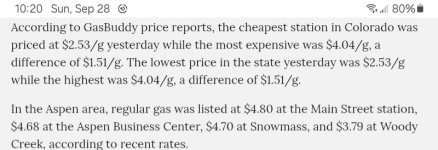
Funny that Gas Buddy reports the highest gas prices in the state of Colorado is $4.04, whereas, it's up to $4.80 within the Colorado Rockies for 85 octane.
Screenshot_20250928_102041_Chrome.jpg
 
That's another consideration for the OP. We burn through a lot more gas towing with our Ram 2500 6.4L than with our Ram 6.7L diesels while towing in the Rockies. Think twice as much on the steeper mountains and we use the cheaper 85 octane gas. 87 octane is 30 to 40 cents more per gallon.

Our nearest fuel station is Grand Mesa RV. Sells both diesel and gas. 85 octane gas, only at $4.70/gallon. It's another 40 miles south on the highway if you want the minimum 87 octane gas that both the 6.4L and 7.3L requires per the owners manual. The diesel at the pump is the diesel recommended.

Funny that Gas Buddy reports the highest gas prices in the state of Colorado is $4.04, whereas, it's up to $4.80 within the Colorado Rockies for 85 octane.
View attachment 89967
85 octane is fine at high altitudes.
 
I'm at 7,000 average and use 86 with no issues or noticeable lack of performance.
 
Yes, 85 is what we use in our Ram 6.4L.

Got to hand it Ford though for recommending 91 for performance in the 7.3L such as when towing. Another reason to stick with diesel or the Ram 6.4L. The recommended fuel is cheaper for both.Screenshot_20250928_112143_Chrome.jpg
 
I think you got it backwards. A quick AI chatbox responded this. "Lower octane fuel is sufficient to prevent detonation at high altitudes because the thinner air reduces cylinder pressures and peak combustion temperatures, making premature ignition less likely. While higher octane fuel resists detonation, its benefit is reduced in lower-density air, as the engine's overall tendency to detonate decreases. Therefore, using lower-octane gas at higher elevations can be a safe and cost-effective way to operate a naturally aspirated engine."

So what does a person do when they start at sea level and then drive up to 8 000 ft ? Or drive back home ? Have a bunch of crap fuel that causes knock in their expensive hemi engine ?

Why would anyone put lower qualify fuel in their expensive truck and listen to a government agency telling them what they should or should not buy ?
 
So what does a person do when they start at sea level and then drive up to 8 000 ft ? Or drive back home ? Have a bunch of crap fuel that causes knock in their expensive hemi engine ?

Why would anyone put lower qualify fuel in their expensive truck and listen to a government agency telling them what they should or should not buy ?

Not possible from or within Colorado. Average elevation is 6,800 feet.

There's nothing within the range with a full 32 gallon tank of gas that our Ram 2500 6.4L could even get close to sea level from an 8,000 feet elevation fuel stop (example Vail, Colorado). Need to refill long prior to driving to lower elevations. Our 50 gallon Ram 3500's 6.7L diesel tank might have a better chance of making it on empty. Another reason to stick with diesel.

united-states-elevation-map-v0-vvnj8vyoeh981.jpg
 
So what does a person do when they start at sea level and then drive up to 8 000 ft ? Or drive back home ? Have a bunch of crap fuel that causes knock in their expensive hemi engine ?

Why would anyone put lower qualify fuel in their expensive truck and listen to a government agency telling them what they should or should not buy ?
If a person starts at sea level, more than likely the fuel in the tank will be 87 octane or higher which will cause no issue at high elevation. I put 86 octane on mine 95% of the time unless I know I’m going to a much lower elevation area. It makes absolutely no sense to pump much more expensive fuel just for the remote possibility that I may have to drive to a lower elevation area. If for some reason, such as a comet, a zombie outbreak, etc. that forces me to flee, I’ll just pump higher octane when I get there. In the meantime the truck’s ECU will sense the lower octane and adjust accordingly to protect the engine.
 
Back
Top