What's new
Ram Heavy Duty Forum

Register a free account today to become a member! Once signed in, you'll be able to participate on this site by adding your own topics and posts, as well as connect with other members through your own private inbox!

GCVWR

lovegolf44

Active Member
Messages
455
Reaction score
201
Points
43
Hey folks, for those of you that have new 2020 3500s, how are you determining the GCVWR for your particular trucks? The only thing I found on the RAM site is the 2019 RAM 3500 Trailer Towing Chart. It's based on the Tradesman unless you have a Mega Cab and they use Big Horn/Lone Star. Is that chart fairly accurate on the GCVR? According to this chart, my vehicle (still waiting for shipment) would have a GCVR of 28300lbs. That sound right? I have a 4x2 SRW/8' box/crew cab/68RFE coming.
 
I believe this is the 2019 Towing Chart you are referencing:
  1. https://www.ramtrucks.com/towing-guide.html
  2. Click on the "Towing Info" button at the top.
  3. Download the PDF for the 2019 Ram 3500.
To test the chart's accuracy, let's compare the chart in the PDF to the actual door sticker on my 2019 Ram 3500 HO/Aisin SRW MegaCab short bed.

The chart says:

1585318138379.png

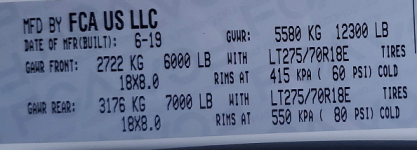
The actual door sticker says:

1585318454409.png
1585318522215.png

As you can see, there is a discrepancy. The chart says the payload should be 4220 lbs, but the door sticker says the payload is actually 3869 lbs. I wouldn't trust the chart to be 100% accurate for all options.

The good news is, the "lookup my VIN" option on the Towing Guide shows the correct values. It shows the payload for my truck as 3869 lbs and the max trailer weight rating as 24279 lbs (which is greater than what is in shown the PDF towing chart).

If the dealer has given you the VIN of your truck that is on order, try putting it in the "look up my VIN" option.
 
I believe this is the 2019 Towing Chart you are referencing:
  1. https://www.ramtrucks.com/towing-guide.html
  2. Click on the "Towing Info" button at the top.
  3. Download the PDF for the 2019 Ram 3500.
To test the chart's accuracy, let's compare the chart in the PDF to the actual door sticker on my 2019 Ram 3500 HO/Aisin SRW MegaCab short bed.

The chart says:

View attachment 3393

The actual door sticker says:

View attachment 3394
View attachment 3395

As you can see, there is a discrepancy. The chart says the payload should be 4220 lbs, but the door sticker says the payload is actually 3869 lbs. I wouldn't trust the chart to be 100% accurate for all options.

The good news is, the "lookup my VIN" option on the Towing Guide shows the correct values. It shows the payload for my truck as 3869 lbs and the max trailer weight rating as 24279 lbs (which is greater than what is in shown the PDF towing chart).

If the dealer has given you the VIN of your truck that is on order, try putting it in the "look up my VIN" option.
Yes, that was the chart I was referencing. I haven't received my window sticker so my VIN doesn't work in the "look up my VIN" yet. I'm quite impressed however with how much more the trailer rating/GCWR are with the H/O diesel vs w/o with SRW. Appears the biggest benefit of the DRW is payload. Of course PL is "the kicker" as Guy Fieri would say.
 
Yes, that was the chart I was referencing. I haven't received my window sticker so my VIN doesn't work in the "look up my VIN" yet. I'm quite impressed however with how much more the trailer rating/GCWR are with the H/O diesel vs w/o with SRW. Appears the biggest benefit of the DRW is payload. Of course PL is "the kicker" as Guy Fieri would say.
Payload AND max trailer weight!... I mean 24000 to 33000 is not just a marginal increase.
 
Payload AND max trailer weight!... I mean 24000 to 33000 is not just a marginal increase.
That is incredible, grant you. Sometimes I regret not ordering the H/O but when I was analyzing trailer hauling without the H/O, I'm still going to be able to haul pretty much any 5th wheel with a GVWR of 18K or less for which there are many options out there. We'll never do full-timing or anything like that so there's no need to haul the biggest and best. :)
 
I'm still going to be able to haul pretty much any 5th wheel with a GVWR of 18K or less for which there are many options out there.

You will most likely run out of payload capacity before you run out of GCVWR.
 
You will most likely run out of payload capacity before you run out of GCVWR.
Maybe but with a payload of 4258, the 5th wheel pin weight would have to be pretty heavy (20+% of trailer GVWR) to exceed my max. I just did calculation on a 19000 GVWR trailer with 3360 pin weight and I still have PL left!
 
Maybe but with a payload of 4258, the 5th wheel pin weight would have to be pretty heavy (20+% of trailer GVWR) to exceed my max. I just did calculation on a 19000 GVWR trailer with 3360 pin weight and I still have PL left!

I suspect your actual door sticker will indicate less than 4258 payload, but let's assume it is correct. If the pin weight is 3360 (is that laden with cargo+water or is that unladen), that leaves 898 lbs of payload capacity for all of the following:

Passengers + pets: My wife, kids, pets, and I weight about 500 pounds combined, yikes!
Diesel: My diesel tank holds 32(?) gallons, so a full tank weighs ~224 lbs.
DEF: 5 gallons weighs about 35+ pounds
Luggage:. My wife's purse weighs thousands of pounds. OK, that's not true, but we do tend to carry a lot of our luggage in the truck for easy access.
Toolbox + tools: air compressor, sockets, tow ropes, etc
Hitch: 5th wheel hitch and chains. I use an Andersen hitch for weight savings.
Accessories: Tonneau cover, light bars, wench, HD bumpers, after-market trailer camera, spare fuel cans with fuel
Bed cargo: Firewood, portable grill, etc.

With all the cargo and the pin weight of the trailer, I quickly consumed the 3869 payload capacity of my truck.

I'm not worried about exceeding my payload by a little, but my point is the payload was consumed much more quickly than I thought it would once I added up all of the weights of everything.

 
Not everyone pulls only one trailer so towing capacity over payload is a consideration.

;-)

That said, your likely to exceed your state's length law with a monster fifth and a heavy 2nd trailer before hitting that max tow.
 
Found a similar truck VIN from inventory and it was rated 4210/20210. Only the HO SRW is rated 24k. SO is 20k.
 
I suspect your actual door sticker will indicate less than 4258 payload, but let's assume it is correct. If the pin weight is 3360 (is that laden with cargo+water or is that unladen), that leaves 898 lbs of payload capacity for all of the following:

Passengers + pets: My wife, kids, pets, and I weight about 500 pounds combined, yikes!
Diesel: My diesel tank holds 32(?) gallons, so a full tank weighs ~224 lbs.
DEF: 5 gallons weighs about 35+ pounds
Luggage:. My wife's purse weighs thousands of pounds. OK, that's not true, but we do tend to carry a lot of our luggage in the truck for easy access.
Toolbox + tools: air compressor, sockets, tow ropes, etc
Hitch: 5th wheel hitch and chains. I use an Andersen hitch for weight savings.
Accessories: Tonneau cover, light bars, wench, HD bumpers, after-market trailer camera, spare fuel cans with fuel
Bed cargo: Firewood, portable grill, etc.

With all the cargo and the pin weight of the trailer, I quickly consumed the 3869 payload capacity of my truck.

I'm not worried about exceeding my payload by a little, but my point is the payload was consumed much more quickly than I thought it would once I added up all of the weights of everything.
Yes, PL includes passengers and other crapola. BTW, a full tank of fuel (generally 90% full) isn't figured in PL, that's part of curb weight. Besides, my example was max capacity in that I have a lot of options when it comes to 5th wheels and it's not likely I will be hauling anything close to 19K lbs anyway.
 
Last edited:
Yes, PL includes passengers and other crapola. BTW, a full tank of fuel (generally 90% full) isn't figured in PL, that's part of curb weight.

I confirmed your claim that the curb weight includes a "nominal" tank of fuel. "Curb weight means the actual or the manufacturer's estimated weight of the vehicle in operational status with all standard equipment, and weight of fuel at nominal tank capacity, and the weight of optional equipment..."

That's great news because I get that weight back in my payload calculation. My sales rep told me I need to add the weight of fuel, so I will let him know that's not correct.
 
I confirmed your claim that the curb weight includes a "nominal" tank of fuel. "Curb weight means the actual or the manufacturer's estimated weight of the vehicle in operational status with all standard equipment, and weight of fuel at nominal tank capacity, and the weight of optional equipment..."

That's great news because I get that weight back in my payload calculation. My sales rep told me I need to add the weight of fuel, so I will let him know that's not correct.
"Curb weight also known as “kerb weight” in British English is defined as the total weight of a vehicle including all factory-installed equipment, all essential consumables for operation like coolant oil, motor oil, air conditioning refrigerant, transmission oil, a 90% full fuel tank and not including any passengers or cargo. This is the actual weight of a vehicle assigned by its manufacturer."

BLUF: There are minor variations of the definition but as you stated, it does include fuel to a certain extent.
 
"Curb weight also known as “kerb weight” in British English is defined as the total weight of a vehicle including all factory-installed equipment, all essential consumables for operation like coolant oil, motor oil, air conditioning refrigerant, transmission oil, a 90% full fuel tank and not including any passengers or cargo. This is the actual weight of a vehicle assigned by its manufacturer."

BLUF: There are minor variations of the definition but as you stated, it does include fuel to a certain extent.

I also found that definition on the Internet, but I believe it may be slightly inaccurate for the USA.

Section 86.1803-01 of Federal law states, "Curb weight means the actual or the manufacturer's estimated weight of the vehicle in operational status with all standard equipment, and weight of fuel at nominal tank capacity, and the weight of optional equipment..."

Nominal fuel tank capacity is defined as, ".... the volume of the fuel tank(s), specified by the manufacturer to the nearest tenth of a U.S. gallon, which may be filled with fuel from the fuel tank filler inlet."

So, it seems in the USA the curb weight includes 100% of the fuel tank capacity to the nearest tenth of a US gallon.
 
Base weight is no passengers and full fluids. Fuel, oil, coolant, washer fluid, DEF, ETC.

Payload is GVWR minus base weight.

Payload is different for each and every truck. The chart is based on a minimally equipped configuration...cab, bed, drivetrain.

GCWR is based on engine, transmission and rear gear. This number is a constant.

You get an allowance of 300 lbs for passengers, conventional hitch and 5th wheel get a weight...I believe 90 and 150 pounds respectively...and tongue weight (10% for bumper pull and 20% for 5th wheel)

You then take GCWR minus your loaded truck to then get your towing max weight.

GVWR and GCWR are specific unchangeable numbers.

GVWR is based on truck series(1500,2500,3500)

GCWR is based on engine, transmission, rear gear.

Use the chart to get your GVWR and GCWR. These are constant.

Payload and max tow vary by each and every individual truck.

Note: 3500 is also decided with single or dual rear wheel
 
Devildodge is exactly right. Gvwr an gcwr are set numbers, they are not something that changes. Pretty easy to figure. My gvwr is 14,000, truck weighs about 9200 that means I can have 4800 for payload. The gvwr does not change, should be on your door sticker. As the truck Weight changes the payload will change all this being important if you intend to stay legal. My gvwr is 43,000, that's max trailer an truck. So minus the 9200 for truck weight, gives me a max trailer weight of 33,800. Again the gcwr can't change, only the truck weight an trailer can change. The more fuel and tools an goodies that are in your truck the less trailer weight you should have. To be legal. I will note there's allot who do run illegal out there, but i do not, not only is it irresponsible but if your involved in an accident your insurance won't cover you an for some that could be several hundred thousand $$$$$$ an a jail sentence if your found at fault
 
if your involved in an accident your insurance won't cover you an for some that could be several hundred thousand $$$$$$ an a jail sentence if your found at fault

This is BS. Insurance covers stupid. There is no "not covered for stupid" clause.

In any case, if there is death or serious injury and you are charged and found negligent, the weight isn't going to matter much, insurance or not when it tops out. If you have an umbrella policy, that also covers stupid.
 
  • Like
Reactions: @JC
I'm ass uming your not calling me stupid an that your referring to stupid decisions. Hate to disagree with you. If you go out an have an accident an all your data will be recorded because I used to do it, vehicle weights an trailer weights an skid marks or not. You call the insurance company an deny the claim to cover the client because they knowingly broke the law, happens every day my friends, an especially with heavy weight it's reckless an dangerous an as you put it stupid. Also weight will matter if you get sentenced in a serious wreck. These guys out there hauling tri axle rigs with srw trucks are knowingly an recklessly causing a ( pre meditated) public safety hazard. It's not like you went over weight because you just forgot to dump your grey tank were your only a few hundred over vs several thousand over. Again I have some Court experience with my employees who have been involved in accidents wich was a clear result of weight. Weight was a major factor for the judge, that's why there's laws.
 
I'm ass uming your not calling me stupid an that your referring to stupid decisions. Hate to disagree with you. If you go out an have an accident an all your data will be recorded because I used to do it, vehicle weights an trailer weights an skid marks or not. You call the insurance company an deny the claim to cover the client because they knowingly broke the law, happens every day my friends, an especially with heavy weight it's reckless an dangerous an as you put it stupid. Also weight will matter if you get sentenced in a serious wreck. These guys out there hauling tri axle rigs with srw trucks are knowingly an recklessly causing a ( pre meditated) public safety hazard. It's not like you went over weight because you just forgot to dump your grey tank were your only a few hundred over vs several thousand over. Again I have some Court experience with my employees who have been involved in accidents wich was a clear result of weight. Weight was a major factor for the judge, that's why there's laws.

I don't doubt you for a moment in a commercial operation. Big difference between commercial operations and a POV. We'll leave it at that.
 
not much difference these days. I bet most people would probably drive a 43,000 lb gcwr rig about the same as there 13,000 lb 33ft fiver. Very scary out there with the way weights keep going up an any one can drive them. Scary times, old man with a hat in his ferd an 45 ft toy hauler, yikes, look out.
 
Back
Top