What's new
Ram Heavy Duty Forum

Register a free account today to become a member! Once signed in, you'll be able to participate on this site by adding your own topics and posts, as well as connect with other members through your own private inbox!

Camper Choices

That's great...generally regulators do...but often the inlet port of the camper has a check valve in it else the water pump would just blow water out the inlet when you run on tank. The inlet check valve would prevent you from ever seeing pressure rise due to the water heater on your regulator's gauge and will cause the water heater related pressure spikes I cited.
Nope. Doesn’t apply to mine. Actually, none of the 6 RVs I’ve owned over the past 30 years were set up like what you’re describing.
 
Nope. Doesn’t apply to mine. Actually, none of the 6 RVs I’ve owned over the past 30 years were set up like what you’re describing.
Okay, great. 2/2 of the ones I've owned will pressure spike on the water heater because the expansion has nowhere to go until the TP valve opens.

Your fresh pump is made of check valves and the water inlet has to have one as well.

A tiny $35 accumulator tank is a worthwhile upgrade that the manufacturer should include. Everybody wants to blame potentially high campground pressure and sell you a chinzy regulator but in the end your camper is making its own pressure spikes.
 
Last edited:
Nope. Doesn’t apply to mine. Actually, none of the 6 RVs I’ve owned over the past 30 years were set up like what you’re describing.

Every camper with a city connection has a check valve on the city connection, they have to. To claim you don’t have check valves is simply not understanding your RV.

The most extreme pressure spike will happen when the takes hot water heater is turned on and water is used. Once water, cold or hot, is used the pressure returns to the cutoff pressure. As long as the hot water heater doesn’t do a full temp swing without water being used the spike in pressure is minimal, but still exists. The pressure spikes obviously don’t apply to RV’s with tankless hot water heaters.
 
Yes, the water pump does have a check valve to maintain pressure while using it and prevent water from leaking into the fresh tank while using city water. However, the city water inlet does not. There is a valve to switch between the two. When changed to the fresh water tank setting it closes off the city water inlet. No check valve needed. Was the same on my other 5 RVs.
Agree to disagree.
Cheers.
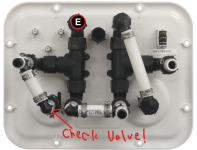
My nautilus panel has a valve to swap between the pump and city water, but said valve is only cycling the suction side of the pump between the tank and the suction port. Both settings rely on the check valve in the city water inlet. And in the days before the nautilus panels, those simpler city inlets had check valves in them.

Which is why I just leave my camper in the "dry camp" setting even when hooked to city water and it works just fine.

Try it sometime. Leave your valve lineup in dry camp mode, pump off, connect city water.

1762998296668.png
 
Last edited:
My nautilus panel has a valve to swap between the pump and city water, but said valve is only cycling the suction side of the pump between the tank and the suction port. Both settings rely on the check valve in the city water inlet.

Which is why I just leave my camper in the "dry camp" setting even when hooked to city water and it works just fine.

Try it sometime. Leave your valve lineup in dry camp mode, pump off, connect city water.
The Nautilus panel is different from other “normal” water control systems. I have accidentally done that and ended up with water pouring out of my fresh water tank drain valve (I always leave it open).
Agree to disagree.
Cheers.
 
The Nautilus panel is different from other “normal” water control systems. I have accidentally done that and ended up with water pouring out of my fresh water tank drain valve (I always leave it open).
Agree to disagree.
Cheers.
In that case it was because the $8 diaphram/check valve in your pump needed replacement. It was not because the check valve in your city inlet didn't exist.
 
Well, after some research I stand corrected. Big enough to admit I was wrong. Sometimes I think I know more about a topic than I do. Apologies for any ruffled feathers. Thank you for the insight.
 
Before I moved up to a fifth wheel TH I had two different bumper pull toyhaulers. Both had vapor walls between the living quarters and the garage and they had separate ventilation. I never had an issue with dirt or vapors in the living area. Not sure what the manufacturers are currently offering as far as floor plans. I agree, parking the toys in the living room is a no-go for me.
Not a fancy toy hauler but I camped in my enclosed trailer a few times. oil leaks, steering leaks and mud make it a dang mess inside of there.

I don’t know a lot about RV life but I have to recommend a separate garage and living room if possible.

IMG_2465.jpeg
 
Back
Top