What's new
Ram Heavy Duty Forum

Register a free account today to become a member! Once signed in, you'll be able to participate on this site by adding your own topics and posts, as well as connect with other members through your own private inbox!

Articulink? Technical discussion

el_barto

Well-Known Member
Messages
1,433
Reaction score
2,116
Points
113
My brain kinda smooth today. I was thinking about the PW suspension and cant really figure out what the Articulink on the front radius arms do.

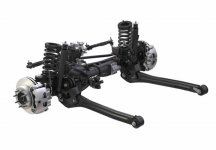
In general: the Ram front suspension is a 3 link: 2 radius arms + track bar. Track bar prevents lateral movement, while the radius arms prevent fore/aft movement.

The standard Ram radius arm connects to the axle on 2 points and 1 point on the frame. The PW radius arm retains the same one point on the frame and 2 points on the axle, but the upper point on the axle is connected to the radius arm with a small bracket that is pinned on the radius arm bushing, rather than welded/being of the same part.

I just cant wrap my head around how this extra pinned point / bracket actually does anything. Best i can understand is it allows the axle to slightly roll (About the axis of the axle) forward in droop or rearwards in rebound; but i dont even see what the advantage of this would be? And it seems like it would only work at extreme angles (articulation)
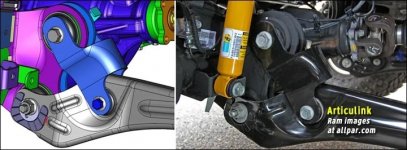
5AD6C8A0-A2BB-47D2-8DDA-BFBEF99CC44D.jpeg3FD51F75-4953-4764-A9E9-8207E0CEEE86.jpeg
 
Not sure if this helps you any but found this cool vid of our suspension in action (the articulink is mentioned briefly):
I’ve seen that video, but it doesn’t seem like the Articulink pivots at all
 
That’s kind of all I can figure as well, since it doesn’t seem like it would move much /at all in normal range of motion.
Any time you are flexing where you need the sway bar disconected it is doing something, i cant remember the exact angle the control arms need before they bind/start to twist from when i built my custom 3/4 link jeep but it was not much past the oem sway bar limits
 
Any time you are flexing where you need the sway bar disconected it is doing something, i cant remember the exact angle the control arms need before they bind/start to twist from when i built my custom 3/4 link jeep but it was not much past the oem sway bar limits
Sure I can see how things would bind up when one side is in droop and the other side is in compression since the ends of the hubs move on an “arc” while the radius arms allow for vertical movement on a perpendicular arc…I’m still having a hard time visualizing how the Articulink resolves this though
 
Sure I can see how things would bind up when one side is in droop and the other side is in compression since the ends of the hubs move on an “arc” while the radius arms allow for vertical movement on a perpendicular arc…I’m still having a hard time visualizing how the Articulink resolves this though
The extra bushings allow for more twisting motion as much as i can see, im surprised they dont have a Johnny joint style rod end on the frame side mount as that would allow for all the articulation you could want with the stock radius arms
 
Looks more flexy to me from here.

Instead of one solid radius arm it’s kinda like a hybrid of a Y long arm kit like were common on TJ/XJ where the upper link attached to the lower link.

Edit to add pic
View attachment 23766
But it’s not a heim joint where the little arm connects to the big arm…that’s why I’m confused I guess.
 
But it’s not a heim joint where the little arm connects to the big arm…that’s why I’m confused I guess.
I’ll send pics of the articulink and the normal 2500 radius arm like i have to my brother and see what he comes up with and I’ll report back. He knows a thing or two more about suspensions than I do since he designs them for a living
 
I’ve seen that video, but it doesn’t seem like the Articulink pivots at all
it does tho a small amount the rubber bushing lets It flex all the time which smooths things out and helps reduce binding. If you have ever put a jeep on a ramp that has stock arms and then put the same jeep on with arms that have something like johnny joints you can see where the stock arms start binding as soon as it reaches a certain point. The johnny joint lets them go a lot further. Probably with a solid joint is they are not going to be as smooth on the road as a rubber joint so Ram needed to keep the smooth ride and allow a bit more articulation.
 
My brother basically said that there is one more bushing and it’s placement allows the radius arm to flex slightly, (it’s actually not the radius arm flexing, but the bushing joint allows movement that would be equivalent to the radius arm flexing in torsion) whereas the solid radius arm does not flex.

If the bushings didn’t flex, The radius arm could only move in one plane.

My non-Pw radius arm, solid.
ED567F62-1483-45DB-BD0C-5146C86ED73A.jpeg
 
So it’s not pivoting on that extra connection, it’s flexing on the bushing at that connection…
 
So it’s not pivoting on that extra connection, it’s flexing on the bushing at that connection…
That’s all links do. Links don’t pivot, the bushing flexes, When speaking of vulcanized oem bushings. The center tube of the bushing is clamped in place. The bushing is doing all the work.

Don thuren explains that pretty well here.
 
Slightly off topic but related to the front arms. I always thought aside from the softer springs the Power Wagon frame, brakes, everything else was just as capable as the regular 2500 weight carrying and towing wise. Looking at that regular trucks radius arm it’s quite a bit beefier than the PW from the looks of it.
 
Slightly off topic but related to the front arms. I always thought aside from the softer springs the Power Wagon frame, brakes, everything else was just as capable as the regular 2500 weight carrying and towing wise. Looking at that regular trucks radius arm it’s quite a bit beefier than the PW from the looks of it.
Negative, I believe the Articulink is the main reason the PW has such low payload. The PW GAWR Front is 4750lb and GAWR Rear is 6200lbs; as compared to a similar (4x4 CC 6’-4” Hemi) typically has a GAWR front of 5500lb and rear 6000lb. I can only guess they derated the front due to the articulink…though it is unclear why they updated the rear.

Also, digging thru part numbers, most of the suspension components are different. Shocks, springs obviously. But also spring seats/isolation dampers, rear control arms, sway bars front(obviously) and rear, etc.

Axles are different (obviously) due to lockers, but generally the same. However, The axle shafts are a different part number and there are some other changes (unclear)…

Brakes, hitch, and frame are the same though.
 
Negative, I believe the Articulink is the main reason the PW has such low payload. The PW GAWR Front is 4750lb and GAWR Rear is 6200lbs; as compared to a similar (4x4 CC 6’-4” Hemi) typically has a GAWR front of 5500lb and rear 6000lb. I can only guess they derated the front due to the articulink…though it is unclear why they updated the rear.

Also, digging thru part numbers, most of the suspension components are different. Shocks, springs obviously. But also spring seats/isolation dampers, rear control arms, sway bars front(obviously) and rear, etc.

Axles are different (obviously) due to lockers, but generally the same. However, The axle shafts are a different part number and there are some other changes (unclear)…

Brakes, hitch, and frame are the same though.

Thank you for that clarification. I will now stop spouting misinformation lol
 
Are the axle shafts different due to a higher spline count? Thought I read somewhere on here that info.
 
Are the axle shafts different due to a higher spline count? Thought I read somewhere on here that info.
Per Yukon Gear, larger compared to PW rear 2014-2018:
“ The REAR is all new, has a larger 32 spline pinion, different carrier, different axles etc. nothing interchanges with the older applications in the back. “

Not sure what the difference between a 2019+ regular 2500 axle shaft and PW axle shaft is though
 
Back
Top