What's new
Ram Heavy Duty Forum

Register a free account today to become a member! Once signed in, you'll be able to participate on this site by adding your own topics and posts, as well as connect with other members through your own private inbox!

Anyone Ever Seen This?

Units

Well-Known Member
Messages
725
Reaction score
802
Points
93
Location
South Ms.
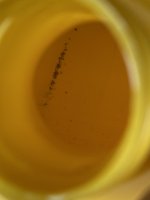
Filled up my 2 - 5 gal gas cans for my upcoming trip. This was in the bottom of both of them after filling them up. Looks like black flecks of various sizes. Have never put unfiltered diesel into anything, not sure if this is normal and yes I cleaned the cans before using. Smells like diesel, is this bad fuel? Never saw this in any of my unleaded cans. Best picture I could get.

1719782611764.jpeg
 
Filled up my 2 - 5 gal gas cans for my upcoming trip. This was in the bottom of both of them after filling them up. Looks like black flecks of various sizes. Have never put unfiltered diesel into anything, not sure if this is normal and yes I cleaned the cans before using. Smells like diesel, is this bad fuel? Never saw this in any of my unleaded cans. Best picture I could get.

View attachment 74568
Almost looks like rust based on the reddish color that I see in your photo on my computer.. But then I also recall last month seeing a photo of something similar from a guy who worked at a gas station who had a photos of something similar he found when changing out gas station pump filters..
 
Looks like the pumps filter or hose is breaking down. I would not pour it in my tank.
 
Plan on filtering it out and using. Preciate the info fellas.
 
That’s what a fuel filter is for.

That was my initial reaction but then I thought, what else might be in there?
If that is rust from a deteriorating tank, can the fuel filter remove the tiniest specks? Small enough to get through the filter perhaps but still abrasive iron molecules entering the HPFP.
I’d be tempted to ask for a refund. I bet they don’t want to get the State inspector involved.
 
That was my initial reaction but then I thought, what else might be in there?
If that is rust from a deteriorating tank, can the fuel filter remove the tiniest specks? Small enough to get through the filter perhaps but still abrasive iron molecules entering the HPFP.
I’d be tempted to ask for a refund. I bet they don’t want to get the State inspector involved.
You don't know what 2 micron is do you? One micron in decimal is equal to 00003937 inches or 0.001mm the filter in your truck is 2 micron on the side of the engine trust me that won't make it to your engine

Also I'm not sure the laws in the US but here in canada no fuel stations can have a metal tank thats underground they have to be approved plastic tanks or the station can not be refuelled
 
Last edited:
Asphaltites
Asphaltines wouldn’t be present in fuel that has yet to be run through the fuel system. In any event they wouldn’t be the at visible. It’s usually a sludge at the bottom of the tank. What the OP has is a much larger debris, likely from a deteriorating fuel storage or supply issue at the station where the fuel was purchased.
 
Asphaltines wouldn’t be present in fuel that has yet to be run through the fuel system. In any event they wouldn’t be the at visible. That is a much larger debris, likely from a deteriorating fuel storage or supply issue at the station where the fuel was purchased.
Thought about filtering it, makes me anxious thinking of putting it in my truck. May just get rid of it.
 
Thought about filtering it, makes me anxious thinking of putting it in my truck. May just get rid of it.
Aside from the visible debris, it looks otherwise very clear. Any sign of water at the bottom? If it’s just a small amount of that debris, it’s really not something to lose sleep over. I would do your due diligence to screen it out but that’s it. Maybe try to pour it so that there’s a few inches left in the bottom and toss the rest. That type of contamination happens more often than we realize. It’s just you don’t get to “see” it when everything is buried inside the filler neck and tank. But it is a clear example of why routine fuel filter changes with good quality filters is of paramount importance on these trucks. If that little bit of debris were to somehow make its way to the HPFP and beyond, you can kiss the entire fuel system goodbye. I’ve yet to drop a tank that was immaculately clean inside. There’s always some level of debris in there. Also a good practice to refrain from letting the fuel tank go down too low. To me, 1/4 tank is routine empty. 1/8 tank is emergency level.

 
DK_2.5_GalDrum_16_32_80_Cummins_REV3.png

 
Aside from the visible debris, it looks otherwise very clear. Any sign of water at the bottom? If it’s just a small amount of that debris, it’s really not something to lose sleep over. I would do your due diligence to screen it out but that’s it. Maybe try to pour it so that there’s a few inches left in the bottom and toss the rest. That type of contamination happens more often than we realize. It’s just you don’t get to “see” it when everything is buried inside the filler neck and tank. But it is a clear example of why routine fuel filter changes with good quality filters is of paramount importance on these trucks. If that little bit of debris were to somehow make its way to the HPFP and beyond, you can kiss the entire fuel system goodbye. I’ve yet to drop a tank that was immaculately clean inside. There’s always some level of debris in there. Also a good practice to refrain from letting the fuel tank go down too low. To me, 1/4 tank is routine empty. 1/8 tank is emergency level.
I’ve always gone by 1/4 is empty, I fuel up before then, if on a trip then I fuel at half tank. No water in there from what I can tell. I don’t have time to filter it right now, going out of town in a couple days. Probably gonna dump it in a couple of 5 gal buckets with lids for when I get back and refill my cans from a different station. Hopefully I get different results.
 
Long-term storage and thermal instability can also cause the formation of asphaltenes. Asphaltenes are naturally occurring organic hydrocarbons found in diesel fuel that positively contribute to the fuel’s BTU value. Extreme heat causes the asphaltenes to agglomerate and fall out of suspension, resulting in black carbon (soot) formations on fuel-filters and leads to deposits on injectors. In worst-case scenarios, they can completely coat the fuel tank and fuel system, leading to costly repairs.
 
Back
Top