
His original post said 22, but purchased in 2023. That's how I read it anyways.Well, I guess the 2023’s can have this issue.
I’ll get you on the sheet.
Just need the typical information on there.
1. Date you ordered the truck (if applicable)
2. Date of manufacture (See sticker on driver door for "date of manufacture (Build date))
3. Date you purchased the truck
4. Mileage on odometer at the time of failure
5. Serial Number of failed transmission (see blue stamped metal tag on side of the transmission. It will be something like "2H-2345"
6. Serial Number of replacement transmission (if applicable)
7. Were you towing at the time of failure?
8. Did 1st through 4th gear work?
9. Did reverse work?
10. What date did the transmission fail?
11. When was the truck returned to you after repair?
12. Did your dealer replace the transmission with a new unit or was the failed transmission repaired with parts?
Ram Heavy Duty Forum
You are using an out of date browser. It may not display this or other websites correctly.
You should upgrade or use an alternative browser.
You should upgrade or use an alternative browser.
2022 Aisin Failure Tracking Sheet
- Thread starter mbarber84
- Start date

No you’re not wrong. I am the one who got mixed up.Maybe I'm following the entire thread wrong. I was looking at your response to Bruno who stated they had a 22 3500, but your attachment is for 2023 5500. I must have mixed up the posts somewhere.
I am bouncing between two different forums at the same time and got mixed up. You are correct.
@BrunoQuenneville post didn’t mention model year. I’m waiting for the information from him.
The post I got mixed up with is on Cummins Forum. A user there posted he had a 2023 5500 go down just recently. Dealer confirmed by the codes in the ecm and the way it’s acting it meets the criteria for the K1 snap ring failure. They haven’t dropped the transmission yet but they’re moving forward with the TSB repair process.
Truck is a 2023 model year (MDH 122102) with an Aisin manufactured early in December 2022. (“2L” transmission serial)
I’m waiting for more info but it sounds like it might be a confirmed 23 failure. If it does indeed have the bad snap ring, it would explain exactly why Ram had the 2023’s listed on the TSB initially and kept them there after the March 8th revision.
At least the transmission is a 2022 build. Hopefully the date range of the bad K1 snap rings can be isolated. I've read posts of 2021's with bad K1 snap rings out in internet land as well. Not very reassuring. I will check the nameplate of my transmission as soon as I get it. I saw on your earlier post on how to determine the year and month it was made.No you’re not wrong. I am the one who got mixed up.
I am bouncing between two different forums at the same time and got mixed up. You are correct.
@BrunoQuenneville post didn’t mention model year. I’m waiting for the information from him.
The post I got mixed up with is on Cummins Forum. A user there posted he had a 2023 5500 go down just recently. Dealer confirmed by the codes in the ecm and the way it’s acting it meets the criteria for the K1 snap ring failure. They haven’t dropped the transmission yet but they’re moving forward with the TSB repair process.
Truck is a 2023 model year (MDH 122102) with an Aisin manufactured early in December 2022. (“2L” transmission serial)
I’m waiting for more info but it sounds like it might be a confirmed 23 failure. If it does indeed have the bad snap ring, it would explain exactly why Ram had the 2023’s listed on the TSB initially and kept them there after the March 8th revision.


Ionicbrick
Active Member
- Messages
- 238
- Reaction score
- 190
- Points
- 43
Ram customer care called me today asking about my repair (for reference my truck was down from Mid-Dec to Mid-Jan). They wanted to be sure I was reimbursed for everything. I told them I was paid back for the rental, and he asked about my truck payment. He’s setting up the claim so I get the month worth of payments back. Just in case anyone is fighting with theirs… This was unprompted by me.
Sent from my iPhone using Tapatalk
Sent from my iPhone using Tapatalk
The tracking sheet is up and running. Please share. If you are on the list, please make sure your data is correct. If not, I can update. Also, if someone is not on there and would like to contribute I can add. Public has viewing and commenting rights only. Thanks!
Link to the sheet:

2022-2023 Ram / Aisin Transmission Failures Tracking
docs.google.com
Thank you for keeping this up. After 90 days we got our truck back. Replaced transmission. Told parts are now available in Portland, OR (I'm south of Seattle). Returned to us on 5/11/2023. I'm listed under Bob Smithing row 104 on the sheet. Let me know if there is anything else you need. Came back with 999 miles after testing. Bob
Thank you very much for the update. I’m glad you finally got it back. 90 days is an incredibly long time. I hope they’re taking care of you / compensating accordingly.Thank you for keeping this up. After 90 days we got our truck back. Replaced transmission. Told parts are now available in Portland, OR (I'm south of Seattle). Returned to us on 5/11/2023. I'm listed under Bob Smithing row 104 on the sheet. Let me know if there is anything else you need. Came back with 999 miles after testing. Bob
I am missing the following information on your row:
1. Trucks date of manufacture
2. Original transmission serial number
3. Replacement transmission serial number
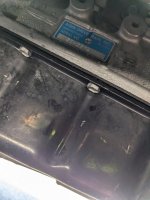
The transmission serial number is on a blue stamped metal tag on the side of the transmission itself. It’ll be a six character serial number like “2B-1234”. Since your truck received a full replacement, I would really appreciate it if you could get the serial off of the new transmission. I’m sure your old transmission is long gone now and that’s ok. The tag says “Aisin Drivetrain” and looks like this:


neutroniens
Member
- Messages
- 49
- Reaction score
- 65
- Points
- 18
TSB parts kit installed 5-16-2023 transmission has deeper issues. Now waiting on new replacement transmission.Okay let us know what they’re able to tell you. Hopefully they have a grasp on things. You are the 182nd truck I’ve added to the spreadsheet since 1/10/23. You’re on there as of now. Please keep me updated as you are able. I appreciate your info and I hope this goes smoothly and quickly for you.
Thanks for the update. You’re not the first one to have an unsuccessful TSB repair. You’re better off with a whole new complete transmission anyway. It should be a 2023 manufactured unit. When you get it back, check the serial number on the new one. It should start with a “3”. My guess would be “3D” or “3E”TSB parts kit installed 5-16-2023 transmission has deeper issues. Now waiting on new replacement transmission.
Glad I found this thread. Owned my truck a week and mine failed at 996 miles, towing a light trailer. 2022 3500 HO. Not sure on the build date, I know it got to the dealers lot in December of 22.
The dealer is currently trying to buy my truck back and put me in a 2023, but they don’t have the same trim level.
The dealer is currently trying to buy my truck back and put me in a 2023, but they don’t have the same trim level.
did they confirm it’s the K1 snap ring?
I can get you on the spreadsheet, just need some info on your truck:
1. Date you ordered the truck (if applicable)
2. Date of manufacture (See sticker on driver door for "date of manufacture (Build date))
3. Date you purchased the truck
4. Mileage on odometer at the time of failure
5. Serial Number of failed transmission (see blue stamped metal tag on side of the transmission. It will be something like "2H-2345"
6. Serial Number of replacement transmission (if applicable)
7. Were you towing at the time of failure?
8. Did 1st through 4th gear work?
9. Did reverse work?
10. What date did the transmission fail?
11. When was the truck returned to you after repair?
12. Did your dealer replace the transmission with a new unit or was the failed transmission repaired with parts?
I can get you on the spreadsheet, just need some info on your truck:
1. Date you ordered the truck (if applicable)
2. Date of manufacture (See sticker on driver door for "date of manufacture (Build date))
3. Date you purchased the truck
4. Mileage on odometer at the time of failure
5. Serial Number of failed transmission (see blue stamped metal tag on side of the transmission. It will be something like "2H-2345"
6. Serial Number of replacement transmission (if applicable)
7. Were you towing at the time of failure?
8. Did 1st through 4th gear work?
9. Did reverse work?
10. What date did the transmission fail?
11. When was the truck returned to you after repair?
12. Did your dealer replace the transmission with a new unit or was the failed transmission repaired with parts?
I should be near the dealer today or tomorrow and will grab the rest of the info for you.did they confirm it’s the K1 snap ring?
I can get you on the spreadsheet, just need some info on your truck:
1. Date you ordered the truck (if applicable)
2. Date of manufacture (See sticker on driver door for "date of manufacture (Build date))
3. Date you purchased the truck
4. Mileage on odometer at the time of failure
5. Serial Number of failed transmission (see blue stamped metal tag on side of the transmission. It will be something like "2H-2345"
6. Serial Number of replacement transmission (if applicable)
7. Were you towing at the time of failure?
8. Did 1st through 4th gear work?
9. Did reverse work?
10. What date did the transmission fail?
11. When was the truck returned to you after repair?
12. Did your dealer replace the transmission with a new unit or was the failed transmission repaired with parts?
1. Date you ordered the truck (if applicable) N/A
2. Date of manufacture (See sticker on driver door for "date of manufacture (Build date)) Will get this as soon as I can
3. Date you purchased the truck: 5/6/23
4. Mileage on odometer at the time of failure 996
5. Serial Number of failed transmission (see blue stamped metal tag on side of the transmission. It will be something like "2H-2345": Will get this info as soon as I can
6. Serial Number of replacement transmission (if applicable) N/A
7. Were you towing at the time of failure? Yes
8. Did 1st through 4th gear work? No
9. Did reverse work? Yes
10. What date did the transmission fail? 5/18/23
11. When was the truck returned to you after repair?
12. Did your dealer replace the transmission with a new unit or was the failed transmission repaired with parts?
Has anyone been able to get RAM to preemptively replace the problem - or is everyone just sitting on a potential disaster. I just purchased my 2022, upgraded from a 2019 2500 because I purchased a new and larger RV and was up against and over payload. Now I feel like I am supposed to travel this summer with a truck that is less safe than the one I just traded in. Sorry for venting, but are there options?
Sent from my iPad using Tapatalk
Sent from my iPad using Tapatalk
From my understanding of the situation I believe your dealer should have checked your trucks VIN against the DealerCONNECT database to see if RSU #23-065 applies prior to selling it to you.Has anyone been able to get RAM to preemptively replace the problem - or is everyone just sitting on a potential disaster. I just purchased my 2022, upgraded from a 2019 2500 because I purchased a new and larger RV and was up against and over payload. Now I feel like I am supposed to travel this summer with a truck that is less safe than the one I just traded in. Sorry for venting, but are there options?
Sent from my iPad using Tapatalk
RSU is “rapid service update” which, from what I gather, is basically the same as a TSB (Technical Service Bulletin) only it applies primarily to unsold inventory. It would basically outline immediate action items that need to be addressed prior to selling a vehicle.
From what I’ve gathered, Ram started to upload unsold inventory VIN numbers to their DealerCONNECT software as early as March 2023. The VIN numbers they uploaded were supposed to highlight unsold trucks that had the potential for the K1 snap ring failure. Supposedly dealers were urged to check their unsold 2022 inventory against the numbers uploaded in the dealer network and identify if they had trucks on the lot with the flawed parts. Ram wanted them to apply TSB 21-002-23 (the one responsible for instructing technicians how to diagnose and repair an Aisin with the defective snap ring failure) to these trucks preemptively in an effort to have them reliable for a new customer.
I’ve given this advice to three recent potential customers, all of whom were looking at 2022 3500’s with Aisin transmissions. Two out of the three had success in getting the dealer to identify the VIN as effected by the RSU and the dealer subsequently ordered the parts to replace the defective ones prior to selling. Ive also seen a few recent advertisements from ram dealers selling leftover 2022’s that publicized in their advertisements: “Service required for snap ring issue has been completed”. So dealers, or at least some of them, are aware that this repair campaign exists and are effectively carrying out the repairs.
I would recommend having a conversation with your dealer. Hopefully they did this and the truck either was repaired before it was sold to you (if the VIN number was identified as applicable), or the trucks VIN didn’t register as being one of the ones affected.
What I can’t speak to is the totality of Ram’s information regarding this issue. I have no idea how accurate their VIN number assessment is. I can’t say for certain whether or not they have been able to identify every single affected unsold truck by VIN, or if they’re using “build windows” as a basis for which VINs get flagged for having this issue. It’s probably best to start by discussing this with your selling dealer and see if they did indeed follow TSB 21-002-23 and RSU 23-065. Hopefully they checked it, identified whether or not it had the potential for failure, and handled it accordingly prior to selling it to you.
I’ve had several people try to have their VIN’s scanned through the database for this issue and have only had one or two successful “hits”. It seems like for the vast majority, they come back as not applicable. This may be due to the fact the RSU is primarily targeting unsold trucks.
In terms of “sitting on a potential disaster”…..that’s pretty much how it has been since I started following and documenting this issue five months ago. “Fix as they fail” has been the moto from the start, with no sign of a recall campaign in sight. The RSU has been as close as we’ve gotten to any sort of proactive repair approach and it would seem it’s primarily targeting unsold inventory. The rest of us who already signed on the dotted line are stuck wondering and waiting. I can’t even give you specifics on what percentage of the total number of trucks are failing. All I have is the data on the ones I’ve collected on the spreadsheet. At the very least it helps.
Out of curiosity do you happen to know the date of manufacture for your 2022 truck? You can find it on the white sticker applied to the edge of your drivers door.
This is an example of a dealer who is obviously aware of the issue and is taking appropriate measures to address them prior to sale:

It was manufactured 7/22. The dealer is not someone I am trusting at the moment as, without telling me, they fixed the listed recall (23V-060) on the day I took it back to them with a tire issue (two days after I took it off the lot). That all occurred on 4/24. They never talked to me about the transmission issue nor the electric short issue though both were clearly known issues when they sold it to me. I will take your advice and try and see if I can get some answers from them.
Sent from my iPad using Tapatalk
Sent from my iPad using Tapatalk
No problem, let us all know what you find out after speaking with them. If they sold you the truck and didn’t scan the truck to see if the RSU applies, there’s a chance if they run it now it may still flag. Can’t say for sure though.
Happy to help.And thank you for your efforts and teaching…I sure appreciate your work on this.
Sent from my iPad using Tapatalk
Also, I sent you a PM. Please respond at your convenience. Thanks!