What's new
Ram Heavy Duty Forum

Register a free account today to become a member! Once signed in, you'll be able to participate on this site by adding your own topics and posts, as well as connect with other members through your own private inbox!

2019 Ram 2500 Starting Problem

rac54

New Member
Messages
3
Reaction score
3
Points
3
2019 Ram 2500 Bighorn Cummins
I need some guidance here please. Everything was normal when I parked my truck last Friday afternoon. The next day, Saturday afternoon, the truck would not start. The truck engine will not turn over. The batteries are reading 12.4 volts. I verified adequate voltage at the starter motor. I assumed the starter was bad & installed a new one. It still won't turn over. I confirmed manually that the engine & all pulleys rotate freely. During the start cycle it has a audible click from the starter & you can see a very slight momentary movement of the engine but, it will not turn over to start.

Am I missing something that would prevent the starter from running & cranking the engine?

I will add that a few weeks ago I checked the batteries before leaving on a trip & all appeared normal. After the truck wouldn't start I obviously checked the batteries again & discovered the drivers side negative terminal had developed excessive corrosion (which has been cleaned).

Any suggestions are appreciated!
 
If those are original batteries they are done. There’s at least 3 posts a month on here with your issue and it’s always batteries going tits up.
With the cold weather coming I expect this number to go up exponentially. ;)
 
Measure the battery voltage during the crank attempt. If it stays above 10.5 volts it’s not the batteries.
You can measure the voltage at points along the wire to the starter during the crank attempt too. Where the voltage goes below 3-4 is where the poor connection is.
 
Dead battery (s). You are right at the end of life for them on a 2019. Voltage doesn't mean much, need to load test them but I guarantee it's a bad battery or 2
 
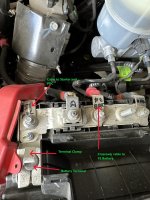
If you measure the battery VOLTAGE during the crank attempt, you are doing a load test. Start with the starter cable terminal. If that's low do the clamp tab. If that's low do the battery terminal. If that's low you have a bad battery or terminal. If the battery terminal voltage is not low but the clamp tab is or the starter cable is, you have a poor battery connection.
You can work the same process with the #2 battery.
You can use your voltmeter probes to find the bad connection. With the meter set to volts, put the red lead on the battery terminal and the black lead on the starter cable. Try and crank. if the meter reads more than about .2-.3 volts, you have a bad connection. Isolate it further by measuring across the connection/s between the meter probes. Try and crank again.

1 battery terminals a.jpg2 battery terminals a.jpg
 
If you measure the battery VOLTAGE during the crank attempt, you are doing a load test. Start with the starter cable terminal. If that's low do the clamp tab. If that's low do the battery terminal. If that's low you have a bad battery or terminal. If the battery terminal voltage is not low but the clamp tab is or the starter cable is, you have a poor battery connection.
You can work the same process with the #2 battery.
You can use your voltmeter probes to find the bad connection. With the meter set to volts, put the red lead on the battery terminal and the black lead on the starter cable. Try and crank. if the meter reads more than about .2-.3 volts, you have a bad connection. Isolate it further by measuring across the connection/s between the meter probes. Try and crank again.

View attachment 63703View attachment 63704
Thank you so much for providing the detailed instructions. We'll let you know what we find tonight.
 
The only way voltage is going to tell you anything about load on a battery is how quickly/how much it drops during a good load. If the starter isn't turning its going to be hard to replicate enough load on a dual battery setup like that without the appropriate load like a diesel trying to start. You can have 12.7 volts on a circuit with next to no amperage or load carrying capability.

OP the first step is removing the batteries and having them charged and load tested.

If that checks out then go buy a 10 dollar test light from Harbor Freight and check for power at the starter. You want B+ constantly on the main lug of the starter and B+ on the solenoid wire only when cranking. If both of those things light up the test light then the starter has what it needs to work and you can condemn it (short of a large voltage drop on the main starter cable. doubtful here...)

Since you've already replaced the starter and batteries are a known issue, my bet is the batteries.
 
The only way voltage is going to tell you anything about load on a battery is how quickly/how much it drops during a good load. If the starter isn't turning its going to be hard to replicate enough load on a dual battery setup like that without the appropriate load like a diesel trying to start. You can have 12.7 volts on a circuit with next to no amperage or load carrying capability.

OP the first step is removing the batteries and having them charged and load tested.

If that checks out then go buy a 10 dollar test light from Harbor Freight and check for power at the starter. You want B+ constantly on the main lug of the starter and B+ on the solenoid wire only when cranking. If both of those things light up the test light then the starter has what it needs to work and you can condemn it (short of a large voltage drop on the main starter cable. doubtful here...)

Since you've already replaced the starter and batteries are a known issue, my bet is the batteries.
With a good start circuit and a functional starter my battery voltage drops from12.7 to 10.5 during a normal start. Without measuring the actual current, lets say it's 100 amps(which I believe is actually higher than that). So a 100 amp draw is lowering the voltage 2 volts. If the starter stalls due to too much physical resistance or binding the amperage will go even higher. That's what happens when you physically stall an electric motor..
So you're saying that the OP can't observe a voltage drop during a crank if the engine isn't cranking? Nonsense.
The OP says his batteries show 12.4 volts. Pretty good for 4 year old batteries. If he engages the starter and the voltage only drops to 11.5 volts and no crank, there is a circuit problem, poor connection or bad starter, and the voltage downstream of the poor connection will be practically nothing. If it goes to 7 volts and no crank, the batteries are weak or you have a stalled starter, either from mechanical lock or bad starter.
Without knowing what his actual voltage drop is, you can't tell at this point.
 
You’re way over complicating things and jumping to conclusions.

Yes - obviously you will see a voltage drop from a working as well as a non working starting circuit. But it’s a pointless measurement because there are too many variables involved. What is the typical drop of a healthy starter cranking the engine? What about a starter that sends the bendix out but won’t turn? What about a starter that the solenoid energizes but nothing else happens? How about a seized engine? Too many variables and without knowing exactly how much load you’re putting on the battery this kind of testing is pointless. Why do you think most carbon pile testers tell you to first charge the battery in question and then load it to 1/2 it’s rated CCA? A predictable load with accurate data.

Test light is a much more useful tool in preliminary diagnosis. The multimeter should stay in the tool cart until everything else has been exhausted and things like voltage drop across bad connections is expected. Very unlikely on a new truck…

Edit: I forgot to add that in the instance of testing a batter with a predicted load like a carbon pile then yes watching the voltage level of the batter during the test is valuable. If it maintains then the battery is likely fine. If it plummets it isnt
 
Last edited:
You’re way over complicating things and jumping to conclusions.

Yes - obviously you will see a voltage drop from a working as well as a non working starting circuit. But it’s a pointless measurement because there are too many variables involved. What is the typical drop of a healthy starter cranking the engine? What about a starter that sends the bendix out but won’t turn? What about a starter that the solenoid energizes but nothing else happens? How about a seized engine? Too many variables and without knowing exactly how much load you’re putting on the battery this kind of testing is pointless. Why do you think most carbon pile testers tell you to first charge the battery in question and then load it to 1/2 it’s rated CCA? A predictable load with accurate data.

Test light is a much more useful tool in preliminary diagnosis. The multimeter should stay in the tool cart until everything else has been exhausted and things like voltage drop across bad connections is expected. Very unlikely on a new truck…

Edit: I forgot to add that in the instance of testing a batter with a predicted load like a carbon pile then yes watching the voltage level of the batter during the test is valuable. If it maintains then the battery is likely fine. If it plummets it isnt
I’m not the one that said change the batteries or even pull them without doing some simple testing with a voltmeter, if you know how to use one.
So no jumping to conclusions here.
I guess we’ll see.
 
Thanks so much to everyone for your comments. We ended up installing 2 known good batteries and that solved my problem. I've learned a lot about this dual battery set-up the last few days.
 
Thanks so much to everyone for your comments. We ended up installing 2 known good batteries and that solved my problem. I've learned a lot about this dual battery set-up the last few days.
Glad you got it resolved
 
2019 Ram 2500 Bighorn Cummins
I need some guidance here please. Everything was normal when I parked my truck last Friday afternoon. The next day, Saturday afternoon, the truck would not start. The truck engine will not turn over. The batteries are reading 12.4 volts. I verified adequate voltage at the starter motor. I assumed the starter was bad & installed a new one. It still won't turn over. I confirmed manually that the engine & all pulleys rotate freely. During the start cycle it has a audible click from the starter & you can see a very slight momentary movement of the engine but, it will not turn over to start.

Am I missing something that would prevent the starter from running & cranking the engine?

I will add that a few weeks ago I checked the batteries before leaving on a trip & all appeared normal. After the truck wouldn't start I obviously checked the batteries again & discovered the drivers side negative terminal had developed excessive corrosion (which has been cleaned).

Any suggestions are appreciated!
Was this issue accompanied by a flashing check engine light?

Currently having a very similar issue with a truck of comparable age.
 
2019 Ram 2500 Bighorn Cummins
I need some guidance here please. Everything was normal when I parked my truck last Friday afternoon. The next day, Saturday afternoon, the truck would not start. The truck engine will not turn over. The batteries are reading 12.4 volts. I verified adequate voltage at the starter motor. I assumed the starter was bad & installed a new one. It still won't turn over. I confirmed manually that the engine & all pulleys rotate freely. During the start cycle it has a audible click from the starter & you can see a very slight momentary movement of the engine but, it will not turn over to start.

Am I missing something that would prevent the starter from running & cranking the engine?

I will add that a few weeks ago I checked the batteries before leaving on a trip & all appeared normal. After the truck wouldn't start I obviously checked the batteries again & discovered the drivers side negative terminal had developed excessive corrosion (which has been cleaned).

Any suggestions are appreciated!
Were you just getting click noise when pressing the start button? i'm having the same issue, just a click and nothing else?
 
Were you just getting click noise when pressing the start button? i'm having the same issue, just a click and nothing else?
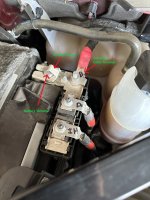
Attached is a picture of the bus bar on the drivers battery.
Check the voltage on the strap labeled ST, when you try to start it. That will be the voltage being applied to the starter. If that voltage is below about 10 volts, you have a bad battery or a poor connection.
To verify the connection at the battery + post, measure the voltage with the meter probe right on the battery post (lower left corner of the picture)again while you try to start it.
Compare to the voltage on the strap. If it’s more than 1 volt higher on the post, you have a poor connection between the post and the strap.
The 3rd strap from the left is the connection to the passenger battery. You can compare it too to see how that circuit and battery are.
Lastly you can measure right at the + post on the passenger battery, and compare to the rest. If you find a voltage that is more than about 1-1.5 volts higher you have found a poor connection.
 

Attachments

  • 1 battery terminals.jpg
    1 battery terminals.jpg
    793.1 KB · Views: 19
Last edited:
Attached is a picture of the bus bar on the drivers battery.
Check the voltage on the strap labeled ST, when you try to start it. That will be the voltage being applied to the starter. If that voltage is below about 10 volts, you have a bad battery or a poor connection.
To verify the connection at the battery + post, measure the voltage with the meter probe right on the battery post (lower left corner of the picture).
Compare to the voltage on the strap. If it’s more than 1 volt higher on the post, you have a poor connection between the post and the strap.
I appreciate the info. Since i messaged earlier, i took my batteries to get tested and there was zero charge, he told me if the batteries charge, it could possibly be the alternator. I drove the truck 3 days ago with no issue and now i'm here. My truck is a 2019 with only 25k miles.
 
Attached is a picture of the bus bar on the drivers battery.
Check the voltage on the strap labeled ST, when you try to start it. That will be the voltage being applied to the starter. If that voltage is below about 10 volts, you have a bad battery or a poor connection.
To verify the connection at the battery + post, measure the voltage with the meter probe right on the battery post (lower left corner of the picture)again while you try to start it.
Compare to the voltage on the strap. If it’s more than 1 volt higher on the post, you have a poor connection between the post and the strap.
The 3rd strap from the left is the connection to the passenger battery. You can compare it too to see how that circuit and battery are.
Just to add on, it measured 10.5 on the ST and on the battery post prior to removing the batteries.
 
Just to add on, it measured 10.5 on the ST and on the battery post prior to removing the batteries.
10.5 means you have bad batteries at least one has a dead cell typically. In general you should not have less than 11V on a 12V battery without load if its lower than 11V it usually wont come back from that. Being a 2019 with only 25k miles it likely sits a lot which is not good for batteries id reccomend a battery tender
 
Back
Top