What's new
Ram Heavy Duty Forum

Register a free account today to become a member! Once signed in, you'll be able to participate on this site by adding your own topics and posts, as well as connect with other members through your own private inbox!

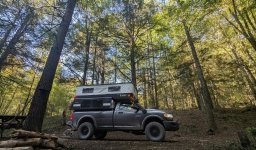
2021 RAM 3500 Tradesman | AEV Prospector | FWC Grandby

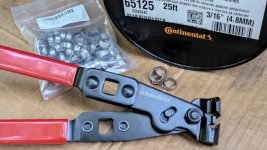
You may recognize these Schwaben Ear-Type Clamp Pliers, designed for use with Oetiker clamps in automotive and industrial applications. Oetiker clamps provide uniform compression, compensate for component tolerances, and enable fast, reliable installation. To select the correct clamp diameter, install the hose onto the fitting and measure the hose's outer diameter (OD). The measured OD should be slightly larger than the average value of the clamp’s diameter range. A clamp is adequately closed when the ear width is reduced by at least 40% using the appropriate closing force. For my project, I needed only a foot of fuel hose but opted for a 25-foot roll of Continental 3/16" ID Fuel Line/Emission Control Hose (SAE 30R7). This hose, constructed with Hysunite and Chemigum, is rated for temperatures up to 250°F and offers versatility for multiple applications.
RC 25-343.jpg

Ear-Type Clamp Pliers function by crimping Oetiker ear clamps to create a secure, leak-proof seal on hoses or tubes. The user positions the clamp around the hose and fitting, then places the pliers’ jaws over the clamp’s ear. Squeezing the handles applies precise force, deforming the ear to reduce the clamp’s diameter and lock it in place. Engineered for uniform compression, these pliers ensure a reliable 360° seal. Their jaw configurations accommodate various clamp sizes and are designed for use in confined spaces.

RC 25-344.jpg

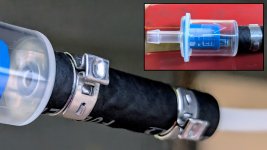
This image illustrates the transition from an accessory to the 5mm OD, 2mm ID fuel line used by Eberspächer, Wallas, and Webasto diesel heaters. Here, I connect a Hengst Filtration diesel fuel filter to the Continental 3/16" ID hose, secured with two Oetiker clamps at each end for a robust, leak-free connection.
RC 25-345.jpg

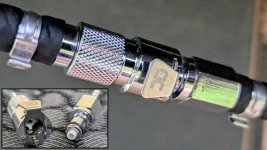
I also incorporated a premium quick-disconnect for the diesel fuel line to allow easy removal of my camper without fully disconnecting the fuel line from the truck’s fuel tank or the diesel heater inside the camper. I selected a Goodridge chrome-plated brass quick-disconnect for $100 (shipped) and am eager to evaluate its performance. The Continental hose and Oetiker clamps bridge the disconnect to the standard fuel line, ensuring a secure connection.
RC 25-346.jpg

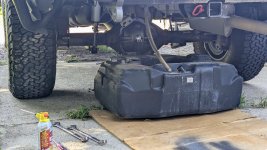
Removing the 30-gallon TITAN auxiliary fuel tank from beneath my truck was a daunting task, and reinstalling it after adding wiring, a vent hose, a rollover hose, a primary fill hose, and trimming everything to length was equally challenging. I recall the initial tank installation, which was difficult even with a friend’s help. This time, I completed the task alone, making it even more demanding.
RC 25-347.jpg

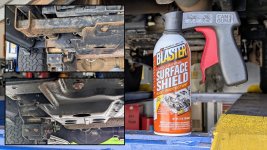
B’laster Surface Shield provides robust protection for a truck’s undercarriage with its lanolin-based formula, effectively preventing rust and corrosion in harsh environments, such as salt-heavy roads. Its moisture-wicking properties form a durable barrier against water and contaminants, offering protection for up to two years. Compared to alternatives like Fluid Film or Woolwax, Surface Shield applies cleaner, is less messy, and adheres better in high-wash areas while remaining safe for rubber, plastics, and electrical components. Its low viscosity ensures excellent creep into crevices for comprehensive coverage, and its non-drying, tacky film resists wash-off, making it ideal for rugged, off-road conditions. I regret not applying this product years ago. In March, I ordered six cans of Surface Shield and two Can-Gun1 spray handles, which provided ample product and performed exceptionally well during application.
RC 25-348.jpg

Innovative projects often present unique challenges requiring creative solutions. To mount a universal fuel pick-up tube with ears and male M18x1.0mm threads into a double-tapped tank bushing with 1" NPT male and 1/2" NPT female threads, I rejected the simplistic approach of plugging the 1/2" NPT female hole and drilling a new one elsewhere. Instead, I purchased a 1" NPT brass hex head plug, a 17mm drill bit, and an M18x1.0mm tap. I drilled and tapped a hole in the brass hex head, removed the silver solder, knocked off the mounting ears, cleaned the threads, and sealed the modified components with yellow gas-line PTFE tape. This solution ensured a precise, professional outcome.
RC 25-349.jpg

I’m an ordinary guy with a few close friends, including one I worked with at Siemens VDO and later at NASA Langley Research Center. He’s the finest mechanical engineer I’ve ever known, currently serving as a Senior SME Principal Mechanical Engineer at NASA Langley. With a shared sense of precision, he invited me to his shop to drill, tap, and trim the fuel pick-up for my diesel heater. While there, he showed me his special cutting oil, a can he’s owned since he was 16, working in a small engine repair shop to save for university. An older colleague gifted him the can and wished him well - a gesture from half a century ago. This story reminds us that a small act of generosity can profoundly impact someone’s life.
RC 25-350.jpg

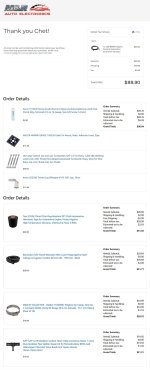
Here, I continue documenting expenses for historical reference.
RC 25-351.jpg

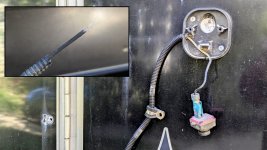
The fuel pick-up (tank fitting) is now installed, and I expect it to perform reliably. The fuel pump in a Wallas Nordic DT diesel heater, a low-pressure electric pump designed for compact marine or RV heating systems, faces significant challenges when drawing diesel through a hose with an inner diameter (ID) greater than 2mm to a height of six feet. The pump’s limited suction capacity, optimized for 2mm ID hoses and shorter lift heights, struggles with the increased volume and flow resistance of a larger hose. A hose with a >2mm ID demands greater vacuum pressure to overcome the fuel column’s weight, which increases with both height (six feet creates substantial static head pressure) and the hose’s larger internal volume. Additionally, the pump risks cavitation or air ingress due to insufficient priming or sealing, reducing efficiency and potentially stalling. These factors - insufficient vacuum strength, increased fuel weight, and potential air ingress - make consistent fuel flow difficult. This is why I invested extra effort to install a fuel pick-up with a 2mm ID. The inset picture compares the original fuel pick-up to the one I constructed. I hope this solution succeeds, as it operates near the fuel pump’s performance limits. Function is the key...
RC 25-352.jpg
 
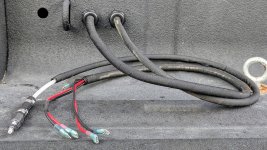
All parallel upgrades and modifications are rapidly converging, nearing a point where the system will become fully operational with remarkable seamlessness. The Sealcon glands in my truck bed now accommodate one diesel fuel line and five electrical wires. The fuel line supplies diesel to the Wallas Nordic DT diesel cooktop/heater. Three wires connect to the fuel level sensor, while the remaining two are 12-volt signal wires: one activates the air compressor from the cab, and the other controls the Victron Energy Orion XS 12/12-50 DC-DC converter, also from the cab.
RC 25-353.jpg

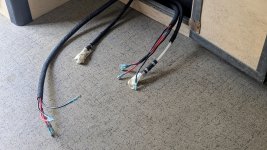
All connections from the camper are positioned adjacent to their corresponding connections from the truck, as viewed from inside the camper, which has been remounted. I intentionally left the connections slightly longer to avoid the need to remove the camper and extend lines later. Trimming a few inches once everything is in place is simpler than adding length. My objective was to ensure all connections are easily accessible through one of the turnbuckle access doors in the Four Wheel Camper.
RC 25-354.jpg

While removing my camper approximately one month ago, I inadvertently failed to disconnect the Low-Voltage Differential Signaling (LVDS) cable. This digital serial interface supports high-resolution video over a single shielded coaxial cable, typically equipped with a FAKRA connector, offering superior signal integrity, reduced noise, and higher-quality imaging compared to older analog composite systems. This oversight resulted in a $90 repair cost but, fortunately, required only a few hours to rectify.
RC 25-355.jpg

With the camper remounted and the auxiliary diesel fuel system fully operational, I conducted a shakedown run late in the evening, transferring ten gallons of diesel into the 30-gallon auxiliary tank mounted under my gasoline-powered truck. At the Mobil station, I approached the counter, paid $40 in cash, and requested diesel fuel for pump nine. When purchasing diesel south of the Mason Dixon it's important that you pronounce "diesel" properly by drawling it out with a rugged, low tone, emphasizing the grit in your voice. Say "DEE-zul": Break it into two syllables. The first part, "DEE," is sharp and slightly elongated, like you’re spitting it out. The second, "zul," is short, gruff, and drops low, almost like a growl. Lean into a Southern twang. Let the "DEE" linger a bit, like "DEEE-zul," but don’t overdo it - keep it tight, not sing-songy. And finally, speak from your chest, not your throat. Add a gravelly edge, like you’ve been chewing tobacco and yelling at cattle all day. Think Clint Eastwood squinting in the sun.
RC 25-356.jpg

"With an anxiety that almost amounted to agony, I collected the instruments of life around me, that I might infuse a spark of being into the lifeless thing that lay at my feet. It’s alive! It’s alive!" ~ Frankenstein (1931)

The fuel level registered at 35%, precisely as expected, and the Wallas controls and heater are fully operational. All systems have been verified and are functioning correctly, confirming readiness for full operation.
RC 25-357.jpg

My Mountain Hardwear sleeping bags, now fifteen years old, have exceeded their expected lifespan but continue to perform reliably. The three-season bag sustained another tear, which I repaired using Tenacious Tape repair tape, a product I’ve had in my inventory for approximately 10–12 years. The repair was successful, restoring the bag’s functionality.
RC 25-358.jpg

My AEV Prospector with Four Wheel Camper, fully loaded, weighs 8,960. GVWR is 11,000; original payload was 4,529. AEV Prospector upgrade added 618 pounds, Four Wheel Camper and accessories added 1,871. Actual payload is 2,489 so I am using 55% of available payload (2,489/4,529). Perfect.
RC 25-359.jpg

Documentation of expenses for this phase of upgrades and repairs.
RC 25-360.jpg

As a traditional Catholic devoted to the Latin Mass, I discern the hand of Divine Providence in the feather that gently settled on my windshield moments before embarking on a long and treacherous journey alone. This delicate sign, perhaps from my guardian angel or a beloved soul now in heaven, speaks of God’s tender protection. In the sacred communion of saints, I am reminded that I am never truly alone, strengthened by the intercession of the Immaculate Heart of Mary and the ever-watchful love of the Almighty, guiding me safely on my path.
RC 25-361.jpg

And the road becomes my bride...rover, wanderer, nomad, vagabond. Call me what you will.
RC 25-362.jpg
 
Mid-Atlantic Backcountry Discovery Route

Part One of Three

The Mid-Atlantic Backcountry Discovery Route (MABDR) is a thrilling 1,080-mile off-highway adventure crafted by the nonprofit Backcountry Discovery Routes organization specifically for dual-sport and adventure motorcycles, weaving through the remote, historic, and scenic landscapes of Virginia, West Virginia, Maryland, and Pennsylvania. Beginning in the charming town of Damascus, Virginia, near the Appalachian Trail, the route kicks off with winding dirt and gravel paths through the George Washington and Jefferson National Forests, progressing northward via a balanced mix of challenging backcountry trails, rural paved roads, and technical sections like the twisty Tub Run Road, all while offering sweeping mountain vistas, dense hardwood forests, rolling farmlands, Amish communities, and historic battlefields. Drivers encounter diverse terrain that demands attention to ruts, washouts, and seasonal changes, with opportunities to explore cultural landmarks and even recharge at cozy lodgings along the way, ultimately delivering an immersive 9-12 day journey into the natural beauty and heritage of the Appalachian region.
RC 25-363.jpg

Following months of modifications and upgrades to my AEV Prospector and FWC pop-up camper, it felt great to be back out in the wild. My adventurous soul is like a restless flame, forever flickering toward the horizon where the known meets the unknown. It is not merely a desire for movement but a deep, unshakable yearning to uncover what lies beyond the next ridge, to taste the air of primitive lands, and to feel the pulse of the world in its rawest form.
RC 25-364.jpg

Hurricane Helene, which struck in late September 2024, caused catastrophic flooding and destruction across western North Carolina, eastern Tennessee, and southwestern Virginia, damaging infrastructure like roads and bridges. The first section of the MABDR dances between North Carolina, Tennessee, and Virginia.
RC 25-365.jpg

While exploring sections two and three of the MABDR you will find yourself in the rugged Appalachian terrain of Virginia and West Virginia, weaving predominantly through the majestic George Washington and Jefferson National Forests (GWJNF). Originally named the Shenandoah National Forest and later renamed for America's first president, the GWJNF expanded with the addition of the Jefferson National Forest preserving over 1.8 million acres wilderness composed of sweeping vistas of ancient hardwoods, wildflower meadows, and historic mountain passes that once served as a backdrop for Revolutionary War and War of Northern Aggression.
RC 25-366.jpg

Overland travel does not necessitate continuous dirt or gravel roads, as paved backcountry or farm roads often interrupt these rugged stretches. In today’s age, maintaining an unbroken journey of over a thousand miles solely on dirt is nearly impossible due to modern infrastructure. These paved connections, weaving through rural landscapes, allow travelers to sustain the spirit of overland exploration while navigating a mix of surfaces with the spirit of adventure and self-sufficiency.
RC 25-367.jpg

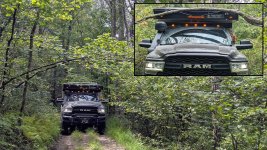
Overland travel often involves equipping campers with solar panels to harness the sun's energy, but properly mounting them four inches above the roof for optimal cooling and solar efficiency presents challenges. This elevated setup enhances airflow maximizing power output, which is critical for off-grid adventures. However, it increases the risk of snagging low-hanging branches or fallen trees on rugged trails, potentially slowing progress or causing damage. Despite these obstacles, the improved solar efficiency typically outweighs the risks, as reliable power is essential for extended overland journeys, making the raised mounting a worthwhile trade-off.
RC 25-368.jpg

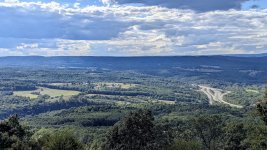
Just down the road from Mountain Lake Lodge in Virginia, where the iconic 1987 movie Dirty Dancing was filmed, a stunning vista reveals the Blue Ridge Mountains in their splendor. The rolling peaks, draped in a misty haze, stretch across the horizon, their blue tint stemming from isoprene released by the dense forests, scattering sunlight to create the signature glow. This serene scene, with lush greenery in the foreground and the majestic, blue-tinged ridges in the distance, offers a tranquil escape steeped in natural beauty.
RC 25-369.jpg

In Warm Springs, Virginia, the historic Warm Springs Pools beckon with their mineral-rich hot and warm springs, a 19th-century haven I plan to visit again someday for a soothing soak. As I travel north, I enter the National Radio Quiet Zone, created in the 1950s to protect the Green Bank Observatory’s radio telescopes and the highly secretive naval listening post at Sugar Grove, whose covert intelligence-gathering mission - rumored to involve a sprawling underground city beneath the base - sparks whispers of hidden operations. This 13,000 square-mile zone disrupts cellular service, leaving travelers without calls or data, though passive GPS navigation remains mostly unaffected.
RC 25-370.jpg

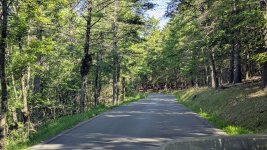
Tub Run Road on the MABDR meanders through a lush, healthy forest where vibrant green trees create a tranquil canopy overhead. Sunlight weaves through the branches, casting soft light on the path below. The road’s continuous twists and turns, particularly along the narrow shelf sections, cling tightly to the rugged terrain, offering a thrilling yet serene ride. Each curve reveals a fresh glimpse of the wilderness, blending the excitement of exploration with the calming beauty of dense, untouched nature that feels both timeless and alive.
RC 25-371.jpg

As a traditional Catholic who cherishes the solemnity of the Latin Mass, I often reflect on how we men struggle to consciously embrace the internal challenges that demand risk and danger, our fallen nature pulling us toward the safety of complacency rather than the forge of trials that temper the soul. This mirrors the trepidation one feels when venturing alone into the dark embrace of the forest at night, where shadows whisper uncertainties and the unknown path tests one's resolve - much like choosing to tackle the rugged, optional challenge of Hite Hollow Road on the MABDR, a demanding stretch that beckons the adventurous spirit to confront isolation and peril head-on. Yet, the more we fully surrender ourselves and our lives to Jesus Christ, the more profoundly protected we become, for our time on earth is but a fleeting moment, our sacred chance to redirect our eternal trajectory toward the glory of Heaven. Godspeed Charlie...
RC 25-372.jpg
 
Mid-Atlantic Backcountry Discovery Route

Part Two of Three

The last 75 miles of MABDR Section 3 offer a thrilling mix of rugged terrain and scenic backcountry riding, highlighted by a half-dozen water crossings that must be navigated with care. On average, these crossings are around six inches deep, though they can swell to one foot or more due to weather conditions, making it essential to assess water levels before proceeding. Throughout this section and others on the MABDR, fuel availability is limited, often requiring drivers to plan ahead; however, a reliable option is the Sunoco station in Brandywine, West Virginia, which offers Top Tier gasoline. To bolster my fuel security, I carry two Wehrmacht-Einheitskanisters, each holding 20 liters (5.3 gallons) for a total of 40 liters (10.6 gallons) of emergency fuel for extended stretches without stations.
RC 25-373.jpg

The MABDR winds through the breathtaking Spruce Knob–Seneca Rocks National Recreation Area in West Virginia, offering riders a stunning blend of rugged landscapes and iconic natural landmarks. This section showcases three major areas of interest: (1) Spruce Knob, the highest point in West Virginia at 4,863 feet, provides panoramic views from its observation tower, revealing rolling Appalachian ridges and serene valleys, perfect for a scenic pause. (2) Seneca Rocks, a dramatic 900-foot-tall Tuscarora sandstone formation, towers over the North Fork Valley, attracting climbers and sightseers with its jagged profile and nearby visitor center offering historical insights. (3) Smoke Hole Canyon, carved by the South Branch Potomac River, features deep gorges, limestone caves, and lush forests, creating a remote and tranquil setting ideal for exploration. Together, these landmarks make this stretch of the MABDR a highlight for adventure riders seeking natural beauty and geological wonder.
RC 25-374.jpg

Riding through the thick forest on the MABDR, I started seeing single power lines on old poles, a sign that a town was close by. A few miles later, the trees opened up to wide farm fields under a big blue sky, with cattle grazing peacefully, welcoming me back to open country. It felt good to roll out of the wild and into civilization again. Soon, I pulled into Petersburg, West Virginia, a historic town founded in 1745 with some Civil War history. At The Hermitage Inn & Taphouse, I stopped for a solid lunch on their shaded porch where my adventure vehicle caught the eye of everyone sitting outside. The waitress, super friendly and a bit flirty, made the meal even better, and I left her a great tip, though she seemed disappointed I was just passing through on my journey.
RC 25-375.jpg

The MABDR (Section 4) cuts through Green Ridge State Forest (GRSF) after crossing the Potomac River over the Old Town Toll Bridge, a historic low-water wooden bridge built in 1937, connecting Green Spring, West Virginia, to Old Town, Maryland. I’ve crossed this bridge several times over the past seven years, always hearing the wooden boards slap under my tires while taking in the scenic river views. GRSF is Maryland's largest contiguous public land at 49,000 acres, boasting over 80 miles of trails for hiking, biking, and horseback riding; and the Paw Paw Tunnel, a 3,118-foot C&O Canal feat from 1836-1850, boasts nearly six million bricks. I’m considering creating and submitting an alternate hard route through GRSF with 3-5 Town Creek crossings, averaging 1.0-1.5 feet deep, for a tougher challenge. This section of the MABDR offers the Antietam/Harpers Ferry Bypass, which I suggest taking unless you plan to visit Antietam, site of the brutal 1862 War of Northern Aggression battle with 23,000 casualties, and Harpers Ferry, where John Brown’s 1859 raid fueled pre-war tensions; the bypass saves about 17 miles and 30-45 minutes, while the main route is mostly paved through these historic sites.
RC 25-376.jpg

Way down in the blue ridge mountains
Way down where the tall pines grow
Lives my sweetheart of the mountains
She’s my little Georgia rose

RC 25-377.jpg

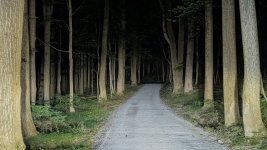
Properly mounted and aimed off-road lights are invaluable for night riding on trails - casting powerful beams that cut through the darkness to reveal the road’s texture and obstacles ahead. My setup, featuring a 30" lightbar, fog lights, and ditch lights, all from Diode Dynamics, delivers high-intensity LED illumination that highlights ruts, rocks, and dips by creating sharp shadows, giving me a clear view of the terrain’s contours and depth. These lights define the trail’s surface helping me adjust speed and steering to tackle the path with confidence.
RC 25-378.jpg

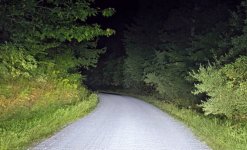
I have always enjoyed cruising on the trail at night - this snapshot captures a smooth, well-graded gravel road bathed in the glow of my light system, revealing a surface so even and free of obstacles that it invites a confident boost in speed. The LED beams cast crisp, shadow-free light across the trail, highlighting its flat, hard-packed texture - no ruts, rocks, or loose gravel to slow me down. This stretch feels like a rare treat on the rugged route, letting me open up the throttle and glide through the cool night air with ease, the illuminated path stretching ahead like a promise of smoother miles.
RC 25-379.jpg

As I crossed from Maryland into Pennsylvania, I entered Michaux State Forest, a vast 85,000-acre woodland that once concealed Camp Michaux, a top-secret WWII POW interrogation camp where over 7,500 German prisoners passed through, including high-level officers from the German U-boat fleet, Afrika Korps, and even the inventor of the V-1 Buzz bomb, whose interrogations aimed to uncover vital secrets about Nazi weaponry and strategies. The camp's remote setting near Washington, D.C., made it ideal for extracting intelligence, and notably, the German POWs proved so trustworthy and respectful that in many U.S. camps, including aspects of operations here, they were permitted supervised visits to nearby towns, fostering a sense of mutual respect amid the wartime tensions. The forest features dramatic elevation shifts from about 600 feet in the valleys to over 2,000 feet on the ridges. Enhancing the trail's camaraderie, local neighbors stock coolers with cold drinks and snacks for BDR riders, much like the support given by "trail angels" to Appalachian Trail hikers who overlap this route.
RC 25-380.jpg

While riding the Trans-Pennsylvania Adventure Trail from north to south in March, I stopped to photograph Long Pine Run Reservoir in Michaux State Forest, a 151-acre lake that was shockingly low at just 45% capacity, its muddy banks exposed due to a dry winter and low rainfall. The scene was a stark contrast to the lush forest around it. Now, months later, on my south-to-north MABDR journey, I passed by again and found the reservoir brimming, several feet above normal levels, thanks to heavy spring rains in April and May, restoring the water supply for Chambersburg and bringing the lake back to life. Seeing such extreme fluctuations makes me wonder if the significant changes in weather patterns over the past decade or so could be tied to weather control efforts, which have historically been explored as a form of warfare - like the US military's Operation Popeye during the Vietnam War, where cloud seeding was used to prolong monsoons and disrupt enemy supply lines.
RC 25-381.jpg

A few days back, I’d texted my buddies Paul and Matt, who’d started the MABDR nearly two weeks ahead of me, and learned they were camped near Pine Grove Furnace State Park, a historic spot dating back to 1764 with its iron furnace and now famous for the Appalachian Trail’s half-gallon ice cream challenge, where hikers celebrate the trail’s midpoint by downing a tub of chocolate or vanilla. Cruising northbound on Ridge Road, I was stunned to see the rugged silhouette of Paul’s RAM HD with a Four Wheel Camper barreling toward me, kicking up a dust cloud that partially hid Matt’s full-size Chevy trailing close behind. I hadn’t shared trails with Paul since we traveled through Arkansas and Oklahoma last year, and it’d been since Overland Expo East 2023 that I’d last seen Matt. We pulled over, swapped stories, and they mentioned upcoming appointments at Main Line Overland in West Chester, Pennsylvania, to tweak their rigs in a few days. Listening to my little Georgia rose as we met on the trail fired me up - what other surprises and thrilling moments awaited on the next leg of this wild ride?
RC 25-382.jpg
 
Last edited:
Mid-Atlantic Backcountry Discovery Route

Part Three of Three

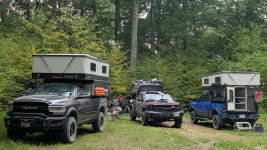
It was early 2023 when I met Paul in the Ocala National Forest, Florida - having just helped an LMP3 team win the Rolex 24 at Daytona, I was eager to escape for some well-deserved rest in the wild. Paul, wintering in Florida, had a Palomino camper that struggled with heavy use, and I joked that his Power Wagon needed a Four Wheel Camper upgrade. Earlier this year, he called, and after some discussion, he purchased a well-appointed FWC Hawk. Now, on the MABDR, we camp side by side in Michaux State Forest, Pennsylvania, our campers nestled in a serene, tree-lined clearing.
RC 25-383.jpg

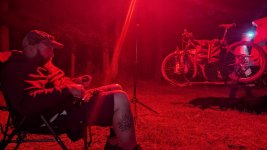
Though 95% of my time in the forest, mountains, or desert is spent alone - I'm now making more of an effort to connect with friends and create lasting memories while adventuring. Solo travel offers the freedom to set my own pace and explore personal interests, fostering self-reliance and reflection, ideal for wild terrain. Yet, it brings risks like no backup, meticulous planning, and occasional loneliness in remote areas. Embracing both solitude and responsibility requires preparation. Tonight, under the red glow of our campsite in the forest, it was nice to sit with Paul and Matt, share a meal, and swap stories and discuss future plans.
RC 25-384.jpg

Under the glow of his headlamp, Matt cooks up a hearty meal on his trusty Chevy Silverado 1500, a versatile truck that's powered his adventures for years despite its payload limits. We met a few years back camping side-by-side at Overland Expo, bonding instantly as military vets. To maximize space, Matt installed a TopperEZLift - an all-electric 12V roof-lift system that transforms a standard fiberglass camper shell into a pop-up sleeping platform, with ventilation through zippered windows, and easy gear access. However, exceeding the payload limit has led to a series of unexpected issues, prompting Matt to hint at seeking a new truck to build in the future.
RC 25-385.jpg

Dust on the trail, especially rugged stretches, poses a significant challenge, forcing groups to spread out over great distances to avoid clouds that obscure visibility and coat everything in a fine layer. Trucks following behind the leader get blanketed in dust, while their air intakes pull in particles for hours; conditions these systems aren’t designed to handle. A snorkel, like the AEV Snorkel Kit, sometimes elevates the air intake above the dust cloud, and pairing it with the Sy-Klone, a self-cleaning circular pre-filter, traps up to 99.9% of debris via centrifugal ejection. Additionally, dust coating solar panels can slash their efficiency reducing output by 5-10%.
RC 25-386.jpg

Stretched out across the road, this beautiful black rattlesnake caught my eye, basking in the sun with its shiny dark scales. I stopped my truck to take a closer look, but as I stepped closer, it slithered off and coiled up tight, tail buzzing loud as it reared into a strike pose, those eyes locking on like I’d crossed a line. I eventually backed off, giving it space to settle, a reminder to watch my step around these wild guardians who’d rather flee than fight. In case you are interested; in Pennsylvania, a handful of small towns still host annual rattlesnake roundups where participants capture timber rattlers for prizes like longest or heaviest snake, before releasing them unharmed back into the wild.
RC 25-387.jpg

The 250-mile stretch of the MABDR through Pennsylvania, from the Maryland border to the New York state line, is, to me, the most beautiful part of this journey, winding through stunning state forests like Tuscarora, Rothrock, and Bald Eagle. Trust me, when you travel north of Interstate 80 in central Pennsylvania, it feels like stepping back in time - quiet trails and untouched woods that take your breath away. Here, our trucks parked in this lush forest campsite, we soak in that timeless peace under a canopy of green and gold.
RC 25-388.jpg

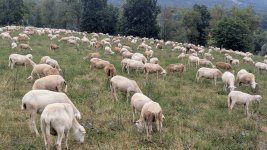
Along the MABDR in Pennsylvania, this farm comes into view with a herd of sheep grazing on the hillside. It’s a quiet nod to the state’s sheep industry, where thousands of family farms raise flocks for lamb, wool, and milk, supporting rural life amid the backcountry. Seeing them graze offered a calm break from the trail.
RC 25-389.jpg

This picture of a rocky incline on the trail brings back a mistake that still sticks with me. Two of us tackled the tougher optional connection, while the third stayed on the primary trail; we agreed via radio to meet where the trails merged again. Sadly, the solo traveler used an outdated GPX file and with our radios’ limited range and no cell service, we lost touch fast on this mountainous stretch. It took nearly an hour to reunite, and I’m still puzzled why we drifted so far. Reflecting on it, we should’ve stopped, stepped out, compared maps, and set a primary meeting point with a time. We also needed a backup spot further along, agreeing to wait there if the first failed, ensuring we’d regroup no matter what.
RC 25-390.jpg

Encountering flat tires while overlanding can transform a scenic trip into a challenge, especially in the wild where help is hard to find. At a high elevation along the trail, Paul wrestled with a stubborn flat that tested his patience, struggling to loosen the OEM lug nuts that seemed to swell under the reduced atmospheric pressure - likely due to the sealed chrome covers reacting to the altitude. He tried the factory 7/8-inch breaker bar, but it wouldn’t fit the nut, and a 15/16-inch socket just spun uselessly. Driving down to a nearby town eased the pressure, and the lug nuts returned to normal size, the chrome covers shrinking as the air thickened - a clear sign of altitude’s quirky effects. Moving forward, I’m swapping my OEM lug nuts for solid aftermarket ones to avoid this headache in the future.
RC 25-391.jpg

The 1,080-mile MABDR was a rugged blend of towering forests, historic passes, and unexpected challenges, with the 250-mile Pennsylvania stretch standing out as my favorite for its timeless beauty north of I-80. Encounters like the black-phase rattlesnake’s warning, a sheep farm’s quiet graze, and dust scattering our group tested our grit, while Matt’s payload-strained Chevy and Paul’s high-elevation flat honed our skills. Reunions with Paul and Matt for meals and stories warmed the solitude, reflecting my solo travel musings, and the trail’s demand for surrender echoed a deeper faith. Camping near this final site under a dusky forest canopy, with gear strewn like memories, felt like a sacred pause; the rustling leaves offered a fitting goodbye as they head home for a month and I move to the next trail, carrying lessons of synced maps and backup plans. Now, boys, don't start your ramblin' 'round...
RC 25-392.jpg
 
Solar System Monthly Validation Report – September 2025

This report presents the system validation and verification results for my solar power system and battery bank after 30 days of off-grid travel. The sole power source consisted of two 250-watt solar panels (Rich Solar) connected to a solar charge controller (SmartSolar MPPT 100/30) and a 200 Ah battery bank (two LiTime 12V 100Ah Group 24 Deep Cycle LiFePO4 batteries). Neither the AC-DC charger (Blue Smart IP22 Charger 12V-30A) nor the DC-DC charger (Orion XS 12/12-50A) was used during this period. The objective was to evaluate the adequacy of the solar system and battery bank capacity to support off-grid travel demands.

System validation and verification for a vehicle’s solar-based electrical system involves confirming that the setup meets design specifications and performs reliably under anticipated operating conditions. Validation ensures the system addresses the intended purpose (e.g., providing consistent power for off-grid requirements), while verification confirms proper integration and functionality of components. This process is critical for my setup, where approximately 65% of operation occurs under forest canopy (reducing solar input) and 35% in semi-open areas with partial sunlight, enabling early identification of inefficiencies.

The histogram below illustrates the maximum state-of-charge (SOC) achieved by the battery bank during each 24-hour cycle. Over the 30-day period, the maximum SOC ranged from 64% to 100%, with 18 days recording values between 96% and 100%. Although I did not log the specific times when SOC reached 100%, this value was frequently attained around midday. These results indicate that the system has sufficient solar capacity for most of September’s operating conditions. It will be valuable to assess performance during December and January, when solar input is typically lower. Overall, I am satisfied with these initial findings, as the system exceeded the design goal of providing sufficient power for seven days using solar energy alone, successfully delivering power for the entire 30-day period.
RC 25-393.jpg

The histogram below illustrates the minimum SOC achieved by the battery bank during each 24-hour cycle. Over the 30-day period, the minimum SOC ranged from 49% to 92%, with 12 days recording values between 79% and 89%. The minimum SOC was typically reached early in the morning, just before sunrise. During the system design, my goal was to ensure the SOC rarely dropped to 25%. The fact that the lowest recorded SOC over the 30-day period was 49%, with all other values higher, demonstrates the system’s robust performance.
RC 25-394.jpg

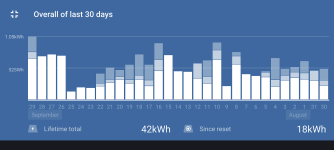
The screenshot below, captured from the Victron Energy solar charge controller, displays the energy collected by the system over the past 30 days. The white portion of each column represents the percentage of time spent in Bulk charge mode, while light blue indicates the Absorption phase and medium blue denotes the Float phase. The data shows that the system reached the Float phase on over half of the days, with a few days only reaching the Absorption phase. This indicates that the system was fully or nearly fully charged for approximately two-thirds of the time. On September 23–25, rainy conditions limited solar input, while on September 26–28, the system operated primarily under forest canopy, absorbing as much energy as possible. By September 29, the system fully recovered and reached the Float phase.
RC 25-395.png

This data is associated with the chart above - note I changed Absorption from 120 minutes to 60 minutes on 18-Sep-25. I attempted to attach the CSV file to this post for further review but the uploaded file does not have an allowed extension.
RC 25-397.jpg

I will periodically measure system performance and publish updates similar to this report. Evaluating the system’s behavior over the coming years will provide valuable insights into its long-term performance and alignment with design expectations. There's no sensation to compare with this - suspended animation, a state of bliss...
RC 25-396.jpg
 
Last edited:
This report presents the system validation and verification results for my solar power system and battery bank after 30 days of off-grid travel. The sole power source consisted of two 250-watt solar panels (Rich Solar) connected to a solar charge controller (SmartSolar MPPT 100/30) and a 200 Ah battery bank (two LiTime 12V 100Ah Group 24 Deep Cycle LiFePO4 batteries). Neither the AC-DC charger (Blue Smart IP22 Charger 12V-30A) nor the DC-DC charger (Orion XS 12/12-50A) was used during this period. The objective was to evaluate the adequacy of the solar system and battery bank capacity to support off-grid travel demands.

System validation and verification for a vehicle’s solar-based electrical system involves confirming that the setup meets design specifications and performs reliably under anticipated operating conditions. Validation ensures the system addresses the intended purpose (e.g., providing consistent power for off-grid requirements), while verification confirms proper integration and functionality of components. This process is critical for my setup, where approximately 65% of operation occurs under forest canopy (reducing solar input) and 35% in semi-open areas with partial sunlight, enabling early identification of inefficiencies.

The histogram below illustrates the maximum state-of-charge (SOC) achieved by the battery bank during each 24-hour cycle. Over the 30-day period, the maximum SOC ranged from 64% to 100%, with 18 days recording values between 96% and 100%. Although I did not log the specific times when SOC reached 100%, this value was frequently attained around midday. These results indicate that the system has sufficient solar capacity for most of September’s operating conditions. It will be valuable to assess performance during December and January, when solar input is typically lower. Overall, I am satisfied with these initial findings, as the system exceeded the design goal of providing sufficient power for seven days using solar energy alone, successfully delivering power for the entire 30-day period.
View attachment 89994

The histogram below illustrates the minimum SOC achieved by the battery bank during each 24-hour cycle. Over the 30-day period, the minimum SOC ranged from 49% to 92%, with 12 days recording values between 79% and 89%. The minimum SOC was typically reached early in the morning, just before sunrise. During the system design, my goal was to ensure the SOC rarely dropped to 25%. The fact that the lowest recorded SOC over the 30-day period was 49%, with all other values higher, demonstrates the system’s robust performance.
View attachment 89995

The screenshot below, captured from the Victron Energy solar charge controller, displays the energy collected by the system over the past 30 days. The white portion of each column represents the percentage of time spent in Bulk charge mode, while light blue indicates the Absorption phase and medium blue denotes the Float phase. The data shows that the system reached the Float phase on over half of the days, with a few days only reaching the Absorption phase. This indicates that the system was fully or nearly fully charged for approximately two-thirds of the time. On September 23–25, rainy conditions limited solar input, while on September 26–28, the system operated primarily under forest canopy, absorbing as much energy as possible. By September 29, the system fully recovered and reached the Float phase.
View attachment 89996

I will periodically measure system performance and publish updates similar to this report. Evaluating the system’s behavior over the coming years will provide valuable insights into its long-term performance and alignment with design expectations. There's no sensation to compare with this - suspended animation, a state of bliss...
View attachment 89997

Looks like wildcat ski area?
 
Another person asked the question below so I wanted to share my answer here also.

Nice rig. I’m curious how you make (made?) your living. Your thread detail makes me think some sort of scientist? My build threads are usually about 15 pages. This one reads like a shop manual with the level of detail!

Thank you for your kind words. I admire your exceptional work in restoring classic Airstreams. As Mekcanix noted, I am a retired military veteran, having served as an Aviation Warfare Operator and Aviation Rescue Swimmer. This role provided a strong foundation, combining the technical aspects of Naval Aviation with the tactical demands of Naval Special Operations. In high school, I struggled academically, graduating last in my class and finding math particularly challenging. However, my military service instilled purpose and a clear set of goals. After nearly two years of rigorous training, during which many peers dropped-on-request, I recognized that perseverance and inner drive are critical to success.

Over the past few decades, I have held roles as a technician, technologist, engineer, and technical project manager at American, German, and Swiss companies. Additionally, as Pacific Northwest yetti mentioned, I worked at NASA Langley Research Center and completed all coursework for an MS in Aeronautics. In engineering and technical fields, providing accurate information is critical to ensuring the safety, reliability, and success of an integrated system. Inaccurate data or assumptions can lead to design flaws, operational failures, or costly rework. Despite my professional background, I consider myself an ordinary individual with a passion for designing, building, and testing complex systems. Below is a summary of key insights for all men:
  • mind
    • continuous learning and intellectual curiosity
    • mental toughness and resilience
    • discipline and prudence
  • body
    • physical exercise as stewardship
    • nutritious diet and hydration
    • adequate rest and recovery
  • soul
    • pursuing sanctity through the Sacraments
    • charity and family leadership
    • moral integrity and spiritual combat
Despite my flaws and imperfections, I strive daily to improve in each of the areas mentioned above.

I will never quit.

RC 25-398.jpg
 
Last edited:
PA Wilds Pennsylvania BDR-X

Part One of Two

After completing the Mid-Atlantic Backcountry Discovery Route and sharing campfires with old friends in the Pennsylvania woods, I was drawn deeper into the Keystone State’s wild heart. Months had passed since I’d tackled a forested loop like this, swapping the open High Plains and Black Hills of Wyoming and South Dakota for Pennsylvania’s dense woodlands and rolling ridges. The PA Wilds, spanning over two million acres of public land in north-central Pennsylvania, is a rugged expanse of deep valleys, high plateaus, and pristine streams. Daytime temperatures linger in the crisp 40s to 50s, dipping into the 30s at night as autumn’s chill settles in. Occasional rain showers slicken the trails, creating the perfect conditions for a reflective, immersive ride. The PA Wilds Pennsylvania BDR-X, crafted by the Backcountry Discovery Routes team, stretches roughly 470 miles, offering ample dispersed camping opportunities. While ambitious riders could complete it in three days, I recommend four or five to savor the scenery and side trips.
RC 25-399.jpg

One standout feature of the BDR-X loops is their flexibility - you can start the trail anywhere. Having just completed the Mid-Atlantic BDR, I opted for a "zero day" of rest at an Army Corps of Engineers (ACE) campground in the Tioga-Hammond Lakes Recreation Area. The ACE manages approximately 4,000 recreation sites across 423 projects, often near dams and reservoirs. Camping in these quiet, scenic spots by the water offers profound health benefits, blending adventure with tangible recovery. Lakeside serenity and stunning views reduce stress and anxiety, while the natural silence enhances sleep quality - the view out my backdoor says it all. It’s a chance to reconnect with how our ancestors lived, rejuvenating both body and mind.
RC 25-400.jpg

A highlight of full-time travel is enjoying home-cooked meals at local restaurants, a weekly treat I cherish over corporate chain eateries. Chains like McDonald’s, Starbucks, and Wendy’s have traded vibrant reds and yellows for drab gray and black minimalist designs, resulting in forgettable, boxy urban facades. If you’re in Mansfield, Pennsylvania, make a stop at Eddie’s Restaurant for a warm, hearty meal. After dining, I spent an hour captivated by stories from a retired Pennsylvania State Trooper in his late 80s, savoring every moment of our conversation.
RC 25-401.jpg

With a full tank of gas and ample water, food, and drinks, I joined the trail in Rexford at the 12 o’clock position, heading anticlockwise. Within minutes, I was immersed in Susquehannock State Forest, followed by Hammersley Wild Area and Elk State Forest - all on the first day. If you’re aiming to spend a week in the forest without retracing your steps, this route is your perfect match.
RC 25-402.jpg

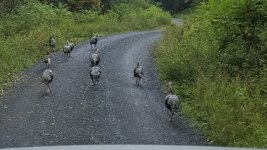
Late one afternoon, I encountered a group of ten wild turkey hens strutting along a quiet trail section. Their glossy feathers shimmered in the early fall light as they moved in a loose, synchronized flock. For nearly a minute, they trotted ahead, their spindly legs kicking up small puffs of dust, seemingly unfazed by my presence. Then, as if on cue, they scattered swiftly into the dense underbrush, vanishing with a rustle of leaves and faint clucks, leaving me alone on the silent trail.
RC 25-403.jpg

One joy of overlanding is pulling into a primitive campsite after dark and falling asleep imagining the sunrise view. You’d think years of this lifestyle would sharpen my mental picture, but I’m still awestruck by the natural beauty I wake to - sometimes even shocked. No human could craft something so intricate and breathtaking, a landscape that shifts with every minute of every day, endlessly.
RC 25-404.jpg

The Elk Country Visitor Center in Benezette, Pennsylvania, is a must-visit, showcasing the largest wild elk herd in the northeastern United States. It features interactive exhibits, a theater, educational wildlife displays, a hands-on discovery room for kids, panoramic viewing areas, and accessible trails for year-round elk observation in their natural habitat. This prime stop along the PA Wilds BDR-X offers a perfect pause for elk sightings amid stunning forests and trails.
RC 25-405.jpg

What I loved about this trail was how each day felt uniquely special, despite following a single-state loop. Exploring the Quehanna Wild Area, followed by Moshannon State Forest, felt like living a dream, driving through pristine forests, wetlands, and streams. Though the trails were smooth enough for 25 mph, I slowed to 15–20 mph, windows down, smiling the whole way. Traveling solo let me set my own pace, free to linger without affecting others.
RC 25-406.jpg

My truck hit 100,000 miles on the trail, and the stats look solid: 14.3% idle (476/3,334 hours) and 85.7% drive time (2,858/3,334 hours). My total engine hours are about average for 100,000 miles, with lower-than-typical idle time and higher drive time. The moving average of 35 mph (100,000 miles/2,858 hours) impressed me, aligning perfectly with my mixed trail (15–20 mph) and backroad (50–55 mph) driving habits.
RC 25-407.jpg

Here’s an adventure secret: when I spot a vehicle approaching on a trail, I slow down, find a spot to pull over, and roll down my window. As we pass, I hang my arm out, smile, and at least say hello. In today’s world, it’s common to keep windows up and eyes forward, avoiding contact - I’ve been guilty of this too. But in small towns or deep in the forest, that open window and smile often lead to stopping, shutting off engines, and sharing a conversation with a fellow traveler.

In this case, despite traveling in opposite directions, the gentleman shared a tip about a private club an hour ahead, just off the trail. He assured me that if I walked in, sat down, and chatted with a member, someone would gladly sign me in. I took his advice and spent the evening swapping stories with hunters and fishermen over a hot, scratch-made meal.

As I drove back into the dark forest alone I though about old friends - and we have just one world, but we live in different ones...
RC 25-408.jpg
 
The picture in the restaurant - I swear the lady on the left looks like Vickie Guerrero (i.e. EXCUSE ME!!!) from WWE. Look her up for some comedic relief.
 
PA Wilds Pennsylvania BDR-X

Part Two of Two

Exploring forest service roads or trails through national forests and state wildlife management areas requires preparation for unexpected challenges, such as locked gates, which I recently encountered. These routes face seasonal closures during winter or spring for snow or mud, and temporary summer or fall shutdowns for maintenance, fire risks, or post-hurricane repairs, as seen in North Carolina’s forests. Hunting seasons further complicate access: gates often open in fall for archery and deer hunts but close post-season to protect nesting wildlife or support habitat recovery. Some areas restrict vehicle entry to permit holders or allow only foot access behind yellow gates. Washed-out bridges, avalanche-prone stretches, or quota restrictions may also force detours. To navigate these challenges, consult local ranger districts for real-time updates and equip your vehicle with the latest offline maps. Above all, maintain a flexible mindset - resolving unexpected navigation issues is part of the overlanding adventure!
RC 25-409.jpg

Pennsylvania’s elk, descendants of Rocky Mountain elk reintroduced from the West a century ago after the native eastern subspecies was hunted to extinction by the 1870s, have thrived through decades of conservation. From a low of 14 animals in 1936, the herd now numbers approximately 1,400 and is the largest free-roaming population on the East Coast spanning north-central counties like Elk, Cameron, Clinton, Clearfield, and Centre. This photo captures a cow elk pausing in the woods to glance back at me, a testament to their quiet integration into Pennsylvania’s forested trails. Elk, larger and more robust than deer, tend to be calmer and less skittish but may startle or bolt if approached too closely, especially cows protecting calves or bulls during rutting season.
RC 25-410.jpg

Most of my trail time under the cover of darkness is spent alone, likely for two reasons: (1) most travelers drive during the day and sleep at night, and (2) dust kicked up on trails at night lingers longer due to reduced wind, with powerful lights illuminating suspended particles, causing “dust-outs.” Personally, I relish being alone in the forest at night, embracing the primal unease tied to limited visibility, unfamiliar sounds, predators, or the risk of getting lost or injured without help. Darkness heightens amygdala activity - triggering fear, anxiety, or aggression. Combined with isolation and an unpredictable forest setting, it’s no surprise adrenaline kicks in. Evolutionary psychology suggests men, historically hunters or warriors, may be wired to seek such high-stakes challenges.
RC 25-411.jpg

As mentioned in a previous post, properly mounted and aimed off-road lights are invaluable for night riding, casting powerful beams to reveal the trail’s texture and obstacles. The PA Wilds BDR-X includes seven optional “hard” routes that slow your pace to 5–10 mph but are not technically demanding. Some of these routes are overgrown or less maintained than primary roads, breaking up the steady 15–20 mph travel. I encourage you to explore a few of these options for a richer experience.
RC 25-412.jpg

This vista is one of many along the PA Wilds BDR-X. I love driving through a tunnel of trees and emerging to a breathtaking view like this. Late in the day, I pulled over, fired up my diesel cooktop, and prepared a hearty meal with plenty of meat as the sun sank below the horizon. As night fell, the forest came alive with clicks, chirps, hoots, and howls. Smiling, I decided to spend the night at this overlook. I was only a day or two from completing the trail, but I wasn’t ready for it to end just yet.
RC 25-413.jpg

The eastern segment of this trail loop was notably distinct despite its proximity to familiar routes, such as the Trans-Pennsylvania Adventure Trail and sections seven through nine of the Mid-Atlantic BDR. Overlap with these trails was minimal, approximately 10-20%, which is remarkable given their close alignment. While navigating Rothrock or Bald Eagle State Forest, I initially expected familiar terrain, yet the trail revealed previously unexplored paths, showcasing impressive route diversity. The accompanying image captures a 10.5-mile, challenging section south of Poe Paddy State Park.
RC 25-414.jpg

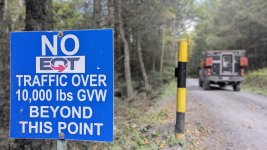
Many forests I explore are working forests, where I occasionally encounter company-specific signs like the one shown. These signs often indicate weight restrictions, typically signaling bridge limitations ahead. In this instance, I proceeded confidently, as my fully loaded truck and camper combination weighed 8,960 pounds on a certified scale, well below the posted limit. In areas with active logging, bridges are commonly rated for 15–20 tons (or 40–80 tons with a permit). However, in remote sections, single-lane bridges with ratings as low as 4–5 tons, or even 3 tons, are frequent. When designing an adventure vehicle for a specific region, consult the local ranger’s office to verify bridge weight ratings. For a versatile, go-anywhere rig, I recommend a maximum weight of 10,000 pounds. Beyond this, many bridges become inaccessible due to weight restrictions.
RC 25-415.jpg

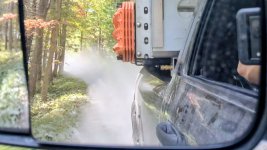
On dirt or gravel trails in state and national forests, particularly in dry seasons with low humidity and minimal traffic, a thin layer of fine silt and clay particles accumulates on the surface creating a powdery crust that's easily disturbed by vehicle tires; when driven over, this leads to dust being kicked up through tire shear and turbulent wake eddies, with the worst speeds being 15-25 mph, as this range generates optimal turbulence to loft particles upward without rapidly dispersing the cloud. The dust, can hang in the air for several minutes - typically 2-10 minutes for clouds rising 10-20 feet high - governed by Stokes' Law, where tiny particles settle slowly in still air. Aggravating factors include forest canopies that shelter the trail from wind shear, creating calm micro-climates with low air movement, thermal updrafts from daytime heating that counteract settling, and dry conditions turning the plume into a lingering "dust fog" that reduces visibility and poses safety risks.
RC 25-416.jpg

In wrapping up my adventure on the PA Wilds Pennsylvania BDR-X, I can confidently say it's one of the very best overland trips east of the Mississippi, offering an immersive 500-mile loop that plunged me deep into the heart of Pennsylvania's vast forests, with about 90% of the journey unfolding on rugged dirt and gravel roads that tested my truck while rewarding me with serene, untamed beauty. Plan for spring, summer, or fall to avoid winter's challenges, and set aside 5-7 days to fully savor the route without rushing - plenty of time to detour to nearby attractions like the breathtaking Kinzua Bridge Skywalk, the elk viewing areas in Benezette, the stunning vistas of Pine Creek Gorge (Pennsylvania's Grand Canyon), or the dark-sky stargazing at Cherry Springs State Park. Camping opportunities abound right along or near the trail, from dispersed sites in state forests to established campgrounds making it easy to pitch a tent under the canopy and wake to the sounds of nature after a dusty day on the trail.
RC 25-417.jpg

Third boxcar, midnight train. Destination, Bangor, Maine...
RC 25-418.jpg
 
Mid-Atlantic to North East Backcountry Discovery Route Connector

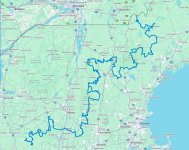
This long-awaited connector bridges the gap between the north end of the Mid-Atlantic BDR at Lawrenceville, PA and the southern start of Northeast BDR at Hancock, NY. It features sections of fantastic dirt forest roads and twisty tarmac. At 142 miles, this track can be accomplished by the average rider in just a day, and features plenty of fuel and lodging opportunities, plus camping in Salt Springs State Park.

In early 2018, while searching for off-road trails to explore in Virginia, I discovered the newly released Mid-Atlantic Backcountry Discovery Route (MABDR). Captivated by its promise of adventure, I began tackling the 1,100-mile route in 275-mile sections, each journey spanning three to four days. My navigation system at the time was rudimentary: a series of screenshots from a digital map, sequenced from south to north and stored on my laptop. To navigate, I would display a screenshot (always oriented north) on my device, use a manual compass to estimate my true direction, and mentally track my progress by comparing approximate distances and directional changes against the terrain. Traveling through dense forests, often under the cover of darkness with scarce road signs, posed significant challenges. Yet, remarkably, this method allowed me to successfully complete the entire MABDR, fueling my passion for backcountry exploration.

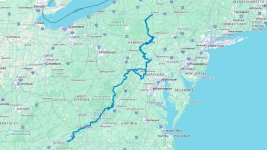
By mid-2019, the team at Backcountry Discovery Routes (BDR) unveiled the Northeast Backcountry Discovery Route (NEBDR), expanding the possibilities for adventure riders. However, when I studied the map, I noticed a significant gap between the northern terminus of the MABDR in Lawrenceville, Pennsylvania, and the southern starting point of the NEBDR in Hancock, New York. This disconnect intrigued me, as the two routes, while geographically close, lacked a seamless link - likely due to the complex terrain and land-use considerations in the region. I hoped the BDR team would eventually bridge this gap. My wish came true earlier this year when they released an official MABDR-NEBDR connector route. Spanning approximately 150 miles through the scenic landscapes of northern Pennsylvania and southern New York, the connector is a thoughtfully designed path of backroads and farm roads. While less rugged than the MABDR or NEBDR, its value lies in uniting these iconic routes, enabling adventurers to experience a continuous journey across the Mid-Atlantic and Northeast. This connector deserves a brief review for its role in creating a cohesive adventure, as illustrated by the accompanying map.
RC 25-419.jpg

While pursuing my MS in Aeronautics, I explored the phenomenon of temporal distortion experienced by pilots during high-stress events like aircraft ejection, where time feels dramatically stretched or slowed. Intriguingly, a similar distortion emerges when traveling full-time through remote landscapes for weeks or months at a time. In these wilderness settings - far from clocks, structured routines, or digital notifications - time loses its usual cadence. After a week immersed in nature, the brain’s prefrontal cortex relaxes. This shift heightens sensory awareness and fosters a present-focused “flow state,” where time feels expansive or even irrelevant, mirroring the serene continuity of the landscape.
RC 25-420.jpg

On a quintessential Pennsylvania day, the countryside reveals its timeless charm along quiet rural roads. Rolling green fields stretch toward the horizon, where a small family farm nestles peacefully. Such serene landscapes invite us to pause, soak in the pastoral beauty, and savor the unhurried rhythm of the journey.
RC 25-421.jpg

A solitary dead tree often draws my gaze during my travels. To me, this once-vibrant tree embodies the fleeting nature of earthly life, pointing toward eternal hope. Its silent presence, like the loss of a pet or loved one, urges a shift from the temporal to trust in God’s enduring promise. Traveling alone grants me the freedom to pause and reflect on such timeless truths.
RC 25-422.jpg

The northern reaches of eastern Pennsylvania, particularly in Bradford, Susquehanna, and Wayne Counties, are a patchwork of thriving farmland. With only a few small state parks and game lands scattered across this region, the prevalence of agriculture likely shaped the careful design of the connector route linking the Mid-Atlantic and Northeast Backcountry Discovery Routes. This rural landscape, vibrant with crops, underscores the challenge of crafting a path through such cultivated terrain.
RC 25-423.jpg

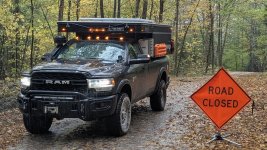
Roadblocks occasionally disrupt travel along rural routes. Near a small town, where cellular reception allowed access to a digital map, I quickly rerouted around an unexpected obstacle. For overland journeys, choose a navigation app such as GAIA GPS or onX Offroad that supports downloading detailed regional maps in advance. Relying solely on a basic route display risks frustration when detours are needed due to unforeseen closures.
RC 25-424.jpg

Curving forest roads reveal stunning views, with evening sunlight glowing through tall trees. The route mixes dirt, gravel, and paved sections, often simple farm roads.
RC 25-425.jpg

Pausing on the trail as the sun sets, I savor the calm beauty of the moment. With darkness falling, I rely on my vehicle’s lights: headlights and fog lights perform adequately, but the A-pillar lights shine for spotting wildlife in the ditches. The 30-inch Diode Dynamics light bar, with three center spot lenses and two outboard flood lenses, balances forward visibility with peripheral illumination, ideal for overland trails at 25–30 mph. Choose lights based on your specific needs, not just what’s popular or flashy.
RC 25-426.jpg

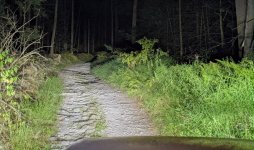
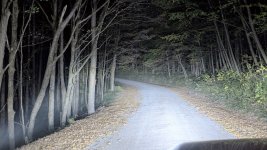
Rolling along a quiet Pennsylvania trail at night, my vehicle’s lights cut through the darkness, clearly lighting the path ahead. The powerful illumination, likely from a well-chosen light bar, excels on stretches like this old rail-bed. However, navigating switchbacks on mountain slopes reveals a gap: my setup struggles to light the sides, making tight turns trickier. For such terrain, consider adding side-mounted lights to enhance visibility.
RC 25-427.jpg

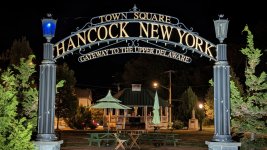
Arriving in Hancock, New York, I found a laundromat to tackle nearly a month’s worth of laundry. While waiting, I checked a local map and spotted a promising field by the East Branch of the Delaware River, near a boat launch - a reliable sign for camping. After dimming my off-road lights, I settled into a flat, well-used spot in the field, fired up my diesel heater, and prepared a quick meal before bed. With plans to meet an old friend in the morning for our first shared trail in a year, I rested easy under the quiet night sky. All I want is to have my peace of mind.
RC 25-428.jpg
 
Last edited:
North East Backcountry Discovery Route

Part One of Six

The Northeast Backcountry Discovery Route (NEBDR) spans seven states; Pennsylvania, New York, Connecticut, Massachusetts, Vermont, New Hampshire, and Maine, covering approximately 1,300 miles before concluding at the Canadian border. My journey took a full two weeks, logging 1,556 miles and 67 hours of drive time, with just a handful of stops at intriguing historical sites. A typical day involved 4-5 hours behind the wheel, though my overall pace averaged 20-25 mph, slightly above the norm; I attribute this to the route's balanced mix of roughly 50% on-road and 50% off-road sections. Keep in mind that seasonal closures affect portions of the trail, so plan for it to be fully accessible from early June through late October. Depending on winter snowfall, spring and early summer can bring muddy, rutted, and slick conditions, particularly over rocks and in low-lying areas. Flies and mosquitoes are also prevalent during those warmer months, so pack plenty of bug spray. For optimal conditions - mild weather, dry trails, and minimal insects - September and October stand out as the prime window to tackle this adventure.

Having completed over 40 adventure routes in recent years, I'd rank the NEBDR among the very best. While many of those trails leaned heavier on off-road segments (70-90%), with varying lengths, none matched the NEBDR's unique immersion across seven states: lands originally inhabited by Native American tribes for millennia, colonized by Europeans in the early 17th century in pursuit of religious freedom, transformed into pivotal self-governing entities during the American Revolution, industrialized powerhouses in the 19th century, and now a region celebrated for its elite educational institutions, rich cultural heritage, and stunning natural beauty. My recommendation? Carve out 3-4 weeks next September or October to embark on an expedition that's truly in a class of its own.
RC 25-429.jpg

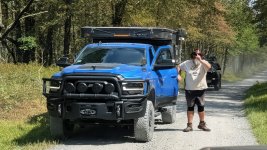
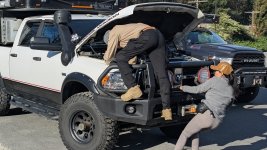
Here’s a snapshot of my good friend Dennis, a civil engineer with decades of experience on projects across Asia, and his wife, fine-tuning their truck on the morning we embarked on our NEBDR adventure. We first bonded in 2017 at the Mid-Atlantic Overland Festival, hosted by Main Line Overland, and have since explored trails together each year, conquering routes like the Allegheny Discovery Route, Sedona Backcountry Trail, and Green Country Oklahoma Adventure Tour. Dennis’s rugged 2011 Ram Power Wagon, equipped with a 5.7L HEMI, 4.56 gears, an Atlas 3.8:1 transfer case, Scheel-Mann seats, and brand-new 37" Mickey Thompson Baja Boss tires, was primed for the challenge. After a hearty sit-down breakfast and a final top-off of our fuel tanks, we hit the trail, ready to navigate the Northeast’s diverse backcountry.
RC 25-430.jpg

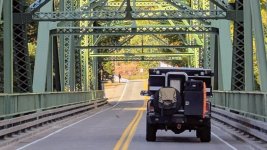
As a mechanically minded adventurer, I find myself captivated by the engineering of bridges like the green steel girder spanning the West Branch of the Delaware River, but Dennis and I weren’t even supposed to be here - Paul and Matt had orchestrated this NEBDR run while we were locked in for a Colorado trip the same week. In a twist worthy of a sitcom, they convinced us to switch allegiances, only for both to bail last-minute, leaving just the two of us veterans to roll across and disappear into the forest.

Bail early, regret eternally; push through, claim the views.

RC 25-431.jpg

The NEBDR’s intensity surges along River Road, a rugged seasonal track skirting a sheer drop-off beside the Delaware River. Dennis and I, piloting our full-size trucks fitted with campers, navigated a grueling gauntlet of tight trees and jagged rock outcroppings, creeping at 5 mph or less for over an hour. The only others daring this stretch were a few adventure motorcyclists and side-by-sides, their wide-eyed stares shouting “you’re insane” as they wedged into scarce pull-offs to let our rigs lumber past in the opposite direction. This pulse-pounding section tested our vehicles and resolve, proving early why demanding off-road stretches like these require both skill and grit.
RC 25-432.jpg

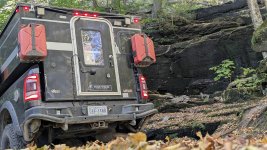
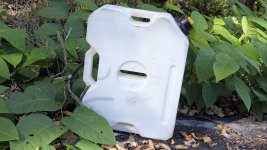
Here’s a tale worth sharing: our descent of over 1,000 feet in under two miles along a narrow, bumpy, unmarked tar-and-chip road turned dramatic when Dennis’s new PowerStop brakes failed, nearly sending him into the back of my truck at a sharp 160-degree turn where I’d slowed down. Unable to stop, he barreled through the bend and up a short, tight path toward a private hunting camp. At the bottom, we halted to inspect his brakes, letting them cool while diagnosing the failure, when two adventure motorcyclists rolled up, noting they’d spotted a Rotopax on the trail a few miles back and asking if we’d lost one. To my astonishment, a quick check confirmed I had lost one, prompting me to drive back up the trail, and fortunately, I retrieved it, transforming my surprise into relief as it became a quirky memento of our chaotic plunge.
RC 25-433.jpg

Encouraged by the Rotopax's recovery and a burst of optimism during our unplanned stop, I ventured further back up the trail to track down the AT Overland Rotopax Holder side strap that had also become loose enough to fall off since I failed to secure it properly. Relying on a fascinating aspect of human vision - our natural ability to pick out man-made objects amid nature’s randomness, driven by their sharp edges and consistent colors, I scanned the roadside with keen interest. As I drove slowly, I pieced together the mishap in my mind: picturing the canister’s slow shift across the bumpy miles, nudged by tight turns and rough spots until it finally fell. Luck struck again; the strap was right there, sparking a thoughtful pause on how this unfolded - Dennis’s brake failure forced our halt, which brought the adventure riders with their helpful tip, giving me the time to drive back a few miles, search for both lost items, and reclaim them, turning a breakdown into an unexpected triumph on the trail.
RC 25-434.jpg

This striking image suggests a near-mythical haven, but take a moment to picture the full scene: the trail humming with the rustle of leaves beneath you, the faint calls of hidden birds resonating through towering trees, and the fresh aroma of hardwoods and moist earth wafting through the air - a sensory richness that nature always reveals. My photos fail to do justice to that vibrant reality, a shortcoming I regret, as I am unable to truly capture the wild’s embrace. I encourage everyone to step into nature themselves, where wild beauty, as hinted here, waits to be experienced firsthand.
RC 25-435.jpg

This BDR is broken down into eight sections approximately 150 miles long, some shorter and a few longer. These first two sections take you in an easterly direction across New York while wandering to the north and south along the way, featuring a mix of minor paved roads, dirt paths, and challenging rocky stretches. What stood out the most to me was the lack of primitive camping and limited ability to procure food and gas. There are a few options for staying at State Parks, private campgrounds, or motels so plan ahead and consider pre-booking during peak seasons to avoid availability issues. All in all, I was impressed with this route through New York and think of the state in a different, more positive way after this trip. You will pass through small towns like Callicoon, Downsville, and Andes; charming rural hamlets in New York's Catskill and Delaware River regions, celebrated for their scenic beauty and outdoor recreation.
RC 25-436.jpg

Over the years, traveling mostly alone but sometimes with others, I've noticed a daily pattern emerge. We generally wake up with the sunrise, relax in our campers, prepare breakfast, clean up, and then step outside to greet fellow travelers and sketch out loose plans for the day. We hit the trail around 0900-1000 and typically stop for lunch between 1200-1300; if near a small town, we might detour to enjoy each other's company at a restaurant or visit a museum together. Eventually, we return to the trail for a few more hours of exploration before discussing possible campsites - sometimes just minutes away, other times an hour or two further. On this particular day, we stopped in Fleischmanns, New York, a quaint Catskills village in Delaware County with a population of about 210, originally named Griffin Corners and renamed in 1913 after the Fleischmann yeast family who developed it as a luxurious summer resort in the late 19th century, for a relaxing lunch.
RC 25-437.jpg

God, in His infinite love and wisdom, created the world not as a mere backdrop or a test of endurance, but as a magnificent gift for us to enjoy and steward. This was no accident; it was an act of paternal generosity. The world - its mountains, rivers, creatures, and seasons - was crafted for our delight, to reflect His glory and draw us closer to Him. Even now, in our fallen state, we glimpse this in the splendor of nature, which the Psalms celebrate: "The heavens declare the glory of God, and the firmament proclaims his handiwork" (Psalm 19:1). We are invited to enjoy it, not as idolaters of the material, but as grateful children who see God's fingerprints everywhere.

Did you exchange a walk on part in the war for a lead role in a cage?
RC 25-438.jpg
 
North East Backcountry Discovery Route

Part Two of Six

During my overland adventures, I often awaken in the dead of night, drawn outside by an irresistible pull to gaze upward at the star-strewn heavens, where the Milky Way arcs like a luminous river across the velvet sky. From my training at Naval Aircrewman Candidate School (NACCS) during the aviation physiology phase, I know our eyes begin adapting to darkness almost immediately - cones adjusting in seconds for basic shapes, with significant rod sensitivity kicking in within 5-10 minutes - but full dark adaptation takes 20-30 minutes. This knowledge echoes my nights flying missions off aircraft carriers, where we'd brief in ready rooms bathed in subdued red lighting, then navigate dim red-lit passageways to the flight deck, preserving our night vision since red wavelengths stimulate cones without bleaching the rods' pigments. From the dawn of humanity, man has paused amid the wilderness to stare into the infinite expanse, pondering existence and the divine; in those quiet moments under the stars, I feel a profound connection to that ancient wanderer, sharing the same awe and humility before creation's vast mystery.
RC 25-439.jpg

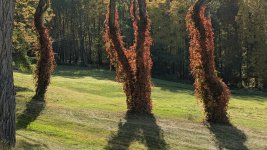
As I wandered along a dusty back road through New York’s countryside, I paused before three towering trees draped in vibrant Virginia creeper, their crimson leaves blazing against a lush green backdrop, backlit by the low autumn sun. The vines climbed skyward, weaving a vivid tapestry that contrasted sharply with the forest’s rich depth. Strong shadows stretched toward me, cast by the trees, creating an almost mystical reflection on the ground - a dance of light and shade that seemed to mirror the creeper’s fiery ascent. Traveling through such rural expanses, beautiful sights like this never cease to amaze me, each scene a fleeting gift.
RC 25-440.jpg

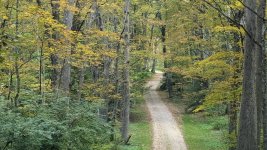
Winding along a narrow dirt road deep in the Catskill Mountains, I marveled at the forest's full autumn symphony - towering hardwoods ablaze in crimson, gold, and amber, their leaves carpeting the path like a fleeting mosaic underfoot. This ancient range, explored by Lenape peoples before Henry Hudson's 1609 voyage sparked European settlement, became a muse for 19th-century Romantic painters like Thomas Cole, whose Hudson River School canvases immortalized its misty peaks as untamed American wilderness. In the 20th century, grand resorts buzzed with vibrant entertainment amid lavish summer escapes that faded by the '70s.
RC 25-441.jpg

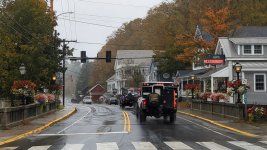
Cruising through the quaint town of Catskill in my adventure vehicle, I was struck by its charming streets lined with historic brick buildings. Founded in the late 17th century by Dutch settlers, Catskill evolved from a trading post along the Hudson River into a bustling 19th-century hub for shipbuilding, tanning, and commerce, its riverfront thriving with steamboats and mills. Today, Catskill pulses with a vibrant arts scene, boutique shops, and festivals like the Catskill Mountain Film Festival, blending its rich past with modern creativity.
RC 25-442.jpg

Guiding my adventure vehicle across the Rip Van Winkle Bridge, I gazed at the shimmering waters of the Hudson River below; its a timeless artery that has carried dreams since time immemorial. Named for Washington Irving’s Rip Van Winkle, the idle dreamer from his 1819 tale who napped through the American Revolution in these very hills, this 5,040-foot bridge, opened in 1935, links Catskill to Hudson, New York. Engineered with a cantilevered 800-foot main span and piers sunk deep into the riverbed, the bridge stands as a testament to progress. Crossing it, I feel Rip’s timeless wanderlust, my journey echoing the river’s ancient currents and the call to explore.
RC 25-443.jpg

Section three of the NEBDR begins in eastern New York near the Massachusetts border, dips into northeast Connecticut’s tranquil riverine trails, climbs through Massachusetts’ Berkshires via Beartown State Forest’s rocky double-tracks, and crosses into Vermont. In New York’s Berkshires, Taconic State Park – Copake Falls Area offers serene gravel paths, with Bash Bish Falls, a 60-foot cascade, luring visitors to its 19th-century trail. Passing through North Canaan, Connecticut, it brings to mind the perspective of Catholic theologians like St. Augustine and St. Thomas Aquinas; Canaan is the Promised Land, a divine gift symbolizing God’s covenant with His people, allegorically guiding the soul toward heavenly rest and eternal salvation. I pause, pondering the Puritan settlers who named North Canaan in 1738, their faith in a new land’s promise mirroring my own journey’s search for meaning through these timeless trails.
RC 25-444.jpg

As we pressed northward through western Massachusetts, our tires gripped more gravel and rocks than pavement, weaving through Beartown State Forest’s 12,000 acres and October Mountain State Forest, the largest in Massachusetts at 16,460 acres. Dennis and I relished the rocky double-tracks, crawling at 10-15 mph, but our anticipation burned for Vermont’s Green Mountain National Forest (399,151 acres), where pavement nearly vanishes and primitive campsites abound. Reflecting on our journey from New York’s Catskills, through Connecticut’s brief riverine loop, to these Massachusetts wilds, we faced a curious challenge: sparsely populated regions offered scarce food and gas, yet dispersed camping remained surprisingly limited, pushing us to plan meticulously.
RC 25-445.jpg

The next morning we celebrated crossing into Vermont and immediately beginning Section 4 which winds through southern and central Vermont, starting just north of the Massachusetts line and traversing roughly 150 miles of the Green Mountain National Forest's dense woodlands, where overlanders can enjoy off-road gravel and dirt tracks that test intermediate to advanced skills. Reviews on forums praise it as the route's pinnacle, with "hero sections" like the infamous "Figure 8" loop and Class IV unmaintained roads - riddled with deep ruts, loose rocks, steep hill climbs/descents, and occasional water crossings - demanding low-speed crawls at 5-10 mph, often bypassed for easier alternatives but hailed as "intense yet rewarding". Occasional reroutes due to washouts, highlight seasonal vulnerabilities (best June-October), while highlights include a unique floating bridge crossing and abundant primitive camping; overall, riders call it the "most challenging and best segment" for its immersive forest immersion and vanishing pavement.
RC 25-446.jpg

Our first alternate "harder" option, a grueling four-mile stretch, took nearly an hour to navigate, with sections so tight I couldn’t stop to snap photos. Five days into the NEBDR, we’d covered just 35% of the 1,300-mile route, projecting a 15-20 day finish at our 20-25 mph pace, a concern since Dennis had only two weeks off. With Vermont and New Hampshire’s trails likely staying rugged we faced tougher terrain ahead. Dennis also needed to budget time for a 600-mile return drive from the Canadian border to his Delaware home. As someone who crunches numbers early, a habit honed from mission planning and technical project management, I know small adjustments can reshape outcomes, much like the long-term forecasting I did at NASA Langley Research Center for multi-year projects which required estimation of breakthrough technologies that didn’t exist at kickoff. If we were going to complete this as a team we needed to push harder, balancing speed with the trail’s demands, to stay on track.
RC 25-447.jpg

In the dawn of powered human flight, when the Wright brothers’ fragile Flyer first stuttered into the skies above Kitty Hawk in 1903, a new romance bloomed between man and the heavens, each trembling ascent a defiant kiss against gravity’s pull. Barnstormers and dreamers, fueled by grit and gasoline, piloted rickety biplanes over patchwork fields, their wings humming with the promise of a world unbound. In those early days, pilots danced with the wind, their machines of wood and canvas creaking under the strain of ambition, chasing horizons where earth and sky blurred into one. As John Gillespie Magee Jr. later wrote in High Flight, they “slipped the surly bonds of Earth” and “danced the skies on laughter-silvered wings,” capturing the exhilaration of those pioneers who, with every flight, wove love letters to the infinite, their hearts soaring as high as their fragile craft. Tonight we sleep at Somerset Airfield, a relic of early 20th-century aviation ambition now repurposed as a dispersed camping area within the Green Mountain National Forest. Fly me to the moon...
RC 25-448.jpg
 
North East Backcountry Discovery Route

Part Three of Six

Your sharp eyes may notice two adventure vehicles in front of me. Paul, one of the men who originally orchestrated this NEBDR run but bailed at the last-minute, contacted us the day before and suggested we camp at Somerset Airfield, which was a great camp spot, since he was planning to wake up early and would drive out to meet us on the trail. Paul would not arrive until around noon time and after reviewing the trail ahead we collectively decided to backtrack into a nearby town to top off on groceries and fuel, and grab a quick lunch. It was great to have Paul back on the trail with us but now we were faced with the fact that it was mid-afternoon and we were just getting back on the trail. Dennis and I had been making good consistent time on the trail and now things had begun to slide.
RC 25-449.jpg

When you begin to add vehicles to an overland adventure, it is important to identify roles, responsibilities, and titles for each vehicle in a moving column. Here is a common breakdown:
  • Lead (or Point): The frontmost vehicle. Sets the pace, chooses the route (if not pre-planned), and makes real-time decisions about obstacles, turns, or stops. Often carries the primary navigator or trip leader.
  • Navigator: Usually rides in the Lead vehicle (or sometimes a dedicated second vehicle). Holds maps, GPS, route plans, and communicates directions to the Lead driver. May also manage radio comms to the group.
  • Sweep (or Tail Gunner/Rear Guard): The rearmost vehicle. Ensures no one is left behind, monitors stragglers, and watches for mechanical issues or dropped gear. Often the most experienced driver; carries extra tools, recovery gear, and first-aid. Confirms the group is intact at junctions.
  • Mid-pack (or Floaters): Vehicles in between Lead and Sweep. Follow instructions, maintain spacing, and relay radio messages if signal is weak. May include support roles like medic, mechanic, or photographer.
  • Scout (optional): A fast, lightweight vehicle sent ahead to check trail conditions, obstacles, or alternate routes. Reports back to Lead before the main convoy proceeds.
Note: Roles can be rotated among qualified participants to share responsibility and build team experience. All vehicles should use two-way radios with agreed call signs (e.g., “Lead,” “Sweep,” “Unit 3”) for clear communication.
RC 25-450.jpg

Let’s briefly discuss convoy size on an overland route. In my view, two or three vehicles strikes the optimal balance between capability and efficiency:
  • Simple communication and easy coordination
  • Quick decision-making
  • Minimal delays at obstacles
  • Ideal crew size for winching, tire changes, or recovery
  • One vehicle can scout ahead or shuttle parts
  • Clear roles: Lead, Mid (if three), Sweep
A major practical advantage is campsite flexibility - nearly any site fits two rigs, with a third easily squeezing in or posted at the entrance for security.
RC 25-451.jpg

While larger groups (4+) gain redundancy and specialized roles (mechanic, medic, photographer, etc.), they sacrifice speed, trail access, and simplicity. One option with four vehicles is to split into two pairs - each with Lead and Sweep - for better maneuverability.

At five or more vehicles, the trip slows dramatically:
  • Harder to find campsites (or nearby alternatives)
  • Increased radio chatter
  • Traffic jams on narrow trails
  • Increased risk of stragglers or breakdowns
Mitigation requires strict leadership and firm schedules - but all participants must buy in. For most overland adventures, two to three vehicles remains the sweet spot.

In this case, I broke away from our three-vehicle convoy to scout ahead and confirm that a closed road was actually passable.
RC 25-452.jpg

As soon as we rejoined, we split again - Dennis’s older Power Wagon with its modified 5.7L HEMI needs more frequent refueling stops. Paul stayed with him at a generic station, but I pressed on, sticking exclusively to TOP TIER fuel. Top-tier fuels provide key advantages for low- and high-mileage vehicles by keeping injectors and valves clean, ensuring optimal power, and fuel economy (up to 1–2%); benefits are greatest in high-mileage engines (>75,000 miles), preventing deposit-related issues. Disadvantages include a premium pricing with limited gains in low-mileage cars and occasional availability challenges, though high-mileage vehicles justify the cost for reliability.

Though we never reconnected on the trail due to spotty cell service, Paul and Dennis found a high-mountain campsite, dropped a pin in Google Maps, and texted me the coordinates. An hour later we reunited, cooked dinner, and settled in for the night - another solid day on the Northeast Backcountry Discovery Route.
RC 25-453.jpg

Section Five of the NEBDR spans 153 miles through the rugged core of Vermont’s Green Mountain National Forest, blending groomed gravel, challenging Class IV roads, and scenic views of apple orchards and maple groves. It heads north for a stretch, climbing slopes with sweeping valley vistas, then turns east near Bristol - chartered in 1762 and home to the quirky “Lord’s Prayer Rock,” where a log hauler carved the prayer into a boulder in 1891 after surviving treacherous hauls - before crossing into New Hampshire; adventurers can detour to Bristol for summer band concerts on the historic green and a dip at Bartlett Falls.
RC 25-454.jpg

The three rigs crawl eastward in perfect formation along velvet-smooth forest roads - tires humming on packed gravel, sunlight occasionally flickering through the canopy like a silent film. Radios remain silent; no one needs words. The rhythm is hypnotic, almost narcotic - hours dissolve into a dreamlike glide where time forgets to matter.
RC 25-455.jpg

Driving through central Vermont’s backcountry, I’m floored by the sheer size of the boulders scattered in the streams - some as big as trucks, others rivaling small houses - ancient glacial giants half-submerged in rushing water, dwarfing the landscape in a way that feels almost unreal. Yet every photo I take flattens them into ordinary rocks; my lens can’t capture the scale, the weight, or the quiet power that’s so obvious when you’re standing right there.
RC 25-456.jpg

The wind off the southern mountains still bites like it did decades ago when I first chased these summits, young and reckless; now the knees creak and the beard’s gone white, but the ridges let me return, boots scuffing the same stones, spruce sharp with October resin, and halfway up I stop where the valley drops away and the river glints like forgotten silver, and there she is - not a ghost, just the memory of her shoulder against mine, hair smelling of woodsmoke, laughter at my wrong-named peaks, letters that thinned and stopped, yet every autumn the mountains hand her back, wind combing birches with her voice saying my name; I sit on a flat boulder, cut an apple in half with the old Randall knife - one piece for me, one for the ravens she fed - juice running down my wrist the color of her eyes at dusk, the small warmth the mountains keep in every stone I step on, even as the trail down steepens and the dark turns gentle like the night we shared one sleeping bag under stars, tomorrow maybe snow, me in the valley with boots by the fire, but tonight the range keeps its promise: her hand still in mine.
RC 25-457.jpg

A single autumn leaf lies flat on the forest floor, its veins laced with raindrops that gleam like scattered rosary beads under the muted light - each droplet a tiny prism catching God’s quiet farewell. Its days of green glory are done; it has fed the tree, danced in the breeze, and now surrenders in holy obedience, nourishing the soil for the season stirring beneath. We stride past such small retirements daily, blind to the exquisite beauty the Creator scatters for our delight, yet to truly live we must pause, kneel, and peer close - only then do we glimpse the divine artistry woven into every ending.

Adagio in G Minor (Albinoni)
RC 25-458.jpg
 
Unbelievable pictures and poetry in your descriptions. I think living alone deepens a man and gives him time to really think and use words beyond what we normally use.

I love this statement:
"the Psalms celebrate: "The heavens declare the glory of God, and the firmament proclaims his handiwork" (Psalm 19:1). We are invited to enjoy it, not as idolaters of the material, but as grateful children who see God's fingerprints everywhere."
 
North East Backcountry Discovery Route

Part Four of Six

Today our crew gears up to traverse the iconic Sunset Lake Floating Bridge in Brookfield, Vermont - the sole pontoon span east of the Mississippi River, first erected in 1820 to shortcut around the lake without a miles-long detour. Spanning 318 feet across the glacial-formed Sunset Lake, which plunges to a maximum depth of 120 feet, this engineering marvel opts for buoyancy over fixed pilings. Over two centuries, eight iterations have risen and occasionally sunk, evolving from basic timber rafts to barrel-supported designs, Styrofoam floats, and now a durable rebuild featuring ten robust 11-foot-wide by 51-foot-long fiber-reinforced polymer (FRP) pontoons interconnected with high-strength rods, steel splice plates, I-beams, and pressure-treated wooden decking. With our full-size trucks, each tipping the scales near the bridge's capacity, we played it safe by crossing one at a time, feeling the gentle undulations of the water beneath as we rolled over the oak-plank surface.
RC 25-459.jpg

Continuing our push to the east we begin to encounter a patchwork of small-to-medium dairy and beef operations that embody central Vermont's resilient agricultural heritage.
RC 25-460.jpg

As midday hunger struck while approaching Chelsea, Vermont, our convoy veered off the NEBDR route for a quick refuel and bite at the Vermont 110 Quick Stop, the lone convenience hub in the area. In the world of overlanding, we typically prepare breakfast and dinner at camp, but midday often calls for a detour to a roadside spot like this one, where a modest exchange of cash nets you a fresh deli sandwich or hot meal. This pit stop not only satisfied our appetites but sparked unhurried chats among the crew - recapping the morning's adventure, previewing the afternoon's terrain, and scouting potential campsites via maps. Pulling up in our rugged rigs inevitably drew curious locals, who wandered over to quiz us on our setups, swap stories of Vermont's backcountry gems, and even tip us off to unique destinations nearby, turning a simple lunch into a slice of small-town connection.
RC 25-461.jpg

Echoing insights from my earlier breakdown of the Mid-Atlantic BDR, ensuring every team member loads the freshest digital trail files (like GPX or KML formats compatible with Gaia GPS or OnX) keeps the group aligned on the main path, bypasses, and any detours. Publishers frequently roll out revisions to account for seasonal disruptions like fallen trees, eroded fords, or landowner changes that could interrupt travelers. With synchronized updates, the expedition flows smoother, minimizing mid-trail debates and enhancing safety. For crews of two or more plotting an overland adventure, I recommend appointing a dedicated primary navigator to verify that all navigation devices, be it tablets, phones, or in-dash units, are synced with the current files before rollout.
RC 25-462.jpg

It was late on the second day of section five, and we were still battling to finish this grueling 153-mile stretch, with tensions running high. A momentary sense of relief hit as we crossed the Connecticut River from Vermont into New Hampshire, but it faded fast. We were all exhausted, starving, and eager for a hot meal and some decent shut-eye - yet that wasn't in the cards just yet. It felt like we were looping endlessly, bickering over the radios about where to camp. No one's view was truly off-base; it all came down to personal tastes: one wanted raw wilderness camping, while another was ready to call it and drop $25 on a bare-bones state site lacking power, proper bathrooms, or showers. Someone else proposed pressing eastward, firing up our pricey auxillary lights to illuminate the woods, knock out more distance, and snag a free primitive site. After scouting several options, a team member expanded the hunt to include boat launches and trailheads. Bingo! We found a trailhead lot nearby, parked our rigs snugly with space for others, and started mapping out a short sunrise hike.
RC 25-463.jpg

Section six winds through a fantastic collection of picturesque dirt and paved roads for 229-miles from the western border to the east, passing through woodlands and sprawling farm fields. Turning north, the route takes the famous Kancamagus Highway for about ten miles along the Swift River, chock full of spectacular views before turning off. The Mt. Washington Auto Road is not to be missed – it’s a steep, serpentine 7-mile road up to the summit at 6,288 feet. Clear days offer amazing 360-degree views for a hundred miles, but be advised the highest recorded wind speed in the US was measured here at 231 mph in April 1934.
RC 25-464.jpg

Bath Village Covered Bridge stands as a remarkable testament to early 19th-century American engineering and is one of New Hampshire's most cherished historic landmarks. Built in 1832, it spans the Ammonoosuc River in the quaint town of Bath, and holds the distinction of being the state's longest covered bridge, as well as one of the oldest surviving examples in the United States. Bath itself is a small town with a population under 1,100, known for its trio of historic covered bridges, which collectively highlight the region's architectural heritage.

One of the earliest and most prominent bridge builders in our country was Theodore Burr from Torringford, Connecticut. His career began in New York where he built a bridge spanning the Hudson River in 1804. Burr's truss design soon became one of the more frequently used sytems. The Burr arch truss, as the design became known, used two long arches, resting on the abutements on either end, that typically sandwiched a multiple kingpost structure.

RC 25-465.jpg

Newfound Lake is a pristine, 4,106-acre glacial lake in central New Hampshire, often called one of the cleanest in the world due to its spring-fed waters and sandy bottom. Overlanding doesn’t demand wall-to-wall dirt; the NEBDR proves that long, smooth stretches of pavement are just as valid and often essential. Those paved ribbons break the hypnotic 15–20 mph grind of forest roads, resetting the mind, easing the suspension, and letting you cover ground without white-knuckling the wheel for hours. The interplay between dirt and asphalt is the unsung rhythm of a multi-day route: one fuels the raw adventure, the other prevents burnout and keeps the journey sustainable.
RC 25-466.jpg

At a weathered gas pump in Campton, New Hampshire, with the White Mountains looming like silent judges, we crossed paths with two adventure bikers fueling up their machines. What started as a quick nod turned into nearly an hour of roadside debate: the slow, deliberate pace of our full-size trucks with four-wheel pop-up campers (steady, dry, and loaded with gear) versus the raw, wind-in-the-face freedom of their bikes. They laughed about our “rolling cabins,” we envied their ability to travel fast and vanish down singletrack detours, but the real gold came when they leaned in with local intel: the trail ahead had slim pickings for campsites, especially this late in the season. “Last decent weekend for local campers,” one said, rattling off a shortlist of dispersed sites and trailhead pull-offs. “Move fast or you’ll be sleeping in a parking lot.” We thanked them, topped off our tanks, and rolled on with renewed urgency, their warning echoing like a countdown.
RC 25-467.jpg

Diving into the dense embrace of the White Mountain National Forest felt like a triumph, but the math was humbling: Dennis and I had been grinding the NEBDR for over a week, with Paul only hopping in a few hundred miles back, and together we’d barely crested 65% of the route. I snapped this group shot under the forest canopy, unaware it would be the last time all three of us drove as a team. Can you picture what will be?
RC 25-468.jpg
 
Last edited:
Solar System Monthly Validation Report – October 2025

This report presents the system validation and verification results for my solar power system and battery bank after 61 days of off-grid travel. The sole power source consisted of two 250-watt solar panels (Rich Solar) connected to a solar charge controller (SmartSolar MPPT 100/30) and a 200 Ah battery bank (two LiTime 12V 100Ah Group 24 Deep Cycle LiFePO4 batteries). Neither the AC-DC charger (Blue Smart IP22 Charger 12V-30A) nor the DC-DC charger (Orion XS 12/12-50A) was used during this period. The objective was to evaluate the adequacy of the solar system and battery bank capacity to support off-grid travel demands.

System validation and verification for a vehicle’s solar-based electrical system involves confirming that the setup meets design specifications and performs reliably under anticipated operating conditions. Validation ensures the system addresses the intended purpose (e.g., providing consistent power for off-grid requirements), while verification confirms proper integration and functionality of components. This process is critical for my setup, where approximately 65% of operation occurs under forest canopy (reducing solar input) and 35% in semi-open areas with partial sunlight, enabling early identification of inefficiencies.

The histogram below illustrates the maximum state-of-charge (SOC) achieved by the battery bank during each 24-hour cycle. Over the most recent 31-day period, the maximum SOC ranged from 69% to 100%, with 24 days recording values between 96% and 100%. Although I did not log the specific times when SOC reached 100%, this value was frequently attained around midday. These results indicate that the system has sufficient solar capacity for most of October’s operating conditions. It will be valuable to assess performance during December and January, when solar input is typically lower. Overall, I am satisfied with these findings, as the system exceeded the design goal of providing sufficient power for seven days using solar energy alone, successfully delivering power for the entire 61-day period.
RC 25-485.jpg
The histogram below illustrates the minimum SOC achieved by the battery bank during each 24-hour cycle. Over the most recent 31-day period, the minimum SOC ranged from 50% to 93%, with 22 days recording values between 79% and 89%. The minimum SOC was typically reached early in the morning, just before sunrise. During the system design, my goal was to ensure the SOC rarely dropped to 25%. The fact that the lowest recorded SOC over the 31-day period was 50%, with all other values higher, demonstrates the system’s robust performance.
RC 25-486.jpg
The screenshot below, captured from the Victron Energy solar charge controller, displays the energy collected by the system over the past 31 days. The white portion of each column represents the percentage of time spent in Bulk charge mode, while light blue indicates the Absorption phase and medium blue denotes the Float phase. The data shows that the system reached the Float phase on well over half of the days. This indicates that the system was fully or nearly fully charged for approximately two-thirds of the time. On October 20–22 and 30-31, rainy conditions limited solar input, while on October 23-24 the system quickly recovered pulling in as much as 1.08kWh on a single day.
RC 25-487.jpg

This data is associated with the chart above. I attempted to attach the CSV file to this post for further review but the uploaded file does not have an allowed extension.
RC 25-488.jpg
I will periodically measure system performance and publish updates similar to this report. Evaluating the system’s behavior over the coming years will provide valuable insights into its long-term performance and alignment with design expectations.

Here are links to all previous reports:

2025: September
 
Back
Top