What's new
Ram Heavy Duty Forum

Register a free account today to become a member! Once signed in, you'll be able to participate on this site by adding your own topics and posts, as well as connect with other members through your own private inbox!

Dealership fuel filter replacement quote

Huh.

I’d be interested to see what the difference is in our setups.

I literally just use a regular 3/8 drive ratchet with a 9” handle. No problems whatsoever on my 2022 SO.
When I get to the house I snap a quick picture. If momma don’t hem me up when I get there;)
 
You have also significantly downgraded the quality of filtration that your 10 thousand dollar fuel system is benefiting from. The nanonet filters on the under hood unit are extremely fine, filtering down to 3 micron.

I’m not saying it’s a sure fire way to destroy parts, but the OEM system is as good as it gets as far as quality of filtration.
I searched around trying to find specs for the OEM filters and had no luck. The FASS (CWS1010) Coalescing Water Separator is rated @ 10 microns. The FASS (XWS3002XL) Extreme Water Separator is rated @ 2 microns absolute. I'm no engineer and cannot test either the OEM or FASS filters for their advertising claims. FASS claims to be superior to OEM, and there are multiple people/garages way smarter than me that think the same way. This is the first time I have heard OEM fuel filters are as good as it gets.
 
I searched around trying to find specs for the OEM filters and had no luck. The FASS (CWS1010) Coalescing Water Separator is rated @ 10 microns. The FASS (XWS3002XL) Extreme Water Separator is rated @ 2 microns absolute. I'm no engineer and cannot test either the OEM or FASS filters for their advertising claims. FASS claims to be superior to OEM, and there are multiple people/garages way smarter than me that think the same way. This is the first time I have heard OEM fuel filters are as good as it gets.

FASS marketing is still using old specs that no longer exist today.

 
FASS marketing is still using old specs that no longer exist today.

So how is one supposed to know if the FASS specs (or any others for that matter) are "Old" or "Current"?
 
I searched around trying to find specs for the OEM filters and had no luck. The FASS (CWS1010) Coalescing Water Separator is rated @ 10 microns. The FASS (XWS3002XL) Extreme Water Separator is rated @ 2 microns absolute. I'm no engineer and cannot test either the OEM or FASS filters for their advertising claims. FASS claims to be superior to OEM, and there are multiple people/garages way smarter than me that think the same way. This is the first time I have heard OEM fuel filters are as good as it gets.
As far as filtration goes, the OEM setup simply can’t be beat.

The only thing a Fass improves is fuel volume, regardless of what their marketing department is claiming
 
Genuinely curious, where can one find this quantifiable data?

Have to do a little research and digging. @mbarber84 and @AH64ID have "quantifiable" data gathered from various manufacturers scattered around this and other forums...


Consensus is that FASS is using old filtration ratings that haven't been tested in at least 10 years or more. You also lose the fuel preheater and WIF unless you womp up some other system.
 
"Consensus is that FASS is using old filtration ratings that haven't been tested in at least 10 years or more. You also lose the fuel preheater and WIF unless you womp up some other system."

You can add FASS's fuel preheater option (at an additional cost) and the FASS Drop-in kit it comes with a wiring harness for the WIF sensor. I'm not understanding the statement "using old filtration ratings". It could be OEM is better... could be FASS is an improvement on the OEM. IMO no one can really say either way without 3rd party comparison testing.
Just my opinion....
 
"Consensus is that FASS is using old filtration ratings that haven't been tested in at least 10 years or more. You also lose the fuel preheater and WIF unless you womp up some other system."

You can add FASS's fuel preheater option (at an additional cost) and the FASS Drop-in kit it comes with a wiring harness for the WIF sensor. I'm not understanding the statement "using old filtration ratings". It could be OEM is better... could be FASS is an improvement on the OEM. IMO no one can really say either way without 3rd party comparison testing.
Just my opinion....

FASS and Fleetguard aren’t making up their specs up. They have to meet certain specs, which tells you what you need to know.

FASS is not an improvement in anything except flow over stock. Many of the filters other cross list are much worse than stock.

Unless you are pushing the limits of the stock lift pump, 600+ rwhp, a FASS is a step backwards. With claims like 2µ absolute it’s easy to tell FASS isn’t using modern standards, it’s been over 20 years since those ratings were utilized. I’d take a modern 3µ absolute filter over a 2µ absolute spec from the 90’s…

Too bad you fell for the hype, your truck was much better off with the stock setup. If this thread is the first you’ve heard the OEM filters are the best offered then you didn’t do a lot of research, you just looked at marketing adds for 3rd party products. Do yourself a favor and go back to stock.

The drop in kit is a joke, a WIF sensor in a water absorbing filter is a joke. Water absorbing filters also aren’t used on the road for very specific reasons, like your engine shutting off from a batch of bad fuel and you losing your power steering and brakes (would be great coming down a mountain grade with a trailer). No thank you, give me a water separating filter and a good functioning WIF light.
 
FASS and Fleetguard aren’t making up their specs up. They have to meet certain specs, which tells you what you need to know.

FASS is not an improvement in anything except flow over stock. Many of the filters other cross list are much worse than stock.

Unless you are pushing the limits of the stock lift pump, 600+ rwhp, a FASS is a step backwards. With claims like 2µ absolute it’s easy to tell FASS isn’t using modern standards, it’s been over 20 years since those ratings were utilized. I’d take a modern 3µ absolute filter over a 2µ absolute spec from the 90’s…

Too bad you fell for the hype, your truck was much better off with the stock setup. If this thread is the first you’ve heard the OEM filters are the best offered then you didn’t do a lot of research, you just looked at marketing adds for 3rd party products. Do yourself a favor and go back to stock.

The drop in kit is a joke, a WIF sensor in a water absorbing filter is a joke. Water absorbing filters also aren’t used on the road for very specific reasons, like your engine shutting off from a batch of bad fuel and you losing your power steering and brakes (would be great coming down a mountain grade with a trailer). No thank you, give me a water separating filter and a good functioning WIF light.

Well, I guess everyone has an opinion whether it's right or wrong! I find it hard to believe FASS is a step backwards... but then, that's my opinion! There's a lot of bashing in your post with no links or info backing them up, other than your opinion. I like a constructive, learning dialog. But this seems more like product bashing and listen to me, I know best.
 
Well, I guess everyone has an opinion whether it's right or wrong! I find it hard to believe FASS is a step backwards... but then, that's my opinion! There's a lot of bashing in your post with no links or info backing them up, other than your opinion. I like a constructive, learning dialog. But this seems more like product bashing and listen to me, I know best.
FYI.
Most aftermarket parts vendors are selling solutions to a problem that doesn’t exist. Be informed.
 
Last edited:
Well, I guess everyone has an opinion whether it's right or wrong! I find it hard to believe FASS is a step backwards... but then, that's my opinion! There's a lot of bashing in your post with no links or info backing them up, other than your opinion. I like a constructive, learning dialog. But this seems more like product bashing and listen to me, I know best.

I get it, you made an investment thinking you were doing best for your pickup and don’t want to admit you didn’t know best or didn’t do enough research when making that investment.

Be glad it’s only one step backwards, that’s a lot better than it used to be. When I was a new diesel owner in 2007 (05 5.9 HPCR) I heard a lot about FASS and AD, which was often talked about as the only way to protect the expensive HPCR fuel system. So I did some research, then some more, a lot more. The FASS/AD systems then were 3 steps backwards from stock, and stock didn’t even meet Bosch specs for the HPCR system. It was atrocious. The AD f/w sep was only rated at 50% free water removal and 0% emulsified water removal compared to the OEM filter 98% free and 95% emulsified removal ratings. The FASS 95 used the same filter. The FASS had a better filter, but it was only rated at 55% of the flow the pump was. That’s just the f/w ratings, the final filtration ratings were also worse than stock, which was 7µ and Bosch wanted 5µ.

Anyhow, changes were made to what filters were used and what filters would fit the pumps. Things improved, but a quick look at the FASS cross reference sheet shows that they still have minimal understanding of filtration ratings. They have filters on the water separator list that aren’t even water separation filters, it’s a joke… but people don’t do their own research and they get screwed.

If I needed the flow of an external pump I’d have no problem running a FASS, but there is no way I would be running their recommended filters. I’d run filters I know meet the specs that are needed. So it’s not a blanket product bash, I think they are good at what they do with pumps and are extremely uneducated on filters. That being said, them OEM intank pump has proven more reliable than the external pumps, so it really is a flow issue and I have no interest in a truck with over 450 rwhp, so an external pump isn’t in my future. Stock pump and stock filtration for a 13+ 6.7, stock pump with added filtration for any HPCR 5.9 and 07-12 6.7.

This isn’t just a FASS thing. Any aftermarket filtration kit you see still using Cat filters is preying on consumers with 20+ year old data. The 1R-0750 was a great filter in its day, I ran one for years. It quit being the best a LONG time ago. It was never intended for HPCR applications. Cat f/w seps being utilized have never met Dodge/Ram/Cummins/Bosch f/w separation specs for this application yet they are sold by 3rd parties as better than OEM.

I’m not a OEM only guy either, it depends on the application. My 05 had 3 fuel filters, 2 oil filters, a coolant filter, and an air filter. Everything was non-OEM except the air filter. I’m a specs guys. My 6.7’s got OEM filters for good reasons, they are simply the best and unbeatable. Fleetguard’s nanonet media is the best and donaldon has their Synteq XP media that’s on par. Donaldson just doesn’t have crosses for the OEM filters.

Most of my info doesn’t have direct links, it’s the results of countless hours of research over many years. You can do it yourself or you can take my word for it, you can also search multiple diesel forums and find lots of factual filtration specs I’ve posted over the last 18 years. The choice is yours, but I assure you that your choice was a step backwards, and that’s not even taking warranty into consideration. The truth is out there if you put the effort in. You fell for marketing, nothing more.

One last thing, a water absorbing filter on a vehicle truly is just dumb. That’s a catastrophe waiting to happen on a vehicle where the steering and brakes are so heavily reliant on the power steering pump.

 
I get it, you made an investment thinking you were doing best for your pickup and don’t want to admit you didn’t know best or didn’t do enough research when making that investment.

In all reality, who really knows best? In my 66 years around the sun, the thinking "I know best" attitude is long gone. Doing research on the internet these days is probably not the best source... the adage, anyone can write a book comes to mind.

Be glad it’s only one step backwards, that’s a lot better than it used to be. When I was a new diesel owner in 2007 (05 5.9 HPCR) I heard a lot about FASS and AD, which was often talked about as the only way to protect the expensive HPCR fuel system. So I did some research, then some more, a lot more. The FASS/AD systems then were 3 steps backwards from stock, and stock didn’t even meet Bosch specs for the HPCR system. It was atrocious. The AD f/w sep was only rated at 50% free water removal and 0% emulsified water removal compared to the OEM filter 98% free and 95% emulsified removal ratings. The FASS 95 used the same filter. The FASS had a better filter, but it was only rated at 55% of the flow the pump was. That’s just the f/w ratings, the final filtration ratings were also worse than stock, which was 7µ and Bosch wanted 5µ.

Anyhow, changes were made to what filters were used and what filters would fit the pumps. Things improved, but a quick look at the FASS cross reference sheet shows that they still have minimal understanding of filtration ratings. They have filters on the water separator list that aren’t even water separation filters, it’s a joke… but people don’t do their own research and they get screwed.

If I needed the flow of an external pump I’d have no problem running a FASS, but there is no way I would be running their recommended filters. I’d run filters I know meet the specs that are needed. So it’s not a blanket product bash, I think they are good at what they do with pumps and are extremely uneducated on filters. That being said, them OEM intank pump has proven more reliable than the external pumps, so it really is a flow issue and I have no interest in a truck with over 450 rwhp, so an external pump isn’t in my future. Stock pump and stock filtration for a 13+ 6.7, stock pump with added filtration for any HPCR 5.9 and 07-12 6.7.

It is quite clear you have done research and most likely know way more about this subject then I do. I also have no interest in building a truck with huge HP gains, am only looking for reliability. I do do some research, I don't blindly look at a product and say; That looks cool, I gota have that! I guess keeping the OEM intank pump is a plus for me anyway.

This isn’t just a FASS thing. Any aftermarket filtration kit you see still using Cat filters is preying on consumers with 20+ year old data. The 1R-0750 was a great filter in its day, I ran one for years. It quit being the best a LONG time ago. It was never intended for HPCR applications. Cat f/w seps being utilized have never met Dodge/Ram/Cummins/Bosch f/w separation specs for this application yet they are sold by 3rd parties as better than OEM.

I’m not a OEM only guy either, it depends on the application. My 05 had 3 fuel filters, 2 oil filters, a coolant filter, and an air filter. Everything was non-OEM except the air filter. I’m a specs guys. My 6.7’s got OEM filters for good reasons, they are simply the best and unbeatable. Fleetguard’s nanonet media is the best and donaldon has their Synteq XP media that’s on par. Donaldson just doesn’t have crosses for the OEM filters.

Most of my info doesn’t have direct links, it’s the results of countless hours of research over many years. You can do it yourself or you can take my word for it, you can also search multiple diesel forums and find lots of factual filtration specs I’ve posted over the last 18 years. The choice is yours, but I assure you that your choice was a step backwards, and that’s not even taking warranty into consideration. The truth is out there if you put the effort in. You fell for marketing, nothing more.

I appreciate the time you put into this post, I can see you are passionate about this subject, a lot of info to digest. I wouldn't say I "fell for marketing", everyone relies on marketing to some degree. It's unfortunate that there are companies that push dubious claims to sell their products. If what you found doing your research is accurate, I find it hard to believe someone hasn't called them out. I have no desire to spend hours researching, so I rely somewhat on marketing and light research as many do.

One last thing, a water absorbing filter on a vehicle truly is just dumb. That’s a catastrophe waiting to happen on a vehicle where the steering and brakes are so heavily reliant on the power steering pump.

Again, thanks for your post. It never hurts to learn and hear opinions from others.
 
In all reality, who really knows best? In my 66 years around the sun, the thinking "I know best" attitude is long gone. Doing research on the internet these days is probably not the best source... the adage, anyone can write a book comes to mind.
The people who design the fuel system set the parameters on “what’s best”. Bosche sets those parameters and Fleetguard (now Atmus) and Parker-RACOR (Baldwin) builds the fuel filtration system to meet the requirements set by Bosche. Fleetguard builds the engine mounted fuel filter canister, and the accompanying FS53000 filter cartridge to be used with it. As @AH64ID has already explained, the current fuel system on 2013-2026 Ram / Cummins trucks is state of the art, and nothing currently available in the aftermarket world exceeds the capabilities in terms of water removal and particle removal that the stock system already gives.
It is quite clear you have done research and most likely know way more about this subject then I do. I also have no interest in building a truck with huge HP gains, am only looking for reliability. I do do some research, I don't blindly look at a product and say; That looks cool, I gota have that! I guess keeping the OEM intank pump is a plus for me anyway.


I appreciate the time you put into this post, I can see you are passionate about this subject, a lot of info to digest. I wouldn't say I "fell for marketing", everyone relies on marketing to some degree. It's unfortunate that there are companies that push dubious claims to sell their products. If what you found doing your research is accurate, I find it hard to believe someone hasn't called them out. I have no desire to spend hours researching, so I rely somewhat on marketing and light research as many do.
The marketing is indeed at-issue here, and has been for a while now. FASS, BMP, and others are not filtration experts. One is a pump producer, the other is a machine shop that builds bolt-on “upgrades”. Again, as was previously explained, in order to sell their products they have to first create a demand for them. FASS has been around for a long time. They build a very high quality product but it has a very niche application and market. In order to increase sales, they rely heavily on an otherwise under-informed buying public and a lot of hype to get people to buy their very expensive product and bolt it up to a stock truck. The issue with filtration specs is, it isn’t a simple science. It’s one that is far above and over the head of most truck owners. BMP and others who create spin-on filter “adapters” (marketed as upgrades also) are never filtration specialists. They’re all various machine shops looking to make simple kits to sell at substantial profit. They look for basic specs, and filters that can be readily accessible, and boom. “Upgrade kit”. They never really do significant filtration research. If they did, pretty much none of their products would be marketable without them intentionally “stretching” the truth.
Again, thanks for your post. It never hurts to learn and hear opinions from others.
Pretty much none of the information that has been relayed to you here is “opinion”. It is substantiated fact, based on a lot of independent research we’ve both done over the past several years.

It’s easy to see how people who purchase these kits could be coerced into doing so. It all “sounds” great on the front end. It’s just unfortunate that there’s a lot of incorrect information backing up the marketing.
 
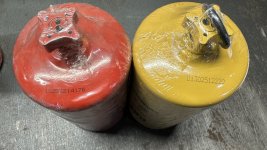
just to demonstrate:

IMG_3179.jpeg
Baldwin BF1268 on left, “Cat” 175-2949 on right in the picture above.
IMG_3177.jpeg
Both with 11 digit batch codes.
(Baldwin is the only filter company that uses an 11 digit batch code system)
Both with the same identical canister.
Both roll off the assembly line at Baldwin’s Kearney Nebraska plant.

The only difference is the color of the paint, the name and part number printed on the side, and the Cat is packaged with the O-ring since most Cat applications using that filter also happen to have a spin-on sight glass which attaches in place of the drain screw.

They’re the same filter.
The Cat version is commonly offered as part of BMP’s “upgrade” kit.

I’ve reached out to Cat and asked for specifications for this filter and they cannot (will not) supply them. Conversely I reached out to Baldwin and they were happy to provide me with the specifications for the BF1268, but “could not comment” on whether or not they do indeed manufacture the 175-2949 for cat, nor could they provide specs for that filter. The guy repeatedly said the same thing: “If you use the Baldwin in applications where the Cat is recommended, you will have no issues. It is equivalent”

Tells you everything you need to know.

So based on that, here are the specs for the BF1268 (and thereby the “Cat” 175-2949 also)

Micron: 13 absolute, 4 nominal

Compared to the OEM Parker (Baldwin) PF46152 (same as Mopar 68436631AA) which has a >4 micron absolute rating

Absolute means 98% efficient
Nominal means 52% efficient.
 
I guess I must be missing something or I'm just an idiot.
I've searched and searched, what I have found is that OEM filters, filter down to 3 or 4 microns "absolute", this is depending on where you read. FASS advertises that their filter (the one I use) filters down to 2 microns "absolute". With the information I found, it's hard to believe the FASS system is a step backwards. I have no reason to believe all of FASS's hype in their marketing, and there is a lot of it. It seems to me that (what I found searching anyway) the FASS system is at least as good as OEM.
 
I guess I must be missing something or I'm just an idiot.
I've searched and searched, what I have found is that OEM filters, filter down to 3 or 4 microns "absolute", this is depending on where you read. FASS advertises that their filter (the one I use) filters down to 2 microns "absolute". With the information I found, it's hard to believe the FASS system is a step backwards. I have no reason to believe all of FASS's hype in their marketing, and there is a lot of it. It seems to me that (what I found searching anyway) the FASS system is at least as good as OEM.
I promise you that the members responding to this thread aren’t feeding you lies. Their research is legitimate. @mbarber84 and @AH64ID know their ****.

Legitimately the only thing a FASS improves is fuel volume. If that’s good enough for you, then great, but the fass marketing machine is deceiving you on the filtration and water separator quality.
 
Back
Top