I doubt there is much calibration also. In my mind lack of calibration consistency is the only way to explain the wide range of opinions on the air suspension. Just a few posts up is a guy that has never had a truck that rides so nice. Yet you don't have to do much searching to find others that wish they'd have never ordered the air suspension..... Hopefully the system is calibrated during the truck assembly process to set normal ride height but I doubt it.
Ram Heavy Duty Forum
You are using an out of date browser. It may not display this or other websites correctly.
You should upgrade or use an alternative browser.
You should upgrade or use an alternative browser.
'21 3500 Rear Air Suspension - Smoooth Ride!
- Thread starter roegs
- Start date
Nick
Well-Known Member
My question is...Iif you adjust the bags down for a smoother ride empty . Will it affect the fill amount and ride when you tow a heavy 5th wheel ?
My question is...Iif you adjust the bags down for a smoother ride empty . Will it affect the fill amount and ride when you tow a heavy 5th wheel ?
Ride quality is always subjective but I'll give you my opinion. Right now my adjustments with the truck empty allow me to insert my index finger between the front rubber bump stop and spring. In this case bags are slightly filled. Our 5th wheel has a pin weight of approximately 2500 lbs. Yesterday when I lowered the pin onto the truck, the suspension automatically re-leveled to the same point of me being able to insert my index finger between front rubber bump stop and spring. It sensed the load and brought the truck back to where it was empty. In my case the 5th wheel rides a little nose high so I set the suspension to alt height which lowers it about 1". Alt height lowers the truck enough that there is no longer any space between front rubber bump stop and spring. With all the pin weight in the back I still feel its a very acceptable ride.

John Jensen
Well-Known Member
- Messages
- 1,274
- Reaction score
- 1,154
- Points
- 113
The system will keep the truck to the set height regardless of the load.My question is...Iif you adjust the bags down for a smoother ride empty . Will it affect the fill amount and ride when you tow a heavy 5th wheel ?
Thank you for this! I am new to big trucks (2018 3500 Turbo Diesel) and I did notice the air bags are rock solid and significant jarring. Put on new Cooper AT3 XLT's at 65 front 60 rear when unloaded (based on chalk test) which helps, but still jarring on sharp bumps and holes.As I put my order together for a '21 3500 SRW, I went back and forth on the air suspension. What surprised me was the number of vastly different reviews on how this truck rode empty with air suspension. Some loved it, and others regretted ever getting it. From test drives that I did, I actually preferred GM trucks, but RAM HD's are shorter and were the only trucks that would fit in my garage without a major re-organization. Magazine reviews all rave about RAM HD ride quality - including the 3500 air suspension. We're retiring and would like to do some traveling with a 5th wheel - but lets be honest, 80% of this trucks use would be DD getting groceries and Home Depot runs. In theory, the air suspension should make a big difference in ride quality. RAM basically takes a much lighter spring pack (I think it basically is there to hold the axle in place) and then uses air bags to assist once a load is applied and the rear of the truck lowers on the light spring pack. Anyway, that's my understanding.
Rolled the dice and ordered it.
The dealer I purchased from was about 45 miles away. After taking delivery of the truck, I pulled around the building and checked tire air pressures. They were all over 80 lbs. Lowered the front axle to 60 lbs. and rear to 50 lbs. Then proceeded to drive home. Mixed combination of backroads and freeway. It rode okay, but I was sure hoping for better.
Next morning I slid under the truck and poked my finger into the air bags. Passenger bag had no pressure in it, but the drivers was very firm. What! I figured each would be the same. I had seen a youtube video where a guy had adjusted the height sensors somehow, so I figured I'd take a look.
1. Each side of the rear axle has its own sensor. The photo below is not the best, but the sensor has a long arm that extends to a rod that attaches to the axle. The sensor itself is mounted to the frame with two bolts.
2. I measured the angle of the sensor on the passenger side (angle sensing app built into iphone's) and it was 4 degrees different than the drivers sensor angle.
3. I loosened the two bolts on the drivers side (where sensor bolts to frame) and the holes are somewhat slotted in the sensor bracket. Before loosening them, the top of the sensor bracket was parallel with the frame. Same for passenger side (top of the sensor bracket was parallel with the frame).
4. After loosening the drivers side bolts, I was able to turn the bracket clockwise. Look close at the photo and you can see that the bracket is no longer parallel with the frame. There is not a lot of play in the bracket holes, but enough for me to hear the bag on the drivers side deflate. Excellent!
5. At this point, I went for a drive - finally! It rode like I thought it should.
6. Not done yet though - went to the local recycle drop off and weighed my truck. Front axle, Rear axle, and combined.
7. Firestone Load Chart for our tires (I have 20" Longhorn rims) showed I could easily go down to 40 lbs in the rear when the truck is not towing. 60 lbs is good for the front axle (Cummins HO).
Between these two, my truck now has a beautiful ride.....to be honest, not a whole lot different than my '15 Eco with air suspension that I traded in.
My theory....(and I'd love to find someone with a 19+ RAM Service Manual to see how they recommend setting the sensors.)
1. I'm thinking that with an empty truck, the bags should have little to no air in them.
2. The sensors are very sensitive, and a small amount of rotating the drivers bracket was all it took for mine.
3. Based on my truck, I'm guessing the assembly line guys install the sensor brackets so both passenger and drivers are parallel with the frame. I suspect there are no further checks done to ensure sensors are both set the same.
I hope this works for others. These are spendy trucks and having it ride nice around town was the icing on the cake for me.
View attachment 13337

- Messages
- 5,260
- Reaction score
- 5,491
- Points
- 113
Thank you for this! I am new to big trucks (2018 3500 Turbo Diesel) and I did notice the air bags are rock solid and significant jarring. Put on new Cooper AT3 XLT's at 65 front 60 rear when unloaded (based on chalk test) which helps, but still jarring on sharp bumps and holes.
Still sounds like way too much air pressure for an unloaded truck. What size tires?

- Messages
- 5,260
- Reaction score
- 5,491
- Points
- 113
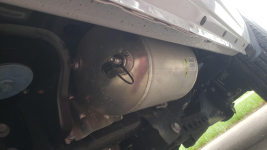
Looked at a factory rear air 3500 today. Crawled underneath and noticed it has a large reservoir tank on the front RH side outside the frame. Even has a quick coupler on it. Anyone swapped it out for a more common air chuck? View attachment 85122
View attachment 85123
The system will throw a leak code if the compressor runs too long, so it’s not a viable source of air.

Looked at a factory rear air 3500 today. Crawled underneath and noticed it has a large reservoir tank on the front RH side outside the frame. Even has a quick coupler on it. Anyone swapped it out for a more common air chuck? View attachment 85122
View attachment 85123
That's for pre-filling the system after service.

PyroJoe
Active Member
- Messages
- 228
- Reaction score
- 161
- Points
- 43
Compressor's that weak eh? That's a bummer. I'm surprised there isn't an aftermarket upgrade with a better compressor & some alfaobd tuning to get rid of the trouble codes. So much untapped potential here.That's for pre-filling the system after service.
Compressor's that weak eh? That's a bummer. I'm surprised there isn't an aftermarket upgrade with a better compressor & some alfaobd tuning to get rid of the trouble codes. So much untapped potential here.
AlfaOBD isn't a tuner. It can only make changes to what's supported in a BCM and that the developer supports. You could always disable the system and go 100% aftermarket, perhaps using the tank with a robust compressor.
Alternatively, some smart coder could possibly engineer an Arduino MITM solution.

I think the way to do it would be to pull the factory tank out, put a larger one in, and install your own compressor with a lower start pressure than the factory compressor. That way the factory one pretty much never runs. You’re still carrying around the factory compressor, but you’ve eliminated the space wasted by the factory tank.AlfaOBD isn't a tuner. It can only make changes to what's supported in a BCM and that the developer supports. You could always disable the system and go 100% aftermarket, perhaps using the tank with a robust compressor.
Alternatively, some smart coder could possibly engineer an Arduino MITM solution.
Of course, it would be far easier to just leave the factory system alone and install your own separate system.