What's new
Ram Heavy Duty Forum

Register a free account today to become a member! Once signed in, you'll be able to participate on this site by adding your own topics and posts, as well as connect with other members through your own private inbox!

5w40 vs. 10w30 vs..... 5w30?

I have ran amsoil 10-30 max duty since 2018.

3 different trucks. no issues. Heavy towing. However i change my oil at 7500 miles. needed? doubt it. but i do it regardless. its easy and cheap insurance
 
I have ran amsoil 10-30 max duty since 2018.

Cummins, not Ram, does authorize 10w-30 in the ISB with a minimum HTHS of 3.5, which is what the Amsoil DTT has.

Many years ago I ran Amsoil's HDD 5w-30 in my 05 since it met the Cummins specs. When we pulled the motor apart, different reason, the cam/tappets all had a lot more wear than they should have for the miles and we attributed that to the 5w-30 just meeting, not exceeding, the HTHS requirements from Cummins.
 
Oof, ya got me I guess. Won’t see me trying that concoction in my engine.

The only oil that’s documented with direct correlation to lifter issues is 15w-40.
Yeah I'm not doing it, but if someone did, doubt very seriously it would have any ill effects. If 10/30 is fine and 5/40 is fine, then a mix of the two should be fine.

And maybe I don't understand your comment about lifter issues and 15/40 but there's been more than just a couple failed lifter engines that used both 10/30 and 5/40, assuming the owners are being honest. So not sure how you mean that.
 
And maybe I don't understand your comment about lifter issues and 15/40 but there's been more than just a couple failed lifter engines that used both 10/30 and 5/40, assuming the owners are being honest. So not sure how you mean that.

There are two type of lifter issues, those attributed to the wrong oil spec (15w-40), and all the rest that are lifter failures that are independent of oil related issues.
 
I've heard from more than one source recently that many of the lifter failures have been caused by bad product and poor material from a few suppliers. Some of those sources have suggested that as of 2024, those bad product suppliers have been rooted out and are no longer supplying Cummins, leading one to believe that as of 2024, the failed lifter issue due to poor lifter quality had been identified and eliminated. Do you have any reliable reason to believe this is true? Does anyone have any knowledge of failed lifters in a 2024 6.7?
 
I've heard from more than one source recently that many of the lifter failures have been caused by bad product and poor material from a few suppliers. Some of those sources have suggested that as of 2024, those bad product suppliers have been rooted out and are no longer supplying Cummins, leading one to believe that as of 2024, the failed lifter issue due to poor lifter quality had been identified and eliminated. Do you have any reliable reason to believe this is true? Does anyone have any knowledge of failed lifters in a 2024 6.7?
Cummins has used three independent suppliers to provide the lifter bodies since 2019. The source supplier (manufacturer) can be identified by looking at the lifter body itself. They use a series of grooves around the upper portion of the lifter to identify which supplier the part came from. Some suppliers have multiple production lines so they use a number of grooves (or different groove spacing) to signify which manufacturer, and which particular production line the lifter body came from. One of the three suppliers uses no identifying grooves at all. These are the “smooth” ones that have shown up in some engines. Some of these suppliers have demonstrated more prolific failures than others, due to quality control issues and lifter geometry being out of spec. The three suppliers manufacture the lifter body itself, but not the roller assembly attached to the bottom of the lifter. The roller assembly is supplied by three other totally different manufacturer / suppliers.

The three lifter body suppliers are still producing lifter bodies for 2024 and 2025, however the three roller suppliers have changed over the years. One supplier supplied rollers from 19-21, another from 21 to 24, and a new supplier has been taken on for 2025+

These lifters have been problematic from the very beginning, demonstrating quality control issues from their very inception. Cummins has been actively monitoring / addressing these issues since the new valvetrain was implemented. The quality control issues have been improving, and changing suppliers has rectified some issues, while also generating new ones. I think part of what gives this issue more complexity is that there are warehouses full of lifters that, in some cases, might be NOS and contain flaws. As far as I know there’s been no internal recall to remove older supplies of these lifters and supplement them with new ones in order to prevent potentially “bad” ones from being installed under the “fix as they fail” approach ram is using to address these problems.

I sincerely hope that these issues will become less and less common as time goes on, but it does seem like supplier quality control issues are at the heart of this particular failure. I’d assume it’s rather difficult to monitor the quality of these since there are so many being produced from so many different suppliers. Seems like it would be a logistical nightmare. Especially when you consider in some instances, Cummins is relying on the manufacturers themselves to “check” and “affirm” that the parts are within the specs Cummins supplies / requires.
 
Very informative reply, thank you. Lots of info there. Unfortunately it does little to assauge my concerns. You were supposed to say, "Yup, everything has been figured out and the 24's are good to go ."

LOL!

It will never cease to amaze me how much questionable quality and downright garbage parts and systems these manufacturers are KNOWINGLY willing to put out into the world, and then take a "figure it out as we go" approach with customer's investments.
 
Very informative reply, thank you. Lots of info there. Unfortunately it does little to assauge my concerns. You were supposed to say, "Yup, everything has been figured out and the 24's are good to go ."

LOL!

It will never cease to amaze me how much questionable quality and downright garbage parts and systems these manufacturers are KNOWINGLY willing to put out into the world, and then take a "figure it out as we go" approach with customer's investments.
Believe me, I wish I could give you (and everyone else) that type of affirmation in earnest. Unfortunately that’s not possible and wether or not there will be improvement remains to be seen.
 
not sure if this was on the 2021 or earlier, but guess you dont have to ask what weight oil to go to anymore on the 24's lol.

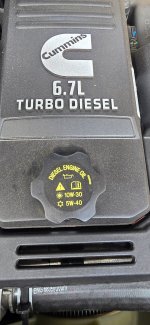
did my first oil change yesterday and noticed this


20241229_130015.jpg
 
So here's a question -
I believe the oil change frequency is 15,000 miles or 12 months (whichever comes first). Assuming a person consistently hits the 12 month mark rather than the mileage mark, which would be the better "all season" choice?

depends on where you live, but im seeing west virgina so i would assume 10-30 would be fine for all year use. its what i use as maryland's winter average is warmer
 
So here's a question -
I believe the oil change frequency is 15,000 miles or 12 months (whichever comes first). Assuming a person consistently hits the 12 month mark rather than the mileage mark, which would be the better "all season" choice?
This is a commonly misunderstood / misinterpreted concept.

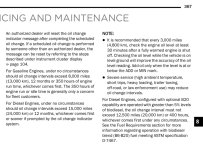
The 15,000 mile / 12 month / 500 hour oil change interval is not the recommended interval by Ram. It is the maximum allowable limit. There’s a difference. Ram isn’t coming out and saying everyone should be changing the oil in these things every 15k, although that’s what’s widely spread / rumor-milled / perpetuated. The interval should change based on how the truck is used, the climate it operates in, its daily duty cycles, the type of engine oil used, and even the type of fuel used in the truck.

IMG_9775.jpeg

The “when” of when it’s time to change your oil is based on all of the above. I’d venture to say there’s a significant number of owners out there who should be changing their oil more frequently than the maximum allowable limit, or even before the oil life indicator tells them too.

Not all oils are created equal and no two owner - operators are the same.

If you really want to know when it’s time, Oil Analysis is the best way to develop a schedule that suits the conditions your truck is existing in.

 
i do my oil at 7500. do i need to, dunno. but its about when i feel it should be done.
 
This is a commonly misunderstood / misinterpreted concept.

The 15,000 mile / 12 month / 500 hour oil change interval is not the recommended interval by Ram. It is the maximum allowable limit. There’s a difference. Ram isn’t coming out and saying everyone should be changing the oil in these things every 15k, although that’s what’s widely spread / rumor-milled / perpetuated. The interval should change based on how the truck is used, the climate it operates in, its daily duty cycles, the type of engine oil used, and even the type of fuel used in the truck.

View attachment 80676

The “when” of when it’s time to change your oil is based on all of the above. I’d venture to say there’s a significant number of owners out there who should be changing their oil more frequently than the maximum allowable limit, or even before the oil life indicator tells them too.

Not all oils are created equal and no two owner - operators are the same.

If you really want to know when it’s time, Oil Analysis is the best way to develop a schedule that suits the conditions your truck is existing in.

You are correct, and I appreciate you pointing that out.
I was actually reacting to the "710" cap - thinking about viscosity choice across the seasons and trying to ask about that. In other words, if you changed oil today and temps are above 0° F but three months from now they are going to be below 0° F, which would you choose?
 
not sure if this was on the 2021 or earlier, but guess you dont have to ask what weight oil to go to anymore on the 24's lol.

did my first oil change yesterday and noticed this


View attachment 80671

I believe the oil cap has looked that way since 2019.

So here's a question -
I believe the oil change frequency is 15,000 miles or 12 months (whichever comes first). Assuming a person consistently hits the 12 month mark rather than the mileage mark, which would be the better "all season" choice?

5w-40 provides the best hot and cold weather performance. 10w-30 may yield slightly better fuel economy.

This is a commonly misunderstood / misinterpreted concept.

The 15,000 mile / 12 month / 500 hour oil change interval is not the recommended interval by Ram. It is the maximum allowable limit. There’s a difference. Ram isn’t coming out and saying everyone should be changing the oil in these things every 15k, although that’s what’s widely spread / rumor-milled / perpetuated. The interval should change based on how the truck is used, the climate it operates in, its daily duty cycles, the type of engine oil used, and even the type of fuel used in the truck.

View attachment 80676

The “when” of when it’s time to change your oil is based on all of the above. I’d venture to say there’s a significant number of owners out there who should be changing their oil more frequently than the maximum allowable limit, or even before the oil life indicator tells them too.

Not all oils are created equal and no two owner - operators are the same.

If you really want to know when it’s time, Oil Analysis is the best way to develop a schedule that suits the conditions your truck is existing in.

Aside from B20, since the truck doesn't know if you're running it or not, the oil change interval is 12 months, 15K miles, or 500 hours whichever happens first. Nothing it the owners manual recommends changing it sooner unless the oil change indicator prompts sooner which should take into account severe service. Last year (oil change in sept of 23) my fuel filter and oil change indicators didn't match as my first few thousand miles of use was in the severe category. By the time I hit 8 months on the oil they equaled out. This year (sept 24) my oil change indicator and fuel filter indicator are matched (within 1% since fuel hits 99% as soon as you drive) as my use was not severe for the first couple months.

Deeper in to the owners manual the verbiage is pretty hard to misinterpret, and definitely doesn't elude to any reason other than what's stated to shorten the OCI. Change it when the first of the 4 things happens.

Change engine oil every
15,000 miles (24,000 km) or
12 months or 500 Hours or
sooner if prompted by the oil
change indicator system,
whichever comes first.
 
My 2019 didn't come with the oil labeled cap, I remember something about a TSB about an oil type update that came out later, may have had something to do with folks using 15W-40 oil? And they did come out with the updated available cap after that. I do tow my small toyhauler 6-8 times a year, have 0 degrees F to 90+ yearly weather, and I just go by the oil change indicator which has always been15,000 miles. So obviously nothing for severe duty since the oil indicator isn't telling me to change sooner, and I use 5W-40 which covers both spectrums of the cold and warm weather I have here.
 
Back
Top