What's new
Ram Heavy Duty Forum

Register a free account today to become a member! Once signed in, you'll be able to participate on this site by adding your own topics and posts, as well as connect with other members through your own private inbox!

Regeneration Frequency Issue: MAF Poll

Please indicate which MAF your truck has and wether or not it has a Regeneration Frequency problem.

  • I have AARFN and a regeneration frequency issue.

    Votes: 26 53.1%
  • I have AARFN and NO regeneration frequency issue.

    Votes: 14 28.6%
  • I have ABMBV and a regeneration frequency issue.

    Votes: 7 14.3%
  • I have ABMBV and NO regeneration frequency issue.

    Votes: 2 4.1%

  • Total voters
    49
Thank you very much for that informative response. I never look at the gauge function you refer to. I'll have to check it out. Is an increase in idle speed from around 700 up to 1000 to 1100 while warming up in the driveway on a cold morning part of a regen cycle? What does PID refer to? DD'd? Thanks again!
The increase in idle RPM during cold start up is part of the trucks automatic cold weather warm up strategy. It does not have anything to do with regeneration. However, the truck does monitor idle time. If you accumulate 2 hours of collective idle time within a certain period of time, the truck will increase the engine idle speed to about 900-1000rpm as part of the “hydrocarbon desorption mode”. This is designed to increase in-cylinder combustion temperatures so that the fuel is burned more completely and excess unburned fuel and soot isn’t sent downstream to the DPF under low exhaust flow. It prevents face-plugging of the DPF as well as reduces the chance for condensation to form in the exhaust system during idle operation. The moisture in the system would cause issues with soot flow and can also adversely effect the sensors in the system.

PIDs are parameter ID’s. Basically items that can be monitored via sensors in the vehicle.
 
Thank you very much for that informative response. I never look at the gauge function you refer to. I'll have to check it out. Is an increase in idle speed from around 700 up to 1000 to 1100 while warming up in the driveway on a cold morning part of a regen cycle? What does PID refer to? DD'd? Thanks again!
DD = Daily Driven. As in stop and go, short trips and unloaded. ie grocery getter
 
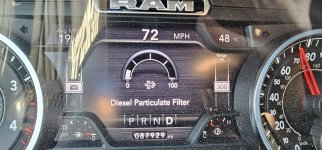
Today out of curiosity more than anything, my truck had 18 hours since last regen with 25% on the DPF dash gauge and I wanted to see how long it would take it to passively regen back to zero towing. It took a total of 15 miles towing my 7K TT at 65 mph with a few hills mixed in and outside temps of 70 degrees.
 
Today out of curiosity more than anything, my truck had 18 hours since last regen with 25% on the DPF dash gauge and I wanted to see how long it would take it to passively regen back to zero towing. It took a total of 15 miles towing my 7K TT at 65 mph with a few hills mixed in and outside temps of 70 degrees.
Towing a moderate load is the fastest easiest way to achieve passive regeneration. It is absolutely the best option. It’s more effective and much faster than trying to achieve it unloaded.
 
I kept going for another 10 miles and then the 25 miles back home. I was amazed at how fast it dropped back to zero. Wife also asked me if I ever had to put DEF in this truck. She said our 18 used a lot more DEF than this truck does.
She knows. She pays the bills.
 
Regeneration is the process that the trucks emission system uses in order to clear out trapped soot in the diesel particulate filter (DPF).

As you drive the truck, the soot gets trapped in that filter. The soot is constantly trapped inside it, and then systematically removed through a process called regeneration. There are three types of DPF regeneration cycles that can occur in your truck. These are “Active Regeneration (aka automatic regeneration)”, “Passive Regeneration”, and “Forced Regeneration (aka stationary desoot or parked regeneration”

Active regeneration cycles occur in one of two ways. Either based on the current soot load in your DPF or every 24-25 hours of engine operation. In the soot-load based mode, the cycle will automatically initiate when the % of soot in the DPF reaches a pre-programmed threshold. In our trucks, that threshold is about 50% on the in-dash DPF gauge. Once it starts, it will continue until the % reaches zero, or the operator does something to inhibit the cycle (putting the truck in park or shutting it off) If the cycle is inhibited by the operator, it will pick back up when the truck begins to move again and conditions in the engine and emissions systems are favorable for regeneration to continue. In the timed mode, the same cycle will initiate every 24-25 hours of engine operation regardless of the % soot load in the DPF. Active regeneration initiated either at the 50% soot load threshold, OR at the 24 hour engine timer. Whichever scenario happens first. The timer always resets when a cycle is completed, regardless of which type of initiation started it. In both the scheduled and threshold based active regeneration cycles, diesel fuel is being injected into the exhaust stream to raise the temperature in the DPF high enough to burn away the accumulated soot. You should do your best to allow this cycle to continue once started, and preferably during highway driving. When the truck is in an active regeneration, if you scroll to the DPF gauge in the dash, you’ll see a message that says “automatic exhaust system regeneration in progress”.

Passive regeneration is another way the DPF is cleared of soot. In this type of regeneration, the truck is generating high enough exhaust temperature that the temperature inside the DPF is raised to a point where soot will naturally begin to burn away. Passive regeneration happens naturally while you drive, without any additional fuel added to the exhaust steam. The only requirement is that the truck is working hard enough to generate high enough EGT’s to maintain the reaction in the DPF. The DPF has to remain at around 600-660°F or higher in order for passive regeneration to continue. Passive regeneration usually takes longer to clean the DPF out especially when the trucks engine is operating under a reduced load (unloaded or not towing) This type of regeneration typically only happens at highway speed or while towing continuously. There is no message on the dash when this type of regeneration is occurring. The only way you’ll know it’s happening is a visible reduction in the % soot load gauge on the dash screen.

Forced regeneration is the third type of regen cycle. It is similar in function to an active regeneration cycle as mentioned before. The only difference is, a forced regeneration occurs while the truck is sitting in park. It must be initiated by either a service scan tool, or in the case of the chassis cabs, by means of an option on the display. These are often referred to as “stationary de-soot” cycles. They are extremely effective at cleaning the DPF out because the truck has full control of the engine RPM and fuel dosing, and can thus increase and hold the temperature in the DPF to a very high level for a continuous length of time. These types of regeneration cycles are only needed if the other two types of cycles are not regularly allowed to occur.

Great description! However; what is the mode when the message indicates : automatic exhaust system regeneration in progress continue driving?
 
That’s the mode just before the “DPF Full See Dealer”. Too many failed attempts to automatic regen.
 
Great description! However; what is the mode when the message indicates : automatic exhaust system regeneration in progress continue driving?

Active regen that hasn’t been able to complete so the filter has above normal soot loading. Best driving in this scenario is high speed interstate driving where you get steady state filter cleaning until it’s complete.
 
Great description! However; what is the mode when the message indicates : automatic exhaust system regeneration in progress continue driving?
Thats what’s known as an “Intervention message”. When you see the “continue driving” message, that means the normal regeneration cycles have not been allowed to complete, or have been interrupted several times. The truck is going to urge you to continue driving so that it can complete the necessary regeneration. These trucks are programmed to regenerate every 24 engine hours, or anytime the soot load in the DPF reaches 50%. If the regeneration isn’t allowed to complete, or the truck is driven in such a manner as it can’t be effective, the truck is going to attempt to alert you to this condition and get the truck on the highway where it can regen effectively and get the soot load down below 50%.
 
That's "active regen" ie. it's adding more fuel to force higher EGTs to burn off soot.
All regeneration where a notice is given is active regeneration. But there are two different messages depending on what’s going on

automatic exhaust system regeneration in progress” = Normal active regeneration

Automatic exhaust system regeneration in process continue driving” = intervention message due to normal active regeneration not being completed as scheduled / needed
 
Does the continue driving message display regardless of what screen you have the EVIC on?
 
Does the continue driving message display regardless of what screen you have the EVIC on?
Yes.

Since it is considered an “intervention” message, it will “pop-up” on the EVIC regardless of what screen you are currently viewing. It also is usually accompanied by an audible chime from the dash.

Normal regeneration message is only visible if you happen to scroll to the DPF screen when the truck is currently running an active regeneration cycle.
 
whats the average amount of active regens?
That’s going to vary based on how the truck is used / operated. If you’re using the truck in a manner consistent with ideal operation, the only active regeneration you should see is once every 24 engine hours (which usually works out to around 900-1000 miles between them)
 
That’s going to vary based on how the truck is used / operated. If you’re using the truck in a manner consistent with ideal operation, the only active regeneration you should see is once every 24 engine hours (which usually works out to around 900-1000 miles between them)

ok, i asked cause my truck has been burning def but hasn't gone into active regen, and doesn't show any % on the DEF screen. its been about 1000 miles. i do burn through miles since i daily it 110 miles a day. Most highway at 75-80mph :)
 
ok, i asked cause my truck has been burning def but hasn't gone into active regen, and doesn't show any % on the DEF screen. its been about 1000 miles. i do burn through miles since i daily it 110 miles a day. Most highway at 75-80mph :)

DEF and regen are not related. DEF is to control NOx and regen deals with soot.

If your DPF gauge stays at 0% you will regen every 24 hours of runtime. How far you get is based on your average speed, to include idle hours.
 
ok, i asked cause my truck has been burning def but hasn't gone into active regen, and doesn't show any % on the DEF screen. its been about 1000 miles. i do burn through miles since i daily it 110 miles a day. Most highway at 75-80mph :)
What model year is your truck?
 
Back
Top