What's new
Ram Heavy Duty Forum

Register a free account today to become a member! Once signed in, you'll be able to participate on this site by adding your own topics and posts, as well as connect with other members through your own private inbox!

Regens at alarming rate!

I’ve had automatic regens happen at 23,24&25 according to the EVIC. The last 2 were with the DPF gauge on 0 but after reading some with the CTS3 it can read 0 on the gauge and still be up to 45% loaded according to the CTS3.

Same here with 23,24,25 for 24 hour based regens. It’s simply how the hour meter reports without any decimals. I know it’s a 24 hour regen by monitoring the soot PID on my CTS3 and the EVIC DPF gauge.

The CTS3 is showing multiple things with the DPF PID, time and soot loading. Following an active regen it’s soot loading, but I’ve found that the number at the completion of a regen isn’t as accurate as the next start cycle number.

For example, if my truck completes an active regen the PID may show 30-40%. If I shut the truck down and let it rest for 10 minutes, computers to sleep, and start it back up it will show a more accurate soot loading, normally 9-15% but I’ve seen at low at 6%.
 
Thanks! That makes sense and was originally how I thought the 24 hour timer operated. Because I've lost lock on when my last active regen completed, I probably need to let a soot-based regen happen so I know exactly when the 24 hour clock resets. A couple of weeks ago I drove for about 30 minutes with the EVIC on the trip computer and noticed my soot load was down to zero when I switched back to the DPF screen. I bet that's when my last active regen happened and I just didn't see the message because I was on the wrong screen.

I probably need to let my truck "soot up" anyway because the way I'm driving it now (hopping on the highway every time the soot load increases) only masks any problems. During the winter months I don't tow anything and don't normally drive long distances. Since it's been so long since I've let a soot-based regen occur I'm not even sure how many miles I can get between active regens given my current stop-and-go driving pattern, but it wouldn't surprise me if it was only around 300 miles.
I just reset trip meter B as soon as my truck completes an active regen, easy to track. If my soot load gets to around 45%, it starts an active regen, my 24 hr timer starts at the end of the active regen completion. Even driving interstate back and forth to work every day I don’t always make it to the 24 hr interval, I average around 600 miles before a regen.
 
I don’t think your issue is 100% software based or most of us would have issues very similar, which leads me to believe you probably have a bad DPF pressure sensor and the PCM things the DPF is more clogged than it is.
They said they replaced the sensor the 3rd time is was in for the check engine light ( around 4k miles ago). There was some thought during that time that the sensors were defective. Maybe they replaced it with the same part number.
They also said that I was running the wrong filter, even though it was a stock Mopar filter from the dealer. It had the glue strips, and replace it with one without the strips. I just ordered a new filter with the correct non strip part number called out in P2459 Star service bulletin. The package arrived with the 53034051AB Mopar number on the bag but the filter has the glue strips. I looked at the part number on the filter and its completely different, 68517554AA, which is the filter that I had on before and they said it was the wrong one. If the people who supply Mopar parts are not putting the correct parts in the correct bag, how is someone to know they are getting the right part. Seems like a hugh supply mess.
 
They said they replaced the sensor the 3rd time is was in for the check engine light ( around 4k miles ago). There was some thought during that time that the sensors were defective. Maybe they replaced it with the same part number.
They also said that I was running the wrong filter, even though it was a stock Mopar filter from the dealer. It had the glue strips, and replace it with one without the strips. I just ordered a new filter with the correct non strip part number called out in P2459 Star service bulletin. The package arrived with the 53034051AB Mopar number on the bag but the filter has the glue strips. I looked at the part number on the filter and its completely different, 68517554AA, which is the filter that I had on before and they said it was the wrong one. If the people who supply Mopar parts are not putting the correct parts in the correct bag, how is someone to know they are getting the right part. Seems like a hugh supply mess.

Order your filters from Geno’s Garage. They know the difference and will send you the correct filter.

Your sensor issue could be the sensor or the sensor wiring.
 
Did you order the filter from Amazon? If you did or do you have to read ALL of the fine print. I tried to leave a review on Amazon showing that they call it one thing but show farther down that it’s actually the other one. They also know it’s an issue or they wouldn’t try to camouflage it. They declined my review.
 
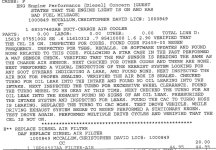
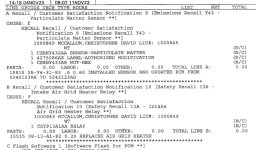
Second occurrence of the CEL and P2459 code.

This was the breakdown of what the techs performed on the initial troubleshooting.

LoL, note the air filter number hahaha. It seems the system still calls out the AA filter.

Note, both the grid heater relay and PM sensor recalls were performed at the same time.

Same as others no active regens when towing. I watch as is passively regens under load.

I’ve been looking at other manufactures, each one has their own issues, Ram and these 22’s are just probably one of the more problematic.

I’ll give it 3 times at the dealer for the same issue and ya boy is seeking legal counsel.
 

Attachments

  • IMG_0012.jpeg
    IMG_0012.jpeg
    688.2 KB · Views: 39
  • IMG_0013.jpeg
    IMG_0013.jpeg
    406 KB · Views: 38
Last edited:
Second occurrence of the CEL and P2459 code.

This was the breakdown of what the techs performed on the initial troubleshooting.

LoL, note the air filter number hahaha. It seems the system still calls out the AA filter.

Note, both the grid heater relay and PM sensor recalls were performed at the same time.

Same as others no active regens when towing. I watch as is passively regens under load.

I’ve been looking at other manufactures, each one has their own issues, Ram and these 22’s are just probably one of the more problematic.

I’ll give it 3 times at the dealer for the same issue and ya boy is seeking legal counsel.

Did they not flash the PCM or just a typo?

1704137310213.png
 
Did they not flash the PCM or just a typo?

View attachment 67367
Holy crap! Hahaha I hope that’s a typo. I’ll call them tomorrow to see what’s up.

Luckily I have a dealer nearby that the advisor actually calls me back, takes questions to the techs, provides feedback and advise for everything.

In fact after this ‘fix’ he has called me probably 4-5 times to see how everything is going and encourages me to keep him informed. Probably using the data to help RAM figure this blunder out.

I’ll reply after talking with them.
 
Holy crap! Hahaha I hope that’s a typo. I’ll call them tomorrow to see what’s up.

Luckily I have a dealer nearby that the advisor actually calls me back, takes questions to the techs, provides feedback and advise for everything.

In fact after this ‘fix’ he has called me probably 4-5 times to see how everything is going and encourages me to keep him informed. Probably using the data to help RAM figure this blunder out.

I’ll reply after talking with them.

If you have a good relationship with the service crew, ask for a printout of the WiTech scan. It will; show flash levels in all the modules.
 
Holy crap! Hahaha I hope that’s a typo. I’ll call them tomorrow to see what’s up.

Luckily I have a dealer nearby that the advisor actually calls me back, takes questions to the techs, provides feedback and advise for everything.

In fact after this ‘fix’ he has called me probably 4-5 times to see how everything is going and encourages me to keep him informed. Probably using the data to help RAM figure this blunder out.

I’ll reply after talking with them.

If you have a good relationship with the service crew, ask for a printout of the WiTech scan. It will; show flash levels in all the modules.
I will ask, thanks.

I’m wondering how this will all shake out once the emission police come down on Cummins / Ram.

I’m also wondering if the lack of PM sensor during the initial build created ‘opportunities’ for a rush fix program that was faulty and the subsequent after PM sensor program is also lacking proper configuration. It’s got to be calculating the PM % with a decimal in the wrong spot or something. 100% speculation of course.
 
I will ask, thanks.

I’m wondering how this will all shake out once the emission police come down on Cummins / Ram.

I’m also wondering if the lack of PM sensor during the initial build created ‘opportunities’ for a rush fix program that was faulty and the subsequent after PM sensor program is also lacking proper configuration. It’s got to be calculating the PM % with a decimal in the wrong spot or something. 100% speculation of course.
That is my suspicion, others disagree. I should get the new MAF sensor, that has already shown to not be the fix, next week.
 
That is my suspicion, others disagree. I should get the new MAF sensor, that has already shown to not be the fix, next week.
This is like chasing aliens at this point.

Reading some other posts about aluminum and iron content in oil, rocker arms not allowing exhaust valves to open completely leaving regens not actually completing but showing complete at 0% , premature wear on internals in the combustion sequence. Like what the heck RAM, it’s 2023 y’all, my god, get it together!
 
Just my thoughts but the problem is the MAP sensor. I have said it before a month or so ago and I will say it again. MAP sensor is the problem. Until the program is fix to read the map sensor correctly or the MAP to send the correct signal then your trucks will continue to have problems because it will continue to send too much fuel to each cylinder. The MAP sensor is sending a higher reading than it should to the ECU which is giving it more fuel. That’s why your DPF is full of soot and will not get cleaned out. But this is just my opinion.
 
Just my thoughts but the problem is the MAP sensor. I have said it before a month or so ago and I will say it again. MAP sensor is the problem. Until the program is fix to read the map sensor correctly or the MAP to send the correct signal then your trucks will continue to have problems because it will continue to send too much fuel to each cylinder. The MAP sensor is sending a higher reading than it should to the ECU which is giving it more fuel. That’s why your DPF is full of soot and will not get cleaned out. But this is just my opinion.

It very well may be the MAP sensor, I don’t know enough to say yay or nay.. but diesels don’t really care about the MAP signals as much as gas engines.

MAP signals are heavily used to make finite adjustments to timing, and to limit fuel. There are fueling limits based on pressure, but those are coarse adjustments. Basically there is a max fuel at a given manifold pressure, not a specific fuel at a manifold pressure. Giving more fuel than needed would possibly create more soot because we would always be running in the wrong part of the fueling map, but the trucks likely wouldn’t run as smooth or quiet either.

The DPF issues are at low fuel levels, not high fuel levels. At low fuel the timing looks appropriate for for fuel rate, and doesn’t appear to be anything that would cause excessive soot… IMO from tuning HPCRs in the past.
 
Just my thoughts but the problem is the MAP sensor. I have said it before a month or so ago and I will say it again. MAP sensor is the problem. Until the program is fix to read the map sensor correctly or the MAP to send the correct signal then your trucks will continue to have problems because it will continue to send too much fuel to each cylinder. The MAP sensor is sending a higher reading than it should to the ECU which is giving it more fuel. That’s why your DPF is full of soot and will not get cleaned out. But this is just my opinion.
I agree over fueling creates soot but wondering how your AG module helps this situation with the wrong MAP signal and reduces fuel? My understanding is the AG module makes the truck increase fuel rail pressure so more fuel is added during the injector pulses.
 
Just my thoughts but the problem is the MAP sensor. I have said it before a month or so ago and I will say it again. MAP sensor is the problem. Until the program is fix to read the map sensor correctly or the MAP to send the correct signal then your trucks will continue to have problems because it will continue to send too much fuel to each cylinder. The MAP sensor is sending a higher reading than it should to the ECU which is giving it more fuel. That’s why your DPF is full of soot and will not get cleaned out. But this is just my opinion.
At this point I’m willing to hear every and any theory. I believe this is sound, fuel delivery sounds plausible and since a majority of the guys with 21+ HO motors have this issue. the change to the slightly lower compression design probably didn’t help either.
 
I agree over fueling creates soot but wondering how your AG module helps this situation with the wrong MAP signal and reduces fuel? My understanding is the AG module makes the truck increase fuel rail pressure so more fuel is added during the injector pulses.

I see no difference in fuel psi. I see I difference between n MAP sensor by about 3-5 lbs of boost less. From stock to running it on 60hp setting.
 
I see no difference in fuel psi. I see I difference between n MAP sensor by about 3-5 lbs of boost less. From stock to running it on 60hp setting.
Interesting. I see it intercepts FRP and MAP signals.

I’m tempted to try the AG module out. Comes with 30 day money back guarantee.
 
I see no difference in fuel psi. I see I difference between n MAP sensor by about 3-5 lbs of boost less. From stock to running it on 60hp setting.

How are you monitoring rail pressure and boost?

If it’s thru the OBDII port then you are seeing what the module wants the ECM to see, not what’s actually occurring in the motor.

While I don’t know the inner workings of that specific box it appears to be a fuel pressure with boost fooling. That means it will keep the boost reading lower so the ECM doesn’t cut fuel based on over boost and increase rail pressure to gain fuel and that’s how you gain power. None of the connections will effect timing, which is another way to gain power.

You cannot gain power with only connecting to the rail pressure and MAP sensors by lowering boost and not changing rail pressure. Fuel makes power, and there isn’t any added fuel with that equation.

At this point I’m willing to hear every and any theory. I believe this is sound, fuel delivery sounds plausible and since a majority of the guys with 21+ HO motors have this issue. the change to the slightly lower compression design probably didn’t help either.

Compression ratio changes occurred in 2019. There doesn’t appear to be a favorite in the DPF issues between SO and HO, that I have noticed, and SO’s run more compression than 13-18 trucks and HO’s run less.

Interesting. I see it intercepts FRP and MAP signals.

I’m tempted to try the AG module out. Comes with 30 day money back guarantee.

Unless you install analog boost and rail pressure gauges you won’t be able to see what it’s actually doing differently thru the OBDII port.

It appears to be a pressure box, so I’d steer clear of it.
 
Last edited:
Back
Top