What's new
Ram Heavy Duty Forum

Register a free account today to become a member! Once signed in, you'll be able to participate on this site by adding your own topics and posts, as well as connect with other members through your own private inbox!

Setting up Equalizer WD Hitch - those that have please chime in

I edited my post above to clarify. I hang the hitch from the coupler on the trailer, locked with the same locking pin I use when towing, and with the hitch locking pin through the same hole it would normally be in. Never went anywhere in the years I’ve been RVing.L
That's alot of weight your leaving hanging off the travel trailer coupler. I wouldn't feel comfortable doing that. Not designed for. No way you can do that with the GenY weight anyway.
 
That's alot of weight your leaving hanging off the travel trailer coupler. I wouldn't feel comfortable doing that. Not designed for. No way you can do that with the GenY weight anyway.
The coupler would have no issue holding up your hitch. Unless the coupler is severely worn out. Ever see someone loading a UTV car or truck on a flat deck with no landing gear on the rear of the trailer? The trailer tongue can lift up the complete rear end of the truck by the ball sometimes!

Infact when you are hooking up your WDH spring bars you actually have to lift up the truck some with the trailer jack so it can take the weight of your hitch.
 
That's alot of weight your leaving hanging off the travel trailer coupler. I wouldn't feel comfortable doing that. Not designed for. No way you can do that with the GenY weight anyway.
When you use the tongue jack to raise the entire back of the truck up to connect your spring bars you’re putting far more weight hanging on that coupler. The dynamic loads just from driving down the road and hitting a bump are also much higher.

I did it every day for over a year on my Airstream when I was full-timing.
 
Couple things.

The rear height will not change loaded or unloaded, assuming the same mode. So you know what height your ball will be in. The small changes in front height with or without WDH will not have a large effect on rear ball height. The 2” level actually lowered your receiver height, and the 35’s don’t add too much. The 2” level will make it harder to restore front axle weight thou, in my experience.

The 2500 CC SB spring suspension has the highest rear hitch, and the 3500 CC-LB auto-level has the lowest.

Start with 6-7 washers on the equalizer head and setup the L brackets so the bars are parallel with the frame. That should be a good setup and won’t take a lot of adjustments. It seems like a lot of preload for 1K of TW, but your ball is a long ways back from the hitch pin, and the more distance between the two means you need more preload. With that long hitch setup you will still have a harder time restoring 100% of the weight and 50% is what I would hope for.
 
The coupler would have no issue holding up your hitch. Unless the coupler is severely worn out. Ever see someone loading a UTV car or truck on a flat deck with no landing gear on the rear of the trailer? The trailer tongue can lift up the complete rear end of the truck by the ball sometimes!

Infact when you are hooking up your WDH spring bars you actually have to lift up the truck some with the trailer jack so it can take the weight of your hitch.

When you use the tongue jack to raise the entire back of the truck up to connect your spring bars you’re putting far more weight hanging on that coupler. The dynamic loads just from driving down the road and hitting a bump are also much higher.

I did it every day for over a year on my Airstream when I was full-timing.
Guys it's not the concern of the weight being tolerated but the weight hanging on the coupler putting directional strain on the coupler ball latch mechanism inappropriately. That latch isn't meant to "hold" weight. It's locked on the hitch ball in a way where it has play so the ball can pivot inside the coupler but yet keep it secure to the TV. What happens if you bend that locking structure? You ruin the mechanics possibly causing an unsafe operating environment. This is 115+ pounds were talking here. You know what it would take to even lift that entire hitch assembly up in the air steadily and also be able to latch it to the coupler simultaneously? No thanks.
 
Couple things.

The rear height will not change loaded or unloaded, assuming the same mode. So you know what height your ball will be in. The small changes in front height with or without WDH will not have a large effect on rear ball height. The 2” level actually lowered your receiver height, and the 35’s don’t add too much. The 2” level will make it harder to restore front axle weight thou, in my experience.

The 2500 CC SB spring suspension has the highest rear hitch, and the 3500 CC-LB auto-level has the lowest.

Start with 6-7 washers on the equalizer head and setup the L brackets so the bars are parallel with the frame. That should be a good setup and won’t take a lot of adjustments. It seems like a lot of preload for 1K of TW, but your ball is a long ways back from the hitch pin, and the more distance between the two means you need more preload. With that long hitch setup you will still have a harder time restoring 100% of the weight and 50% is what I would hope for.
Actually I need to correct you in that the the 2" leveling kit raised the receiver(rear of the truck) exactly 1-1/4 inches. I used the extended air links from Thuren to add air in the bags and trick the system.

Washers will lower the hitch ball more. I didn't put washers on for my trial install because I noticed the bend in the GenY which halted the install completion but I was exactly at 21" to top of the ball with the head pitch being fairly upright so maybe with 1 or 2 washers. Hard to say. If I went up another hole to have 2 holes showing on the bottom of the shank I would be at 22.5". Maybe too high but we will see. That's where I would likely need the washer count you threw out. But ultimately its going to all depend on what it will take to get the Airstream level.

Replacement GenY is showing up from UPS sometime tomorrow afternoon. Sooner than expected so looking forward to work on.
 
It sounds like your thought process can’t be changed, but I’m with others who damn near lift the back tires of my truck off the ground when locking in the bars on my equalizer WD setup.
 
It sounds like your thought process can’t be changed, but I’m with others who damn near lift the back tires of my truck off the ground when locking in the bars on my equalizer WD setup.
I guess he does not realize the latch is rated for asmuch up lift as the coupler can take down pressure for safety reasons…
 
Actually I need to correct you in that the the 2" leveling kit raised the receiver(rear of the truck) exactly 1-1/4 inches. I used the extended air links from Thuren to add air in the bags and trick the system.

That’s not a level kit, that’s a lift kit. When you say you put a 2” level on a truck that talks about the front to level the truck.

Washers will lower the hitch ball more. I didn't put washers on for my trial install because I noticed the bend in the GenY which halted the install completion but I was exactly at 21" to top of the ball with the head pitch being fairly upright so maybe with 1 or 2 washers. Hard to say. If I went up another hole to have 2 holes showing on the bottom of the shank I would be at 22.5". Maybe too high but we will see. That's where I would likely need the washer count you threw out. But ultimately its going to all depend on what it will take to get the Airstream level.

Washers are what creates the preload. 4 is the minimum, and it doesn’t lower the ball enough to care about it just tilts the head.

The trailer being dead level is secondary to proper preload on the WDH. Don’t fixate on one thing and ignore everything else. With that length of a hitch you need to start at 6-7 washers.
 
That’s not a level kit, that’s a lift kit. When you say you put a 2” level on a truck that talks about the front to level the truck.


Washers are what creates the preload. 4 is the minimum, and it doesn’t lower the ball enough to care about it just tilts the head.

The trailer being dead level is secondary to proper preload on the WDH. Don’t fixate on one thing and ignore everything else. With that length of a hitch you need to start at 6-7 washers.
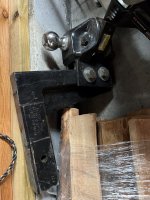
That's not the way the Equalizer manual talks about the washers but yet not much detail about that either in there. No mention of "preload". Update: see photo. Splitting hairs I think on these HD trucks. I don't think the difference with washers are significant enough to matter since truck can already handle the tongue weight rather easily but don't want any sway so will see.

Just telling you what Thuren marketed it as. They say leveling kit. You define how you want. I raised the front with their 2 inch coils 2.25 inches. Rear of the truck was originally 1 inch higher than the front.
 

Attachments

  • Screenshot_20230408-122352_Chrome.jpg
    Screenshot_20230408-122352_Chrome.jpg
    258.1 KB · Views: 6
Last edited:
That's not the way the Equalizer manual talks about the washers but yet not much detail about that either in there. No mention of "preload". Update: see photo. Splitting hairs I think on these HD trucks. I don't think the difference with washers are significant enough to matter since truck can already handle the tongue weight rather easily but don't want any sway so will see.

Read more of the manual. 4 washers minimum, 8 washers maximum. 1 washer is the equivalent of one set of holes on the L bracket. Preferred method of install is level bars, so you set the L brackets for level bars and use washers to get the proper preload. 6-7 is what you will likely need.

HD truck or not the proper number of washers is crucial. Preload, tension, etc… whatever you want to call it is what transfers the weight. No, we don’t need it on these trucks but it sure does tow better with it. You bought it, why not set it up correctly?

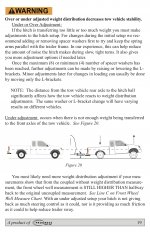
If the hitch is transferring too little or too much weight you must make adjustments to the hitch setup. For changes during the initial setup we rec-ommend adding or removing spacer washers first to try and keep the spring arms parallel with the trailer frame. In our experience, this can help reduce the amount of noise the hitch makes during slow, tight turns. It also gives you more adjustment options if needed later. Once the maximum (8) or minimum (4) number of spacer washers has been reached, further adjustments can be made by raising or lowering the L-brackets. Minor adjustments later for changes in loading can usually be done by moving only the L-brackets.

Just telling you what Thuren marketed it as. They say leveling kit. You define how you want. I raised the front with their 2 inch coils 2.25 inches. Rear of the truck was originally 1 inch higher than the front.

When you combine front and rear it’s a lift. Front only is a level. It makes it easier for people to understand what you did, and help you, when you use proper terminology.

You did buy their level kit, but then you added to it. That changes things.

 
Read more of the manual. 4 washers minimum, 8 washers maximum. 1 washer is the equivalent of one set of holes on the L bracket. Preferred method of install is level bars, so you set the L brackets for level bars and use washers to get the proper preload. 6-7 is what you will likely need.

HD truck or not the proper number of washers is crucial. Preload, tension, etc… whatever you want to call it is what transfers the weight. No, we don’t need it on these trucks but it sure does tow better with it. You bought it, why not set it up correctly?


When you combine front and rear it’s a lift. Front only is a level. It makes it easier for people to understand what you did, and help you, when you use proper terminology.

You did buy their level kit, but then you added to it. That changes things.
I appreciate your input. Really. I'm not a rookie at stuff so not necessary to imply. I installed everything personally on my rig build so know a thing or 2 you could say. I'm not claiming to be a know it all. I'm not by any means but put a wrench in my hand and I get stuff done and educate myself.

If I just installed the front coil lift kit only by your terminalogy the truck would have been sitting ghetto style 1 inch higher in the front than the rear. Thats not very productive now is it? At the end of the day call it whatever you want.... a lift kit or leveling kit. I could care less... Lol.

Also I've been through the Equalizer manual repeatedly. Downloaded recently right off the website for their 10k hitch and nothing I see to your comments on the washers but thank you for the further clarification.
 
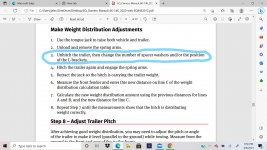
My quote of the manual is out of my downloaded copy. I tried to attach it for reference, but it’s too large. But the cliffs notes is start with 6 and adjust as needed, down to 4 or up to 8. Try to keep the bars parallel to the trailer frame.

The fact that you over leveled the truck doesn’t change anything. Just trying to use proper terminology, it helps us help you. Thuren is pretty specific on how to measure your truck to ensure you get the height you want. Thanks to their instructions I didn’t order the 0.5” springs I wanted because it would have made my truck nose high in ALT ride height.
 
AFAAB258-0C7A-4308-96B2-00E597ED4179.jpeg

B36FBD80-FE88-445C-BA39-3D63F3C88F98.jpegBA291D66-BCEE-4F78-9952-A114ACD5B525.jpeg
 
My quote of the manual is out of my downloaded copy. I tried to attach it for reference, but it’s too large. But the cliffs notes is start with 6 and adjust as needed, down to 4 or up to 8. Try to keep the bars parallel to the trailer frame.

The fact that you over leveled the truck doesn’t change anything. Just trying to use proper terminology, it helps us help you. Thuren is pretty specific on how to measure your truck to ensure you get the height you want. Thanks to their instructions I didn’t order the 0.5” springs I wanted because it would have made my truck nose high in ALT ride height.
I'll do that for ya.....Page 8 Paragraph #2. Know it well. Only mentioning of it in entire manual besides again on page 15 paragraph #3 and nothing to the detailed points you threw out there. Very vague on the spacers but I get it.
That’s my setup
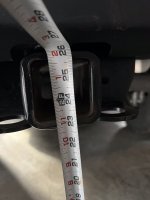
25-5/8 inches to top of receiver. That's some height right there.
 

Attachments

  • Equalizer Washers_LI.jpg
    Equalizer Washers_LI.jpg
    1.5 MB · Views: 15
  • Washers 2_LI.jpg
    Washers 2_LI.jpg
    1.4 MB · Views: 13
I can say that the difference between 5 and 6 washers on my setup is a 20% change in weight returned to the front axle.
That sounds about right. My Airstream dealer sets up 2500's all the time and they recommend 5 washers with rear air but they are dictating off a stock suspension setup and didn't specify if Cummins or Gaser engines which does make a difference since the diesels are 1000lbs additional weight in the front of the truck.

I was going to start with 5 washers and go from there. Didn't get to it yet.
 
That sounds about right. My Airstream dealer sets up 2500's all the time and they recommend 5 washers with rear air but they are dictating off a stock suspension setup and didn't specify if Cummins or Gaser engines which does make a difference since the diesels are 1000lbs additional weight in the front of the truck.

I was going to start with 5 washers and go from there. Didn't get to it yet.

Air suspension and engine choice really don't have a bearing on weight transfer back to the front axle.

The hardest part you will have with transferring weight is the distance from the hitch pin to the ball, which is why I recommended starting with at least 6 washers.

As an example I went from a 18" extended shank to a normal 12" shank and the weight transfer difference was noticable, as was the towing improvement. Nothing else was changed. That was with 6 washers and 1200-1300lbs tongue weight. I should have been at at least 7 washers for that long hitch and weight.
 
Last edited:
Back
Top