
Ram Heavy Duty Forum
You are using an out of date browser. It may not display this or other websites correctly.
You should upgrade or use an alternative browser.
You should upgrade or use an alternative browser.
Trickle Charger On '22 Cummins
- Thread starter Canexpat
- Start date

- Messages
- 5,234
- Reaction score
- 5,455
- Points
- 113
Yes, the way the truck is wired from the factory creates one large battery from the pair.
There is a battery sensor, IBS, on the negative terminal of the drivers side battery. If you put the leads on the drivers side battery it has to be on the truck side of the battery.
Folks will also hook a tender up thru the 7-pin trailer plug. It really just depends on where you park relative to an outlet.
Be sure to get a good quality charger that shuts off when the batteries are 100%, and then starts charging again when they lose charge. I have a NOCO Genius 5 for my truck and it’s hooked up to the drivers side battery. You don’t need one as big as the 5, but it’s great for charging other small batteries too.
This is how I have the pigtail mounted on my truck.
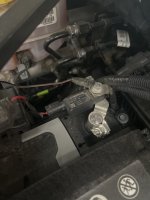
There is a battery sensor, IBS, on the negative terminal of the drivers side battery. If you put the leads on the drivers side battery it has to be on the truck side of the battery.
Folks will also hook a tender up thru the 7-pin trailer plug. It really just depends on where you park relative to an outlet.
Be sure to get a good quality charger that shuts off when the batteries are 100%, and then starts charging again when they lose charge. I have a NOCO Genius 5 for my truck and it’s hooked up to the drivers side battery. You don’t need one as big as the 5, but it’s great for charging other small batteries too.
This is how I have the pigtail mounted on my truck.

Canexpat
New Member
- Messages
- 6
- Reaction score
- 4
- Points
- 3
That's the charger I use, no issues with it. It doesn't matter which battery you hook it up to, as mentioned, the way the batteries are wired, they behave as a one large battery.Thanks for the reply. I was confused by this statement.
I'll be attaching a CTEK MXS 5.0 battery charger/maintainer with a dedicated set of leads.
I use the clamps to connect my charger, we have 2 vehicles, we use truck in summer time and another one in winter time so the charger is moved from one to the other depending which one we use.

dogbreath650
Member
- Messages
- 84
- Reaction score
- 49
- Points
- 18
Still a bit confused with this IBS. What happens if you place the charging lead on the battery terminal (battery side of IBS)?
- Messages
- 5,234
- Reaction score
- 5,455
- Points
- 113
Still a bit confused with this IBS. What happens if you place the charging lead on the battery terminal (battery side of IBS)?
The computer can’t monitor the charge you’re putting back into the batteries and that may have an effect on the charge rate with the engine running. It’s called blind charging.
This TSB is for start/stop vehicles, but the general operation with the IBS and blind charging still applies.

CdnHO
Well-Known Member
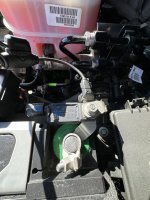
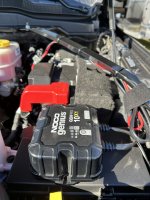
The IBS is a sensor that monitors current going in and out of the batteries. The computer uses this to determine the state of charge. If you connect to the battery terminal itself, the truck does not know if the battery is being charged or not. My truck is often parked for several days at a time as well. I plug in the NOCO charger once in a while to make sure the batteries are fully charged. I had a 2 amp and it took forever to fully charge the batteries. Replaced it with a 10 amp. Much better. All the computers in these trucks seem to draw the (low quality) factory batteries down. Here is my setup. I just velcro the charger to the fuse panel cover. The little rectangular device with the MOPAR logo on the battery post is the IBS. I suspect it is a shunt of some sort. Please note this is the NEGATIVE post. The wire shown attached to the top of the IBS is the NOCO charger negative terminal.
Attachments
- Messages
- 5,234
- Reaction score
- 5,455
- Points
- 113
Why would you want to trickle charge the vehicle batteries with engine running?
I only plug mine in when I don't use it for a while and I just connect the charger clamps to the battery posts
Who is trickle charging with the engine running?
Connecting to the battery posts is fine on the passenger battery, but not on the drivers battery.
Canexpat
New Member
- Messages
- 6
- Reaction score
- 4
- Points
- 3
Excellent link. Thank you.The computer can’t monitor the charge you’re putting back into the batteries and that may have an effect on the charge rate with the engine running. It’s called blind charging.
This TSB is for start/stop vehicles, but the general operation with the IBS and blind charging still applies.
Canexpat
New Member
- Messages
- 6
- Reaction score
- 4
- Points
- 3
Great pics. Thank you.The IBS is a sensor that monitors current going in and out of the batteries. The computer uses this to determine the state of charge. If you connect to the battery terminal itself, the truck does not know if the battery is being charged or not. My truck is often parked for several days at a time as well. I plug in the NOCO charger once in a while to make sure the batteries are fully charged. I had a 2 amp and it took forever to fully charge the batteries. Replaced it with a 10 amp. Much better. All the computers in these trucks seem to draw the (low quality) factory batteries down. Here is my setup. I just velcro the charger to the fuse panel cover. The little rectangular device with the MOPAR logo on the battery post is the IBS. I suspect it is a shunt of some sort. Please note this is the NEGATIVE post. The wire shown attached to the top of the IBS is the NOCO charger negative terminal.
What I was trying to say (trickle charging when engine is running) is, if IBS is a sensor that monitors current going in and out that helps the computer to determine the state of battery charge (as per CdnHO post) then IBS (computer) isn't doing anything when the truck is shut off (is it?) so they only do their thing when truck is running.Who is trickle charging with the engine running?
Connecting to the battery posts is fine on the passenger battery, but not on the drivers battery.
Regardless of if they do anything or not when truck is shut off, the CTEK are intelligent chargers / maintainers and they do their own monitoring that's why they can be connected directly to the batteries without IBS or any other computer getting involved.
... Unless the batteries aren't connected in parallel or this IBS sensor is somewhere in between these connected batteries... I didn't look hard under the hood trying to figure out the connections, didn't need to
CdnHO
Well-Known Member
The IBS is connected between both batteries and the vehicle negative ground. There is always a slight current draw due to the electronics in the truck, even when not running. It is not a lot but over many days it adds up to the point where the system won't allow you to start the truck. If you connect the charger directly to the post, the IBS cannot account for that current going into the batteries. The batteries will charge but the trucks computer doesn't account for it. I wil go out later and put a clamp meter on the cable going to the IBS and report back.What I was trying to say (trickle charging when engine is running) is, if IBS is a sensor that monitors current going in and out that helps the computer to determine the state of battery charge (as per CdnHO post) then IBS (computer) isn't doing anything when the truck is shut off (is it?) so they only do their thing when truck is running.
Regardless of if they do anything or not when truck is shut off, the CTEK are intelligent chargers / maintainers and they do their own monitoring that's why they can be connected directly to the batteries without IBS or any other computer getting involved.
... Unless the batteries aren't connected in parallel or this IBS sensor is somewhere in between these connected batteries... I didn't look hard under the hood trying to figure out the connections, didn't need to
I understand there's always a small current draw that's why we use the battery maintainers when not using our vehicles for a while.
Thx for explaining the IBS thing, I get it now, I won't however believe that the computer won't let the truck start because it "thinks" the batteries are empty when they're not, all it needs to do is check the voltage to see it. I guess we will see how it goes when I'm back home, I hooked up my CTEK to a driver's side battery posts when I parked my trucking my workshop and left for work a month ago, I'm not gonna be home for at least another 2 months.
Thx for explaining the IBS thing, I get it now, I won't however believe that the computer won't let the truck start because it "thinks" the batteries are empty when they're not, all it needs to do is check the voltage to see it. I guess we will see how it goes when I'm back home, I hooked up my CTEK to a driver's side battery posts when I parked my trucking my workshop and left for work a month ago, I'm not gonna be home for at least another 2 months.
CdnHO
Well-Known Member
I put my Fluke Clamp meter on the negative cable and it shows a draw of approximately .3 - .4 amps. That is roughly an amp every three hours. Not sure if that varies over time. That would end up pulling 8 amp hours out of the batteries every day. Not sure what these batteries are rated at. It will be interesting to see what happens when you get home. One used to be able to buy shop manuals for this sort of information. Now you have to subscribe to Chryslers tech data. I may get a three day subscription and just download the stuff that interests me.I understand there's always a small current draw that's why we use the battery maintainers when not using our vehicles for a while.
Thx for explaining the IBS thing, I get it now, I won't however believe that the computer won't let the truck start because it "thinks" the batteries are empty when they're not, all it needs to do is check the voltage to see it. I guess we will see how it goes when I'm back home, I hooked up my CTEK to a driver's side battery posts when I parked my trucking my workshop and left for work a month ago, I'm not gonna be home for at least another 2 months.
- Messages
- 5,234
- Reaction score
- 5,455
- Points
- 113
I put my Fluke Clamp meter on the negative cable and it shows a draw of approximately .3 - .4 amps. That is roughly an amp every three hours. Not sure if that varies over time. That would end up pulling 8 amp hours out of the batteries every day. Not sure what these batteries are rated at. It will be interesting to see what happens when you get home. One used to be able to buy shop manuals for this sort of information. Now you have to subscribe to Chryslers tech data. I may get a three day subscription and just download the stuff that interests me.
That seems really high. Had the key fob been in the truck recently?
CdnHO
Well-Known Member
Half hour before I took the measurement. The truck was locked with the hood open.That seems really high. Had the key fob been in the truck recently?
- Messages
- 5,234
- Reaction score
- 5,455
- Points
- 113
Half hour before I took the measurement. The truck was locked with the hood open.
Interesting. On another forum I saw a note about 0.010 with all systems off after some troubleshooting.