What's new
Ram Heavy Duty Forum

Register a free account today to become a member! Once signed in, you'll be able to participate on this site by adding your own topics and posts, as well as connect with other members through your own private inbox!

Recommended Tire Pressure dropped from 2017 2500 (20s) to 2022 2500 (20s)???

Okay. Went and got some real sidewalk chalk and had some time today to devote to the experiment. I was trying to use little white pieces of chalkboard chalk and it just wasn't working that well. Between the chalk and being rushed for time I don't think I was giving the chalk test the time I needed to do it correctly.

Started at 60 PSI all four corners. Test one, all four tires way over inflated (for the purposes of chalk test, I'm sure 60 is fine)

Dropped to 55 front 50 rear. Test 2, starting to a little difference. Outside 3rds still much less wear the middle.

Dropped to 50 front 45 rear. Test 3, much better but outside chalk still much less worn than middle.

Dropped to 45 front 40 rear. Test 4, almost there.

Dropped to 40 front 35 rear. Test 5, what do you know, almost perfect chalk wear edge to edge.

I was for sure it was going to be under inflated at 40/35 when I started the test.

Took it for a test drive. Much happier with the ride and handling now. Even more so than when I went from delivery PSI of 80 to 60.

When I look at the vehicle from the side parked the tires look way too low, but I've probably been driving around on over inflated tires my entire life, so I'm not used to the visual.

I said when I first got this truck the ride was harsh. That was at 80 PSI. It was tooth rattling. Advised to drop to 60. Yuge difference, much more like the FX4 that I just got rid off.

Now at 40/35 it's a plush ride. 99% of my F150 with the four corner Bilstien Kit. My Fords tires were I'm sure over inflated for 10+ years. Wonder how nice the ride would have been had I had them set correctly?

Can't wait to drive it off road. I'm guessing it will be much more compliant over our rocky southwest terrain. Drove it the other day off road at 60/58 and it wasn't bad, but still bounced me around pretty good.

Learned a ton from this forum in the past 8 months. Grateful.
 
Okay. Went and got some real sidewalk chalk and had some time today to devote to the experiment. I was trying to use little white pieces of chalkboard chalk and it just wasn't working that well. Between the chalk and being rushed for time I don't think I was giving the chalk test the time I needed to do it correctly.

Started at 60 PSI all four corners. Test one, all four tires way over inflated (for the purposes of chalk test, I'm sure 60 is fine)

Dropped to 55 front 50 rear. Test 2, starting to a little difference. Outside 3rds still much less wear the middle.

Dropped to 50 front 45 rear. Test 3, much better but outside chalk still much less worn than middle.

Dropped to 45 front 40 rear. Test 4, almost there.

Dropped to 40 front 35 rear. Test 5, what do you know, almost perfect chalk wear edge to edge.

I was for sure it was going to be under inflated at 40/35 when I started the test.

Took it for a test drive. Much happier with the ride and handling now. Even more so than when I went from delivery PSI of 80 to 60.

When I look at the vehicle from the side parked the tires look way too low, but I've probably been driving around on over inflated tires my entire life, so I'm not used to the visual.

I said when I first got this truck the ride was harsh. That was at 80 PSI. It was tooth rattling. Advised to drop to 60. Yuge difference, much more like the FX4 that I just got rid off.

Now at 40/35 it's a plush ride. 99% of my F150 with the four corner Bilstien Kit. My Fords tires were I'm sure over inflated for 10+ years. Wonder how nice the ride would have been had I had them set correctly?

Can't wait to drive it off road. I'm guessing it will be much more compliant over our rocky southwest terrain. Drove it the other day off road at 60/58 and it wasn't bad, but still bounced me around pretty good.

Learned a ton from this forum in the past 8 months. Grateful.
no that you are close use the 10% rule to confirm everything is hunky dory. from stone cold at 40/35 your fronts should hit about 44psi after 10 miles of highway driving and your rears like 39psi. if they are 43-45 38-40 you are golden.
 
Its fine for me

Yea. Sorry. Not sure what was happening. It’s appearing correctly now.

Now to figure out how to change the TPMS threshold.

a318aaf19006fa44cbb31bb892a15cbc.jpg


Just showed up, I’ll be using it with OBD Jscan. Ordered the KOAdtech cable.
 
no that you are close use the 10% rule to confirm everything is hunky dory. from stone cold at 40/35 your fronts should hit about 44psi after 10 miles of highway driving and your rears like 39psi. if they are 43-45 38-40 you are golden.

So if they heat up more than about 5psi they are generating too much heat, correct?

I’m gonna hit a CAT scale next time I’m up that way. And again once I get the airstream hooked up.
 
So if they heat up more than about 5psi they are generating too much heat, correct?

I’m gonna hit a CAT scale next time I’m up that way. And again once I get the airstream hooked up.
5 would be ok especially at 40psi cold now I am not talking running for 100 miles because that could end up heating up more which is understandable. go for 5-10 miles at 60mph and you should be 44-45 up front..
 
Okay. I'm obsessed with tire pressure. At least for now. Until I find something else. Squirrel!

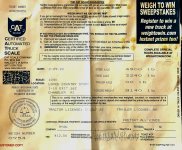
Got the truck weighed.

Ram Weight 2-9-22.jpg

Diesel is obviously quite a bit heavier. I had about 100-150 pounds of shooting stuff in the back seats and the bed, I was standing on the pad (235), and I only had about 1/4-1/2 tank of diesel, so not a true cub weight, but close.

I settled on the fronts at 42 PSI and the rears at 31 PSI cold, based on the combination of the chalk test and the tire load chart from above, considering the heavier front end of the Cummings trucks.

After about 10-15 minutes of highway driving fronts up to 46 PSI and rears 33 PSI.

After about 20-30 minutes of highway driving fronts up to 47 PSI and rears at 34 PSI.

After 35 minutes of highway driving fronts 48 PSI, touched 49, but came back down, and rears 35 PSI bumping up against 36 PSI.

Verified on 2 different days of driving.

Based on all the data I have gathered. I think I'm gonna bump up the fronts to 44 PSI and the rears to 33 PSI and call it a day.

Obviously have to bump up the rears about 10 PSI when I hook up the Airstream and load up the truck for camping, but the fronts at 44 PSI should be good as is.

Thoughts?
 
I would say you are pretty darn close and would just leave them a 42 and 31.I bet they feel way better than when you started this obsession lol.
 
I know. I'm ridiculous.
oh I am the same way trust me. if you are in AZ 20-30 minutes on the highway is all you need. Sure if you drive longer in hotter temps they will go up a bit but you pretty much are how I would have them.
 
I run 65 pounds in my tires on a 2500 cummins. They are wearing well and riding ok. I tried the low pressure route and it road like it was wallowing on the dips and turns. At 65lbs I also dont have to mess with airing up unless I tow heavy. Normally I tow 4K to 8K so no worries so far.
 
I run 65 pounds in my tires on a 2500 cummins. They are wearing well and riding ok. I tried the low pressure route and it road like it was wallowing on the dips and turns. At 65lbs I also dont have to mess with airing up unless I tow heavy. Normally I tow 4K to 8K so no worries so far.

Yea. I’ll admit I get a little bit of that depending on the size of the dip and the speed I hit it at , but it’s minor and infrequent. And the ride is so much better for 99% of my driving with the lower pressure, that I’ll take it.

Every thing is a compromise in one form or another. Now that I know where I’m at I’ll see how much of a pain it is to air up and down.

I have a giant compressor in my shop next to where the truck is parked so hopefully it won’t be too much of a pain.

I’m planing to put in an onboard compressor when I do the Titan fuel tank down the road so I’ll have air with me.

I’m guessing the rocky SW terrain is going to be more less jarring at the lower pressure so I’d like to be able to air up and down when I’m driving off road.
 
oh I am the same way trust me. if you are in AZ 20-30 minutes on the highway is all you need. Sure if you drive longer in hotter temps they will go up a bit but you pretty much are how I would have them.

It’s perfect here weather wise right now.

I would imagine I’ll have to go up and down a little when it’s 110°+ in the summer vs 30’s in the morning in the winter?

The 31/42 I gave you the other day was 1st thing in the morning the earlier in the week when it was in the low 40’s here overnight. Went out to the garage this morning and they were 33/44. Truck hasn’t moved in over a day. Was only the mid 50’s last night. Having a warm spell.

Just gonna leave it lie.
 
I bought a super quiet low draw compressor from(gasp) harbor freight. I believe makita makes one also. I Have the 110 plug in the bed so I just keep that one in the bed. It runs to 135 pounds and is two gallons. Not a lot of volume but works good on truck, trailer tires etc. Pretty portable little unit that runs fine with the factory truck 110 plug as long as the truck is running. I like this option better than onboard air, for my uses.
 
I just realized it has a one gallon tank. Im not sure if their two gallon would run on the 400 inverter. I didn't mean to get off topic.
 
I just realized it has a one gallon tank. Im not sure if their two gallon would run on the 400 inverter. I didn't mean to get off topic.

No worries. I was also considering a portable it. I know Amazon has one that is well reviewed around the YouTubers community.
 
Last edited:
Not sure if people know that, but tire pressure influences a lot of stuff:
1) Wear
the LT tires have a very stiff side wall to handle loads and towing. The pressure needs to compensate for these stiff side wall.
When the tire tread wears you want it to wear everywhere the same, center and outer tread (inner and outer side wall). If the center section has more tread than your outer areas that means you were running too low pressures. If the tread in the center of the tire is lower than on the outer and inner side of the tire, then your pressure is too high. I noticed that my 65psi cold on the 18 inch tires is too high in the rear and too low in the front with the heavy Diesel.
2) Handling
The tire pressure influences your spring rate, the tire is a spring, too.
Higher tire pressures make the ride stiffer and you loose traction. If you mess with the front to rear bias then you could run into not optimal handling situations. A too high rear pressure may make your vehicle tail happy (oversteer). That is a difficult situation and should be avoided. Even in racing we avoid oversteer because you constantly need to fight the car. Good is a neutral vehicle, neither understeer nor oversteer w/o major throttle inputs.
Too high tire pressures lower the contact patch and you could lower lateral and longitude acceleration, increasing your braking distance and cornering speeds. Of course too low pressures do the same.
Subjective handling is poor with too low tire pressure, it feels sluggish and the vehicle responds to your steering inputs very slow and it does not feel crisp and responsive.
3) MPG
A lower tire pressure makes you burn more fuel, as a side effect it lowers top speed (racing only).
4) Tire heat
Low pressures could heat up your tire, in extreme cases damages the tire
Dual rear wheel tires might rub at each other, that can cause burning tires in extreme cases. When these are underinflated, the buldge out and could touch each other side wall. That could be more an issue on big rigs, maybe not on pick ups.
5) Contact patch off road
You might want lower pressures in sand and off road in general. The larger contact patch increases traction and gets you going while a high tire pressure makes you get stuck. Too low pressures get the tire off the wheel.
6) Comfort
Low tire pressure= usually more comfort
High tire pressure= bouncy ride

Not sure if I forgot something, maybe we have some tire engineers on that forum?
I keep it with 65psi cold (18 inch wheel) because I go after the door sticker and like a good balance between tire wear and MPG (cheapskate LOL).


Screenshot 2022-01-19 175106.jpg
 
I run 65 pounds in my tires on a 2500 cummins. They are wearing well and riding ok. I tried the low pressure route and it road like it was wallowing on the dips and turns. At 65lbs I also dont have to mess with airing up unless I tow heavy. Normally I tow 4K to 8K so no worries so far.
I know I'm bringing back an older thread, but obviously there are a lot of tire pressure threads and thought I'd simply add on to this one.

SL1 sums it up for me, I see many people here that run pressures in the 40's, and a few talking about 35 psi cold. I know it's about the truck setup, gross weight, etc, but for me I can't see running E rated tires at those kind of lower pressures, . On a series of 2500's I've tended to run (all cold #'s) 60 front and 55-60 rear unloaded, 65 front and 70 rear towing medium (5,000- 8,000 lb. loads). Plowing I air up the fronts to 70-75 and rears 65-70, carrying 500 lbs. in the bed.

I'm always willing to learn and be proven wrong, just thought I'd comment since I was spending a fair amount of time reading threads here.
 
Go to the tire manufactures website and look up your tires. they usually have a spreadsheet that shows how much weight the tire will support at a given PSI.

I run BFG 35x12.50 17's. On the BFG website, it shows I can run down to like 25 PSI for the weight of the truck. But I run 45/37 hot on a normal day where I live and get good contact and tread wear pattern. If I run at 60 PSI like you, I can see daylight on the outer edges of the tire which says they are over inflated and the tread is not touching the ground. On a long highway trip, they may go up about 5 PSI.
 
I know I'm bringing back an older thread, but obviously there are a lot of tire pressure threads and thought I'd simply add on to this one.

SL1 sums it up for me, I see many people here that run pressures in the 40's, and a few talking about 35 psi cold. I know it's about the truck setup, gross weight, etc, but for me I can't see running E rated tires at those kind of lower pressures, . On a series of 2500's I've tended to run (all cold #'s) 60 front and 55-60 rear unloaded, 65 front and 70 rear towing medium (5,000- 8,000 lb. loads). Plowing I air up the fronts to 70-75 and rears 65-70, carrying 500 lbs. in the bed.

I'm always willing to learn and be proven wrong, just thought I'd comment since I was spending a fair amount of time reading threads here.
The psi listed on the door jamb are for max GVWR of the truck so with the plow and balast there is no need to run more than 60 psi fyi. I run 60 front and rear unless i am towing heavy that includes all winter with the 800lbs plow and 800 lbs ballast weight
 
Back
Top