What's new
Ram Heavy Duty Forum

Register a free account today to become a member! Once signed in, you'll be able to participate on this site by adding your own topics and posts, as well as connect with other members through your own private inbox!

What's the difference between 14-18 and 19-24 suspension?

Shots

Active Member
Messages
138
Reaction score
128
Points
43
I'm speaking purely of suspension here, which is why I posted in this section.
I'm considering leveling my truck and have looked a multiple kits. Sure Thuren and Carli get a lot of talk here, but they're also over a grand. I'm not a label snob so I don't care who's sticker is on the side of my parts. I'm not doing any off-roading or sport driving with it. It's a truck, not a Jeep or Corvette. I drive it places, and haul things with it so I don't need anything special. I do want a ride that is at least equivalent to stock.
Bilstein has been in the business for quite a while and they've maintained a good reputation across several vehicle makes, so I'm not concerned with quality. What's more, their kit cost half that of the other two.

I'm looking at a 2" kit that comes with springs and struts (Bilstein #46-268655 gas / 46-302137 diesel). According to Americantrucks.com the kit fits 2014-2024. However, the same kit at Summit Racing shows that part number for 2014-2018 for the gas kit. So who's right?
Here's the kicker. Going to Bilstein's site directly they list how fitment "2024-2014" so I assume Summit just failed to updated their fitment guide???

Are the springs/struts the same for both 4th and "4.5" generations? That seems logical enough if they're not designating the 19+ as a 5th gen. Any ideas?
 
Has to be a glitch on the Summit's site. When you look at the Thuren site it lists their kits for 14-24, they would know if there is a difference between 4th/4.5 gen and it's the same part #.

I know your not interested in spending the money on Thuren, just using them as an example. When I was asking on this forum about the kit you are thinking of buying several members chimed in and said it was a wonderful kit.
 
Thank you both for the quick responses. I appreciate the input.
Wholeo, I never thought to look at brands like Thuren and Carli for their model year ranges. Clever. If theirs fit '14-'24 there's no reason other brands wouldn't too.

I've already got a new track bar sitting in a box ready to go, so just had to figure out which what kit to buy.
 
Yeah, it recenters the axle, and is probably recommended. However, based on most things I've read, and after leveling many of my own trucks in the past, I wouldn't say it's strictly necessary with a 2" kit. It's my understanding that 2.5" or less it's "acceptable" to run with the stock track bar.
Having said that, a new track bar wasn't that expensive, and can be done fairly affordable with them ranging from $150-$400 depending on brand. It's also just a matter of 1 more bolt when you're doing the install (you already have to unbolt one end). You're already in there doing the work, so you might as well swap it out.

So technically, to keep everything oriented properly, yes a track bar is needed.
 
I went a bit above/beyond on this one. I've commonly used spacer lifts to keep the stock springs/struts and retain the factory ride. This time around I replaced the factory parts (including the track bar). And doing the install properly, not only are you supposed to adjust the caster, but you're supposed to loosen, and retighten the radius arms. Seems weird, but like I said, I was going a little above and beyond this time around. In fact, once it stops raining, I'm putting on a 5mm (0.19") spacer to correct the scrub radius too, so everything will be in spec and/or stock orientation. The 5mm spacer is minimal and not enough to see, but it allows the wheel to still nest on the hub while correcting for the wee bit of difference resulting from the geometry changed from leveling. I've done this before, and each truck/kit needs a size specific to it. Keeping the scrub radius close to zero really helps to eliminate the "heavy" feel while turning when it's offset in/out.

The alignment is all squared away too. I scheduled that to be done right away. I've read about people doing their own alignments, but that's not something I've ever tired before, so I don't have any of the tools to do it. The dealership took care of that one for me for $119, which was cheaper than a lot of local shops.
 
Drag Link Adjustment is necessary to straighten up the Steering wheel after install but Caster if in the correct adjustment is not required. Setting TOE to 0 is important. Your install looks Good.
 
Can you elaborate on the 5mm spacer to correct the scrub radius? I don't understand.

I recently installed a used Bilstein 2.3" kit on my 2020. It came off a 2016 and fit my 2020 just fine. I prefer the 5100 shocks over the stock shocks.
 
Adjusting the drag link is simple, and from what I've read these trucks will trigger a traction control warning light if you drive too long without adjusting it. I assume that's because the steering wheel angle tells the truck you're turning (slightly) but you're still going straight, thus making the computer think there's a traction problem. Not sure though, just my theory on why it would trigger. Either way, it's easy enough to adjust on these.
 
Can you elaborate on the 5mm spacer to correct the scrub radius? I don't understand.

I recently installed a used Bilstein 2.3" kit on my 2020. It came off a 2016 and fit my 2020 just fine. I prefer the 5100 shocks over the stock shocks.
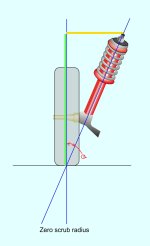
This is primarily a concern with increasing the tire size, but level does have some effect on it. To simplify it, look at the suspension as a triangle. Your stock configuration has X" from where the suspension mounts to the frame (yellow line on image). That point is Z" from the ground (green line). With those two sides, we can make a triangle, and thus determine the angles of where everything lines up (red theta).
Untitled-2.jpg

When you install a bigger tire and the suspension geometry is unchanged, X (yellow) the angle (red) are unchanged. However, Z (green) is increased so you end up with a negative scrub radius.
Untitled-3.jpg

Lifts/levels can adjust for some of this by changing the angle of the suspension a little bit. Then of course there's the option to do like I did and add a minimal spacer to make the finite adjustments. To be completely clear though, this isn't a huge concern if we're talking about modest size tires, and minimal lifts. Not something that needs to be done. Just something that can be done to keep an OEM feel while cornering at low speeds.

Point being, you can end up with a positive/negative scrub radius by changing wheels tires or both and by installing a lift/level while leaving everything else alone. Suspensions are a basic concept, but they're complicated all at the same time. There's lot of angles in play that people don't think about. These examples are all static and 2 dimensional. It gets deeper when you start talking about the Y axis, and dynamic movements of the suspension.
 
This is primarily a concern with increasing the tire size, but level does have some effect on it. To simplify it, look at the suspension as a triangle. Your stock configuration has X" from where the suspension mounts to the frame (yellow line on image). That point is Z" from the ground (green line). With those two sides, we can make a triangle, and thus determine the angles of where everything lines up (red theta).
View attachment 76159

When you install a bigger tire and the suspension geometry is unchanged, X (yellow) the angle (red) are unchanged. However, Z (green) is increased so you end up with a negative scrub radius.
View attachment 76160

Lifts/levels can adjust for some of this by changing the angle of the suspension a little bit. Then of course there's the option to do like I did and add a minimal spacer to make the finite adjustments. To be completely clear though, this isn't a huge concern if we're talking about modest size tires, and minimal lifts. Not something that needs to be done. Just something that can be done to keep an OEM feel while cornering at low speeds.

Point being, you can end up with a positive/negative scrub radius by changing wheels tires or both and by installing a lift/level while leaving everything else alone. Suspensions are a basic concept, but they're complicated all at the same time. There's lot of angles in play that people don't think about. These examples are all static and 2 dimensional. It gets deeper when you start talking about the Y axis, and dynamic movements of the suspension.


Shots,
Thank you for the detailed explanation and pictures. I understand scrub radius and whole heartedly agree with everything that you said but I don't understand how that installing a leveling kit changes scrub radius. No change in wheel offset or tire diameter should affect scrub radius. I know my response makes it sound like I'm trying to pick a fight on the internet, but I am not. I am just trying to understand how a leveling kit affects scrub radius.
 
These trucks are solid axle, not independent suspension. Lifting will not change the scrub radius.
 
It was not taken as picking a fight at all. Looking closer at it, I would say jsalbre is correct with a solid front axle. Coming from the world of 1500's, it did make a difference. With IFS, the springs/struts are at an angle (even if minimal). Raising/lowering the upper mount point cause the wheel to swing in/out a bit depending on how far you go, which would effect scrub radius too. But since our wheels are tied to each other laterally by the solid axle they go straight up/down, not sweeping at an angle/radius. So, it would appear we pretty much only have to worry about changing tire size on these trucks affecting scrub radius.

That said, I did increase my tire size too. The math from before (5mm) came from that change, not the level. I didn't take the time to look at potential changes from the Bilsteins, because I wasn't going to go any bigger than the 5mm spacer. Any larger than that and the wheel no longer contacts the hub, and you're effectively making the wheels lug-centric instead of hub-centric (on the front anyway), and I'm not a fan of that. I also don't want to use a larger spacer that has a lip to make it hub-centric because I think trucks (or even cars) with wheels that stick way out look ridiculous. No offense to anyone here that's done it. To each their own, and if you like it, that's great for you. No shade, just not my cup of tea and I wasn't going to consider it for my truck so didn't look beyond the 5mm adjustment.
 
since these are radius arm suspension in the front, lifting the front will require a caster adjustment. caster changes can adversely affect scrub radius.
 
Caster was adjusted with the install, all good on that end.
Though I'm not sure how that would have any affect on scrub radius. Handling yes, due to angles being change, but I fail to see how it's related to where the tire contacts the road in relation to the mounting point on the frame. Caster is a linear function, and scrub radius is affected by a lateral position.

To simplify. If the truck has 3 axis, with X being right to left, Y being front to back, and Z being up and down. Caster is moved along the Y (and technically probably a bit on Z) because the adjustment is attached to the radius arm. Scrub radius is affected by moving along the X axis. Caster shouldn't have any influence there.
Yes caster certainly affects handling, but I think it's a different thing being affected than scrub. I could be wrong though, I'm not a mechanic. Although I am an engineer (mechanical) so if someone who knows for sure can explain it, I should be able to grasp it.

As mentioned a few posts ago, suspension geometry gets pretty mixed up once you start talking about 3 dimensions of movement, which involves angles and radii. Simple concept to start, but can get pretty twisted. Which leads to conversations like this. What's tied to what, and how does one affect another.
I really appreciate everyone's input on this. It's gotten quite interesting, and potentially helpful for others in the future.
 
Adjusting the drag link is simple, and from what I've read these trucks will trigger a traction control warning light if you drive too long without adjusting it. I assume that's because the steering wheel angle tells the truck you're turning (slightly) but you're still going straight, thus making the computer think there's a traction problem. Not sure though, just my theory on why it would trigger. Either way, it's easy enough to adjust on these.
You are correct. Happened to me when I replaced my drag link and tie rod but didn't recenter the steering wheel after setting the toe. Was off by about 20 degrees. Didn't bother the driving, but got the traction control warning.
After adjust the steeringwheel back to center, the warning went away.
 
Funny that some people don't adjust it back to center, even without the light. It would drive me nuts to have the steering wheel turned all the time. I'm not super picky about stuff being lined up exact, but 20° seems like it would be enough to bug me. Glad to hear the light turns off when it's corrected though.
 
Funny that some people don't adjust it back to center, even without the light. It would drive me nuts to have the steering wheel turned all the time. I'm not super picky about stuff being lined up exact, but 20° seems like it would be enough to bug me. Glad to hear the light turns off when it's corrected though.
Mines gotta be dead nuts or I’m back under there readjusting lol.
 
Back
Top