What's new
Ram Heavy Duty Forum

Register a free account today to become a member! Once signed in, you'll be able to participate on this site by adding your own topics and posts, as well as connect with other members through your own private inbox!

WDH for a cargo trailer?

kennelpj

Active Member
Messages
104
Reaction score
165
Points
43
Hi all, Ive traded my single axle 6x12 ft cargo trailer for a 10k GVRW dual 5200 axle car hauler. Intend on using it to tow my 2 door jeep wrangler enclosed as well as moving some furniture and like items. Is it recommended to use a WDH if im near the 10k total weight? I see them talked about with TT, but not much discussion on cargo trailer from what I've seen. Will be a bumper tow. 2500 w 6.7l

Just want to have a comfortable and safe set up while moving across country this summer. Thanks!
 
WDH is a solution looking for a problem. They're completely unnecessary gimmicky garbage in my opinion. They cause more problems than they solve. WDH was designed for people who pull big travel trailers with 1/2 ton trucks like goobers.

A jeep on that trailer won’t be anywhere near 10k. More like 7k-7500k. You’re looking at around 1000lb tongue weight.

Before you go and spend hundreds of dollars on a WDH please do yourself a favor and load everything up without a WDH, move your jeep around on the trailer until you have a good tongue weight and pull that dang trailer. Your truck will be totally fine and pull it great without one
 
Last edited:
I'd get one and I use one. My 19 3500 srw squats 2.0" when putting a 750lbs tongue weight trailer on it (empty tongue weight of my TT). Towing level is one of the key things to towing without sway. I use my wdh to help level the trailer and tuck, otherwise I'm riding even more nose high with the truck squatting and the trailer nose down. I do find that without auto leveling suspension on my 3500 I have problems with the trailer scraping sometimes due to the rear sag of the tuck, and the distance the hitch receiver is from the rear axle. Especially coming in and out of driveways, wish it had rear air suspension. WDH redistributes weight from the drive axel to the steer axle and trailer axle, allowing everything to tow level. Many trucks require it to support higher tongue weights.
 

Attachments

  • trucktrailer.jpg
    trucktrailer.jpg
    382.4 KB · Views: 33
Last edited:
WDH is a solution looking for a problem. They're completely unnecessary gimmicky garbage in my opinion. They cause more problems than they solve. WDH was designed for people who pull big travel trailers with 1/2 ton trucks like goobers.

A jeep on that trailer won’t be anywhere near 10k. More like 7k-7500k. You’re looking at around 1000lb tongue weight.

Before you go and spend hundreds of dollars on a WDH please do yourself a favor and load everything up without a WDH, move your jeep around on the trailer until you have a good tongue weight and pull that dang trailer. Your truck will be totally fine and pull it great without one
well the trailer is about 3500lbs, my jeep stock is 3300, but being a rock crawler its probably closer to 4k+. But thats just trailer and jeep, I'll have some furniture and storage totes as well. Jeep is 12ft long, trailer is 24ft and will likely be full. My guess is ill be close to the 10k. Just seems like people pull the same weight in TT and need one. Havent pulled anything this heavy before.
 
Ask 10 guys you’ll get 20 opinions….

Here’s my $0.02 - take with a grain of salt - I’ve never used a cargo trailer…

According to multiple CAT scale trips, I know my travel trailer loaded for camping is just shy of 7000 pounds. Tongue is 1040 pounds - 15% of the weight of the trailer. When I towed with my Chevy 2500 Duramax and now with my RAM 2500 Hemi over 400 pounds gets lifted off the steer axle when connecting the trailer. That can have a significant impact on steering capability in good weather let alone bad.

Free advice worth everything you paid for it but if you’re towing something in the 7-8000 pound range, it’s going to want to squat your rear axle (possibly overloading it) and lift your front axle making steering less reliable. I’d recommend talking with a pro in the business. Good luck!
 
I don’t believe your 3500 squats 2” with 750lb of tongue weight. Sorry not sorry.

I’ve loaded over 2400lb in the bed of my 2500 (not including the topper) and it squatted less than 1”
 
Like what?

My trailer came with one and now I am curious.
It’s more common to see someone who is new to towing set their wdh up incorrectly and cause odd trailer handling characteristics than it is to see a wdh actually solving any problem.

Look at people who tow trailers for a living. Landscapers, people who pull equipment trailers. AT&T trucks, etc. not a single one of them have a WDH. That should tell you all you need to know
 
I don’t believe your 3500 squats 2” with 750lb of tongue weight. Sorry not sorry.

I’ve loaded over 2400lb in the bed of my 2500 (not including the topper) and it squatted less than 1”I'lll bet your diesel gets 30mpg too, at 90, with a 37" tires and a lift.
I can assure you it does sag 1.5" initial then it settles after about 30 minutes to 2" with ~750lbs of tongue weight (trailer tongue and weight of hitch), measured at the hitch ball. We had to measure the squat to get the trailer level when we set it up for towing. I don't have the after pictures pics but I'll snap them if weather allows (pullling trailer out tomorrow to wash it if it doesn't storm). this is pretty much what TFL truck finds with a light trailer

Great that your truck can do that, I can assure you mine does not have as little sag.and it does not have self leveling suspension. I'm sure you have the cat scale slips to prove the load and tape measurements of your wheel wells before and after loading it that you'll add later to your post.
 

Attachments

  • IMG_4910.jpg
    IMG_4910.jpg
    320.4 KB · Views: 27
  • IMG_4861.jpeg
    IMG_4861.jpeg
    323.2 KB · Views: 27
Last edited:
It’s more common to see someone who is new to towing set their wdh up incorrectly and cause odd trailer handling characteristics than it is to see a wdh actually solving any problem.

Look at people who tow trailers for a living. Landscapers, people who pull equipment trailers. AT&T trucks, etc. not a single one of them have a WDH. That should tell you all you need to know

I agree that its pretty common to see people not setting their trailer or truck to tow well, and that's why we get all these threads of well I'm swaying, buy a bigger truck.

Ah yes the argumentum ad populum fallacy. In argumentation theory, an argumentum ad populum (Latin for "appeal to the people") is a fallacious argument which is based on claiming a truth or affirming something is good because the majority thinks so.

I pull trailer's for a living and use WDH. I see plenty of landscaper's with it fits its ships in their trailers. Driving with their trailer wheels bowed because of overloading the trailers and their bearings smoking, or worse on the side of the road with a wheel missing. I assume they know what they're doing.
 
Last edited:
I appreciate the sway control from the equalizer wdh I use when towing my 27’ travel trailer. Windy days and passing semi trucks are a breeze (pun) now without the tail wagging the dog. Expansion joints and road dips are more subtle as well. Lastly the front end is right about the same height as without the trailer attached so my headlights are not blinding oncoming traffic and on the road where I need them most.
 
It’s more common to see someone who is new to towing set their wdh up incorrectly and cause odd trailer handling characteristics than it is to see a wdh actually solving any problem.
So set it up correctly and it solves problems?

Look at people who tow trailers for a living. Landscapers, people who pull equipment trailers. AT&T trucks, etc. not a single one of them have a WDH. That should tell you all you need to know
Fairly sure AT&T vehicle decisions are made by bean counters and not motivated by safety or employee comfort. The trades who are towing safely in and out of traffic much less correctly loaded are few and far between at least around here. That said, I suppose I can't really say anything one way or the other on that because to be honest I never really look in that area to note whether they do or do not run one.
 
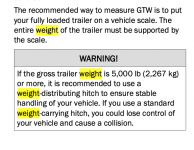
I think the manual says use a wdh with any bumper pull trailer over 5000lbs. I liked the wdh setup when I had a 1500.
I never use one on a 2500 truck.
Getting the trailer kinda level and the load on there right works for me.
Sounds like a sweet trailer.
 
OP asked if he needed a WDH to pull a 10k trailer. He 100% does not.

People like to buy gear for their trucks before they even have the truck or trailer in hand.

Don’t know why some people get offended when asking for opinions and they get one they don’t like.
 
I can assure you it does sag 1.5" initial then it settles after about 30 minutes to 2" with ~750lbs of tongue weight (trailer tongue and weight of hitch), measured at the hitch ball. We had to measure the squat to get the trailer level when we set it up for towing. I don't have the after pictures pics but I'll snap them if weather allows (pullling trailer out tomorrow to wash it if it doesn't storm). this is pretty much what TFL truck finds with a light trailer

Great that your truck can do that, I can assure you mine does not have as little sag.and it does not have self leveling suspension. I'm sure you have the cat scale slips to prove the load and tape measurements of your wheel wells before and after loading it that you'll add later to your post.

Slips? Let me see what i can find.

Ok. You caught me, i mis-remembered. It was 2400lb with the topper.

And my truck is a base 2500, no air suspension.


Not towing today but doing truck stuff. 2280lb of muriatic acid.
View attachment 20265View attachment 20266
 
I don't see anyone being offended.

Personal opinion vs what's in the manual. Whatever the OP want's to do based on his comfort level and experience I guess. Personally, I will keep mine on though and make sure I understand how to set it up.

Screen Shot 2022-05-23 at 22.36.37.png
 
Agreed, WDH is a tool in the towing arsenal and definitely provides benefits if used right like everything else. I looked up the 2500 manual and saw the same warning that WDH is recommended anytime you're towing a trailer over 5K lbs. So in your case, if your trailer and cargo exceed 5K lbs then the manufacturer recommends the use of a WDH.

Is WDH required?? or just beneficial? that depends on the parameters of an individuals towing situation. If you're in a situation where how and what you've loaded the trailer with has caused you to exceeded the GAWR (Gross Axle Weight Rating) and or payload of your truck or trailer and redistributing the load isn't feasible then you should use WDH to correct the situation if possible. Which in my experience can be really easy to do especially when your towing and have family members/co-workers in the tow vehicle with you. The only way to know if you've exceeded GAWR or payload is to take it to the CAT scales and measure it. I have definitely been in situations where I've exceeded the rear GAWR on tow vehicles without knowing and only finding the problem when weighing in at the scales. When you exceed your axel/tire/tongue/payload weight ratings things don't magically blow up or fail, but it accelerates wear on your vehicles and can lead to trailer sway, tires wear badly, tire blow outs, early shock failure and etc.. Most people can't eyeball a towing setup and tell how much and how weight is distributed by looking at it.

In the beneficial area If setup properly WDH can make a much better towing experience even if the parameters of your situation don't require it. I can say that towing my trailer with WDH, I don't have issues in high winds 20-25mph or passing semi's. In any vehicle I tow with. But when its not there I can definitely tell the difference, and yes my 3500 can sway, even when towing a light weight trailer under the right conditions. I've towed this particular trailer with 5 different tow vehicles, with and without WDH under all kinds of weather and terrain conditions. My experience indicates a WDH when used right makes for a better towing experience when you have heavier trailers. I see benefits in ride quality, tolerance to wind gusts and sway, keeping the headlights pointed level (nice at night), and the trailer and truck are less sensitive to how I load them making it easy to skip the cat scales with confidence.

From the 2019 3500 manual P.413 on WDH recommendations.
 

Attachments

  • ramman.png
    ramman.png
    63.5 KB · Views: 22
Last edited:
I have a 10k 24' enclosed Carson Racer car trailer that is 29' overall that I tow with a 2500 Laramie Mega 6.7L. Last time I went over the scales it registered 4740# front axle, 4840# rear axle, 7640# trailer axles. I have a weighsafe drop hitch, it usually reads about 700-1000# on the hitch. I tow a racecar and lots of spares. I have 4300 miles on this setup, mostly in California. I usually cruise at about 62 MPH, because CA is 55 only for trailer pulling. I have never used a WDH. I have never experienced any sway or other issues even in a very strong crosswind. The nose does bounce a little, but it is never unstable.

YMMV
 
Good point, Speed and the aerodynamics of your trailer are factors in towing comfort. I tow faster generally at or slightly above the speed limit in most states. In Texas that can mean 75-80mph towing speeds. When you're earning a living towing and paying people time for driving time is money. I can say with my setup, its pretty impervious to sway, but the nose does bounce a bit on bridge transitions especially bad ones in new Mexico. But I think that's a lot to do with the suspension design/shocks the trucks come with. I hate to admit I've gotten my rig up to 90mph accidentally while towing, and its very stable (use a WHD/anti-sway setup). I was passing someone and trying to not impede traffic (too badly) in the left lane and gunned it while passing a semi and went faster than intended, and once I noticed immediately backed off. But it was nice to see no sway at all at high speeds while passing a semi on a windy day. In fact I didn't even notice I was going so fast until I looked at my speedo. No sense at all of the speed from the trailer.
 
Back
Top