Ram Heavy Duty Forum
You are using an out of date browser. It may not display this or other websites correctly.
You should upgrade or use an alternative browser.
You should upgrade or use an alternative browser.
Spare tire size different then the (4) Four tires
- Thread starter sherdep
- Start date

There is no such thing as P- Metric…. There is P tires and then metric measurement's but the P has nothing to do with the metric measurements P is a ply rating
More ridiculousness.
Go look at just about any tire store and you will see some sort of the following: (this one from Tirerack.)
What's the difference between the tire sizes of P225/60R16 and 225/60R16? The obvious answer is the "P" in front of the first size, but just what does the "P" stand for and what does it tell us about the tires?
P-metric sized tires are the ones with the "P" at the beginning of the tire size, (such as P225/60R16 listed above). They were introduced in the United States in the late 70s and are installed on vehicles primarily used to carry passengers including cars, station wagons, sport utility vehicles and even light duty pickup trucks. Their load capacity is based on an engineering formula which takes into account their physical size (the volume of space for air inside the tire) and the amount of air pressure (how tightly the air molecules are compressed). Since all P-metric sizes are all based on the formula for load, vehicle manufacturers can design their new vehicles (weights and wheelwell dimensions) around either existing or new tire sizes.
Metric or Euro-metric sized tires are the ones without the "P" at the beginning, (such as 185R14 or the 225/60R16 listed above). Using metric dimensions to reflect a tire's width actually began in Europe in the late 60s. However, since Euro-metric sizes have been added over time based on the load and dimensional requirements of new vehicles, the tire manufacturers designed many new tire sizes and load capacities around the needs of new vehicles. Not quite as uniform as creating sizes using a formula, but they got the job done.
Euro-metric and P-metric tires in the same size (i.e. P225/60R16 & 225/60R16) are equivalent in their dimensions with just slight differences in their load capacity calculations and inflation pressure tables. So if Euro-metric and P-metric tires have the same numeric size, the same tire performance category and the same speed rating, the two are considered equivalent and interchangeable if used in axle pairs or sets of four. Simply continue to follow your vehicle manufacturer's recommended inflation pressures provided in the vehicle's owner's manual or on the vehicle tire placard (usually found on the door jamb or on the glovebox or console door) for either size tire.
While most mfr have dropped the leading P and moved to Euro metric sizing, it was - and still is - used as designation for passenger load rated tires.
They now use a numeric load and speed rating at the end of the tire size designation.

Shots
Active Member
- Messages
- 138
- Reaction score
- 128
- Points
- 43
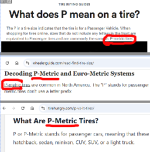
Okay, I may be wrong, but I'm not insane. A quick search for "p metric tires" and there were pages of options to chose from. It may not be an official term but I'm not coming out of left field with this and making up terms.
3 sources from that 30 second search, with plenty more to chose from:

3 sources from that 30 second search, with plenty more to chose from:
Attachments

- Messages
- 5,244
- Reaction score
- 5,467
- Points
- 113
LOL, I'm good with both.
Good with both what? Using terms incorrectly?
Shots
Active Member
- Messages
- 138
- Reaction score
- 128
- Points
- 43
That it's a term, and it's not the tire to use on a HD truck. That said, I don't think anyone was ever discussing tire recommendations, and I wouldn't recommend a passenger tire on a HD truck. But, you know. P-metric and LT-metric, or Euro-metric all being the same when it comes to size my point stands that the tires the OP asked about weren't "the same."
Now that we've taken an entertaining trip down terminology lane. In my post that prompted all that, I was simply trying to point out that the concern likely wasn't about the wheel size on the metric sizing.
Now that we've taken an entertaining trip down terminology lane. In my post that prompted all that, I was simply trying to point out that the concern likely wasn't about the wheel size on the metric sizing.

sherdep
New Member
- Messages
- 27
- Reaction score
- 5
- Points
- 3
Just to clear it up - I am not confused on Tires Sizes - My concern was that the tire size difference (regardless of being 18" or 20") - even if it a small amount - as a Kid I was always told to make sure the tire sizes are all the same especially on a 4 wheel drive's and one that has Limited Slip Differential.
I am 52 now and this is actually my first 3/4 ton truck - I have always owned Half Ton Dodges.
My next set of Tires will most Likely be Michelin's in my size Load Range E or F (10ply or 12ply) - Looks like these are the newer tire for the Ram 2500 - DEFENDER LTX PLATINUM or Toyo Open Country All Terrains
I am 52 now and this is actually my first 3/4 ton truck - I have always owned Half Ton Dodges.
My next set of Tires will most Likely be Michelin's in my size Load Range E or F (10ply or 12ply) - Looks like these are the newer tire for the Ram 2500 - DEFENDER LTX PLATINUM or Toyo Open Country All Terrains
- Messages
- 5,244
- Reaction score
- 5,467
- Points
- 113
My next set of Tires will most Likely be Michelin's in my size Load Range E or F (10ply or 12ply) - Looks like these are the newer tire for the Ram 2500 - DEFENDER LTX PLATINUM or Toyo Open Country All Terrains
I’m not sure you can find LRF in the OEM sizes, from what I’ve seen it’s more for flotation sizes.
The load range isn’t the most important number either, the load index is and then max pressure. In sizes larger than stock you may see two tires with the same load index but one will take 65 psi and the other 80. The 80 psi tire will generally be more stable for towing and/or hauling.
The old rule that LRC = 50 psi, LRD = 65 psi, and LRE = 80psi doesn’t hold true anymore. It’s generally correct, but not always.
What he said.
Also, larger than OEM tires with load ratings that require 80PSI will generally exceed the axle and wheel rating anyway, so either of those are more likely to be a limiting factor than the tire itself.
Also, larger than OEM tires with load ratings that require 80PSI will generally exceed the axle and wheel rating anyway, so either of those are more likely to be a limiting factor than the tire itself.