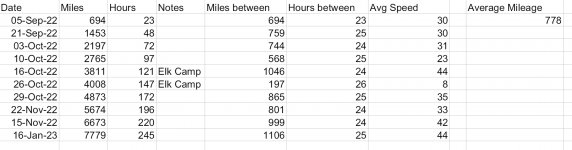

I tried to search prior to posting, but "frequency" of regen is bringing up more content related to DTC's. This did not match my scenario so here we are:
My Truck: 2022 3500 HO CCLB DRW 3.73
Current Odometer: 23,950 miles
Background Information:
I just completed my second fluid and filter service on December 30th 2022 with 23,052 miles on the odometer. As per my usual routine I changed engine oil (Amsoil Signature 10W-30 Diesel) and filter (Fleetguard LF16035), both fuel filters (Fleetguard FS53000 and Mopar 68436631AA), and the engine and cabin air filters. This service was previously completed at 11,728 miles. Total mileage elapsed between services comes out to 11,324 miles. The only difference between the previous service and the one I just completed was a change in the engine air filter (The previous air filter was a Napa Gold #6930 of the older design, which contained the orange foam and yellow filtration media WITHOUT the glue strips. The new filter was a MOPAR 68517554AA) and the addition of Hotshots Secret Diesel Extreme in to a full tank of fuel (50 gallons). It should be noted that I also have hotshots EDT in the fuel. In terms of how I use my truck, it is my daily driver used for both commutes to and from work as well as for farm-related work and towing. Drive cycles consist of primarily highway travel where speeds are usually 65-75 mph for lengths ranging from 20 minutes to 2 hours, with some lower speed local driving mixed in. When operating below 50mph, I usually use the ERS to limit the truck to 4th or 5th gear depending on road conditions in order to keep rpm`s up and reduce some gear searching / lugging. I do my best to limit idle time, allowing the truck a few minutes to warm up before driving in cooler temps and shutting if off during fueling and other situations where the truck needn't continue running.
Observation:
I seem to be noticing a significant reduction in the number of active (aka "automatic") regeneration cycles compared to that of the previous oil change interval. Prior to this most recent service, I seem to remember the truck performing an active regen cycle regularly, usually initiating when my DPF hit about 25% full. Active regen cycles were regularly noticed and seemed to be on a fairly frequent basis. This frequency remained rather constant and consistent throughout the 11,728 miles traveled. My DPF gauge almost never exceeded 25% full at any time, with an occasional higher reading of up to 30% or so. The frequency of the regen cycles, coupled with the highway drive cycles I completed seemed to "keep the DPF at bay" so to speak. At no point did the truck ever show any signs of a malfunction, and no MIL`s or DTC`s were present. Fast forward to today: I have traveled just shy of 900 miles and encompassed 21 days since the last service was completed. During this time, the truck has NOT conducted an active regeneration cycle. Drive cycles have remained primarily the same with no significant changes in how the truck is used or driven. The DPF gauge has been slowly creeping up. I have noted some reduction in the soot reading over this time period which, I can attribute to passive regeneration occurring during highway driving. That being said, however, the gauge is ultimately still increasing overall. As of right now, the DPF gauge is reading very close to 50% full. Based on my previous experience with active regen cycles over the course of the last service interval, I feel as though the truck "should" or "would" have completed one automatic cycle by now. I have also noticed some erratic behavior in regard to the DPF gauge itself. In one such instance, I drove the truck approximately 2 hours steady at highway speed averaging 70-72mph. During this trip, the DPF gauge moved from about 30-35% full at the beginning of the trip, to about 25% at the end of the trip. On my 15 minute highway commute to work the following morning, the gauge started out at 25% where it left off the previous day, and by the time I reached work fifteen minutes later, the gauge was reading practically zero. I found myself struggling to understand how a 2 hour highway drive could result in a reduction of only 5-10% and yet a fifteen minute short highway commute resulted in a reduction of 20% or more.
Questions / Hypotheses:
1. Why isn't the truck actively regenerating at the same frequency it was prior to the most recent service given that the drive cycles are pretty much identical?
2. If the truck was regenerating more frequently during the previous service interval, what was causing that? Was it a result of an inferior engine air filter? If the Napa / Wix was inferior, why did it not trigger a MIL / DTC?
3. What effect would the Hotshot EDT / Extreme additives have on the frequency of regeneration?
At this point, I am hopeful that I`ll see an active regen cycle soon. IF that does happen, I plan to begin tracking those more intentionally. I regret that I didn't start doing that during the previous service interval as I would have some concrete data to draw conclusions from. Ultimately this will be a learning lesson in many ways. I`m still learning the ins and outs of this truck even a year in to it`s ownership. I can say with certainty this is a different animal than my previous 2017 3500 HO. I like the idea of having the DPF gauge to monitor, however I am beginning to question the functionality and accuracy of it. It does not seem to provide timely information or feedback, the moves that it makes do not seem to coincide with what I know and expect of the emissions system operation, and I am curious as to the sensitivity of the emission system over my previous truck. I told a friend of mine the other day, as we were discussing the same issue I`m now sharing with you, that I sometimes look back at the my 2017 truck and think about the fact that I did not have a DPF gauge to monitor. I simply drove the truck as I needed to, and the emission system gave me almost 80,000 trouble-free miles before I sold it to fund this new one. I guess the old saying "Ignorance is bliss" has some merit.
I`ll keep driving and monitoring for now, with the hope I`ll have an automatic regen cycle start soon. I don't have any trailering to do in the near future so there wont be much opportunity for passive regen to clean it all out. I`m in a good position to see if this thing is going to kick in soon. In the meantime, I would be interested to hear your thoughts and input on all of the above.
My Truck: 2022 3500 HO CCLB DRW 3.73
Current Odometer: 23,950 miles
Background Information:
I just completed my second fluid and filter service on December 30th 2022 with 23,052 miles on the odometer. As per my usual routine I changed engine oil (Amsoil Signature 10W-30 Diesel) and filter (Fleetguard LF16035), both fuel filters (Fleetguard FS53000 and Mopar 68436631AA), and the engine and cabin air filters. This service was previously completed at 11,728 miles. Total mileage elapsed between services comes out to 11,324 miles. The only difference between the previous service and the one I just completed was a change in the engine air filter (The previous air filter was a Napa Gold #6930 of the older design, which contained the orange foam and yellow filtration media WITHOUT the glue strips. The new filter was a MOPAR 68517554AA) and the addition of Hotshots Secret Diesel Extreme in to a full tank of fuel (50 gallons). It should be noted that I also have hotshots EDT in the fuel. In terms of how I use my truck, it is my daily driver used for both commutes to and from work as well as for farm-related work and towing. Drive cycles consist of primarily highway travel where speeds are usually 65-75 mph for lengths ranging from 20 minutes to 2 hours, with some lower speed local driving mixed in. When operating below 50mph, I usually use the ERS to limit the truck to 4th or 5th gear depending on road conditions in order to keep rpm`s up and reduce some gear searching / lugging. I do my best to limit idle time, allowing the truck a few minutes to warm up before driving in cooler temps and shutting if off during fueling and other situations where the truck needn't continue running.
Observation:
I seem to be noticing a significant reduction in the number of active (aka "automatic") regeneration cycles compared to that of the previous oil change interval. Prior to this most recent service, I seem to remember the truck performing an active regen cycle regularly, usually initiating when my DPF hit about 25% full. Active regen cycles were regularly noticed and seemed to be on a fairly frequent basis. This frequency remained rather constant and consistent throughout the 11,728 miles traveled. My DPF gauge almost never exceeded 25% full at any time, with an occasional higher reading of up to 30% or so. The frequency of the regen cycles, coupled with the highway drive cycles I completed seemed to "keep the DPF at bay" so to speak. At no point did the truck ever show any signs of a malfunction, and no MIL`s or DTC`s were present. Fast forward to today: I have traveled just shy of 900 miles and encompassed 21 days since the last service was completed. During this time, the truck has NOT conducted an active regeneration cycle. Drive cycles have remained primarily the same with no significant changes in how the truck is used or driven. The DPF gauge has been slowly creeping up. I have noted some reduction in the soot reading over this time period which, I can attribute to passive regeneration occurring during highway driving. That being said, however, the gauge is ultimately still increasing overall. As of right now, the DPF gauge is reading very close to 50% full. Based on my previous experience with active regen cycles over the course of the last service interval, I feel as though the truck "should" or "would" have completed one automatic cycle by now. I have also noticed some erratic behavior in regard to the DPF gauge itself. In one such instance, I drove the truck approximately 2 hours steady at highway speed averaging 70-72mph. During this trip, the DPF gauge moved from about 30-35% full at the beginning of the trip, to about 25% at the end of the trip. On my 15 minute highway commute to work the following morning, the gauge started out at 25% where it left off the previous day, and by the time I reached work fifteen minutes later, the gauge was reading practically zero. I found myself struggling to understand how a 2 hour highway drive could result in a reduction of only 5-10% and yet a fifteen minute short highway commute resulted in a reduction of 20% or more.
Questions / Hypotheses:
1. Why isn't the truck actively regenerating at the same frequency it was prior to the most recent service given that the drive cycles are pretty much identical?
2. If the truck was regenerating more frequently during the previous service interval, what was causing that? Was it a result of an inferior engine air filter? If the Napa / Wix was inferior, why did it not trigger a MIL / DTC?
3. What effect would the Hotshot EDT / Extreme additives have on the frequency of regeneration?
At this point, I am hopeful that I`ll see an active regen cycle soon. IF that does happen, I plan to begin tracking those more intentionally. I regret that I didn't start doing that during the previous service interval as I would have some concrete data to draw conclusions from. Ultimately this will be a learning lesson in many ways. I`m still learning the ins and outs of this truck even a year in to it`s ownership. I can say with certainty this is a different animal than my previous 2017 3500 HO. I like the idea of having the DPF gauge to monitor, however I am beginning to question the functionality and accuracy of it. It does not seem to provide timely information or feedback, the moves that it makes do not seem to coincide with what I know and expect of the emissions system operation, and I am curious as to the sensitivity of the emission system over my previous truck. I told a friend of mine the other day, as we were discussing the same issue I`m now sharing with you, that I sometimes look back at the my 2017 truck and think about the fact that I did not have a DPF gauge to monitor. I simply drove the truck as I needed to, and the emission system gave me almost 80,000 trouble-free miles before I sold it to fund this new one. I guess the old saying "Ignorance is bliss" has some merit.
I`ll keep driving and monitoring for now, with the hope I`ll have an automatic regen cycle start soon. I don't have any trailering to do in the near future so there wont be much opportunity for passive regen to clean it all out. I`m in a good position to see if this thing is going to kick in soon. In the meantime, I would be interested to hear your thoughts and input on all of the above.