What's new
Ram Heavy Duty Forum

Register a free account today to become a member! Once signed in, you'll be able to participate on this site by adding your own topics and posts, as well as connect with other members through your own private inbox!

Should I select the 220 amp alternator option for my HD gas build?

RKCRLR

Active Member
Messages
212
Reaction score
117
Points
43
I'm building a gas Big Horn 3500 on the Ram website to haul my truck camper. Upgrading to a 220 amp alternator only cost $145 so it seems like a good idea. On the other hand I can't picture myself needing more than the base 180 amp alternator. I plan on keeping the truck stock and not adding things like a winch, lights, etc. I'm getting the Tech Package which includes LED headlights but if anything I'd expect them to draw less current than the base headlights.

It's easy to say it is only $145 so just do it but I'm already adding the $545 5th wheel prep package that I'll probably never use and the $155 Auxiliary Switches just in case I need them so I need to draw the line somewhere.

So, why would I need more output than the 180 amp alternator?
 
If you think there's value in the aux switches, then get the alternator to power the items on the switches.
I got the upgraded alternator on the snow plow prep package, and wish I had gotten the dual alternators, but I bought off the lot.
With the 5th wheel and aux switches, I would recommend the dual alternators too. It's cheap now, but not after delivery.
 
If you think there's value in the aux switches, then get the alternator to power the items on the switches.
I got the upgraded alternator on the snow plow prep package, and wish I had gotten the dual alternators, but I bought off the lot.
With the 5th wheel and aux switches, I would recommend the dual alternators too. It's cheap now, but not after delivery.
The only reason I'm adding the auxiliary switches and 5th wheel prep is because they are so much more expensive to add later. I currently have no plans for using them and it is tempting to remove them from my build. But, as far as I know, I could easily add the 220 amp alternator later if for some reason I found I needed it. Are there any wiring upgrades that come with the 220 amp alternator or anything else that would be expensive to add later?
 
Why not? You won't miss $145 and it might be helpful one day when you sell the truck.
 
Why not? You won't miss $145 and it might be helpful one day when you sell the truck.
I had decided to add it to my order but my order got picked up by Ram. My salesman said I would need to cancel my order and hope it got picked up again. I decided not to upset the applecart and go without the 220 amp alternator.
 
Get the dual alternators for charging your camper batteries
As I mentioned the order is in and I don't want to upset it at this point. The stock wiring can only handle 30 amps so to make use of higher charging current I'd need to run a dedicated bigger wire with appropriate controls and protection to the camper batteries in addition to the higher output alternators. For my use the juice isn't worth the squeeze.
 
Does anyone know how much current the truck uses during normal high consumption use? I.e., all lights on windshield wipers on, fans blowing, etc.?
 
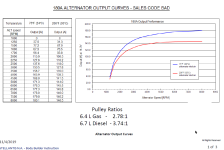
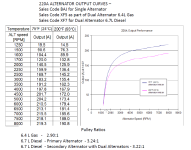
I believe on the single 220amp alternator, over 100amps is available for upfitter use. Maybe as high as 135amps, I can't quite remember what the specs say.
 
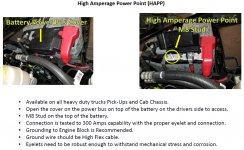
Regardless of alternator setup, the HAPP is good to 300A. Chassis ground is only good to 50A. Higher than that has to go direct to the engine block.

I wish I had a pulse on the available alternator output for accessories, but I don't see that detail anywhere in the current builder site info.

In the case of AUX PDC, there's a max of 135A continuous listed so probably at least that.

1727309924189.png

You should be able to add 2nd (dual) alternator DIY after delivery.

1727300475108.png
1727300514049.png
1727300532782.png
 
I found the manual for the alternators somewhere somewhat recently, but cannot find it in my history because I was curious about the same thing. Outside of commercial uses, I cannot imagine where dual alternators is something that would be required. Ambulances, tow trucks, things like that, sure. But not for folks pulling trailers or running a winch. It is just one more thing that can malfunction. Seriously, though, how many people on here have something that is pulling 125amps from the charging system? What are you using it for?
 
It seems like I saw the 135amp statement in an upfitter guide or schematic. It was a Ram document for sure.
 
I found the manual for the alternators somewhere somewhat recently, but cannot find it in my history because I was curious about the same thing. Outside of commercial uses, I cannot imagine where dual alternators is something that would be required. Ambulances, tow trucks, things like that, sure. But not for folks pulling trailers or running a winch. It is just one more thing that can malfunction. Seriously, though, how many people on here have something that is pulling 125amps from the charging system? What are you using it for?

2 is 1, 1 is none.

Faster recovery time on a battery charge after a hard pull, long cold start, etc. is nice.

I can recall several threads of owners posting battery (accessory) limp mode after cold starts.
 
2 is 1, 1 is none.

Faster recovery time on a battery charge after a hard pull, long cold start, etc. is nice.

I can recall several threads of owners posting battery (accessory) limp mode after cold starts.
Can you run the truck properly with a failed alternator? I suppose that would depend entirely on how it failed and what it may have taken with it. I am in agreement that what OP asked for might be reasonable, a 220amp vs 180amp. I am completely in disagreement that many personal owners (RVers especially) will benefit from dual alternators (meaning they also have 2 batteries and a diesel). If you are running 100amps+ at 12v over 20 feet you are already doing it wrong due to voltage loss at that level of current. Would be far better at that point to consider 24/48v systems.
 
I found the manual for the alternators somewhere somewhat recently, but cannot find it in my history because I was curious about the same thing. Outside of commercial uses, I cannot imagine where dual alternators is something that would be required. Ambulances, tow trucks, things like that, sure. But not for folks pulling trailers or running a winch. It is just one more thing that can malfunction. Seriously, though, how many people on here have something that is pulling 125amps from the charging system? What are you using it for?
My winch on my trailer can be 440A at max pull (trailer has a battery then a 0/1 cable from trucks battery with a quick connect at the trucks rear bumper) . My plow is 175A. I have dual 220a alternators


My friend has the hemi and a single 180A alternator when he runs the plow there are many times where some accessories will stop working due to the plow using so much power one of them being the blower motor
 
Last edited:
My winch on my trailer can be 440A at max pull. My plow is 175A. I have dual 220a alternators


My friend has the hemi and a single 180A alternator when he runs the plow there are many times where his accessories will stop working due to the plow using so much power.
This is the type of use case I would expect dual alternators to be useful, especially since you are in a cold climate. Are you doing this commercially or only personal usage?
 
This is the type of use case I would expect dual alternators to be useful, especially since you are in a cold climate. Are you doing this commercially or only personal usage?
Depends on the year to be honest. The last couple years its just been personal with the odd parking lot to help a friend. Im still on the OEM batteries too and they load test great
 
This is the type of use case I would expect dual alternators to be useful, especially since you are in a cold climate. Are you doing this commercially or only personal usage?
I’m running dual alternators for my personal use, pushing 100A to my RV so I can run the AC while I drive without depleting my battery bank. Dual alts means even at idle I’m making enough power.
 
I’m running dual alternators for my personal use, pushing 100A to my RV so I can run the AC while I drive without depleting my battery bank. Dual alts means even at idle I’m making enough power.
Another good use case. Not too many people are set up to push 100A to the RV. However, that is within the use case of a single 220amp alternator imo. How long do you idle vs driving at speed when charging? But in your case, definitely an informed decision, not just a two is better than one sentiment others might take.
 
Another good use case. Not too many people are set up to push 100A to the RV. However, that is within the use case of a single 220amp alternator imo. How long do you idle vs driving at speed when charging? But in your case, definitely an informed decision, not just a two is better than one sentiment others might take.
I’m usually driving, but I’ve found myself stuck due to accidents on the road (and one time a wildfire that shut down the interstate for 6 hours). I don’t idle it the whole time of course because that’s rough on the engine, but it gives me the ability to do so when the alternative is everything in the trailer getting hot and or melting. We’ve lived full time in an RV before (and may do it again), so when we go out it’s less “camping” and more “home on the road”, sometimes for weeks or months. The single 220A would be at the limit at idle speeds with a hot engine.

I do also have the factory Warn Winch, which can pull down 460+ amps. Not that you run it for very long at a stretch, but I have done recoveries with it that probably ran the winch for 30 minutes out of an hour.
 
Back
Top