What's new
Ram Heavy Duty Forum

Register a free account today to become a member! Once signed in, you'll be able to participate on this site by adding your own topics and posts, as well as connect with other members through your own private inbox!

Payload Question

Wpg_Ram

Active Member
Messages
251
Reaction score
101
Points
43
So I know that may sound stupid, but what exactly is Payload ? I mean is it the amount of weight I can put in the back safely ? How much weight can I toss into the back and not have squat ?

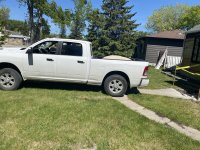
I had a yard and a half of 1/4 down in the back just now and she had major squat. Not the first time I’ve done this and I’ll do it again repeatedly. I’m just curious and thought I would ask.
Weight was about 3,800 lbs and ram says Payload 4,000. I’ve done worse though with the truck, so not worried. Just curious.

thanks for the learning for those of you who know exactly how weight / squat / payload work !
 

Attachments

  • C114F163-2340-4445-B643-D772917F830F.jpeg
    C114F163-2340-4445-B643-D772917F830F.jpeg
    1,002.3 KB · Views: 72
Payload is simply the total amount of weight you can safely add to the truck. It includes passengers, cargo and trailer tongue weight.
 
To get the payload capacity, the automaker takes the GVWR (Gross Vehicle Weight Rating - how much the vehicle can weigh total) and subtracts the truck’s curb weight, plus a little extra to account for a driver and other expected add-ons like fuel. The Payload capacity tells you how much additional weight can be added to the vehicle (like stuff you put in the bed or anywhere else in the truck). You also want to understand GAWR (Gross Axle Weight Rating) - The maximum weight your front and rear axle can each carry safely. The sum of these two are more than the GVWR of the vehicle for some additional safety margin but you dont want to overload either axle.
 
Last edited:
Payload is subjective of axle weights, usually you will hit your RGAWR before you hit the max payload on 3500s at least 2500s will max the payload before the RGAWR
 
To get the payload capacity, the automaker takes the GVWR (Gross Vehicle Weight Rating - how much the vehicle can weigh total) and subtracts the truck’s curb weight, plus a little extra to account for a driver and other expected add-ons like fuel. The Payload capacity tells you how much additional weight can be added to the vehicle (like stuff you put in the bed or anywhere else in the truck). You also want to understand GAWR (Gross Axle Weight Rating) - The maximum weight your front and rear axle can each carry safely. The sum of these two are more than the GVWR of the vehicle for some additional safety margin but you dont want to overload either axle.
Thank you for the inside ! … any ideas where I can find the rear axel weight for the 2500 6.4? I’m quite curious and plan to do some more googling now !
 
Payload is subjective of axle weights, usually you will hit your RGAWR before you hit the max payload on 3500s at least 2500s will max the payload before the RGAWR
I totally didn’t know that. Thank you !
 
your axle ratings are on the driver doorjamb sticker with your payload info, tire info etc. look for a white sticker, probably has your VIN# on it.

also, squat is normal as you add weight to the bed. not sure if your truck is a 2500, but if it is, then you probably see more squat compared to a 3500 as the 2500 uses coil springs that are progressive, meaning the more weight the more they compress. this is by design, it's also why when your truck is not loaded with any payload, you'll see the rear of the truck sitting higher then the front.... so as it squats in the rear there is a point where it is just level and your headlights aren't shooting up in the sky.
 
your axle ratings are on the driver doorjamb sticker with your payload info, tire info etc. look for a white sticker, probably has your VIN# on it.

also, squat is normal as you add weight to the bed. not sure if your truck is a 2500, but if it is, then you probably see more squat compared to a 3500 as the 2500 uses coil springs that are progressive, meaning the more weight the more they compress. this is by design, it's also why when your truck is not loaded with any payload, you'll see the rear of the truck sitting higher then the front.... so as it squats in the rear there is a point where it is just level and your headlights aren't shooting up in the sky.
The oem coils are not progressive FYI they are fixed rate coils
 
My bad...was focused on explaining the behavior/design and misstated the specific type ;) Thank you for correcting!
I’ve got a 2500 big horn gasser (my first solid front axel truck ! ) … thank you for all the info ! I had it loaded up with a couple yards of gravel and the squat and steering were crazy bad. I mean I know I overloaded it and the pic didn’t do it justice, but it made me curious how rough I was being with my truck. I mean I know I can pop a tire, but I don’t really know what else could go wrong with these trucks. My old 2010 1500 was similar but felt sooo different that now I’m trying to relearn everything and change the way I think about my truck. Anyways, thanks again for the learning moment !
 
HD load rated tires are over 3,000#s each and collectively more than the RAM RAWR.

If you want to save your truck a bit next time (and from scratches), check out renting a dump trailer from Home Depot or Facebook Marketplace/Craigslist.

Payload to the moon!
 
your axle ratings are on the driver doorjamb sticker with your payload info, tire info etc. look for a white sticker, probably has your VIN# on it.

also, squat is normal as you add weight to the bed. not sure if your truck is a 2500, but if it is, then you probably see more squat compared to a 3500 as the 2500 uses coil springs that are progressive, meaning the more weight the more they compress. this is by design, it's also why when your truck is not loaded with any payload, you'll see the rear of the truck sitting higher then the front.... so as it squats in the rear there is a point where it is just level and your headlights aren't shooting up in the sky.
The oem coils are not progressive FYI they are fixed rate coils
Not only that, progressive springs compress less when they get loaded more. They become stiffer the more they compress.
 
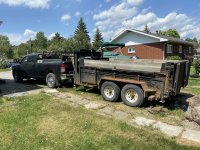
Here is why i like my dump trailer this is 6.5 ton of quarry A im over the trailers rating by a 1.5 ton truck does not have any issue or squat
 

Attachments

  • A47D43D0-ED2A-4703-9ED4-7405DE9936BE.jpeg
    A47D43D0-ED2A-4703-9ED4-7405DE9936BE.jpeg
    927.5 KB · Views: 30
  • 222EB4DC-45DC-4616-8F69-093C2ED46955.jpeg
    222EB4DC-45DC-4616-8F69-093C2ED46955.jpeg
    794.2 KB · Views: 30
Back
Top