
What's new
Ram Heavy Duty Forum

Register a free account today to become a member! Once signed in, you'll be able to participate on this site by adding your own topics and posts, as well as connect with other members through your own private inbox!

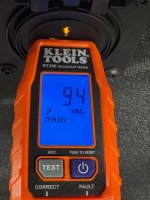
Only 94 Volts from 115V Outlets & Cummins Inverters

JeffNY

New Member
Messages
3
Reaction score
1
Points
3
Hi Guys,

I have a 2024 RAM 3500 Limited Longhorn Mega Cab 4x4 w/Cummins, but I'm only getting 94 to 95 Volts at the 115V outlets in the truck bed and in the cab. Is this "normal"? Seems like it shouldn't be. Anyone else have a similar issue?

I also have the 440-Amp dual alternators, am looking to get 100 to 200 Amps of that power to back of my truck so I can plug in my Cougar 5th wheel to it while driving to charge batteries in the camper. Debating whether to run 12V to the camper or maybe put a 2000 to 3000 watt inverter in the truck and send 120V to the camper. Anyone know who may sell a relay/fuse kit to go on the battery under the hood to power either?

Thanks,
Jeff-
 

Attachments

  • IMG_9719.jpeg
    IMG_9719.jpeg
    334.5 KB · Views: 7
  • IMG_9737.jpeg
    IMG_9737.jpeg
    231.7 KB · Views: 7
Hi Guys,

I have a 2024 RAM 3500 Limited Longhorn Mega Cab 4x4 w/Cummins, but I'm only getting 94 to 95 Volts at the 115V outlets in the truck bed and in the cab. Is this "normal"? Seems like it shouldn't be. Anyone else have a similar issue?

I also have the 440-Amp dual alternators, am looking to get 100 to 200 Amps of that power to back of my truck so I can plug in my Cougar 5th wheel to it while driving to charge batteries in the camper. Debating whether to run 12V to the camper or maybe put a 2000 to 3000 watt inverter in the truck and send 120V to the camper. Anyone know who may sell a relay/fuse kit to go on the battery under the hood to power either?

Thanks,
Jeff-

Nice setup on the alternators.

You are almost always better off running a good quality inverter to run power very far vs 12 volt. Also safer believe it or not.

At idle, the alternators only put out a fraction of the rating, and the total system performance will also depend on having a very solid starter battery set up ( at least 2 ) to buffer during driving and variable rpm. I am guessing that the truck came with something similar.

In the van world, we use a dual feed to higher power inverters to get enough amps into the inverter. ( for 12 volt applications )

Double check the rating of your outlet, many vehicles with outlets are only rated for 400 watt, and are really intended to charge cell phones.

There is a standby draw from most inverters, so it is common to rig up a way to remote turn them on / off from a switch or engine on / off relay.

Here is a diagram that I use for what you are trying to do.

The shunt portion is optional, but helpful for monitoring in case that is interesting.

Not sure about the new trucks, but on vans, exactly where you attach the grounds is a big deal, as some of them have current monitoring built into the ECU operation.
 

Attachments

  • Example Electrical Diagram Harry Niedecken 11 July 2024.jpg
    Example Electrical Diagram Harry Niedecken 11 July 2024.jpg
    350.5 KB · Views: 15
Last edited:
Thanks for the info.

"At idle, the alternators only put out a fraction of the rating"
....I was wondering this too, what my draw limits are at idle. I'm trying to get good info on that.

I see the new 2025 RAM HD's have an option for a 2.4kW inverter (goes below rear seat), that'd be 200 Amps...am looking into if I could buy that inverter and cables to retrofit to my 2024. But before I buy going to consult with some of the RV solar guys that install these systems. I have an Epoch 460Ah battery to go into the Cougar, may add a second in time. Just got the Cougar (with 440 watts of solar, and ability to add more) 11 days ago, so I just starting to lay out how I want to proceed.

Thanks again, any other input appreciated...
Jeff-
 
At idle, the alternators only put out a fraction of the rating,

While true, since any number can be a fraction… the output isn’t quite as low as I think you’re trying to imply.

In a cool engine bay the alternator(s) have 77% of their output at idle, and 65% in a hot engine bay. Nothing to complain about there, that’s over 180A usable at idle in a 200°F engine compartment with the dual alternator setup. With a simple bump to 1500 rpms it’s over 340A @ 200°F.
 
Thanks for the info.

"At idle, the alternators only put out a fraction of the rating"
....I was wondering this too, what my draw limits are at idle. I'm trying to get good info on that.

I see the new 2025 RAM HD's have an option for a 2.4kW inverter (goes below rear seat), that'd be 200 Amps...am looking into if I could buy that inverter and cables to retrofit to my 2024. But before I buy going to consult with some of the RV solar guys that install these systems. I have an Epoch 460Ah battery to go into the Cougar, may add a second in time. Just got the Cougar (with 440 watts of solar, and ability to add more) 11 days ago, so I just starting to lay out how I want to proceed.

Thanks again, any other input appreciated...
Jeff-

Makes sense - yes I am one of those RV / Van conversion electrical guys, but getting additional input is a great idea.

Just as some examples, this outfit sells multiple brands of inverters and combo inverter / chargers.

I am personally a fan of the stand alone inverters for what you are doing, but it all can be made to work.

If you sort through their list for:
- inverter
- pure sine wave
- 12 volt input
- 120 vac
- 60 hz

and purchase something that costs at least $ 0.50 / watt, you should be ok. ( so at least $1K for a 2k watt inverter)

Part of what you are paying for is the ability to deal with inductive loads and high frequency chargers.


This is just one supplier of a number of them, but they are well regarded. Don't buy electronics like this from scamazon.

solar-electric.com

Here is another well known supplier.

_______________________________


Don't get hung up on surge ratings, those are just bs - look at continuous ratings. All ratings on ALL inverters go down as they get hot.

Some brands such as victron will call an inverter a "3000 va", but it is really 2400 watts. ( India )

Others, such as exeltech ( really the top of the line / made in USA ) will sell an inverter rated for 2000 watts - and it will keep up just fine with a V 3000 all day long.

The outback ones are water resistant, but need a controller, vs the exeltech just runs as is. Has a remote terminal pin for on / off.

Samlex is not listed on that site, but they make nice inverters as well. (Taiwan)

Give yourself some headroom watts wise if you can.
 
While true, since any number can be a fraction… the output isn’t quite as low as I think you’re trying to imply.

In a cool engine bay the alternator(s) have 77% of their output at idle, and 65% in a hot engine bay. Nothing to complain about there, that’s over 180A usable at idle in a 200°F engine compartment with the dual alternator setup. With a simple bump to 1500 rpms it’s over 340A @ 200°F.

I agree. I have not done enough research on the RAM truck versions yet.

On the promaster, there is quite a bit of power consumed by operating the engine, electric radiator fan, air conditioning fans, etc. Just the radiator fan uses ~ 50 amps.

The 180 amp alternator just barely keeps up with the vehicle loads and has perhaps 50 amps to spare at a stop light.

The Transit, dual 220 amp alternator setup is able to supply ~ 100 amps continuous for charging, maxing out somewhere around 150 for people pushing their luck in the summer. The way that it is setup, is the ECU first turns on alternator 1 and runs up the field current as needed. If it cannot keep up, it starts to turn on alternator 2 to support low rpm operation.

I am very excited to see what these dual 400 amp setups can do on the ram trucks.
 
I've typically done DC-DC chargers for truck -> RV on systems that I install, and I'm running a 50A Victron Orion XS in my trailer right now (fed by a 2AWG line from the truck). With the current 50A set-up, plus 800W of solar all feeding into 600Ah of LiFePO4 I can usually get about 6-8 hours of drive time with the AC running, depending on how hot it is. That said, I've been considering installing a power inlet on the front of my trailer and going to an inverter setup, just for the much higher power I can push that way, and the far less expensive wiring. Finding a good place to install a large inverter in the truck, and reach it with 2/0-4/0 is a problem of course.

As far as the dual alts, on the Hemi trucks the second alt is optional, as is even stepping up from the 180 to the 220. Thus is stands to reason that if you have the 380A dual system then you should have at least 200A available for use (at cool temps and at non-idle speed of course). My thought is to run a 2400W inverter from the truck, but tell my trailer system (all Victron) to only pull 2000W from it, leaving the inverter unstressed and only drawing about 165A from the alternators.

I don't know how much power the Cummins needs to support itself, but I'd expect you probably have about 200A available there as well.
 
Back
Top