What's new
Ram Heavy Duty Forum

Register a free account today to become a member! Once signed in, you'll be able to participate on this site by adding your own topics and posts, as well as connect with other members through your own private inbox!

New CP8 Pump--Do you use Fuel Additive to increase lubricity?

After going to Archoil website and doing more research---I ordered (2) bottles of Archoil AR6500 yesterday...Enough to treat 800 gallons of diesel.
I look forward to seeing how it improves performance of truck....
Performance is going to be all but un effected.

Archoil does seem to improve DPF function though, and that’s always a good thing.
 
After going to Archoil website and doing more research---I ordered (2) bottles of Archoil AR6500 yesterday...Enough to treat 800 gallons of diesel.
I look forward to seeing how it improves performance of truck....
Been using this since day 1. AR6500 every tank (double dose) and AR6400-D every 3K miles.
 
After going to Archoil website and doing more research---I ordered (2) bottles of Archoil AR6500 yesterday...Enough to treat 800 gallons of diesel.
I look forward to seeing how it improves performance of truck....
I started using it after I saw my soot load regens were every 250-275 miles, after I started using Archoil products I now see a full 24 hour regens for the last year, but this winter it seems the DPF want to load soot up sooner between regens then last year at this time, I now expect I'll have to expect to increase longer hwy drives to keep the DPF happy :(
 
I've used HotShot, Archoil and most recently XPD.
Of the 3, my preference is now XPD. It's the priciest of the 3, but it appears to have significantly cut down on DPF buildup. I could be full of ****, so take that with a grain of salt. To each there own with these additives...
 
After going to Archoil website and doing more research---I ordered (2) bottles of Archoil AR6500 yesterday...Enough to treat 800 gallons of diesel.
I look forward to seeing how it improves performance of truck....
Use it at the performance dose, didn’t help me much using the 1oz/10gal dose.
 
Use it at the performance dose, didn’t help me much using the 1oz/10gal dose.
Agreed. I tried the performance dose for a while. Then switched back to the normal dose. No difference in soot loading or regeneration frequency positive or negative on the performance dose. The only thing I saw was a doubling of the amount of residual potassium showing up in my UOA results. When I went back to the normal dose, the potassium dropped back by half.
 
Agreed. I tried the performance dose for a while. Then switched back to the normal dose. No difference in soot loading or regeneration frequency positive or negative on the performance dose. The only thing I saw was a doubling of the amount of residual potassium showing up in my UOA results. When I went back to the normal dose, the potassium dropped back by half.

mbarber84,
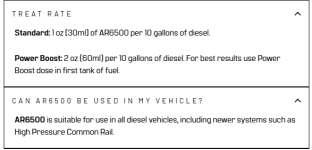
ok...This treat rate is straight off the Archoil website: (see below)

You are saying I need to use 2oz/gallon to see any noticeable results. Any harmful effects of "doubling of amount of residual potassium in UOA results"?
(I change my oil and filter every 5K--hence I should be good from a potassium standpoint?)

1768010864797.png
 
mbarber84,
ok...This treat rate is straight off the Archoil website: (see below)

You are saying I need to use 2oz/gallon to see any noticeable results. Any harmful effects of "doubling of amount of residual potassium in UOA results"?
(I change my oil and filter every 5K--hence I should be good from a potassium standpoint?)

View attachment 92847
sorry I meant to say 2oz/10gallon....
 
Agreed. I tried the performance dose for a while. Then switched back to the normal dose. No difference in soot loading or regeneration frequency positive or negative on the performance dose. The only thing I saw was a doubling of the amount of residual potassium showing up in my UOA results. When I went back to the normal dose, the potassium dropped back by half.

I'm also a little confused by the remarks.

"Agreed" but then "No difference."

mbarber84,
ok...This treat rate is straight off the Archoil website: (see below)

You are saying I need to use 2oz/gallon to see any noticeable results. Any harmful effects of "doubling of amount of residual potassium in UOA results"?
(I change my oil and filter every 5K--hence I should be good from a potassium standpoint?)

View attachment 92847

AFAIK, high Potassium levels can mask actual coolant contamination by the presence of the mineral.
 
sorry I meant to say 2oz/10gallon....
No…sorry I guess that was more clear in my head than it was on paper, wasn’t it?

Let me phrase it a different way:

I saw no benefits by using the performance dose at 2oz per ten gallons. The truck performed, in every perceivable way, the exact same regardless of which dose I used. The only exception being twice the amount of potassium in the engine oil when used at the performance dose. Taking all of this into consideration, I elected to stay at the standards dose (1oz per ten gallons).

My apologies for the lack of clarity. I’ve been basically bedridden for the past four days fighting off a rather potent bug. Been a rough week!
 
I'm also a little confused by the remarks.

"Agreed" but then "No difference."


AFAIK, high Potassium levels can mask actual coolant contamination by the presence of the mineral.
Yeah yet another one I clearly didn’t process correctly. Sorry man.

I read @Units comment incorrectly. My “agreed” comment would be an incorrect response. I actually experienced the opposite results.

As for the potassium, yes you are indeed correct that it is very often a marker for coolant contamination. That being said, usually the potassium is also accompanied by an elevation in sodium as well, whenever coolant is the primary suspect. In the case of all of my oil analyses on that engine, sodium levels remained low and consistent. From what I researched, it seemed like the potassium had to be showing up as a result of the fuel additive in use as well as the dosage. Potassium levels stayed around 100’ish ppm when I was using the performance dose (2oz per ten gallons) and then subsequently dropped to the 50’ish ppm when I went down to the normal dose (1oz per ten gallons). As for what the potassium actually does to the engine oil, I don’t recall and am not sure. I remember the big concern being that having higher than normal potassium level being used predominantly to warn of a pending coolant intrusion, and the risk of a “false positive” effect this would have.

 
No…sorry I guess that was more clear in my head than it was on paper, wasn’t it?

Let me phrase it a different way:

I saw no benefits by using the performance dose at 2oz per ten gallons. The truck performed, in every perceivable way, the exact same regardless of which dose I used. The only exception being twice the amount of potassium in the engine oil when used at the performance dose. Taking all of this into consideration, I elected to stay at the standards dose (1oz per ten gallons).

My apologies for the lack of clarity. I’ve been basically bedridden for the past four days fighting off a rather potent bug. Been a rough week!
mbarber84, ok...yes, much better wording :).. This being said I will stick with the standard dose (1oz/10 gallons).

Sorry to hear about the tough bug----I decree Exodus 15:26 over you for a speedy and full recovery! "For I am the Lord who heals you.” NKJV
 
I've used HotShot, Archoil and most recently XPD.
Of the 3, my preference is now XPD. It's the priciest of the 3, but it appears to have significantly cut down on DPF buildup. I could be full of ****, so take that with a grain of salt. To each there own with these additives...
XPD and Archoil are the best. I use Archoil and I'm very happy with it. AR6500 every tank and AR6400-D every 3K miles.
 
Yeah yet another one I clearly didn’t process correctly. Sorry man.

I read @Units comment incorrectly. My “agreed” comment would be an incorrect response. I actually experienced the opposite results.

As for the potassium, yes you are indeed correct that it is very often a marker for coolant contamination. That being said, usually the potassium is also accompanied by an elevation in sodium as well, whenever coolant is the primary suspect. In the case of all of my oil analyses on that engine, sodium levels remained low and consistent. From what I researched, it seemed like the potassium had to be showing up as a result of the fuel additive in use as well as the dosage. Potassium levels stayed around 100’ish ppm when I was using the performance dose (2oz per ten gallons) and then subsequently dropped to the 50’ish ppm when I went down to the normal dose (1oz per ten gallons). As for what the potassium actually does to the engine oil, I don’t recall and am not sure. I remember the big concern being that having higher than normal potassium level being used predominantly to warn of a pending coolant intrusion, and the risk of a “false positive” effect this would have.
That was just my observation using archoil. I’m not too concerned with elevated levels of potassium in UOAs. For comparison sake my 1st uoa @ 20k was 90 ppm with some of that attributed to new engine break in and on my last uoa @ 41k, my potassium was at 50ppm. I’ll do another right around 60k and we’ll see what it looks like. I’ve been around long enough to know if cross contamination ever rears its ugly head and gets to the point where I’m worried about it, it will be obvious. I will add that other than passive regen occurring easier and some added lubricity, claims they make for added mpg are non existent.
 
That was just my observation using archoil. I’m not too concerned with elevated levels of potassium in UOAs. For comparison sake my 1st uoa @ 20k was 90 ppm with some of that attributed to new engine break in and on my last uoa @ 41k, my potassium was at 50ppm. I’ll do another right around 60k and we’ll see what it looks like. I’ve been around long enough to know if cross contamination ever rears its ugly head and gets to the point where I’m worried about it, it will be obvious. I will add that other than passive regen occurring easier and some added lubricity, claims they make for added mpg are non existent.
I never saw any appreciable mpg gains either.
I was more pleased with the increase in time between regen cycles and the reduced soot loading in the DPF. And I agree, the passive regeneration also seemed to be more easily achieved as well.
 
Back
Top