
Ram Heavy Duty Forum
You are using an out of date browser. It may not display this or other websites correctly.
You should upgrade or use an alternative browser.
You should upgrade or use an alternative browser.
Increase payload
- Thread starter Desperado
- Start date

BrownieNpadre
Member
- Messages
- 40
- Reaction score
- 8
- Points
- 8
What is determines being legal for insurance covoverage?

If you’re over GVWR on your rig and get in an accident, your insurance company will most likely use that information to deny any claim.What is determines being legal for insurance covoverage?

UglyViking
Well-Known Member
- Messages
- 1,414
- Reaction score
- 1,789
- Points
- 113
Insurance covers negligence in almost every policy. I've never, ever, heard of a single denied claim for someone towing over their max. Has it happened? Sure, maybe, but with all the people asking these questions online, and all the answers similar to what you have given, I've never seen an account where there is a datapoint where an insurance company actually denied the claim.If you’re over GVWR on your rig and get in an accident, your insurance company will most likely use that information to deny any claim.
I have seen exceptionally rare occasions where people have been charged when something horrible happens, for an example there was a F-350 from a few years ago that was towing a roughly 40k boat that killed 2 people because the brakes failed and it blew through an intersection. That driver was charged, but that is a way overboard example. The guy was towing 2x the max tow rating of that truck. I don't think you'll find anyone who would be considered sane, and would also recommend towing 2x the max rating.
For what it's worth DOT only cares about axle rating and tire rating. I've never heard of DOT checking "payload". If you get put on a scale, they will check your tire rating, and your axle rating, at least that is everything I've ever read. I'm not sure that commercial driving cares about payload. I'm pretty sure payload numbers are related to manufacturer spec for warranty more than anything else.

I agree, I have a 2500, empty it has 3,000 lbs on the rear axle and 5,000 lbs on the front axle. Me personally, I would not have a problem with 6,000 lbs on the rear axle, which will limit you to less than 3,000 lbs pin weight ( available capacity for pin weight will be reduced by anything in the bed/cab, including humans )I would not be comfortable towing a fifth wheel with a 3500# pin weight without DRW. An 1-ton SRW could probably do it, but after having the stability of a DRW, that is the only way for me. I would not do this with a 3/4 ton.
One other thing to keep in mind with the 2500's and the coil spring rear setup; the coils are inboard so far that all come with a rear sway bar. This whole setup is not conducive to confident driving with high center of gravity fifth wheel loads; it will rock side to side significantly more than a 3500 SRW, even though it has no sway bar, but the springs are outboard much further.
However, the 2500 does great even with extreme loads on a gooseneck trailer (the ball is the apparent center of gravity)

H3LZSN1P3R
You're doing it wrong
That is one of the most common lies spread on the internet. If they had it in their policy then sure but they don’t. Further more that would mean any drunk driver would not be covered or anyone who has broken literally any law in an accident such as speeding. It is simply not true the most an insurance company can do is drop you after everything is settled which happens quite oftenIf you’re over GVWR on your rig and get in an accident, your insurance company will most likely use that information to deny any claim.
BrownieNpadre
Member
- Messages
- 40
- Reaction score
- 8
- Points
- 8
If you’re over GVWR on your rig and get in an accident, your insurance company will most likely use that information to deny any claim.
BrownieNpadre
Member
- Messages
- 40
- Reaction score
- 8
- Points
- 8
What if your over your PIN weight on a 5th wheel travel trailer? My mega cab ram is only a 1900 Payload. That is my main concern.
Insurance companies can do what they want, it’s their policy, all there needs to be is some intentional misuse, I.e. drunk driving. You can find any common misconception on the internet if you look. I chose to not even put myself in a situation where I have to worry if my insurance is going to cover me or not, I’d rather err on the side of caution. Stay within your GVWR and go on about your day.That is one of the most common lies spread on the internet. If they had it in their policy then sure but they don’t. Further more that would mean any drunk driver would not be covered or anyone who has broken literally any law in an accident such as speeding. It is simply not true the most an insurance company can do is drop you after everything is settled which happens quite often
IMHO, just as has been discussed plenty of times, if you’re concerned about being over your payload, you may need to upgrade to a truck with more payload.What if your over your PIN weight on a 5th wheel travel trailer? My mega cab ram is only a 1900 Payload. That is my main concern.
H3LZSN1P3R
You're doing it wrong
No thats NOT how it works you are in a legally binding agreement with your insurance company they provide you of a list of what is and is not covered but they can not just refuse to cover you that is how insurance companies get suedInsurance companies can do what they want, it’s their policy,
H3LZSN1P3R
You're doing it wrong
Payload is a joke it means nothing. stay within your axle weightsWhat if your over your PIN weight on a 5th wheel travel trailer? My mega cab ram is only a 1900 Payload. That is my main concern.
UglyViking
Well-Known Member
- Messages
- 1,414
- Reaction score
- 1,789
- Points
- 113
This is really what it boils down to. There are guys that aren't comfortable unless they have 30% more payload than the max they will use, and there are guys that are comfortable being 30% over axle ratings.IMHO, just as has been discussed plenty of times, if you’re concerned about being over your payload, you may need to upgrade to a truck with more payload.
End of the day, it doesn't matter to anyone but the driver on what is comfortable. Personally, I've towed with things more than they are rated for, and less. I'd rather have more than I need, but I don't need to get crazy, more of just don't want to feel limited in what trailer I can buy and don't want to trade trucks every year if I can avoid it.
The two things I can't stand are:
- The "don't worry about the mule, load the wagon" crowd, who seem to take any and every rating and something that only applies to squares and guys who read manuals. I find some of this comically unsafe, and while I don't really care if you decide to put your own life or family at risk, I do worry that these guys share the road with me.
- The "insurance won't cover you / you'll go to jail" fear monger crowd. Both of which are never based on fact or data supporting it, and are simply fears they have bought into for the reasons they need an extra 30% overhead on an already safety margined scale.
EDIT: Formatting.
Just cause I really like this meme and worked hard on it... And it's 100% relevant
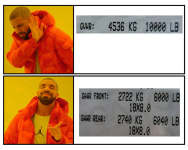
IDK if it should also be noted, the 6040 rear axle rating is @ 60psi in the tires, the 3500SO rear axle is rated at 7000 @ 80psi in the tires, afaik they're the same axle.
IDK if it should also be noted, the 6040 rear axle rating is @ 60psi in the tires, the 3500SO rear axle is rated at 7000 @ 80psi in the tires, afaik they're the same axle.
I have read that the difference between your truck’s payload / GVWR and the individual axle ratings (which add up to be greater) is a safety margin. I’d say using your truck at its max rated load, particularly over long distance and challenging conditions (wind, heavy breaking for traffic, etc) is probably not advisable.
H3LZSN1P3R
You're doing it wrong
You know this is within the engineering factor of safety right? They can handle way more than the axle ratings but due to the factor of safety it gets the ratings it has. Where ever you read that is not true just someones wrong interpretationI have read that the difference between your truck’s payload / GVWR and the individual axle ratings (which add up to be greater) is a safety margin. I’d say using your truck at its max rated load, particularly over long distance and challenging conditions (wind, heavy breaking for traffic, etc) is probably not advisable.